Handed Down, Not Handed Out: The Case For Heritage Nationalism
Ask an Englishman what he is, and the political class hands him two answers: a blood test or a birth certificate. He believes neither. A third answer has been sitting in plain sight for centuries, and nobody in Westminster has any interest in naming it. The days of "ethnat" vs "civnat" must end.

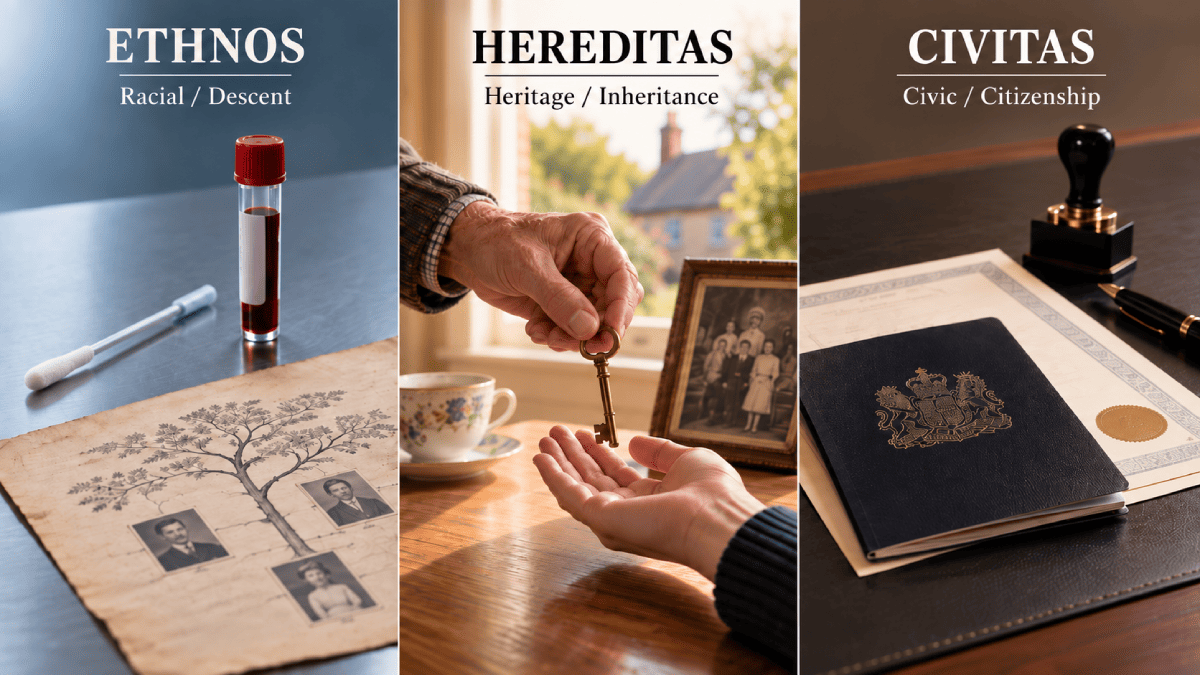
The foolish division between ethnonationalism and civic nationalism is a false dilemma on the British right, which makes our side of the debate a sitting duck for divide et impera strategies by the Raj or the legacy parties. Ethnat vs civnat needs to die.
Citizenship settles who the state owes rights to. It has never settled who the nation is. The two questions get conflated at every opportunity, and the conflation has been politically convenient for everybody who profits from the confusion.
Every other nation in these islands is permitted to notice the difference. Scottish nationalism runs a government in Edinburgh like the BNP and gets written up as civic, outward-looking, and modern. Plaid Cymru sits in the Senedd as a radical Welsh nationalist party without anybody reaching for a counter-extremism referral. Irish nationalism won a state, a flag, and an anthem, and is toasted every March in Boston.
English nationalism is offered two doors and no third.
- Behind the first stands the ethnonationalist, for whom Englishness lives in the blood and can never be acquired by anyone.
- Behind the second stands the civic nationalist, for whom Englishness arrives with legal status.
Walk through the first and you are a racist. Walk through the second and you have conceded England is a departure lounge with a flag over the door.
The man in the pub believes neither.
He watches national hero Jude Bellingham, born in Stourbridge and raised through the Birmingham City academy, and sees an Englishman with no hesitation whatever. He then considers a man naturalised last Tuesday, who speaks little English, has been in the country eighteen months, and lives entirely inside a community transplanted whole from somewhere else.
That man holds a British passport and every right the law can confer, and the pub is quite sure he is not yet an Englishman.
The ethnic theorist cannot explain the first judgement. The civic theorist cannot explain the second. The pub is right twice, and has been left without a word for why.
Four Positions, Not Two
Where only two conceptions of nationhood are available, every thick account of Englishness gets filed under ethnicity by default. Any English attachment deeper than paperwork becomes evidence of bad character. The politician wishing to condemn it has a ready-made category, and the one wishing to defend it must first insist the attachment is really very thin indeed.
Nobody has to engage with what tens of millions of people actually believe, which is neither of those two things.
A false dilemma with no middle term needs no conspirator. It only needs to go unchallenged because it is already under-specified. The vagueness lets each camp answer for positions it does not hold. Four distinct hooks are at work in ordinary argument, and they need separating before anything useful can be said.
Race / Phenotype
Racial nationalism hooks membership to phenotype. You are one of us because you look like us.
Descent / Ancestry
Descent nationalism hooks membership to ancestry. You are one of us because you come from us. Race often travels alongside as a proxy, and the two are not the same proposition.
Territory / Soil
Territorial nationalism hooks membership to soil. You are one of us because you were born here. This is the position the Heathrow baby refutes, and it is routinely mistaken for civic nationalism by people attacking both at once.
Civic / Leave To Remain
Civic nationalism hooks membership to legal and political status. You are one of us because the state says so, or in its more serious versions, because you participate in a common constitutional order.
The distinctions matter because the sloppy version of this argument conveniently has civic nationalists defending soil they never claimed, and ethnonationalists retreating from race to descent and back again depending on who is watching.
A Scotsman Or A Briton?
The permission slip granted to Scottish nationalism rests on an empirical claim: Scottish national feeling is civic and generous, English national feeling is ethnic and suspect. The British Social Attitudes survey measured it in 2023.
- Forty-six per cent of people in Scotland say ancestry matters to being truly Scottish.
- Across Britain, 39 per cent say the same about being British.
- Thirty per cent of Scots say a person must be born in Scotland to be truly Scottish, against 19 per cent in England who require birth in Britain for Britishness.
- Among people in England who feel primarily English, the figure is also 30 per cent, identical to the Scottish figure.
Sir John Curtice and Alex Scholes concluded conceptions of national identity north and south of the border are remarkably similar.
What the evidence does not show is Scotland possessing a uniquely generous conception of nationhood unavailable to England. The two countries answer the same questions in much the same way. Only the commentary differs.
Curtice also identified the structural reason behind the Scottish numbers, and it applies with far greater force south of the border.
Scotland has no citizenship of its own, and where no legal definition exists, family and history fill the vacuum.
England has no citizenship, no passport, and no legislature of any kind.
A civic English nationalist is a man swearing loyalty to institutions which do not exist.
Civic nationalism describes a Briton competently. It cannot describe an Englishman at all, and when it tries, it shrugs and pushes him into the ethnic box.
What Civic Nationalism Cannot Do
Territorial nationalism died in British law decades ago and nobody mourned it. The British Nationality Act 1981 came into force on 1st January 1983 and ended automatic citizenship by birth on British soil.
A child delivered at Heathrow during a layover and flown to Ankara the following morning acquires nothing from the coordinates of the maternity ward, and British law agrees.
The man naturalised last Tuesday holds British citizenship lawfully and completely. He has every right the state can confer, and those rights are not open to qualification by anybody. On the civic account he is now as English as a Dales farmer whose family has worked one valley since the reign of Elizabeth.
Almost nobody believes this, including most of the people who say it. The ones who say it in public are performing a position rather than reporting a belief.
Serious civic theories do better than a certificate. They rest membership on participation in a shared constitutional and institutional order, which is a real answer and a respectable one. It is also an answer about Britain.
England has no constitution, no parliament, and no institutions of its own to participate in, so the civic route to Englishness terminates before it starts.
If the nation is the current list of citizens, it holds nothing to hand on and has no reason to continue beyond the convenience of its members. Roy Jenkins, as Home Secretary, told the National Committee for Commonwealth Immigrants on 23rd May 1966 he defined integration:
not as a flattening process of assimilation but as equal opportunity, accompanied by cultural diversity, in an atmosphere of mutual tolerance.
The formulation became canonical, and it has been quoted approvingly by Home Office ministers ever since. It invites the newcomer to join nothing in particular, and expresses genuine surprise when he doesn't.
What Ethnic Nationalism Cannot Do
The ethnic position had its own recent outing, and it went badly. In early 2025 the podcaster Konstantin Kisin asked of Rishi Sunak, "He is brown and Hindu, how can he be English?" The former Home Secretary Suella Braverman took up the point in the Telegraph, dismissed "a plane ticket and a birth certificate", and asked whether five or six generations must pass before anyone might claim Englishness.
She later stated flatly she is not English but a proud British Asian.
Whatever that means.
Anybody may describe themselves as they wish. The trouble begins with the rule offered to everyone else.
The absurdity runs deeper.
- A retired dentist in Ohio whose forebears left Yorkshire in 1750, who has never crossed the Atlantic and could not find Wetherby on a map, qualifies comfortably.
- A Korean orphan adopted at four months by a family in Devon, raised on cold beaches and school assemblies, who supports Exeter City and says "proper job" without irony, does not.
The historic English were overwhelmingly white.
Saying so describes the past accurately and settles nothing about the present.
The error of ethnonationalism lies in converting a fact about who happened to be here into a permanent condition of entry, and the conversion cannot be defended on its own terms.
The English are Britons, Saxons, Danes, Normans, Flemings, Huguenots, Irish, and Jews, absorbed across fifteen centuries. A theory demanding pure descent must nominate a year and justify why every arrival afterwards fails.
No ethnonationalist has produced the year, because any year he picks exposes somebody's grandparents, quite possibly his own.
The racial version collapses faster still.
Millions of English people watch Jude Bellingham and see an Englishman. A theory of Englishness informing the English their own instinctive recognition is false has stopped describing the English.
What We Already Believe About Who Counts
Public opinion refuses both ethnat/civnat boxes and always has. The British Social Attitudes figures on being "truly British" show where the weight sits:
| Considered important to be "truly British" | 2013 | 2023 |
|---|---|---|
| Respecting British political institutions and laws | 85% | 86% |
| Having British citizenship | 85% | 79% |
| Feeling British | 78% | 71% |
| Having been born in Britain | 74% | 55% |
| Having British ancestry | 51% | 39% |
| Being a Christian | 24% | 19% |
Source: British Social Attitudes 41, National Identity, NatCen, 2024
Nearly everybody treats the civic attributes as important. The division runs between those who stop at citizenship and those who add birth and ancestry on top.
Ordinary people are not choosing between blood and paperwork. They want both, weighted in a way no party has troubled itself to describe, which is why no party can speak to them about it.
On Englishness specifically, More in Common found 74 per cent agree someone can be English regardless of skin colour or ethnic background, against 17 per cent who disagree.
British Future puts acceptance of English-born people who identify as English at nine in ten. Katwala calls the result "inclusive nativism" and gets close to the truth while missing the fact doing the work.
Birthplace is not the operative thing, as the Heathrow baby demonstrates. What people recognise is a childhood spent inside English life.
Cultural Nationalism: Poisoned By Prevent
The natural name for a position resting on culture rather than race is cultural nationalism. The Prevent duty guidance perversely states at paragraph 24 of extreme right-wing terrorist ideologies: they can be:
broadly characterised as Cultural Nationalism, White Nationalism and White Supremacism.
The Intelligence and Security Committee's report of 13th July 2022 reproduces the equally absurd Joint Terrorism Analysis Centre definition at paragraph 63:
A belief that 'Western Culture' is under threat from mass migration into Europe and from a lack of integration by certain ethnic and cultural groups.
The classification does not assert everybody holding such views harbours terrorist intent, and the Committee says as much.
The practical consequence stands regardless. The state has given "cultural nationalism" a specialist counter-terrorism meaning, and any theory of English belonging opening with that phrase spends its first thousand words explaining a label instead of an argument.
The name is unusable, whatever its philosophical merits, and a different one is required.
Heritage Nationalism: Belonging Inherited Without Being Hereditary
The name is heritage nationalism, and the whole of it fits on a beer mat: a nation is handed down, not handed out. A nation may be inherited without being hereditary. Inherited means received from those who came before. Hereditary means restricted to biological descent.
- Ethnonationalism demands the second and collapses under its own absurdities.
- Civic nationalism denies the first and produces a country with nothing to pass on.
- Heritage nationalism takes the first and rejects the second.
Heritage means what your family and your upbringing handed you:
- The accent.
- The jokes nobody explains.
- Sunday dinner.
- The hymns from school assembly and the songs from the terraces.
- The churchyard with your surname cut into four generations of stone.
- The unconscious knowledge of which queue to join, which subjects to avoid with strangers, and which weather to complain about.
- An attachment to a particular landscape, which for most people is sentimental rather than intellectual, and is no weaker for it.
Heritage carries the trait ethnonationalists are right to insist upon, though not in the form they imagine.
A childhood is biographical. It happened, it happened in a particular place among particular people, and no later act revises it.
A Pole who arrives at twenty-five can acquire English belonging by sixty.
He cannot acquire an English childhood at sixty, and neither can anybody else.
That is the unexchangeable thing sitting at the centre of a person's nationality, and a theory denying its existence has lost contact with how human beings actually experience belonging.
An English family raising an adopted Korean infant transmits the entire inheritance: language, memory, loyalties, habits, humour, and home. The child receives everything except the genes.
Adoption is the proof, because it shows family transmission operating at full strength with genetic transmission absent altogether.
Descent Is The Machinery, Not The Title Deed
Civic nationalists have spent decades pretending descent is irrelevant, and the pretence has cost them every argument they have had with ordinary people since. Descent matters enormously, because families are the normal machinery by which a nation reproduces itself.
Language passes down a family line, and so do stories, names, manners, religion or its residue, historical memory, a sense of which village is home, and membership itself. A man whose parents, grandparents, and great-grandparents were English received his Englishness through them and through nobody else.
Treating six centuries of family continuity as one clue among several, filed somewhere near football preferences, is not sober scholarship. It is a lie told for the sake of appearing respectable.
Descent transmits the inheritance, but it does not hold exclusive title to it.
An example might be a man whose mother's line has been English since the fourteenth century and whose paternal grandparents were Scottish, with Scottish ancestry equally deep.
Descent alone makes him as Scottish as he is English and settles nothing. He is English because an English home and an English childhood formed him, and because he took the inheritance as his own. Descent supplied two inheritances. Upbringing decided which one he is.
Bukayo Saka, born in Ealing to Nigerian parents, presents the same structure from the other direction. His family handed him a Nigerian inheritance. His childhood in London handed him an English one. He holds both, exactly as the man with Scottish grandparents holds both, and nobody watching him play has the slightest difficulty saying which country he belongs to.
Heritage can be mixed, because families and childhoods are two different transmitters and a person can be plugged into both.
The doctrine reduces to three sentences:
England has a people. That people hands England on, principally through families and upbringing. Others may enter the inheritance, and neither birth on the soil nor a certificate from the state puts them inside it automatically.
Where Heritage Nationalism Sits Between Both
Any position occupying ground between two camps will be claimed by both and disowned by both, usually in the same week. The boundaries therefore need drawing explicitly.
| Proposition | Ethnic nationalism | Civic nationalism | Heritage nationalism |
|---|---|---|---|
| The nation exists before the state which governs it | Yes | No | Yes |
| Something unexchangeable sits at the centre of nationality | Yes | No | Yes |
| Families are the ordinary machinery of transmission | Yes | No | Yes |
| Ancestry is a condition of entry | Yes | No | No |
| Race is a condition of entry | Often | No | No |
| Every citizen holds identical legal rights | Contested | Yes | Yes |
| Newcomers can fully enter the nation | No | Yes | Yes |
| A certificate confers national belonging | No | Yes | No |
| The host culture is neutral ground open to renegotiation | No | Yes | No |
| Belonging and allegiance are separate questions | No | Unclear | Yes |
Heritage nationalism grants the ethnonationalist four things the civic camp refuses to concede and is wrong to refuse.
- England existed long before the British Nationality Act 1981 and was not created by it.
- Something real and unexchangeable sits at the centre of a person's nationality.
- Families are how nations reproduce themselves, so descent matters profoundly.
- The historic English were overwhelmingly white, and pretending otherwise is a falsification of the record nobody is obliged to join.
It then refuses him the only thing he actually wants.
Descent transmits the inheritance and holds no title to it.
No number of generations converts ancestry into a turnstile, because any barrier built from ancestry excludes the Devon adoptee and admits the Ohio dentist. Both results are absurd.
Bellingham and Saka are English, and a politics unable to say so is describing something other than England. Race is never a condition of entry.
Heritage nationalism grants the civic nationalist four things the ethnic camp refuses.
- Every citizen holds identical legal rights, without qualification, cultural test, or probationary tier.
- Belonging is genuinely open to newcomers, and the door has no racial ceiling on it.
- Nothing touches anybody's vote, passport, public office, or standing before a court.
- Conduct is governed by law which binds every person in the country equally.
It then refuses him the thing he actually wants.
Citizenship settles rights and does not settle belonging, and conflating the two is how a country ends up unable to describe itself.
Adoption is real, substantial, and never automatic, and no clock starts running on the day a certificate is issued. Equal citizenship does not require cultural neutrality, and England is not a vacant lot awaiting proposals.
A nation consisting solely of its current citizen list has nothing to hand on and will not survive the discovery.
Neither camp gets to claim the position, and neither gets to file it under the other's name.
- The ethnonationalist who adopts it must surrender the racial crap permanently.
- The civic nationalist who adopts it must concede England has a people, a culture, and a prior claim to continuity in its own country.
Cradle Englishmen And Converts
Most English people are English by heritage. A smaller number become English by adoption, and ordinary speech has accommodated them for centuries without embarrassment.
People say "my adopted country" and nobody asks them to explain.
A Pole who arrived in Leeds at twenty-five, spent fifty years there, raised children, buried friends, and has grumbled through every Ashes series since 1975 can become English. His childhood remains Polish and always will. He is English by adoption. His children, raised in Yorkshire, hold English heritage outright.
The predictable objection calls this two tiers. The Church has run the identical distinction for two thousand years without anyone finding it sinister. A cradle Catholic and a convert are both fully Catholic.
Nobody pretends the convert was raised in the faith, and nobody ranks him below those who were. Converts are frequently the most devout people in the building. Different route, same membership, no hierarchy.
Adoption is possible and never automatic. Citizenship starts no clock. Residence starts no clock. Birth on the soil starts no clock. A Frenchman may live contentedly in Kent for forty years and die as French as the day he landed, and there is nothing whatever wrong with him.
Two rules keep the door honest in both directions:
- Nobody becomes English against his settled recognised identity. A Scot living thirty years in London who still calls himself Scottish is Scottish, and he is the authority on the matter.
- Nobody becomes English by announcement. Declaring it on arrival achieves precisely nothing. Adoption is a life, not a sentence.
The Premier League defines a Home Grown Player as one registered with English or Welsh clubs for three seasons before his 21st birthday, irrespective of nationality. Ancestry is irrelevant. The passport is irrelevant.
Where a player was formed decides everything.
When Cesc Fàbregas qualified as homegrown having joined Arsenal at sixteen from Barcelona's academy, Greg Dyke as FA chairman objected and his England Commission proposed moving the threshold to eighteen.
Even the Football Association grasped the point: formation means childhood, and a childhood cannot be arranged retrospectively by a lawyer.
When Does A Foreign Thing Become English?
Accent is the densest evidence of formation available to anyone. Thirty seconds of speech tells an English listener where a man grew up, among whom, in roughly which decade, and with what schooling.
London English, the street speech mocked as "Jafaikan", supplies an interesting case.
Linguists describe it as a London vernacular emerging from the 1980s through contact among children of many linguistic backgrounds, and plenty of its speakers have no recent immigrant ancestry at all.
A speech form manufactured entirely inside England can still strike English listeners as something arriving from elsewhere. Anyone doubting the reaction is real has not spent much time listening to how the speech gets discussed in the places where it is spoken.
Liverpool speech was heavily influenced by Irish immigration in the nineteenth century. It is now among the most unmistakably English sounds in the country, secure enough to export comedians.
Something once marking the arrival of outsiders became a regional identity nobody questions.
The honest question is: when does something brought into England stop being foreign influence and start being English inheritance?
Tea came from China. Curry came from Bengal. Both are English now, and no committee ruled on either. Nobody possesses an check sheet, and the absence of one is a description of how national cultures have always worked rather than a defect in the theory.
A living inheritance absorbs new things through the people holding it. What it cannot survive is having the chain of transmission replaced rather than extended, and the difference between absorption and replacement is the difference between a nation growing and a nation ending.
Romany Gypsies have been recorded in England since at least 1514, four centuries before Scouse existed, and have kept distinct customs throughout. They are English Romany, in the same sense as English Cornish, English Jewish, or English Sikh.
The national layer is a floor rather than a uniform: a common public language, a common inherited legal and institutional order, a common public calendar, and a common historical memory.
Everything above the floor, from Geordie to Gujarati, is furniture.
Who Is Not English?
A theory of belonging incapable of excluding anybody is useless. Heritage nationalism excludes by relationship to England and never by category of person.
Three groups fall outside.
Those never formed here and who never made England their own
The Ohio dentist. The Heathrow baby. Tourists, students, diplomats, and workers on time-limited visas. Presence on the soil achieves nothing by itself, and a preacher imported at forty to inform a Luton audience English law is illegitimate is no more English than the fortnight he has been in the country.
Those holding another settled national identity
Scots, Welsh, and Irish living in England, and the American banker in Kensington. They stand outside by their own choice, and the choice commands respect rather than argument.
Newcomers who have not yet entered the inheritance
This includes the man naturalised last Tuesday. The exclusion says "not yet" rather than "never", and it is the only one with a clock attached.
Nobody is excluded for race, ancestry, religion, class, or accent. Nobody is excluded for criminality either, and the consequence deserves stating without flinching.
Albanian trafficking gangs are not English because they never entered the inheritance and never intended to.
A drug dealer born and raised in Brixton is English, a criminal Englishman in precisely the sense a burglar from Basildon is a criminal Englishman.
Any good-behaviour test for nationality will be applied to people with foreign grandparents and to nobody else, and the ethnonationalist wins by the tradesman's entrance.
Englishness is not a reward for conduct. It is a fact about formation.
England Can Produce Men Who Hate England
MI6 officer Kim Philby betrayed his country to Moscow for three decades, defected from Beirut in 1963, and died a Soviet hero. In exile he followed the cricket through the airmail edition of The Times and pestered visitors for Oxford marmalade. Philby was English to the marrow and a traitor besides. He deserved the death penalty.
His betrayal is intelligible precisely because an obligation existed for him to betray.
Dedicated jihadi Mohammad Sidique Khan led the 7th July 2005 bombings. He was born in Leeds, raised in Beeston, taught in a Leeds primary school, and spoke with a Yorkshire accent.
In the video broadcast by Al Jazeera on 1st September 2005 he said "we are at war and I am a soldier", and described Muslims abroad, rather than the country which made him, as "my people".
The comfortable answer declares Khan foreign and moves on.
If Englishness cannot be summoned into existence by declaration, it cannot be abolished by declaration either.
Should an act of violence strip a man of his nationality, conduct has been smuggled back into membership through the side door, and the good-behaviour test returns with all its selective application intact.
England made him, and he turned on England.
Membership carries no guarantee of gratitude, virtue, or loyalty, and never has.
The contradiction belongs to Khan rather than to the country, and pretending otherwise flatters England by relieving it of a failure genuinely its own.
A nation producing its own enemies has a serious problem, and the problem is not solved by reclassifying the enemies as foreigners after the event.
- An Englishman may betray England without ceasing to be English.
- A foreigner may serve England faithfully for fifty years without becoming English.
Neither fact changes who anybody is, and a doctrine conflating the two is describing morality rather than nationality.
None of this reaches citizenship, rights, or the franchise.
Belonging and legal status are separate questions, and an answer to the first licenses nothing whatever in the second.
Primacy, Not Supremacy
England can owe every citizen identical rights without pretending English culture holds no prior claim to continuity in England.
- Equality before the law is a statement about persons.
- Primacy is a statement about defaults.
Confusing the two is the central intellectual failure of British public life since 1966.
English law, the English language, the English calendar, and English public custom are the settings of the country. Newcomers are welcome and are joining something already in progress.
The table is not cleared and relaid on each arrival, and no feature of national life is reopened for negotiation every time a flight lands at Gatwick.
Denmark and Japan both proceed on the assumption a national culture exists and has a claim on newcomers, and neither is treated in the British press as a moral emergency requiring intervention.
Primacy is not supremacy.
Supremacy ranks human beings.
Primacy ranks nothing at all; it merely observes a house has rules before the guest arrives, and the guest was invited into a house rather than onto a building site.
The language matters. The left routinely choose loaded language to deliberately steer and deceive honest debate into strategies of bad faith. It was never a mistake they chose "supremacy" over primacy.
Transmission Has A Rate
If nationhood is transmitted rather than issued, then transmission has a rate. Heritage passes through families, schools, streets, workplaces, and years of ordinary contact. Those channels have a capacity, and no quantity of goodwill expands it indefinitely.
A place can absorb newcomers into English life at some pace and cannot at any pace. The constraint is arithmetic rather than sentiment.
- Civic nationalism has its own reasons to care about numbers, concerning housing, public services, wages, and language provision, and those reasons are real. What it cannot supply is a reason concerning the transmission of nationhood itself, because on its account nothing is being transmitted.
- Ethnonationalism supplies a reason concerning skin, which is why it is never believed and never will be.
- Heritage nationalism adds the missing argument, and the argument can be tested against evidence having nothing to do with race: English spoken at home, friendships crossing communities, marriages crossing them, and shared use of the same schools, clubs, and institutions.
The number is an empirical question about absorption and how many people the country's infrastrructure can physically support. The principle is a philosophical one, and the principle comes first.
Eleven Cases Against Four Ideas
A theory of nationhood should be run against the cases it finds most awkward. We can dump those four ideas into two buckets (racial + descent, and territorial + civic) and place them against heritage nationalism.
| Case | Racial or descent | Territorial | Civic | Heritage |
|---|---|---|---|---|
| Yorkshireman, English family for centuries | English | English | English | English |
| Jude Bellingham | Doubtful | English | English | English |
| Bukayo Saka, Nigerian parents, raised in Ealing | Not English | English | English | English, and Nigerian heritage also |
| Korean baby adopted by a Devon family | Not English | English | English | English |
| Baby born at Heathrow, raised in Turkey | Not English | English | Not a citizen | Not English |
| Ohio dentist, ancestors left Yorkshire in 1750 | English | Not English | Not English | Not English |
| Pole, arrived at 25, fifty years in Leeds | Not English | Not English | English | English by adoption |
| Naturalised last Tuesday, speaks no English | Not English | Not English | English | Not yet |
| Scot, thirty years in London | Not English | Not English | Cannot tell, no English citizenship exists | Scottish, by his own word |
| Kim Philby | English | English | English | English, and a traitor |
| Mohammad Sidique Khan | Depends on his grandparents | English | English | English, and a traitor |
- The descent column fails the adoptee, Bellingham, Saka, and the Pole, admits the Ohioan, and settles the Leeds bomber by consulting his grandparents rather than his life.
- The territorial column turns the Heathrow delivery suite into a qualification and shuts out every child who arrived at three.
- The civic column cannot distinguish the man naturalised last Tuesday from a Dales farmer, and cannot distinguish a Scot from an Englishman at all, because no English citizenship exists for it to consult.
The heritage column produces a coherent answer in every situation without making descent or legal status independently decisive.
Homegrown: The Bellingham Problem
Explain why Jude Bellingham is English without reducing Englishness to race and without reducing it to a passport.
Ethnonationalism cannot manage it without a celebrity exemption for useful footballers, which is an admission rather than an argument.
Civic nationalism can manage it only by declaring the man naturalised last Tuesday equally English, which nobody believes, including the civic nationalists who say it.
Heritage nationalism, or the state of being homegrown, answers in a line.
You are English if an English home raised you, or if across the years you have made England your own.
The English nation is inherited without being hereditary.
It can take in newcomers precisely because it has an inheritance to take them into, and it can lose itself precisely because an inheritance not handed on stops existing.
Blood is not enough, and the Ohio dentist is the proof. Paper is not enough, and the man naturalised last Tuesday is the proof.
A people survives by passing itself on, and a people which stops passing itself on has chosen its own ending regardless of whose grandchildren happen to be standing on the land.
Ethnic and civic nationalists owe an answer to the same question, and neither has offered one in forty years.
If England is more than a state and more than a race, what exactly is being handed from one generation to the next, and who is answerable for making sure it arrives?