£21 Billion Of Housing For An Unknown Number Of Houses
Any minister can promise houses. The shrewd ones promise money instead. Twenty-one billion pounds now sits in a fund with five objectives, no target, no finished business case, and no evaluation, making it the safest object in Whitehall: a programme nobody will ever be able to prove has failed.
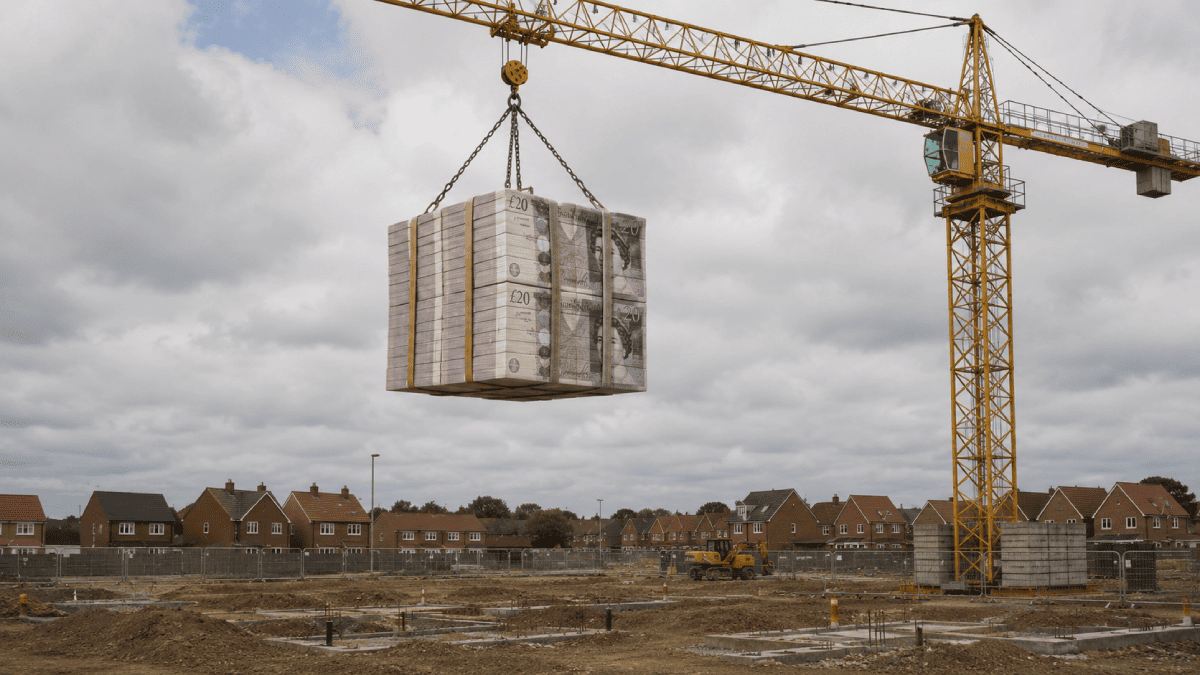
In May the Permanent Secretary of the housing ministry was asked how many homes twenty-one billion pounds would produce. She could not say. The fund had launched in March. The projects had not arrived yet, the business case was still being written, and the department had given itself another year simply to work out how the fund might one day be evaluated.
Twenty-one billion pounds of tax funds was already out of the door and the paperwork explaining what it was for remained in draft.
The Public Accounts Committee wrote this up on 17th July in the flat prose of men who have stopped being astonished. Neither the Ministry of Housing, Communities and Local Government nor Homes England has stated how many homes the National Housing Delivery Fund should deliver, by when, or by what standard anyone should judge it.
The money is precise to the nearest billion. Everything it is meant to achieve has been left agreeably vague.
Vagueness of this kind is not an oversight. It is a technology, and Whitehall has spent a decade perfecting it. Disregarding whether the government should be interfering in the housing market at all, if they absolutely must, the least they could do is the maths.
They Created The National Housing Service
The twenty-one billion splits into two portions. Sixteen billion went to the National Housing Bank (because of course it's the National Housing Service now, a new subsidiary of Homes England), made up of £10.5 billion of investment capital and £5.5 billion of contingent liability for guarantees. Five billion is capital grant for land and infrastructure between 2026 and 2030.
The fund also absorbs seven older programmes and extends beyond unlocking land into support for small builders and "social landlords".
The department declines to say:
- How much of the twenty-one billion will be spent on unlocking land, since it wishes to remain flexible.
- How many homes should result, since it does not yet know which schemes it will back.
- What success looks like for any of its five stated aims, which are housing supply, economic growth, placemaking, quality, and a financial return.
Asked how it picks between grant, loan, and equity, Homes England could not explain its method to Parliament either.
One number did come out crisply.
The department told MPs it had devolved about £1.5 billion to mayoral authorities, then wrote afterwards to say the figure was £1.3 billion.
Two hundred million pounds, mislaid in the witness chair and recovered by correspondence.
500,000 Magic Homes? Or 1.5 Million?
The awkward part is a number does exist. It has simply been kept away from anybody with the power to check it. When the Bank was unveiled in a written statement on June 18th 2025, ministers were fluent to the point of chattiness.
Over the lifetime of the initial £16 billion, the Bank would support delivery of more than 500,000 homes of every tenure, create hundreds of thousands of construction jobs, and pull in a further £53 billion of private money.
Three quantified claims in a single paragraph, none of them hedged.
Eleven months later, in front of a select committee, the department had forgotten how to count. A single figure, officials explained, might create the wrong incentives by prioritising volume over quality and longer-term outcomes.
England cannot house its own children.
The government has staked its record on 1.5 million homes. The department responsible has now told Parliament, with a straight face, it worries about being too focused on building houses.
Ten Years Of Spending, Counted From Space
The reluctance makes perfect sense once the previous decade is laid out, because the previous decade is a disgrace. Since 2016-17 the department has poured £10.5 billion into seven programmes for unlocking land, covering 768 sites with a theoretical capacity of 713,000 homes. Of the money, £8.4 billion has been committed and £5.7 billion actually spent. When the National Audit Office went looking in February for the houses, it found 33,300.
Five per cent.
By May the department had revised the number upward to 57,671 as at the end of December 2025, of which 24,400 had been unearthed retrospectively.
"Unearthed" is the operative word here.
Three of the seven programmes, between them accountable for half the promised homes, were never designed to record whether any homes appeared.
Nobody thought to ask.
Homes England is now reconstructing ten years of outcomes with geospatial imaging, drawing boundaries around old sites on satellite pictures and adjudicating which rooftops belong to the taxpayer. It has finished 90 per cent of the land schemes and 30 per cent of the infrastructure ones, and expects a full total by May 2027....
.... eleven years after the spending began.
Some cases require what officials delicately call judgement. Improvements to junction 10 of the M5 were offered to the committee as an example, a piece of road with no obvious edge to the benefit. Homes England considered writing reporting obligations into its contracts with developers, and decided against, on the grounds it did not wish to burden them.
The British state financed the junctions, waived its right to ask what got built beside them, and now studies aerial photographs to find out how it did.
| Legacy land unlocking programmes, 2016-17 onwards | |
|---|---|
| Allocated | £10.5bn |
| Committed to projects | £8.4bn |
| Spent | £5.7bn |
| Sites supported | 768 |
| Projects finished by December 2025 | 140 |
| Homes the land was supposed to yield | 713,000 |
| Homes the NAO could find, February 2026 | 33,300 |
| Homes the department reported in May | 57,671 |
| Of which located by retrospective analysis | 24,400 |
| Date a complete figure is expected | May 2027 |
Between £14,700 And £99,000 A House, Ish
Divide the £5.7 billion spent by the 57,671 homes so far attributed to it and each one has cost about £99,000 in public money before a brick was laid. Divide the full £10.5 billion by the full 713,000 of hoped-for capacity and the figure drops to roughly £14,700.
Neither is a fair cost per home. Sites unlock over decades, most of the work is unfinished, and departmental cash usually covers only part of a scheme. Quote either number as settled and you would be lying.
Their distance apart is the entire scandal.
Between fourteen thousand and ninety-nine thousand pounds a house sits the difference between shrewd public investment and one of the more expensive follies of the age, and not one minister, official, or agency has planted a flag anywhere on the scale.
They have declined to be judged, and they have declined in advance.
A fund handing out grants, loans, equity, guarantees, and land purchases needs a tighter results framework than a fund doing one simple thing, because each instrument carries its own risk, leverage, and unit cost.
Complexity is an argument for more measurement. It has been used here as an excuse for less.
Homes England assures the committee it is hard-nosed about whether applicants' costs are realistic. Applicants are held to standards the agency has never been asked to meet.
Previous Home Schemes: Zero Homes
None of this is inevitable. The same building, in the same year, runs programmes with published outcomes.
| Programme | Public money | Output promised | Outcome |
|---|---|---|---|
| Starter Homes, 2015 | £2.3bn set aside, £174m spent on land | 200,000 homes, 60,000 in the first wave | Not one built, regulations never laid |
| Housing Infrastructure Fund, 2017 | £4.35bn | Unlock 326,000 homes by March 2028 | Swallowed by the new fund |
| Affordable Homes Programme, 2021-26 | £11.5bn | 157,000 to 165,000 homes | Downgraded to 157,000 |
| Social and Affordable Homes Programme, 2026-36 | £39bn | Around 300,000 homes, 180,000 for social rent | Bidding opened February 2026 |
| National Housing Delivery Fund, 2026 | £21bn | None | Cannot be assessed |
Starter Homes remains the most instructive humiliation in modern housing policy. David Cameron promised 200,000 discounted properties for first-time buyers under forty. The Treasury earmarked £2.3 billion. The ministry spent £174 million buying and cleaning up land in Plymouth, Bury, Basildon, Stockport, and elsewhere.
The secondary legislation was never laid, the sites were quietly recycled into other schemes, and in 2019 the auditors confirmed the existence of precisely zero Starter Homes.
Everyone remembers it for one reason. A number had been published.
Two hundred thousand promised, none delivered, and the sum did the rest. Any journalist, researcher, or clerk could carry out the calculation on the back of a train ticket.
A department determined never to repeat the experience has two routes available. Build better, which is hard, expensive, and requires competent people to stay in post for a decade.
Or withhold the denominator, which costs nothing and can be arranged in an afternoon.
Whitehall, unsurprisingly, has chosen the afternoon.
Outcome First, Target At The End
The incentive is visible in real time. Labour's central housing pledge remains falsifiable, and is being falsified in public every quarter.
The promise is 1.5 million net additional homes in England this parliament, which needs more than 300,000 a year, a rate last achieved when Harold Wilson was in Downing Street. Departmental estimates put net additions at 392,400 between 9 July 2024 and 14 June 2026, roughly a quarter of the total with well over half the parliament gone.
Completions in 2025-26 came to 143,110, the worst year since 2015-16. Even left-wing "fact checkers" have the pledge off course, and Savills judges it reachable only in circumstances without precedent.
Watch one measurable promise disintegrate on the front pages for two years and the attraction of attaching no measurable promise to the next twenty-one billion needs no further explanation.
The £39 billion magic social housing programme still carries a figure of around 300,000. Its London portion will set a target after the first bidding round. The National Housing Delivery Fund (not to be confused with the other useless submarine delivery quango) will apparently acquire one when enough schemes have been approved to make the arithmetic safe.
Targets, in other words, are now set retrospectively, once the outcome is more or less known.
One has to marvel at the sheer gall of the civil service on some days. The utter cynicism it takes to cook the books on this scale is pathological.
The department has invented the political equivalent of marking your own homework after seeing the results, and has been candid enough to say so to a committee of the House of Commons.
Everything Except The Thing Which Matters
The committee has asked for the missing machinery: success criteria for each aim, milestones, key risks, annual reporting on homes completed and homes expected, confirmation the business case has finally been signed off, an explanation of how investment types are chosen, and news of the evaluation nobody has yet bothered to commission. Every item on the list describes work a competent sponsor completes before releasing the money rather than after being asked twice by MPs.
The proper sequence is not a mystery.
Establish the need, define the output, estimate the unit cost, test whether the industry can deliver it, set milestones, then size the cheque.
Here the cheque came first, in a press release, accompanied by a number of homes which mysteriously became unavailable the moment anyone with subpoena powers enquired.
Parliament has voted the money. Homes England is oversubscribed with applicants, each of them scrutinised on deliverability, affordability, and value. Local authorities are being reorganised around the fund. Mayors are receiving allocations.
Twenty-one billion pounds is moving through the system and the only body in the arrangement facing no numerical test whatever is the one doing the spending.
Eventually the satellites will produce a figure. Whatever it is, it will be announced as the plan, because no plan was ever committed to paper.
Britain has not bought 1.5 million homes, or 500,000, or any other quantity.
She has bought twenty-one billion pounds' worth of ministerial immunity from arithmetic, and on that narrow measure the money has been extremely well spent.