£6.3 Billion On The Stupidest Tank In History
If you have ever wondered what a tank designed by bureaucrats would look like, the waiting is finally over. It arrived eight years late, injured its own crews, was declared safe, made soldiers sick again, and is now being reintroduced under special controls.
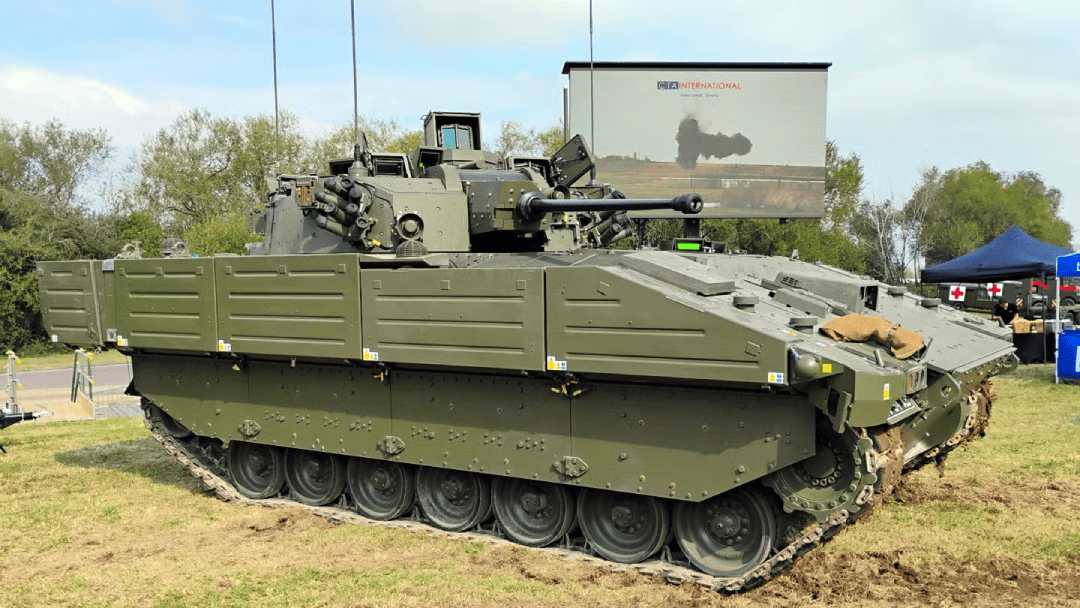
The MoD really has done some stupid and malicious things. This time, it's aced incompetence and waste with spectacular aplomb and a certain degree of talent. You don't need to be an army major, a chap, or even have any interest in the military whatsoever to understand what went wrong.
Ajax is, in the pedantic language of defence procurement, an armoured reconnaissance vehicle. It is not a tank. It does not have a tank's main battle gun. It is not designed to charge across open ground and destroy other tanks. But it is a large, tracked, armoured, cannon-equipped military vehicle costing £10.7m per unit, and if you put it in front of a member of the public they would call it a tank, so we shall call it a tank, and the Ministry of Defence can write a letter. This tank looks stupid, performs stupidly, and was ordered by stupid people.
The government ordered 589 Ajax-family vehicles from General Dynamics Land Systems UK under a contract the National Audit Office valued at £5.522bn. The wider programme figure, cited across parliamentary reports and the press, is £6.3bn. For the same money, Britain could have built six district general hospitals, or thirty-five thousand affordable homes, or one functioning reconnaissance vehicle. It chose none of these.
A Vehicle In Search Of A Decade
Ajax was supposed to replace the CVR(T) reconnaissance fleet, a family of vehicles introduced in the 1970s. The House of Commons Library records these were expected to leave service by 2014, but retirement was extended because Ajax was not ready. So the Army drove Cold War relics into the drone age while waiting for a replacement whose primary battlefield innovation was injuring its own crew.
The original in-service target was around 2017. It missed. The revised target was missed. The re-revised target was missed. By 2022, the NAO reported the programme was years behind and the MoD still could not say when Ajax would be operationally usable. By late 2025, roughly fifty vehicles had been produced out of 589. Full delivery is now projected for 2029, giving the programme an overall gestation period longer than two full elephant pregnancies laid end to end, and considerably less productive.
The MoD's own website describes Ajax as a "world-leading competitive advantage." One suspects Britain's competitors agree.
Thirty Soldiers Walk Into A Tank
The defining scandal of Ajax is not money or delay. It is the fact the vehicle hurts people. Its own people. The ones sitting inside it.
During trials in 2020 and 2021, crews reported hearing damage, tinnitus, nausea, vomiting, swollen joints, and whole-body vibration symptoms.
Leaked assessments suggested Ajax could not safely exceed 20mph, could not fire its cannon while moving, could not reverse over obstacles above 20cm, and required strict limits on how long a soldier could remain inside before being removed for medical reasons.
Personnel needed hearing protection not from the enemy but from their own seat.
One might reasonably ask what an armoured vehicle is for, if not to protect the people inside it. The answer, in the case of Ajax, appears to be: providing employment for review panels.
Trials were paused. Modifications were promised. And by autumn 2025, Ajax was declared to have reached "initial operating capability," the bureaucratic milestone signifying the vehicle was ready to be used by actual soldiers in something resembling real conditions.
Within weeks, around thirty personnel reported noise and vibration symptoms during an exercise on Salisbury Plain. In December 2025, all trials were paused again after a further injury. In April 2026, the government announced it would continue the programme under strict controls, attributing the problems to a combination of incorrect track tension, loose or missing bolts, cold exposure, air quality, and training procedures.
In Whitehall, Ajax achieved initial operating capability. On Salisbury Plain, soldiers achieved initial vomiting capability.
The MoD has not yet confirmed whether vomiting counts as a world-leading competitive advantage.
An Institutional Autopsy On A Breathing Patient
The NAO's 2022 report concluded the approach taken by both the MoD and General Dynamics was "flawed from the start" because neither party understood the scale, complexity, or integration challenge of what they had agreed to build. The Public Accounts Committee was blunter, declaring the programme had "gone badly wrong."
In 2023, Clive Sheldon KC published the typical "lessons-learned" review examining how safety concerns had been communicated and escalated within the MoD. His findings pointed to institutional and cultural failures across the acquisition system. Warnings existed. Warnings were known. Warnings were absorbed into the bureaucratic sediment and left there, like unexploded ordnance in a field everyone agrees not to plough.
Nobody has faced consequences proportionate to a multi-billion-pound programme delivering a vehicle which harmed the soldiers it was designed to protect. The contract is firm-price, meaning the MoD insists General Dynamics will deliver all 589 vehicles for the agreed sum. The contractor may be financially contained. The Army's missing decade of reconnaissance capability is not.
This is the procurement trap in its purest form. The contract says the price is fixed. It does not say the damage is.
Every Armoured Vehicle Programme Failing Simultaneously
Ajax would be alarming enough on its own. It is more alarming in context, because it is not the only British armoured programme collapsing. It is merely the loudest.
- The Warrior Infantry Fighting Vehicle upgrade was cancelled entirely.
- Boxer, the wheeled armoured vehicle selected as a partial successor, is still being delivered.
- Challenger 2 is being upgraded to Challenger 3, but the fleet has been reduced.
Parliamentarians were already asking in 2023 whether the cumulative effect of these decisions had created a gap in mechanised infantry capability. The answers they received were not reassuring, mainly because reassuring answers would have required lying even by parliamentary standards.
The British Army is shrinking around a set of vehicle programmes in which every project is either cancelled, delayed, reduced, or injuring people. The slides promise transformation. The vehicle parks deliver absence. While Ukraine demonstrates the importance of cheap mass, rapid iteration, electronic warfare, and industrial depth, Britain is nursing a bespoke tracked invalid across Salisbury Plain, hoping the next set of bolt checks will finally stop it vibrating soldiers into the medical tent.
The British State Doing What It Does
Ajax follows a pattern so familiar it might as well be printed on government stationery. The average Restorationist reader is more familiar than most. It happens everywhere from the military to civil nuclear power.
- An old capability is retired or extended beyond all reason.
- Its replacement is over-specified, politically protected, and contracted on terms so large no one is permitted to admit failure.
- Warnings appear early.
- Warnings are managed rather than resolved.
- Soldiers, passengers, tenants, or patients become involuntary test subjects for institutional dysfunction.
- Nobody responsible suffers proportionate consequences.
- The project survives not because it works, but because cancelling it would require someone to explain why it was approved in the first place.
Grenfell. Horizon. HS2. Ajax. The product changes. The process does not. The British state does not learn from catastrophe. It commissions a review of catastrophe, accepts the findings of the review, thanks the chair, publishes a lessons-learned document, and proceeds to the next catastrophe with the lessons carefully filed and entirely unlearned.
Britain did not merely buy a defective armoured vehicle. It bought a £6.3bn self-portrait: a machine which cannot arrive on time, cannot protect the people inside it, cannot be cancelled because too much money and reputation are buried within, and cannot be explained to the public without admitting the total institutional collapse of the body responsible for national defence.
Ajax is not the stupidest tank in history because engineers made errors. It is the stupidest tank in history because every British institution involved performed exactly to specification: overpromise, delay, deny, review, recommit, rename failure as progress, and forward the bill to the taxpayer.
The reconnaissance vehicle did, in the end, discover something. It discovered the outer limit of British state competence. And it did so at £10.7m per unit, with a side order of tinnitus.