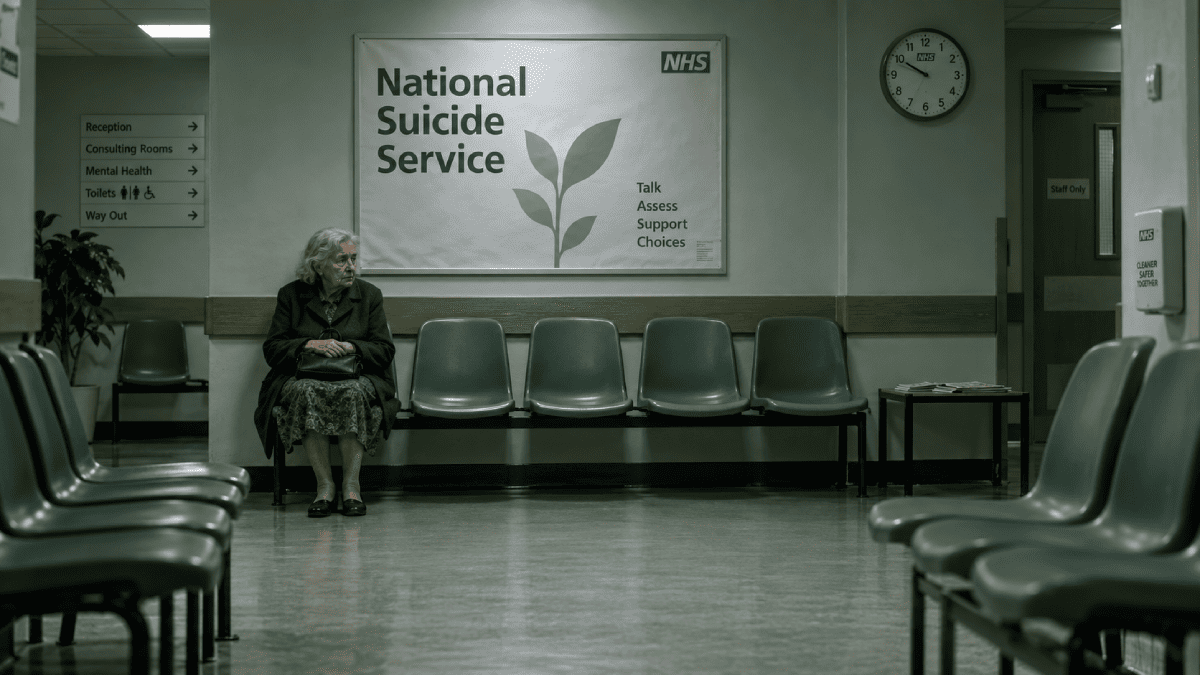
Detained For Your Own Safety, Discharged Into None
Two doctors and a social worker can take an adult out of his own home without a warrant, medicate him against his will, and recall him from the street. Nobody at all can be compelled to give him a bed when he walks out. Britain built the power and skipped the obligation.
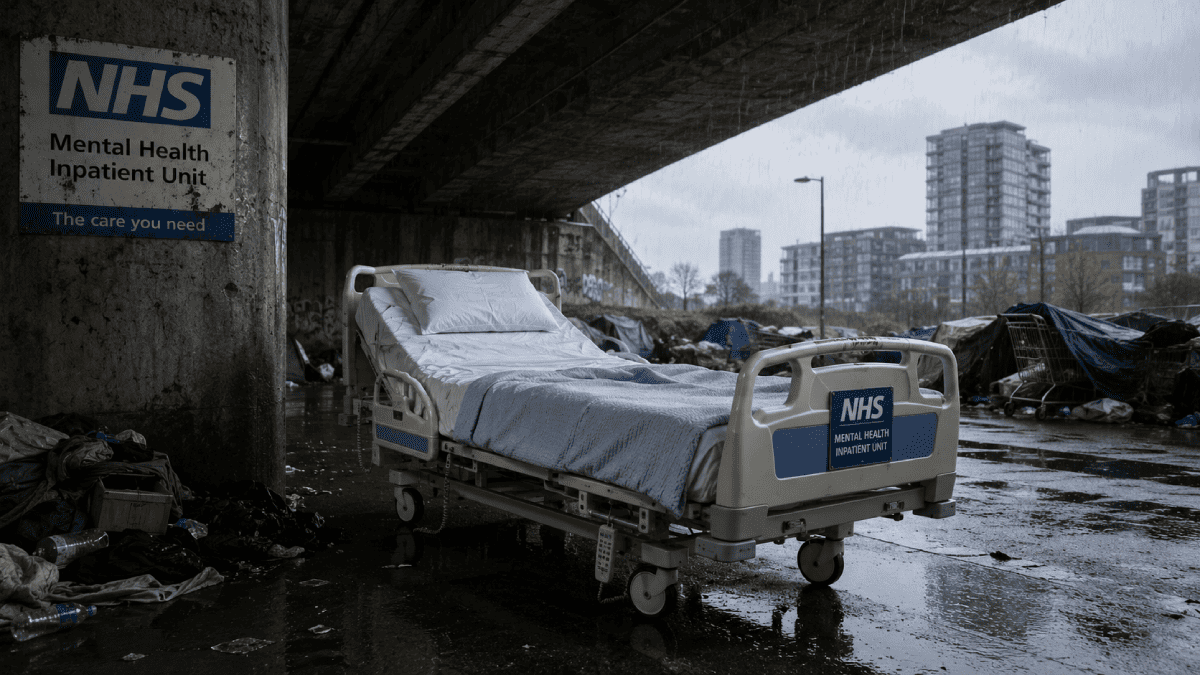
A man of thirty-one stops sleeping. By the second week he is certain the flat upstairs is transmitting through the pipes. His mother rings the community mental health team and is told he must ring himself. She rings the crisis line and is told he is not currently at immediate risk. She rings 999 and is told the matter is medical. Eleven days later he throws a chair through his own window, and within four hours he is in the back of a police van under section 136 of the Mental Health Act 1983, then assessed, then detained for treatment.
At that moment the state acquires powers over him which exist almost nowhere else in domestic law outside the criminal courts. It may hold him, medicate him without consent, decide who visits, place him a hundred miles from home, and, if he leaves, bring him back.
Seven weeks later he is discharged.
His tenancy has gone, because nobody paid the rent while he was on a ward. He is given a bag of medication, a follow-up appointment, and a leaflet.
His mother is told nothing about the discharge, because he has capacity and has not consented to her involvement. She has a spare room, a mortgage, two other children in the house, and no legal authority over anything at all.
The power to take him was overwhelming. The duty to house him afterwards does not exist in the form most people assume. Nothing in that sequence was unlawful.
In England there were 52,731 new detentions under the Act recorded in 2024-25. Across England and Wales, police used their removal power on 31,779 occasions in the year to March 2025.
Almost none of those people had committed an offence.
Asylums Closed And Folded Into The NHS
For most of the nineteenth and twentieth centuries the answer to serious mental illness was custody. Parishes handled the destitute mad under the Poor Law, the workhouse absorbed the rest, and from 1808 onwards county asylums were built to hold those nobody else would keep. The various Lunacy Acts made confinement a judicial act: a magistrate or justice certified a person insane, and the certificate was the authority. Whatever else can be said about such an arrangement (and a great deal can), it was continuous. Once the state took a person, it kept them, fed them, and housed them, frequently for life.
Two things dismantled it.
- The first was the Mental Health Act 1959, which removed certification by magistrates and handed admission decisions to doctors and social workers, encouraged voluntary admission, and folded psychiatry into the new National Health Service.
- The second was money. Mental illness and mental handicap beds peaked at around 152,000 in 1954, consuming a vast share of hospital capacity while attracting a fraction of the budget.
In March 1961 the Minister of Health, Enoch Powell, addressed the National Association for Mental Health and described the asylums standing over the countryside beneath the "gigantic water-tower and chimney combined". He told his audience he had instructed hospital authorities to plan for roughly half as many mental illness places within fifteen years, a redundancy of 75,000 beds.
The Hospital Plan for England and Wales followed in 1962.
The asylums began to close. The closures happened.
The replacement was slower, thinner, and never finished.
NHS inpatient bed provision fell for sixty consecutive years to 2020, with mental illness beds down 90.6 per cent and learning disability beds down 98.7 per cent. By the early 2010s the count of mental health beds in England had dropped to around 22,300, a level unseen since the mid-Victorian period.
Community care, as designed by the NHS and Community Care Act 1990, assumed a network of teams, placements, and supported housing.
What it produced in practice was a division of labour in which no single body holds the person. The custody was abolished. The responsibility was distributed, and distributed responsibility has a habit of evaporating.
2 Doctors, 1 Social Worker, And No Judge
Civil detention under the Mental Health Act 1983 requires no court order. An approved mental health professional, employed by a local authority, makes the application on the recommendations of two registered doctors.
- Section 2 permits detention for assessment for up to 28 days.
- Section 3 permits detention for treatment for up to six months, renewable.
- Section 4 allows emergency admission on one recommendation.
- Sections 5(2) and 5(4) allow a doctor or nurse to hold a voluntary patient already on the ward.
- Section 135 allows a magistrate to grant a warrant for police entry into a private home.
- Section 136 allows an officer to remove someone from a public place on his own judgement.
A judge appears only afterwards, and only if the patient asks.
The First-tier Tribunal reviews the legality of continued detention. It cannot order a council to provide housing, cannot direct an integrated care board to fund a placement, and cannot conjure a bed. A patient can satisfy every legal test for discharge and remain on a ward because there is nowhere for him to go.
The pattern of who this happens to is not random.
In 2024-25 it was notable the standardised detention rate for black people was 262 per 100,000, against 66 per 100,000 for white people, and people in the most deprived areas were 3.6 times more likely to be detained than those in the least deprived.
New community treatment orders (the Orwellian mechanism by which compulsion follows a patient home) rose 17 per cent in a single year to 6,575, with black people subject to them at more than eight and a half times the rate of White people.
The Care Quality Commission reported in January 2026 that people are becoming more unwell before they are referred for assessment and waiting longer once referred, against an average of 453,930 new referrals to secondary mental health services every month.
Higher thresholds do not reduce illness. They reduce the number of people who qualify for help before the police are involved.
Predators Became Default Relative Carers
The one part of the 1983 Act which gives a relative real standing is the nearest relative. Most people assume this means whoever the patient trusts. It does not.
Section 26 sets a fixed hierarchy: spouse or civil partner, then children, then parents, then siblings, with the eldest taking precedence.
The patient has no say. A lasting power of attorney makes no difference.
In FC v UK, a woman complained her adoptive father, whom she said had sexually abused her, automatically became her nearest relative with access to information about her treatment and whereabouts, and the case settled on the government's undertaking to change the law.
In JT v UK the same defect reached the same result.
The remedy Parliament produced was a displacement application to the county court, which requires a hearing, a solicitor, and time nobody in crisis has.
Where the nearest relative is the right person, the role is real but narrow. She must be consulted before a section 3 application and may object, and an application made after a hollow consultation exercise can be unlawful, as the High Court found in GD v Hospital Managers of the Edgware Community Hospital.
She may order discharge on 72 hours' notice, and the responsible clinician may bar it with a report. She cannot prevent a community treatment order. She cannot compel treatment, funding, or accommodation.
The Mental Health Act 2025 received Royal Assent on 18 December 2025 and replaces the nearest relative with a nominated person chosen by the patient.
This is a genuine improvement and it is, as of now, mostly theoretical.
A handful of provisions on conditional discharge and prison transfers came into force on 18 February 2026. Sections 51 and 52 commenced on 6 April 2026, extending Human Rights Act obligations to private care providers and requiring a review of registration regulations.
Royal Assent is not commencement, and a reform which has not commenced changes nothing for the family standing in a ward corridor this afternoon.
Aftercare Duty Which Stops At The Front Door
Section 117 is the strongest thing in the statute for anyone leaving hospital. Where a person has been detained under section 3 or certain forensic provisions, the responsible integrated care board and local authority owe a joint duty to provide aftercare.
It is automatic, it is not means-tested, and following the House of Lords in Stennett it cannot be charged for.
Aftercare means services meeting a need arising from the mental disorder and reducing the risk of deterioration and readmission.
Then comes the part almost nobody outside the field knows.
Accommodation is aftercare only in narrow circumstances. In Mwanza the High Court held everyone needs somewhere to live, so a roof alone cannot be a need arising from mental disorder; what qualifies is accommodation with something added, specialist provision meeting a need over and above ordinary shelter.
Afework narrowed it further, requiring the need for accommodation to be a direct result of the reason for detention, the accommodation to be enhanced and specialised, and the placement to be involuntary in the sense of incapacity.
The result is precise and brutal. A council must pay for supported housing where the support is the point. It owes nothing under section 117 towards a flat.
Which authority owes the duty at all has generated its own litigation. In R (Worcestershire County Council) v Secretary of State for Health and Social Care the Supreme Court held in 2023 responsibility falls on the authority where the person was ordinarily resident immediately before detention, with no deeming provision to keep it with the placing council, and that the duty ends on a fresh detention.
The case took nine years and three courts to determine which of two councils should pay for one woman's care.
What The State May Do And Must Provide
| Power over the person | Legal basis | Who exercises it | Corresponding duty to provide |
|---|---|---|---|
| Entry into a private home | Section 135 warrant | Magistrate, on AMHP application | None to the occupant |
| Removal from a public place | Section 136 | Single police constable | Place of safety for up to 24 hours |
| Detention for assessment | Section 2 | AMHP plus two doctors | Hospital bed, if one exists |
| Detention for treatment | Section 3 | AMHP plus two doctors | Aftercare under section 117 |
| Treatment without consent | Part IV | Responsible clinician, later a second opinion doctor | None beyond treatment itself |
| Conditions on residence in the community | Section 17A | Responsible clinician | No duty to supply the residence |
| Recall to hospital | Sections 17E, 18 | Responsible clinician | Bed on recall |
| Ordinary housing after discharge | None | Nobody | None, unless priority need is established |
The asymmetry in the final row is the whole enchilada.
Compulsion is specific, immediate, and enforceable by warrant. Provision is conditional, contested between agencies, and enforceable, if at all, by judicial review months later.
Capacity Works Beautifully As An Exit
The Mental Capacity Act 2005 presumes capacity, permits unwise decisions, and assesses capacity decision by decision. As a principle of liberty it is sound. As an administrative instrument it is coincidentally superb at closing files.
- A man who is floridly psychotic can retain capacity to refuse an offer of hostel accommodation.
- A woman drinking herself towards liver failure in a stairwell can retain capacity to decline a social care assessment.
Once capacity is recorded, coercion becomes unlawful, and coercion is frequently the only thing services were prepared to offer.
What remains lawful is everything short of it: to keep visiting, to keep offering, to fund, to coordinate, to remove practical obstacles, to try again next week. None of that is a duty enforceable by anyone, and persistence costs staff time which nobody has budgeted.
Adult safeguarding sits in the same position. Section 42 of the Care Act 2014 requires an enquiry where an adult with care needs is experiencing abuse or neglect, including self-neglect, and is unable to protect themselves.
An enquiry produces meetings, records, and referrals. It does not produce a bed, a placement, or a person whose job is to keep going until the problem is solved.
When The Police Stopped Answering Mental Health Calls
Right Care, Right Person began in Humberside and was adopted nationally, on the basis of analysis finding 45 per cent of police attendances at mental health incidents involved no crime and no immediate threat of serious injury. Under it, officers attend only to investigate an offence or where there is a real and immediate risk to life.
The reasoning is unanswerable. A police cell is not a treatment setting, and a constable is not a clinician.
The difficulty is arithmetic.
Withdrawal happened on a fixed timetable. Replacement capacity did not.
Coroners have since issued reports to prevent future deaths raising exactly this gap, in one case recording that a force implemented the policy in September 2023 with little or no consultation with other agencies, and the ambulance service confirmed the scenario leading to the death was not isolated.
For a family in a front room at two in the morning, the effect is the number of doors has reduced by one.
Police decline because it is medical.
Crisis teams decline because the risk is behavioural, or the person is intoxicated, or nobody can be seen without the patient's own call.
The mother in the opening paragraph was not fobbed off by anyone acting improperly. She was correctly informed of four separate thresholds, none of which her son met until he broke a window.
Where The System Fails Most Reliably
The Parliamentary and Health Service Ombudsman apparently examined more than 100 complaints investigated between April 2020 and September 2023 where it had found failings involving mental health care, and identified discharge and transitions as recurring themes.
Families not told their relative was leaving. Teams not speaking to one another. Requests to leave hospital assessed badly. The Ombudsman had made the same findings in 2018.
Meanwhile the wards cannot empty.
Average bed occupancy across mental health overnight beds ran at 90 per cent in 2024-25, well above the 85 per cent safety threshold, and 5,649 out-of-area placements began in the year, five per cent more than the year before, sending patients away from the families expected to look after them.
Research by the Royal College of Psychiatrists, Look Ahead, and the National Housing Federation found the shortage of supported housing produced 121,695 additional hospital bed days in 2024-25 at a cost of about £102 million, with patients awaiting supported housing accounting for 22 per cent of all delayed discharge days.
The same shortage traps people at the other end of the continuum.
Of the 2,150 people with a learning disability or autism in mental health inpatient units at the end of June 2026, a substantial group are recorded as clinically ready to leave, and the main reason for delay is a lack of suitable housing.
The Mental Health Act 2025 restricts detention of autistic people and people with learning disabilities where no qualifying psychiatric condition exists. Removing the legal power to detain them does not create the houses in which they would otherwise live.
A Duty To Refer Is Not A Duty To House
Since October 2018 emergency departments, urgent treatment centres, and hospitals providing inpatient care must refer patients they believe are homeless or threatened with homelessness within 56 days to a housing authority, normally with consent.
The referral obliges the council to assess. It does not oblige anyone to provide a bed. A discharge into homelessness with a completed referral form is fully compliant paperwork.
What happens next is governed by Part VII of the Housing Act 1996.
Accommodation follows only if the applicant is eligible, homeless, unintentionally so, and in priority need. Severe mental illness reaches priority need through vulnerability.
The test was settled by the Supreme Court in Hotak v Southwark, which held the comparator is an ordinary person if made homeless rather than an ordinary homeless person. That part expanded protection. The majority also held councils may take into account support which would be provided by a third party, including a family member. Mr Hotak had significant learning difficulties and relied on his brother for washing, dressing, and cooking. Southwark concluded he was not vulnerable because his brother would go on caring for him even if both were on the street.
A family which keeps helping can therefore be the reason its relative is found not to need housing. Lord Neuberger acknowledged the outcome could be distasteful. It remains the law.
Rent arrears accrued during a manic episode, antisocial behaviour driven by psychosis, or abandonment of a tenancy during a crisis, can each be treated as deliberate acts causing the loss of accommodation. Local connection then allows the person to be referred elsewhere. Each decision is individually defensible.
Where Reasonable Decisions Add Up
| Body | Claimed function | Escape route |
|---|---|---|
| Mental health trust | Assessment and treatment | No clinical criteria met, no bed available, patient has capacity |
| Adult social care | Care, safeguarding, section 117 | No eligible need, refusal of support, ordinary residence dispute |
| Housing authority | Prevention and relief of homelessness | No priority need, intentionality, local connection |
| Police | Public protection | Matter is medical, no crime, no immediate risk to life |
| Ambulance service | Emergency care and conveyance | No medical emergency, police assistance required first |
| Community mental health team | Continuing treatment | Below threshold, non-engagement, discharge from caseload |
| Substance misuse service | Addiction treatment | Mental illness is primary, patient intoxicated, abstinence required |
| Family | Daily care and crisis response | None available |
Non-engagement deserves particular attention, because it is the point at which symptoms become grounds for withdrawal.
Missing appointments, refusing entry, not answering the telephone, moving repeatedly, and distrusting professionals are features of serious mental illness and of street homelessness. They are also symptoms of being an uncooperative arsehole.
Treated as conduct, they justify closing a case. The Rough Sleeping Questionnaire found among people sleeping rough with mental health needs, only 44 per cent had received any treatment in the previous year, 18 per cent had sought help and been declined, and fewer than half of those reporting depression had contacted mental health services at all.
Confidentiality closes the last door.
Clinicians frequently cannot tell relatives anything without consent. Relatives can always tell clinicians everything, and possess most of the useful information about sleep, medication, threats, and early warning signs.
How often this asymmetry is explained to families, rather than presented as a wall, is a matter of local practice.
The Care Quality Commission interviewed over 700 family members and carers for its most recent monitoring report, and inconsistency of experience was among its central findings. Meanwhile only 23 per cent of carers providing substantial care have completed a carer's assessment in the past year, despite the right existing under the Care Act 2014 since 2015.
The Street As The Ward Of Last Resort
In autumn 2025, 4,793 people were estimated to be sleeping rough on a single night in England, the highest figure since counting began in 2010 and a fourth consecutive annual rise. Of those surveyed by the government who had slept rough in the previous year:
- 83 per cent reported a mental health need, rising to 91 per cent among women, with an average of 3.7 conditions each.
- Two thirds first experienced mental health difficulties before they first slept rough, at a median age of eighteen.
In the last quarter of 2025, a history of mental health problems was the most common support need among households owed a homelessness duty in England, affecting 22,980 households, or 30.1 per cent.
The government's national homelessness plan, published in December 2025, records almost 34,000 households became homeless or were threatened with homelessness after leaving a public institution in a single year, and sets an ambition nobody should leave one for the street, backed by a proposed duty on public services to collaborate.
Ambitions and duties to collaborate are not individual entitlements. A person cannot take a duty to collaborate to a tribunal.
University of Bristol research found reports issued to prevent future deaths connected to homelessness and precarious housing rose from 18 cases between 2017 and 2021 to 38 between 2023 and 2025, with reports to authorities responsible for housing increasing from an average of one a year to one every eight weeks, and identified a national shortage of accommodation for people with mental health difficulties among the recurring concerns.
Does The Family Exist In Mental Health Law?
Every institution in the chain has a defensible legal position. The trust cannot detain without criteria. The council cannot house without priority need. The police cannot attend everything. The crisis team cannot see someone who will not open the door. Each decision survives scrutiny on its own.
The aggregate is a man on a pavement with a diagnosis, a prescription he stopped collecting, and a mother who is now the only continuous institution in his life, holding no legal authority, no funding, and no right to information.
Can a state properly claim the power to remove an adult from his home without a judge, and simultaneously deny any enforceable obligation regarding where he sleeps when it releases him?
Detention is justified by necessity. Necessity does not stop at the hospital gate.
If the law will not confer authority on relatives, on the sound principle families are sometimes the danger, what is the basis for treating their availability as a resource in housing decisions?
Section 26 says a family member cannot be chosen by the patient. Hotak says a family member's help can be counted against the patient. Both cannot express a coherent view of what a family is.
And when Parliament reforms this, as it has begun to do, what will be commenced?
The 2025 Act improves patient choice, restricts the detention of autistic people, and strengthens the tribunal. Almost none of it is in force.
The provisions which are in force concern conditional discharge, prison transfers, and a review of registration regulations. Nothing yet commenced creates a single bed, a single supported tenancy, or a single duty owed to a named individual on the day he is discharged.
Compulsion is cheap to legislate and immediate in effect.
Continuity requires housing, staff, and money, and can be deferred indefinitely by a commencement clause.
Britain has repeatedly chosen the first and postponed the second, and has then expressed surprise at the number of unwell people sleeping in doorways.