Remember, Remember: One Bad Thursday Finishes Them
They guard the cellars and ignore the arithmetic. Nine thousand riot police, three thousand spare cells, and a generation of officials who bought quiet with other people's children. Fawkes needed gunpowder. Britain's rulers have done the job themselves. All it takes is someone calling the bluff.

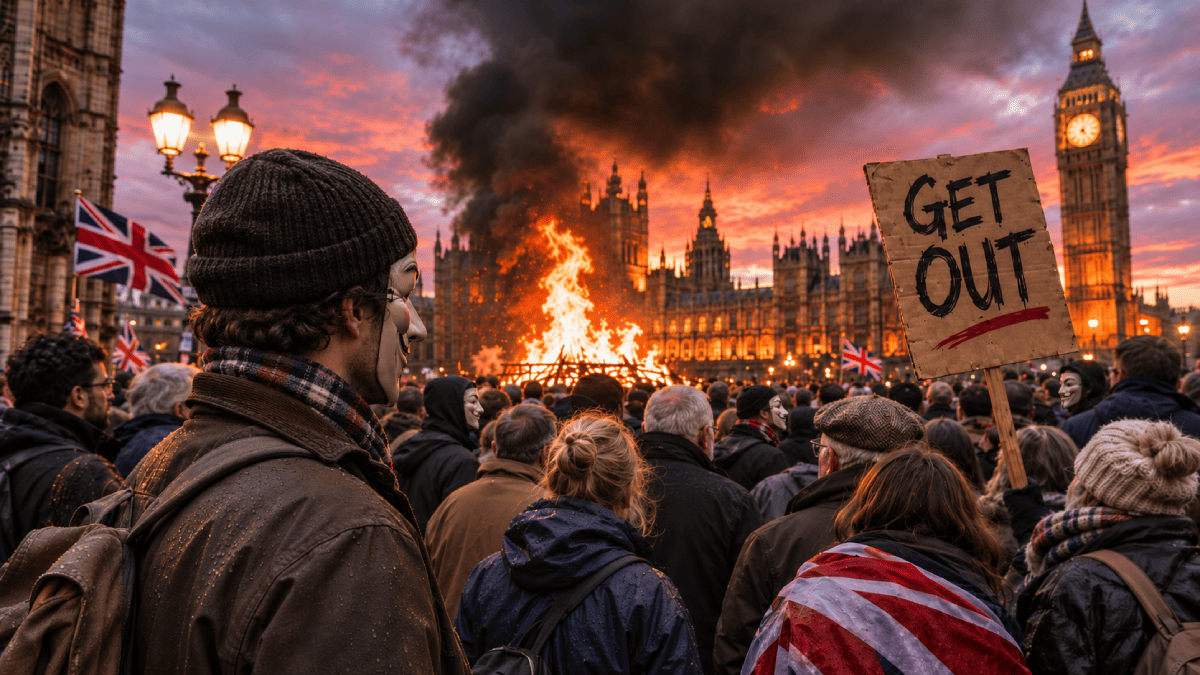
Remember, remember! The fifth of November, the Gunpowder treason and plot; I know of no reason why the gunpowder treason should ever be forgot.
They certainly do at Westminster. The Yeomen of the Guard still search the cellars before every State Opening of Parliament, hunting a Catholic terrorist who has been dead since 1606. Four hundred and twenty years of ceremonial vigilance against one man with a match. In all that time nobody has thought to send a Yeoman down to check whether the government still works.
It doesn't.
It runs on a bluff, and the bluff has a number, and key to understanding the overthrow of the British state is how the number gets called. None of what follows has happened, but all of it adds up.
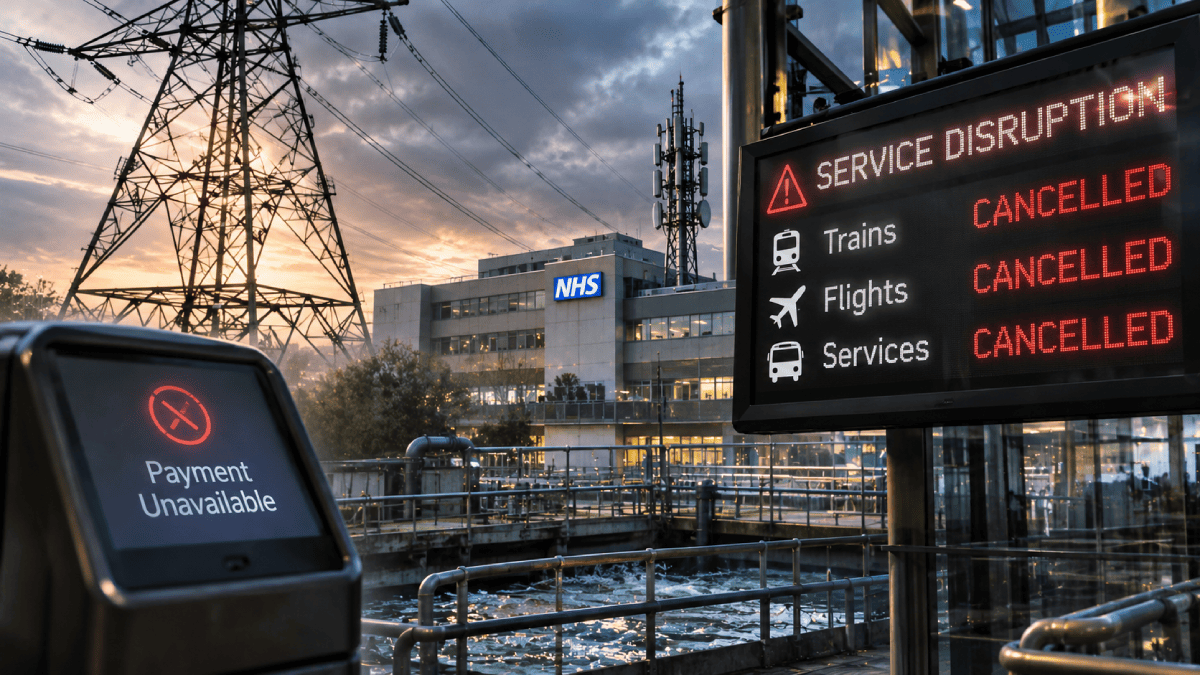
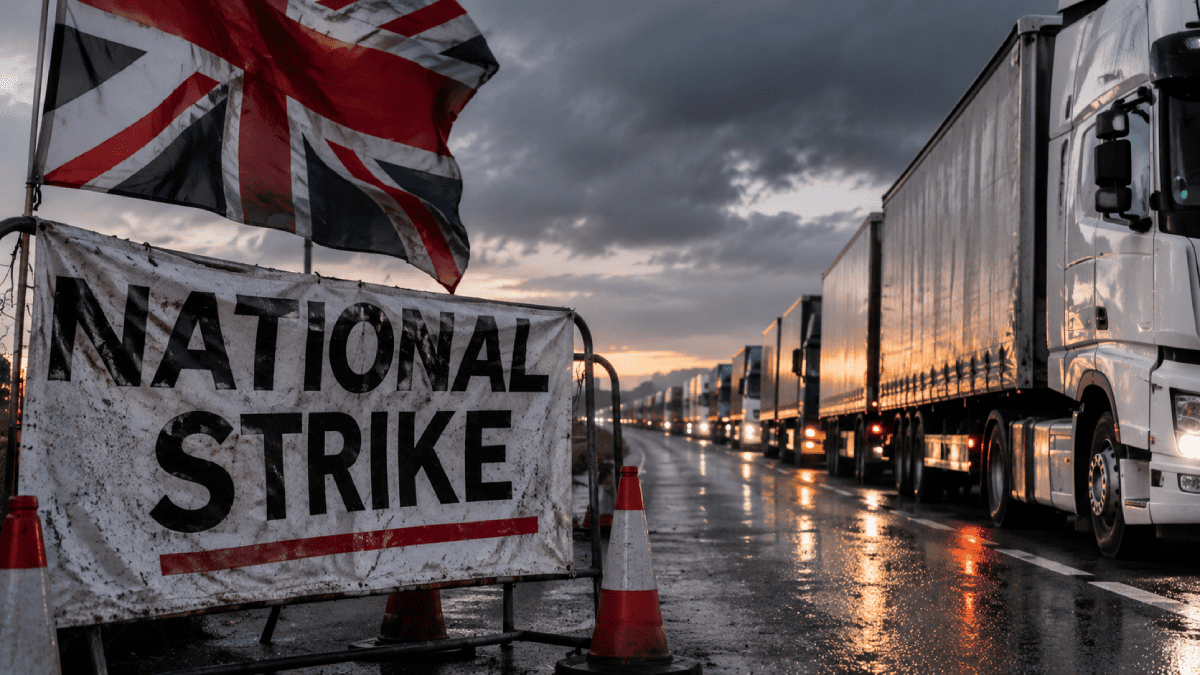
Thursday, 5th November. 6am. A general strike has run for days. Lorries stand idle, the depots are shut, and the country's electricity, networks, and card payments have turned unreliable in places. Water reaches some streets by tanker and other streets not at all.
Mass immigration, the row which started all this, has long since stopped being about policy.
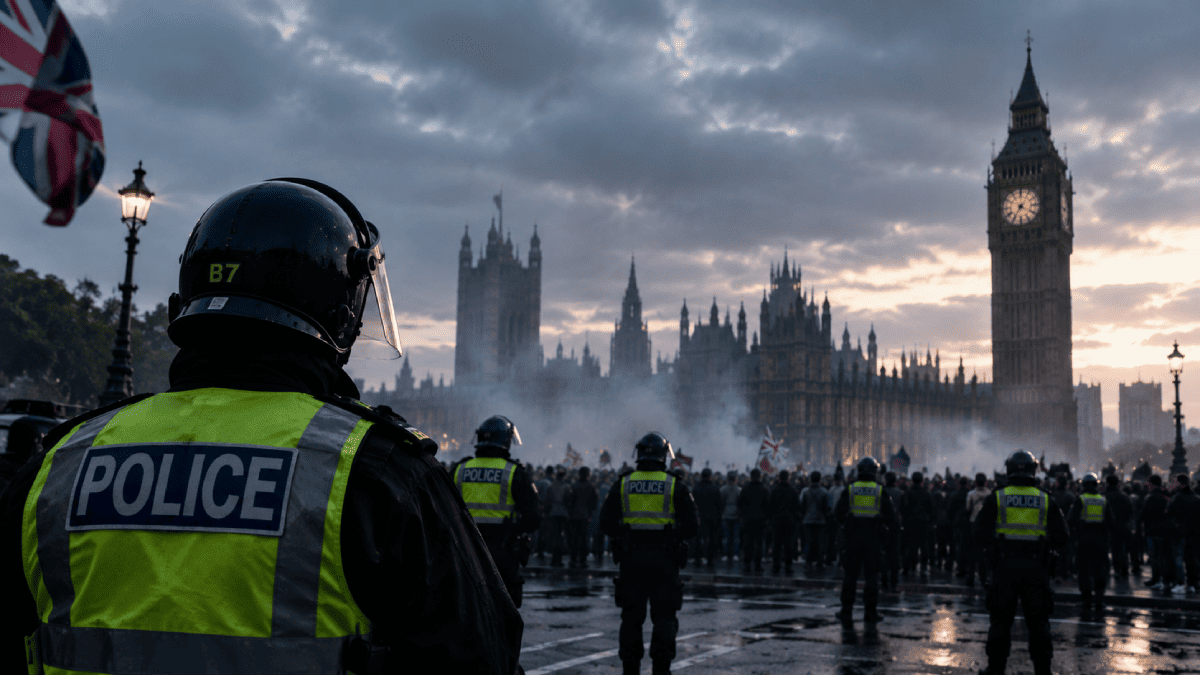
A human tide has been arriving at Westminster since before dawn. Nobody has stormed anything. Nobody needs to. Parliament Square, Whitehall, and every approach for a mile are simply full of people who have sat down and refuse to leave.
The placards disagree about almost everything except the only demand which matters.
Get out.
A few thousand of them wear the grinning mask from V for Vendetta, the symbol of global revolt which famously earned a licence fee for Time Warner. The film's own assault on Whitehall was shot by appointment, from midnight to 5am, across three nights.
Its best scene is a nervous officer at a barricade asking for orders. Nobody answers. The troops stand aside.
Hollywood got one thing exactly right.
Regimes die in radio silence, and Britain has made the arrangements in advance. Ofcom found around 20% of mast sites have an hour of backup power and only 5% have six. Half the country's phones have been dying since Wednesday's infrastructure collapse.
Ministers cannot reach their desks this morning. Neither can the officials who turn a ministerial whim into a letter, a contract, or a payment.
The government retains every power it held on Monday. It could lose Parliament Square for a month and survive.
What it cannot survive is the question it will spend today dodging: when a minister gives an order, does anything happen?
9000 Riot Police Fail Publicly
8am. The Home Secretary, in a borrowed room with a bad signal, asks how many public-order police the country has. The honest answer should end careers.
England and Wales have 145,886 police officers, a figure ministers wave about at every election. Almost none of them can do this. The inspectorate counted 18,351 officers with Level 2 public-order training in July 2024, down 1,883 in two years while the politicians were busy celebrating record numbers.
The national requirement is 297 Police Support Units outside London and 75 in it. Twenty-five people a unit.
Call it 9,300 personnel, the full riot reserve of a nation of sixty million.
It was calculated on a fantasy of three simultaneous seats of disorder for seven days, as though rebellion would have the manners to take a number.
The inspectors asked where this sum came from and reported:
....nobody we spoke with could explain the origin of the decision.
The last line of defence for public order in England and Wales is a figure nobody the inspectors met could account for.
It gets worse.
In 2016 the Home Office ran a test called, with no irony at all, Exercise Breaking Point. The police could field 273 of the 297 units. They failed the exam.
The review which should have followed was still, in the inspectors' words, "long overdue" after the riots of 2024.
Eight people held the office of Home Secretary in between. Eight sets of red boxes, eight sets of speeches about law and order, and not one of them fixed the sum on which the whole edifice stood.
Guy Fawkes at least had the decency to hide his contempt for Parliament in a cellar.
Thursday has rather more than three seats of disorder. It has the biggest crowd in modern British history outside the Palace of Westminster. It has picket lines, hospitals on generators, and depots to protect. It has the woman trying to ring 999 about her husband on a digital landline whose backup battery, at Ofcom's minimum, lasts one hour.
It also has Bonfire Night, the one evening of the year when the British state encourages the young to play with explosives. Police Scotland runs a dedicated public-order operation for the fireworks alone, and 62 of its officers were injured in 2023.
But most importantly, it has done the mathematics and studied what the government is capable of and prepared for. This isn't going to be three cities for seven days, or even one. It's explicitly designed to collapse law enforcement response so a conflict can be ended as quickly as possible.
Every Reinforcement Is Already Somewhere Else
11am. The call goes out for more units. It is the wrong day to ask. August 2024 shows what a far smaller emergency costs. Those riots had no strike, no failing grid, and no siege of Parliament. The Home Affairs Committee and police evidence give the bill.
| Summer 2024 | Cost |
|---|---|
| Public-order shifts, 1st to 18th August | 44,438 |
| Peak deployment in one day | 6,675 officers |
| Officers assaulted | at least 199 |
| Officers injured | 302 |
| Needing hospital treatment | 54 to 69 |
| Arrests | about 1,804 |
| Protests or events | around 250 |
Rest days went. Leave went. Neighbourhood teams were stripped. All of that for scattered mobs in one fortnight of summer.
The Unite the Kingdom rally of 13th September 2025 brought up to 150,000 people into central London on a day when the rest of the country was mowing the lawn. It swallowed more than 500 officers from other forces and put 26 officers in the injury book.
Thursday's crowd has not come for the afternoon.
When floodwater blacked out Lancaster in 2015, police teams came in from surrounding areas, because the surrounding areas were fine. This week nowhere is. Every unit on the move needs fuel from Tuesday's queues and orders over Wednesday's dying networks, and the programme to replace the emergency services' radio system had swallowed almost £2 billion by 2023 with no firm completion date.
Move every unit in the country to Westminster, then.
Now answer the phone from Birmingham. And Leicester. And Bradford. And Manchester. And Liverpool. And Luton.
The state reaches its critical point not when it lacks enough police in aggregate, but when every available reinforcement already has somewhere else it needs to be.
Concurrency sounds like a word from a management seminar, but on Thursday it means ten fires and one bucket.
One crowd of 100,000 is a problem with a GPS pin.
Ten disturbances of a few hundred need ten commanders, ten intelligence pictures, ten custody blocks, ten supply chains, ten sets of casualties, and ten furious demands for the same reserve.
The national reserve cannot be in ten places. No minister can legislate a police van into two cities.
In 2024 the police took one injury for roughly every 147 shifts. Hold 6,675 officers on the line at that rate and you collect about 45 injuries a day, and the equivalent of 25 full units in a fortnight, before counting sickness, exhaustion, smashed vans, and the shields and helmets which the inspectors watched break under repeated blows.
The officers you own stopped mattering days ago.
The only number left is how fast you can replace them, and nobody ever trained a riot officer during a riot.
Police Enforcement Dies In Six Stages
1pm. Nobody throws a helmet in the Thames. Police forces do not collapse like that. They die by inches.
- First comes local saturation: a force can no longer hold its own patch.
- Then mutual-aid dependence, as the neighbours lend officers until the neighbours catch fire too.
- Then national saturation, when the request for help goes round the country and comes back empty.
- Fourth is ordinary-policing degradation. The burglary squad, the domestic violence team, the missing persons unit, and the traffic cars are all on a coach to somewhere else. Children at risk stop being checked on. Nobody will count that as disorder.
- Fifth is enforcement selectivity. Police quietly stop enforcing the law everywhere and defend life, critical sites, and the worst crimes. The law survives on paper, like a railway timetable during a strike.
- Sixth is the one which brings down governments: the political policing threshold. Senior officers receive an order and judge the force, the arrests, or the body count it would take to be legally, operationally, or professionally unacceptable.
British law built this trapdoor on purpose.
In Ex parte Blackburn in 1968 Lord Denning declared a chief police officer:
.... answerable to the law and to the law alone.
A Home Secretary can bluster and write letters, but they cannot command a constable.
Ask the Home Office about Kenmure Street. On 13th May 2021 immigration officers detained two men in Glasgow. Neighbours surrounded the van. One climbed underneath it. Seven hours later Chief Superintendent Mark Sutherland released them for public safety.
The United Kingdom had a statute, an enforcement operation, and a van. It lost to a street.
Hundreds of people and one risk assessment overturned the sovereign power of the Crown in Parliament before teatime, and the Scottish Justice Secretary went on record as "angry and disgusted" with the Home Office.
Scale that up. This is the gap Dominic Cummings has been yelling about for years: authority on paper here, power in the real world over there, and a widening patch of empty air between them.
The minister signs. The signature goes nowhere.
Pensioners With Placards Jam Everything
2pm. Somebody in the bunker says: arrest them. Oh, do. A riot would be a gift to ministers. Rioters supply a villain and a target. A hundred thousand people sitting on the road supply neither, and each one has to be picked up, carried, driven somewhere, booked in, and given a solicitor.
After the ban on Palestine Action, supporters sat down in public with signs. The Met made 890 arrests on 6th September 2025, which organisers said took 11 hours.
Another sweep in April 2026 hauled in 523 people, the oldest aged 87. The running total passed 3,000.
Then the system choked.
The High Court struck the ban down.
The Met stopped arresting, then started again. The Chief Magistrate froze hundreds of prosecutions. The Court of Appeal put the ban back with more than 700 people charged, and by July the courts had adjourned everything again.
A year on, the mighty British state had not finished processing a few thousand people, the oldest of them old enough to remember Suez.
Now try 30,000.
At 81 arrests an hour, the rate from that September day, clearing them takes more than fifteen days without a break, performed by officers who have not slept.
Then where do you put them?
The prison estate held 85,858 people in June against a usable capacity of 89,120. That leaves 3,262 places, and there are 15,386 on remand already.
Bail them and they walk straight back to the crowd. The only option is Covid-style house arrest with army checkpoints, and they've already run that experiment to know how it would work.
Mass refusal turns crowd control into thirty thousand separate legal cases, all queuing for the same custody sergeant. Violence is not required. Only inertia and cameras.
The threat of arrest only ever worked because almost nobody tested it. A government which threatens a crowd and cannot deliver has spent the last thing it owned.
60 Years Of Keeping Minorities Peaceful
3pm. The video lands in Leicester. A water tanker, a queue, a crowded pavement. One caption says the tanker went to the Hindu temple first. The same footage, with a different caption, says the mosque.
It might be real. It might be two years old. Nobody in a cold terrace in the east of the city is in a mood to check.
Whitehall's own planning assumption says rural areas are likely to get their power back before the cities, for excellent engineering reasons which will sound like an insult by torchlight. Every shortage now has a suspect.
Within the hour a few hundred young men are on one street and a few hundred on another, and the city's police are in London.
The British political class built this part of the crisis over two generations, with its eyes shut.
Nobody ever asked the voters whether they wanted postwar Britain transformed. Nobody planned for it either.
From the Race Relations Act 1965 onward, the people running the country took the cheap way out. They stopped dealing with citizens and started dealing with communities. They found a man who could speak for a mosque, a temple, a ward, or a bloc, gave him a seat at the town hall, and called the resulting silence tolerance.
Integration would have meant hard arguments and hard money. Gatekeepers came free. The quarrels of the subcontinent were never settled, only filed.
Bradford sent the first invoice in July 2001: more than 300 police officers injured in three days. The Home Office review gave the country the phrase "parallel lives", and Whitehall answered with cohesion strategies, which is to say leaflets.
In 2015 an election court threw out the Mayor of Tower Hamlets and found a letter from 101 imams "only too reminiscent" of an Irish bishop's pastoral letter from 1892. A London borough in the reign of the smartphone had to be judged by the law of Victorian Meath.
That is what sixty years of decline management delivered: the politics of the pulpit, back in the East End, while everyone too frightened to mention it studied their shoes.
They Traded 1,400 Children For A Quiet Life
At least 1,400 children sexually exploited between 1997 and 2013, predominantly by men of Pakistani ethnicity. Alexis Jay recorded what the people paid to protect them were thinking.
Staff were nervous about naming the perpetrators' origins "for fear of being thought racist". A senior officer suggested influential Pakistani-heritage councillors had "acted as barriers". Councillors called the 2010 convictions a one-off, which Jay called "at best naive, and at worst ignoring a politically inconvenient truth".
The rapists raped.
The politicians and civil service looked away.
On one side of the scales sat 1,400 children. On the other sat an awkward conversation at the town hall.
The British state read the scales and chose the conversation.
Eleven years later Louise Casey went looking and found the machine still running. Ethnicity was unrecorded for two-thirds of perpetrators. In three police force areas with local data, men of "Asian background" were disproportionately represented among suspects. "Instead of examination," she wrote, "we have seen obfuscation."
A decade of evidence, and the system's instinct was still, yet again, to shred the question. She warned this cowardice was also a gift to those who wanted to spread violence against Asian, Pakistani, and Muslim people resident in the UK.
They deserved a state with the nerve to tell the truth as well.
Predictably, the violence came.
On 4th August 2024 masked men tried to set fire to a hotel housing asylum seekers in the borough of Rotherham itself, and 51 officers were injured defending it. Five days earlier a mob had attacked Southport Mosque.
MPs duly found no evidence of two-tier policing, a finding of exactly no interest to anybody in the street.
Plenty of people in Rotherham believe the police will not protect their daughters. Muslims in Southport have seen what happens when a crowd comes for their mosque. Researchers in Leicester recorded perceived unequal treatment of Hindus and Muslims.
Every faction carries a different grievance to the same conclusion.
Nobody is coming. Look after your own.
That sentence is how every sectarian war in history begins. Everyone learns quickly what "your own" really means.
The Cabinet Office has already written the first half of it. In widespread power and water outages, its own resilience plan concedes, the authorities may not be able to reach everyone who needs support in the first few hours or days.
1% Of Each Group Is All Each Riot Needs
Most Muslims will spend this Thursday worrying about the price of bread and the safety of their children. Most Hindus and most of Rotherham will do the same. Disorder belongs to the one per cent who turn up.
The 2021 Census counted 3.9 million Muslims in England and Wales, up from 2.7 million a decade earlier, and about a million Hindus. There are around 400,000 Jews.
It counted 44.4 million ordinary white Britons.
| Group | 1% |
|---|---|
| Hindus | 10,000 |
| Muslims | 39,000 |
| White British | 444,000 |
There are 18,351 Level 2 officers.
The Muslim line alone is more than twice the country's entire trained public-order force.
These are arithmetic, not predictions, and the arithmetic is the problem. Any plan for communal disorder which pictures a few dozen troublemakers belongs in the same filing cabinet as the 297 police support units.
An India against Pakistan cricket match on 28th August became a brawl in Leicester during 2022.
- The brawl became weeks of street mobilisation between young Hindu and Muslim men.
- On 17th September a march crossed the city from Belgrave to Green Lane Road, which an inquiry later said should never have been allowed.
- Days later nearly 200 men massed outside a temple in Smethwick, in another force's area altogether.
We don't even need to go into the antisemitic attacks on Jews and the massive scale of the Israel/Palestine desert wars on London's streets.
Leicester was one city, in a country at peace, with outside help on hand. Nine days after that march the Acting Chief Constable told the Police and Crime Panel he had over 150 recorded crimes, 6,000 hours of video to watch, and more than 50 officers working on it full time.
A year on, 32 people had been convicted and 19 cases were still open.
And the government's response? Its review panel handed over its findings on 1st July 2025.
In April 2026 ministers were still "reviewing" them, three and a half years after the streets went up. We all know why. A state which cannot finish reading a report about one city proposes to manage.... six at once.
Lancaster's neighbours fed each other through the blackout of 2015. Neighbours do that. People living parallel lives on an island of strangers must first decide whether they are neighbours at all, and this week they will decide it in the dark without electricity.
Run Leicester in six cities while the specialists are in Westminster, and sectarianism stops being a subject for the diversity officer.
It becomes the thing which breaks the state.
Rumours Travel Faster Than A Police Van
5pm. England is no Ulster, and the Troubles were no cricket match. Northern Ireland teaches one lesson which travels anywhere. The moment people stop trusting a common police force, every incident recruits for the other side.
Rumour. Mobilisation. Fear in the next street. Counter-mobilisation. Police deployment. Fewer police somewhere else.
Then round again, faster.
In Lozells in October 2005 a rumour of gang rape, pushed by pirate radio, set Black and Asian neighbours in Birmingham at each other's throats. Police never found a victim, a witness, or a shred of evidence.
Two men died anyway.
On 5th August 2024 hundreds gathered in Bordesley Green to meet a "far-right" march which only ever existed on social media.
It never came. A pub was damaged regardless.
Pirate radio took days. A phone takes minutes. "Dangerous fictions", in Jonathan Hall's words, supposedly helped light the 2024 riots, and when Chi Onwurah's committee warned a repeat was "only a matter of time", ministers binned several of its recommendations.
In Leicester, BBC Monitoring found more than half of the 200,000 tweets it examined came from accounts geo-tagged to India.
A fight in the East Midlands was being refereed from another continent.
Any foreign government or freelance fanatic who wishes this country ill would need no agents, no weapons, and no budget. The official reply is already on life support.
- The alert needs a working mast.
- The radio needs a household which still owns a battery set.
- Radio 4 long wave left the air for good on 27th June.
In Lancaster the complaint fitted in five words: "no one told us anything".
On Thursday the lie has the field all to itself.
Edinburgh, Cardiff, And Belfast Will Not Wait
7pm. Here comes the word nobody at Westminster will say out loud: Balkanisation. Everybody thinks of Yugoslavia as mortars on a hillside. Its end started in committee rooms, with a deadlocked presidency, republics ignoring the centre, police forces looking to their own capitals, and an army others came to see as one side's.
Nobody in Swansea is about to shell Newport. The first stages of the process, though, are entirely administrative, and Britain has been rehearsing them for a generation.
The SNP won 58 of 129 seats at Holyrood in May, and on 26th May MSPs voted 72 to 55 to demand the power to hold a second referendum. Downing Street told them no the same day.
Immigration is reserved to Westminster. Policing in Scotland and Northern Ireland is not.
Every expulsion in Glasgow would be a Home Office order relying on a police service which sits in another political universe. Kenmure Street was one van. It's not going to work during a general strike.
Section 98 of the Police Act 1996 lets the Secretary of State direct the chief constable of Police Scotland to send officers south.
Picture it on revolution night: a Home Secretary who cannot reach the Home Office, in a government bleeding authority by the hour, ordering Scottish constables off Scottish streets on Bonfire Night to go and clear English pavements for Westminster.
Scotland needs no declaration of independence to defeat this. A lawyer raises a question, a train fails to run, and the units stay at home. Independence, if it comes, may arrive as an unanswered email.
Cardiff has hospitals, schools, and a government, and not one constable of its own, because policing stays reserved. On 2nd September the First Minister demanded the transfer of policing and justice. The Welsh Secretary replied: "What matters is what works."
Plaid's leader has ruled out an independence referendum in a first term, and he is no firebrand. He does not have to be.
A cautious man with a mandate, a functioning civil service, and nobody answering the phone in London will start taking decisions himself, and no decision taken in an emergency has ever been handed back.
Reform holds 17 seats at Holyrood and 34 in Cardiff Bay. An expulsions crisis splits those parliaments down the middle, with Scots against Scots and Welsh against Welsh on top of everything else.
In June 2025 anti-immigrant riots spread out of Ballymena and 107 officers were hurt in a fortnight. The PSNI, with about 6,245 officers against a target of 7,500, asked Great Britain for 80 more.
On revolution night, Great Britain, the larger island, has none to send.
And England?
England has no parliament, no first minister, and no voice. Its people get the riots, the strike, and the crowd, and its rulers are the ones hiding from them.
The grid may finish the job.
The same planning assumption says northern regions may get power back sooner. Edinburgh lit, Westminster dark.
By nightfall the only governments on these islands able to meet in their own buildings may be in Edinburgh, Cardiff, and Belfast.
Nobody has seceded. They are simply the ones still answering the phone.
Send in the Army And Find Out Who It Serves
9pm. The sentence everybody knew was coming: get me the Chief of the Defence Staff. Headquarters Standing Joint Command can coordinate Military Aid to the Civil Authorities for fuel, failed networks, and emergencies. The rules demand a definite need, clear tasks, and every other option discounted.
Ministers can waive those tests in a catastrophe. They cannot waive this one:
Military personnel on UK operations remain under a military command structure.
A minister can request the Army. A minister cannot turn it into his personal police force by shouting.
The Army has about 75,200 full-time trained soldiers, cooks and signallers and overseas garrisons included. At the height of Operation Banner more than 20,000 regulars served in Northern Ireland alone, drawn from an Army of about 175,000.
Today's is less than half that size, and successive governments have boasted of their commitment to it while cutting it to the bone.
Every rung down the ladder costs more and more.
Trucks and engineers. Guarding the substations. Relieving police from static posts. Standing behind the police line. Standing in front of it.
The last rung ends with a British soldier pointing a rifle at a British citizen, on the orders of a government which may have lost the Commons by breakfast.
Soldiers could clear the crowd. Of course they could.
What then?
An injured policeman is a bad headline. A dead soldier, or a citizen shot on Whitehall, ends the argument about who is governing and starts a much worse one.
On Bloody Sunday, 30th January 1972, fourteen people died. The state was still in court about it on 23rd October 2025, when Soldier F walked free and a judge said the shooters had meant to kill.
Every officer told to issue live orders on 5th November knows the state which gives the order today may prosecute him in fifty years.
Will they obey?
Ministers should hope nobody asks.
In March 1914 at the Curragh, 57 officers of the 3rd Cavalry Brigade announced they would take dismissal over marching on Ulster. Nobody fired. Nobody technically mutinied. Their commander later said he would have obeyed a direct order.
It made no difference.
The Secretary of State for War was gone, the Chief of the Imperial General Staff was gone, the operation was scrapped, and a Liberal government discovered the British Army had a veto.
Constables swear to serve the Crown. Soldiers swear allegiance to it. Neither swears a single word to the man in Downing Street.
When the rubber bullets start flying and the tanks start rolling, it ultimately comes down to what the King demands.
Ministers forget this on every day of their careers except the last one.
CCA 2004 Is Meaningless Without A Parliament
11pm. Government, state, and nation are three different things, and tonight they come apart in the hands of the people who confused them.
The Prime Minister can flee Westminster. Governments can run from anywhere.
Parliament can lose its building; when a German bomb took out the Commons in May 1941, both Houses slipped away in secret to Church House and carried on. A minister was assassinated by a car bomb underneath them. Churchill had a war to run and a Commons behind him.
This ministry has neither, and its enemies are not over Germany. They are in the street, on strike, and asking for it in writing.
Everybody in the bunker reaches for the nasty Civil Contingencies Act 2004.
Emergency regulations lapse after seven days unless each House of Parliament approves them, and if either House has adjourned, its Speaker must bring it back within five.
The statute assumes a Parliament which can meet and a majority which will turn up.
A government with neither holds emergency powers on a one-week fuse. No Commons, no powers.
Here is how the end actually looks:
- the Commons has withdrawn its confidence, or would if it could find a room;
- the police will keep the peace but will not restore the government;
- the Army stands ready for lawful tasks and refuses to become the ruling party's bodyguard;
- the departments keep running and cannot say for whom;
- the public treats every ministerial statement as a suggestion.
No film will ever be made of it.
A Permanent Secretary asks for an instruction in writing. A chief constable takes legal advice. A general requests clarification. A First Minister says he has received nothing he recognises.
Ministers go on issuing statements to a country which has stopped reading them.
They may resign.
They may lose a confidence vote in somebody's borrowed conference suite.
Cabinet may fall apart in instalments, each resignation letter a little more concerned for the national interest than the last.
It hardly matters.
They still have the letterhead. They have lost everything else.
States finally break not when the opposition occupies a square, but when the institutions which normally translate political authority into action stop behaving as though one unquestioned political authority exists.
Everything Still Works Except The Establishment
Midnight. Engineers are still nursing the grid back, one block of demand at a time. HMRC's databases are humming. Benefits are going out. Nurses are on the wards, detectives are on murders, and the Armed Forces still defend the realm. Bins are being collected wherever someone can find a driver.
The nation is alive, exhausted, and furious.
Only the people who claimed to be running it have gone.
This is the most savage insult in the whole affair. Britain's rulers spent sixty years telling the public how indispensable they were.
On 5th November the country finds out how much of it carries on without them, kept alive by people in hi-vis jackets who appear on no minister's list of assets.
Guy Fawkes tried to blow up the government and failed. He got the rack, the scaffold, and four centuries of children setting fire to him.
His successors at Westminster finished the job themselves, with a riot reserve nobody could explain, prisons with no room, a settlement built on silence, and an Army less than half its old size.
The buildings stand. The police remain. The soldiers remain. The pylons, the payrolls, and seventy million people remain.
The authority which tied them together has gone up like a rocket, and nobody saw who lit it, because everybody did.
Now the fireworks are over, and it is getting light.
Who pays the nurses on 6th November? Who commands the police? Who tells the electricity companies who gets power? Who speaks for Britain abroad? Who authorises a single pound of public money? Who appoints ministers? Which laws still bind? Who decides whether Parliament carries on or the country votes?
And how do you tear down a failed political state without destroying the nation underneath it?
Friday arrives at breakfast time, with or without a Prime Minister.