How Radical Foreign Ideology Corrupted British Education
Your grandparents did arithmetic and Latin. Your child cannot add up a shopping bill, but she can tell you why the supermarket is racist. This is not an accident. The swap was not voted on. It has been the default in English teacher training for a generation, and nobody told the parents.
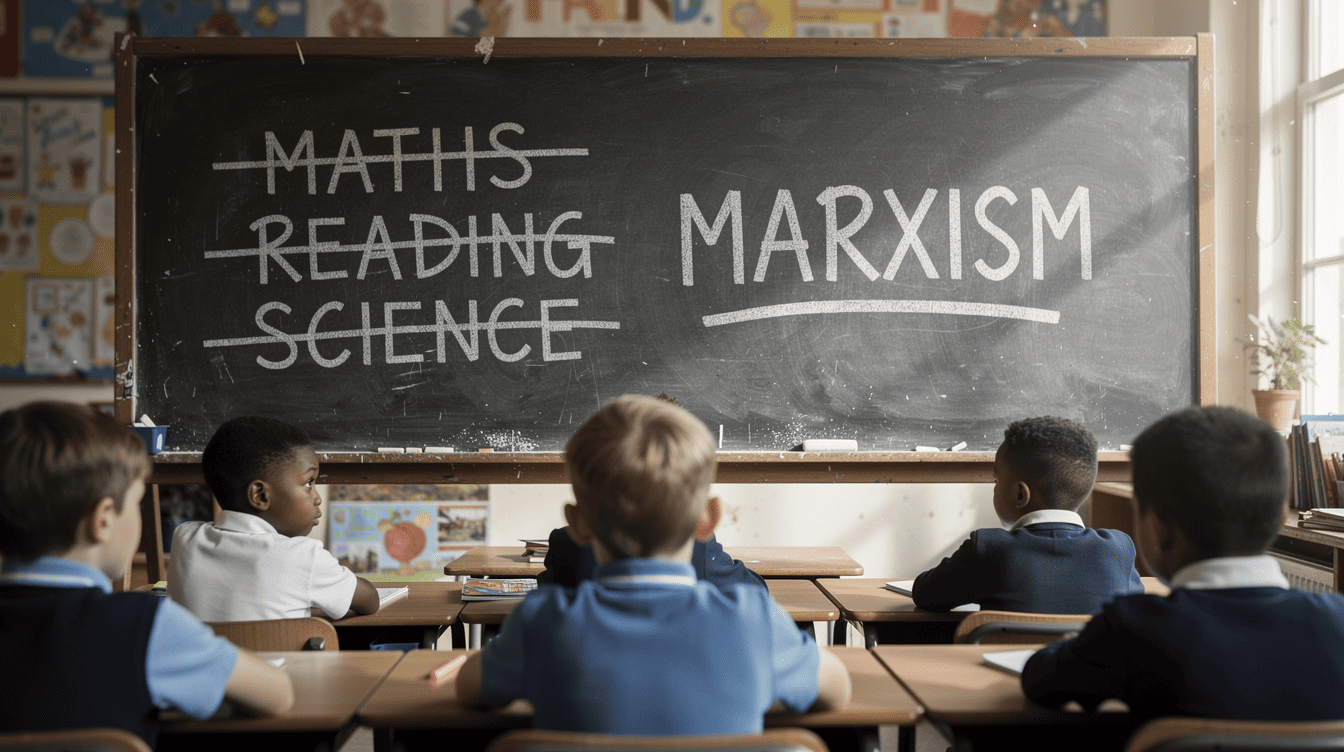
If you are a parent, and you remember your own school days with any clarity, you probably assume your children are doing a slightly updated version of what you did. A bit more computing, perhaps. Less Latin. A nod to the modern world. But broadly the same enterprise: reading, writing, arithmetic, history, geography, a little science, a little literature.
You would be wrong.
Something else has been happening in British classrooms for the better part of fifty years, and it has a name most parents have never heard. It is called critical pedagogy. It sounds dry. Academic. The kind of phrase you skim over in a Sunday paper and forget by Monday. And this is precisely why it has worked so well. Boring names hide enormous changes. If the thing calling itself critical pedagogy had been given an honest label — say, political indoctrination of children via teachers in the schoolroom — parents would have mobbed the local authority decades ago.
So let us do the work the system has avoided. Let us say plainly what the thing is, where it came from, how it entered Britain, and why your child is now being asked whether grocery shops are racist instead of being drilled in long division.
What Is Critical Education Theory?
Strip away the academic fog. Critical pedagogy is a method of teaching, built on a prior belief about society.
The prior belief: society is fundamentally a structure of power, oppression, and domination. Institutions (including schools) exist to reproduce this structure. Knowledge itself is not neutral. The canon, the curriculum, the textbook, the teacher's authority, the examination, even the subject itself. All of these, on this view, are vehicles of social power.
From this premise, the method follows. The classroom is no longer a place where an adult who knows something transmits it to a child who does not. It is a site of awakening. The teacher becomes a "facilitator". The child becomes a "co-learner". Lessons are meant to develop "critical consciousness" : an awareness of how the child is positioned inside a web of power, identity, and historical injustice. Mastery of content takes second place to interpretation of society.
For all intents and purposes, "critical" can be substituted for "communist." Children are to develop a "communist consciousness" of the world, taught by their teacher; who was taught it during their own classrooms of... how to be a teacher.
This is a moral and political doctrine dressed as a teaching technique. It begins with a conclusion about what is wrong with the world, and then deploys the schoolroom as one of the instruments for putting it right.
That is the shape of the thing. Everything else is decoration.
A Marxist Priest, A Bible Of The Seminar Room, And The Americans Who Ran With It
The usual story blames the Americans. Henry Giroux popularised the phrase critical pedagogy in the US academy in the 1980s. But the roots run to a Brazilian called Paulo Freire, a lawyer-turned-educator shaped by liberation theology, the Catholic left, and the Marxist intellectual climate of mid-century Latin America. Freire worked with illiterate peasants in the Brazilian north-east in the early 1960s, was imprisoned and exiled after the 1964 military coup, and wrote his imfamous work, Pedagogy of the Oppressed, in exile in Chile in 1968. It was published in English in 1970.
Yep, all the elements those radical hippie Boomers loved: communism; poor kids; edgy revolution books; it had it all.
Freire did not pretend to be neutral or pretend to be running a quiet classroom experiment. He was explicit. Education was a front in a wider political struggle. The literacy class was a political act. Teaching a peasant to read was teaching him to see himself as a maker of history rather than an object within it. Freire called standard schooling the "banking model" (teachers "depositing" facts into passive children) and rejected it as a tool of "domination." His categories were Marxist: oppressor and oppressed, domination and liberation, false consciousness and critical awakening. His moral charge was theological: the educator as the agent of a redemptive transformation. The book is not coy about any of this. It wears its politics on its sleeve.
What is remarkable is what happened next. Pedagogy of the Oppressed went on to become one of the most widely assigned books in the social sciences on earth. Citation counts put it in the top handful of all academic texts ever produced. It is mandatory reading in education departments from Boston to Birmingham to Buenos Aires.
And in more than fifty years, it has received almost no serious intellectual pushback inside the academy which teaches it. Think about that. A book with an openly revolutionary programme, written for adult peasants under a military dictatorship, has become the near-unchallenged foundational text of how Western teachers are taught to think about their own work. No equivalent text from the conservative, classical, or liberal tradition holds anything like this position. There is no counter-canon. There is barely a counter-conversation.
In the United States, Giroux, Peter McLaren, bell hooks and others took Freire and adapted him for the campus culture war of the Reagan years. Teachers became "transformative intellectuals". Schools became battlegrounds of identity and power. The American story is loud, bitter, familiar, and covered elsewhere.
Two points matter before we cross the Atlantic.
First, Freire begins with a fixed political and theological conclusion about the world and applies it to education. He is not a researcher who happens to discover schools reproduce inequality. He already knows this, because his worldview tells him so. The inquiry is closed before the lesson begins. The classroom is not a place to find out. It is a place to apply ("praxis").
Second, this approach was developed for adult peasants in 1960s Brazil who had been denied any education at all and were living under a dictatorship. Transferring it to a primary school in Bradford or a sixth form in Surrey is a category error of staggering size. A Liverpool ten-year-old sitting in a state school is not a landless labourer in Pernambuco. But the framework travelled anyway, because frameworks do, and because the people receiving it wanted it to.
If none of this sounds particularly British, it's because it isn't. And if one is wondering how any of this foreign garbage got into a country famous all over the world for the quality of its education, read on.
The Subtler British Road To Disaster
Britain did not import Freire wholesale in the 1970s. Nothing so clean. What happened here is more subtle, more institutional, and much harder to reverse, because it never announced itself.
The British road to critical pedagogy ran through four places at once: the London streets, the teacher training colleges, the local authority, and the sociology department. Each was doing something plausible. Each had a grievance or a question worth taking seriously. None of them, on their own, would have been enough. Together, over twenty years, they changed the meaning of education in this country.
Haringey, 1969: A Real Scandal, And The Door It Opened
In 1969, a leaflet circulated in Haringey. A school banding report had implied West Indian children were intellectually weaker than their white peers. Black parents (working people, church people, grandparents freshly arrived from Jamaica and Trinidad) read the document and went cold. These were families who had crossed an ocean for a better life. They had expectations of English schools. They believed, as every migrant generation has believed, education was the ladder out.
Two years later, in 1971, a Grenadian teacher called Bernard Coard published a short pamphlet with a long title: How the West Indian Child is Made Educationally Sub-Normal in the British School System. Coard's argument was blunt. Black Caribbean children were being dumped in "educationally sub-normal" schools on the basis of biased testing, racist assumptions, and low expectations. These schools were dead-ends. Once in, a child never climbed out.
Coard was right. The ESN scandal was real. Testing was crude. Expectations were low. Teachers often did not know a Jamaican accent from a learning difficulty. Children were written off before they could read. Parents had every reason to be furious, and they were.
What followed was not a theory seminar. It was a movement. John La Rose, the Trinidadian publisher, founded New Beacon Books and helped build the Black Parents Movement. Jessica and Eric Huntley ran Bogle-L'Ouverture Publications out of a house in West London and put Coard's pamphlet into thousands of hands. Waveney Bushell led the Caribbean Education and Community Workers Association. Supplementary schools (Saturday schools, evening schools) opened in church halls and front rooms across north and south London. They taught grammar, maths, black history, and discipline. Parents queued to enrol their children.
This is important. The first wave of this movement wanted what every decent parent wants. Good teaching. High standards. Respect for their children. A fair crack at the exam. They were not asking for a revolution in the meaning of education. They were asking for British education, properly delivered.
How A Grievance Became A Programme
Coard's pamphlet did more than expose a scandal. It introduced a way of describing the scandal. The problem was not simply individual teachers were prejudiced or particular tests were flawed. The problem was structural. The system itself produced the outcome. Bias was not a flaw in the machine. It was the machine.
This is the move you need to watch.
Once a legitimate grievance is re-described as a structural feature of the institution, the solution changes shape. You are no longer fixing a bad test or training a bad teacher. You are re-engineering the institution itself. And since the institution expresses the wider society, you are, in the end, re-engineering society through the institution.
At roughly the same time, a very different set of people in British universities were developing a language almost tailor-made to receive this idea.
In sociology departments, a strand of post-1968 thinking (New Left, neo-Marxist, drawn from the French and German theorists) was reframing schools as engines of class reproduction. Basil Bernstein at the UCL Institute of Education wrote about how language codes gave middle-class children an advantage before they had even opened a book. Michael Young edited a book called Knowledge and Control in 1971, the same year as Coard's pamphlet, arguing the school curriculum was itself a product of power. Paul Willis, in his 1977 Learning to Labour, showed working-class boys "choosing" failure in ways which, he argued, locked them into their class.
Alongside this, the Centre for Contemporary Cultural Studies at Birmingham, under Stuart Hall, was developing the idea of culture as contested ground, with schools and media as theatres of struggle. Herbert Marcuse's writing on the "repressive tolerance" of liberal institutions was read in British seminar rooms. Antonio Gramsci's notion of cultural hegemony (the quiet dominance of a ruling idea) became a staple of the postgraduate reading list.
None of this, on its own, tells a teacher what to do on Monday morning. But it gave a generation of academics a vocabulary for describing schools as sites of power rather than sites of instruction.
The Caribbean parents brought a real wound. The sociologists brought a ready-made interpretation. And somewhere in the middle, in the teacher training college, in the local education office, in the advisory committee, those two things fused.
ILEA, Or How To Rewrite A Country Through Its Paperwork
If you want a single institution to watch, watch the Inner London Education Authority. ILEA was enormous. It ran schools across the capital. It trained teachers. It issued curriculum guidance. It was, by the late 1970s, one of the most powerful education bodies in the country.
ILEA absorbed the activist critique. It did not declare war on the old curriculum. It did something far more effective. It began to produce guidance documents, multicultural education materials, in-service training sessions, equal opportunities frameworks.
The language moved slowly.
- "Assimilation" became "integration".
- "Integration" became "multiculturalism".
- "Multiculturalism" became "anti-racism".
By the early 1980s, ILEA was openly rejecting "colour-blind" education and pushing schools toward culturally responsive approaches.
Peter Newsam, who led ILEA for much of this period, is a useful figure. Not a Marxist. Not a radical. An able civil servant of the old school. But the scaffolding around him, the advisers, the working groups, the commissioned reports, pulled policy in one direction for a decade. Newsam operationalised. He took the pressure from the street and the concepts from the seminar room and turned them into paperwork. Paperwork, in the end, is what schools run on.
The rest of the country watched London. What London did, Birmingham and Manchester and Leeds copied. Local authorities across the country issued their own multicultural and equal opportunities statements through the early 1980s. None of this required a vote in Parliament. None of it required parental consent. It happened at the level where most people never look.
Honeyford: The Headmaster Who Said It Out Loud
In 1984, a Bradford headmaster called Ray Honeyford wrote an essay in a small conservative magazine called The Salisbury Review. The essay was later picked up by the Telegraph. Honeyford said, in substance, what many teachers were saying privately: the new multicultural orthodoxy was already inside the system; it had not been voted on; it was being imposed on teachers by local authority fiat; and it was producing worse outcomes for the very children it claimed to help.
Honeyford was right about the first three things. Reasonable people can argue about the fourth. But what matters for our purposes is the structural observation. By 1984 (only thirteen years after Coard's pamphlet) a British headteacher could describe the new framework as established, expected, and enforced. It had moved, in barely more than a decade, from activist outsider position to professional default. Honeyford lost his job for saying so. The speed and ferocity of his punishment was itself a kind of confession. You do not destroy a man's career for criticising an approach which is still being debated. You destroy it for criticising one which has already won.
What is worth noticing, and what Honeyford himself noticed, is the cast of characters involved. He named Marcuse. He named La Rose. He named Chris Mullard, who by then was reframing racism in explicitly institutional and systemic terms. He named pressure groups organised around particular London boroughs. Conservatives were already using the term "soft underbelly" to describe education as a target for entryism. That phrase deserves a moment's attention.
Why the soft underbelly? Because education in Britain is decentralised, professionalised, and low-visibility. It is run by local authorities, advised by academics, staffed by people trained in training colleges, inspected by bodies which themselves move with fashion. Parents interact with outputs, not inputs. They see the report card, not the curriculum meeting. They meet the teacher, not the lecturer who trained the teacher. If you want to change a nation without asking it, education is where you go. No vote is required. No announcement must be made. Change the training, change the guidance, change the inspection framework, and you have changed the classroom without a single parent noticing until the child comes home speaking a different language.
1988, 1992, And The Machine Locks Shut
Then something strange happened. Margaret Thatcher's government passed the 1988 Education Reform Act. On paper, this was meant to be a conservative counter-revolution. A national curriculum. Testing. Standards. Parental choice.
In practice, 1988 did something more ambiguous. It centralised what a school must teach. It created a framework which subsequent governments could fill with whatever they wished. It made the Department for Education the final arbiter of content in a way it had never been before.
In 1992, teacher training was fully absorbed into universities and polytechnics. The old teacher training colleges, semi-academic, networked, practice-oriented, were upgraded into university education departments. The effect was to bind the training of every English teacher to the culture of higher education at exactly the moment when its culture was most saturated with utter junk: the garbage sociology of education, race studies, post-colonial theory, and the vocabulary of lunatic fringe critique. Every PGCE student from 1992 onward was, by default, formed inside that world.
Ofsted arrived the same year. An inspection body which could define "good practice" at a national scale. Whatever language Ofsted favoured, schools adopted, because schools which do not adopt the language of the inspector do not survive inspection.
The safeguarding state grew up alongside all this. Child protection, then relationships, then wellbeing, then mental health, then online safety. Each addition was individually defensible. Together they expanded the scope of the school from teacher of subjects to shaper of lives.
By the late 1990s, under Blair, the structure was complete. A centralised curriculum, a university-based teacher training system, a national inspectorate, a broad safeguarding remit, and a professional culture soaked in the vocabulary of identity, power, and structural inequality. Grammar school expansion was refused. Under the Labour government's School Standards and Framework Act 1998, grammar schools were for the first time to be designated by statutory instrument. Comprehensivisation was locked in. And the language of the academy (by now obsessed with Freire, Giroux, Hall, and decolonisation) flowed down through the training, the guidance, the inspection, and into the classroom, untouched by any popular mandate.
All organised. Formalised. Technocratised. With dashboards and frameworks.
And a catastrophic disaster at scale.
This is what cultural drift looks like when it is wired into statute and institution. Not conspiracy. Not coup. Just the long, quiet agreement of professional incentives, all pointing the same way.
This Is Not Fringe. It Is Standard.
Before we go further, let us settle the question of scale, because the first defensive move any honest critic will meet is the shrug. Oh, critical pedagogy? A few academics. Nothing to worry about. Not really in schools. This is the most important lie in the whole conversation, and it must be dispatched before anything else.
Start with teacher training. In England, almost every new classroom teacher passes through a university-based initial teacher training course. The vast majority are PGCEs, delivered by or accredited through university education departments. Those departments are, overwhelmingly, the places where the vocabulary we have been describing lives. Browse the course pages of UCL's Institute of Education, Manchester Metropolitan, Goldsmiths, Leeds Beckett, Sheffield Hallam, Roehampton, Sussex. You will find, at every level: required readings, module titles, dissertation topics, lecturer research interests; the explicit language of critical pedagogy, social justice education, anti-racist practice, decolonising the curriculum, teacher positionality, and critical consciousness.
Leeds Beckett hosts a national Anti-Racist Teacher Education Network. London Met's PGCE materials openly reference "Education for Social Justice, Critical Pedagogy and the UNCRC". This is not an elective. It is the water the training swims in. A trainee teacher in 2026 who has not encountered Freire by name, and been asked to examine their own "positionality" in a reflective journal, is an outlier.
Then the professional development pipeline. Once qualified, teachers do not stop training. Every year there are INSET days, CPD courses, local authority workshops, subject association conferences, union-sponsored sessions, and a steady drip of guidance documents. The Chartered College of Teaching publishes on anti-racist practice. Subject bodies in English and history run regular sessions on decolonising their respective canons. A generation of middle leaders and heads have been formed in this environment and now commission it for their own staff.
Then the inspectorate. Ofsted's framework is tight on evidence and standards. But its "personal development" strand and its attention to "equality, diversity and inclusion" give schools a clear steer. The path of least resistance for any school leader facing inspection is to demonstrate engagement with the whole vocabulary. Schools which do not demonstrate it do not fail inspection, but schools which do, sail through the softer metrics.
Then Wales and Scotland, where the mask comes off entirely.
The disastrous Welsh Government requires Black, Asian and minority ethnic histories and experiences as a mandatory part of its lunatic Curriculum for Wales. It runs an explicit anti-racist professional learning programme for teachers. Scotland's Anti-Racism in Education Programme, published under successive Scottish governments, talks openly about anti-racism across the curriculum and about decolonising the curriculum as a live policy aim. Education Scotland and the General Teaching Council for Scotland host race-equality and anti-racist learning resources as standard. In these two nations, the doctrine is not smuggled. It is printed on the letterhead.
Can the kids read? Who cares as long as they're radical Marxists?
Then the published curriculum itself. The disgraceful 2017–2018 introduction of compulsory Relationships Education in English primary schools and Relationships and Sex Education in secondary schools (legislated by a Conservative government and brought in from 2020) was a turning point. Under "safeguarding" and "wellbeing", the state quietly handed schools a broad remit to substitute themselves as parents of children: identity, consent, family, online behaviour, mental health. The guidance is not in itself ideological. The guidance gives space. Space, in a school, is filled by whoever has been trained to fill it, and whoever has been trained to fill it is the PGCE graduate of a university education department steeped in exactly in this junk vocabulary and the political idiocy.
Then the materials. Teachers do not invent lessons from scratch. They use resources. Those resources come from commercial publishers, from activist charities with education arms, from union-recommended lists, from Twitter threads, from TES downloads. The volume of material produced by avowedly activist sources — Black Lives Matter in schools packs, decolonising history resources, anti-racist maths lesson plans, climate anxiety workshops — now rivals or exceeds the neutral commercial output. A busy classroom teacher, looking for a lesson on the British Empire on a Sunday night, is statistically likely to land on something produced by someone with a clear position.
Then the softer carriers. School mission statements now routinely speak of values, inclusion, belonging, social justice. Behaviour policies refer to structural factors. Pastoral teams use the language of trauma, intersectionality, and privilege with no more self-consciousness than a previous generation used "discipline" or "pastoral care".
So when a defender of the field tells you that critical pedagogy is marginal in English schools, ask them a precise question.
Where, in the training pipeline, in the inspection regime, in the published resources, in the university that trained the teacher, in the union advice given to the teacher, in the professional development the teacher attended last term, is the alternative voice?
Where is the counter-canon? Where is the serious cognitive science tradition, the classical tradition, the knowledge-rich tradition given equal time in the formation of a new teacher?
The honest answer is that it exists in pockets (some knowledge-rich academy trusts, some independent schools, a handful of dissident blogs and think tanks) and nowhere else at scale. The default is the doctrine. The dissent is the margin.
This is the real story. It is not a fringe. It is the water supply. The only thing keeping it from full and open expression is Section 406 of the Education Act, which restrains the most explicit political teaching, and parental attention, which occasionally flares when something visible enough to notice hits a family WhatsApp group. Remove those two restraints, and you would see in public what is already the private culture of the profession.
This text reads:
406 Political indoctrination.
(1) The local authority, governing body and head teacher shall forbid—
(a) the pursuit of partisan political activities by any of those registered pupils at a maintained school who are junior pupils, and
(b) the promotion of partisan political views—
(i) in the teaching of any subject in the school (in the case of a school in England), or
(ii) in the teaching of any aspect of a curriculum provided in the school under the Curriculum and Assessment (Wales) Act 2021 (in the case of a school in Wales)
(2) In the case of activities which take place otherwise than on the school premises, subsection (1)(a) applies only where arrangements for junior pupils to take part in the activities are made by—
(a) any member of the school’s staff (in his capacity as such), or
(b) anyone acting on behalf of the school or of a member of the school’s staff (in his capacity as such).
When Your Child Gets Home
All of this would be an academic curiosity if it stayed in the seminar room. It has not. Walk into an English state school today. The formal rules still prohibit political indoctrination. The aforementioned Section 406 of the Education Act 1996 forbids the promotion of partisan political views in teaching. Section 407 requires balance on political issues. On paper, Britain has one of the most legally restrictive frameworks for political teaching in the Western world.
On the ground, the law regulates what a teacher says explicitly. It does not regulate the assumptions behind what a teacher says. This is the gap through which the framework flows.
- A maths lesson may nominally teach long division, but be wrapped in a worksheet about inequality in global supply chains.
- A history lesson may nominally teach the Industrial Revolution, but frame the factory owner and the mill hand as oppressor and oppressed, with the child invited to reflect on their own "positionality".
- A literature lesson may nominally teach Of Mice and Men, but spend more time on "structural racism" than on Steinbeck's prose.
- A PSHE lesson (once called "personal and social education" and reserved for the occasional talk about manners) now covers identity, consent, relationships, online behaviour, climate anxiety, and an ever-expanding list of concerns the school has been asked to manage which have nothing to do with academic study and none of the school's business in the first place.
None of this breaks the law. All of it changes the centre of gravity.
The Shopping Bill Test
Here is the simplest test, and the one parents instinctively reach for.
At the end of a lesson, what can the child now do which they could not do an hour ago?
- If the answer is "divide a three-digit number by a two-digit number accurately", the lesson has worked.
- If the answer is "describe how the local grocery store reflects systemic inequality", the lesson may have been interesting, but the child still cannot add up their own shopping.
This is not a cartoon. These lessons happen. In primary schools. In secondary schools. In teacher training modules which the child's own teacher sat through three years earlier. The child who cannot do arithmetic, cannot read fluently, cannot write a coherent paragraph, is nonetheless being asked to interpret the social structure of the country they live in.
You do not need to be a conservative, a traditionalist, or a sceptic of any particular political position to see the problem. You only need to be able to count.
A child cannot think critically about what they do not know. A child cannot analyse a system they cannot read about. A child cannot discuss inequality in the grocery store if they cannot calculate the change from a tenner. Thinking requires tools. Tools require practice. Practice requires time. Time is finite. Every minute spent on interpretation is a minute not spent on the skills which make interpretation possible.
Who Actually Pays The Price
The cruellest twist in the whole story is who pays. Strong students, with bookish parents and well-stocked homes, survive anything. A bright child in a middle-class household will learn her times tables at the kitchen table if the school will not teach them. She will read because her parents read. She will write because she is asked to write thank-you letters to her grandmother. The school can waste her afternoons on interpretive exercises, and she will still clear her GCSEs.
The child who loses is the one who depends entirely on the school. The child of the single mother working two jobs. The child of the Romanian cleaner. The child of the Pakistani taxi driver. The child of the third-generation Caribbean family in Tottenham. The very children Coard was trying to rescue in 1971. For them, the school is the whole of their academic life. If the school is busy discussing structure when it should be teaching fluency, that child walks out at sixteen unable to compete, unable to read a job application properly, and articulate only in the vocabulary of grievance which the school has substituted for skill.
The framework claims to be on the side of the oppressed. Its effect, measured in literacy and numeracy outcomes, is to leave the poorest further behind. Any serious parent, of any background, can see this. Most of them already do.
Why Critical Pedagogy Is Catastrophic
Critical pedagogy has enjoyed nearly half a century of almost unbroken academic applause. Its foundational text is among the most cited books in the social sciences. Its vocabulary is the working language of teacher training. It has written itself into professional standards, inspection frameworks, union guidance, and curriculum materials across most of the English-speaking world. In all of that time, it has faced very little serious intellectual opposition from inside the academy which teaches it. The objections have come mostly from outside the walls: from parents, from dissident teachers, from cognitive scientists, from a few think tanks, from journalists. The inner sanctum has enjoyed a remarkable silence.
It is time to break that silence. Not with snark. Not with ideology. With the kind of rebuttal which, laid out in full, leaves the doctrine nowhere to hide. What follows is not a list of grievances. It is an argument for why, at the root, this entire idea is unfit to teach children.
It inverts the order of learning
The single most important fact about teaching young children is the order in which things must happen. A child must decode letters before she can analyse a text. She must learn number bonds before she can reason about arithmetic. She must know the date of the Norman Conquest before she can debate its meaning. Every serious finding of cognitive science in the last fifty years confirms this. Working memory is narrow. Long-term memory is vast. Thinking is what the long-term memory does with what it has stored. Without storage, there is nothing to think with.
Critical pedagogy flips this order. It begins with meaning, context, interpretation, discussion, and critique, on the assumption these will draw the child into learning. But interpretation is not an input. It is an output. A child with no knowledge of a period cannot critique the history of it. A child with no arithmetic cannot interrogate a statistic. What looks, on the surface, like an enriched lesson — let us discuss whether the supermarket is racist — is, cognitively, a lesson conducted in a vacuum. The child, asked to form an opinion on something she cannot yet analyse, supplies the opinion from the only place available: the mood of the teacher and the air of the room.
This is not a minor technical objection. This is the doctrine crossing its own central wire. It promises critical thinking. It delivers the opposite: confidently expressed ignorance. You cannot reason about what you do not know.
It treats fluency as suspect
The older tradition understood fluency as the gateway to everything else. A child who can read without effort can read anything. A child who can calculate without effort can turn her attention to the problem rather than the procedure. Fluency frees the mind. It is the foundation on which higher thought rests.
Critical pedagogy is hostile to fluency, though it rarely says so in plain terms. It calls drill "rote". It calls memorisation "passive". It calls direct instruction "authoritarian". It calls the examined mastery of a body of knowledge "narrow" or "colonial". This is not a neutral pedagogical preference. It is a prejudice dressed as method. It takes the very thing which liberates the working-class child (automatic command of her own language, her own numbers, her own cultural inheritance) and teaches her teachers to regard it as suspicious.
No serious cognitive scientist believes fluency can be replaced by discussion. Every serious cognitive scientist believes the opposite. The doctrine survives this contradiction only because its audience is inside a closed citation circle which does not read the cognitive science literature.
It mistakes engagement for learning
A classroom hums. The children talk. They have views. They challenge each other. The observer leaves pleased. This has been the aesthetic of the progressive classroom for three generations, and it is one of the more stubborn illusions of the trade.
Engagement is not learning. It is possible for a child to enjoy a lesson and learn nothing. It is possible for a child to endure a lesson and learn a great deal. Noise is not acquisition. Discussion is not mastery. The child who has spent forty minutes in a lively seminar on inequality and cannot, at the end of it, do anything she could not do at the start, has been entertained. She has not been taught.
Critical pedagogy elevates engagement to a virtue in itself, because engagement is what its method produces. Mastery is what its method cannot reliably produce, so mastery is relegated, relabelled as "narrow" or "instrumental", and pushed to the margins. This is not a rigorous position. It is a pedagogy marking its own homework.
It claims to serve the oppressed and harms them most
The doctrine presents itself as the friend of the disadvantaged child. This is the most emotionally effective claim in its arsenal, and it is also, on the evidence, false.
Every child needs structured teaching. Some children receive it at home as well as at school. Those children are insured against any failure of the school. Other children receive it only at school. Those children depend entirely on the school for the ladder out. They have no backup.
When a school tilts away from structured teaching toward discussion, interpretation, and critique, the insured children lose very little. Their parents will teach them their times tables on the drive home. The dependent children lose everything. The structure which was their only route to fluency has been taken away and replaced with a conversation they cannot yet participate in. They leave primary school unable to read properly. They leave secondary school articulate about oppression and helpless in an actual job interview. Every international comparison of literacy and numeracy outcomes shows widening gaps between the best and worst served children in systems which have gone furthest in this direction.
The doctrine claims to stand with the poor. In practice, it widens the chasm between the poor child and the rich child. This is not a side effect. It is a structural consequence of substituting discussion for fluency in classrooms which serve children who need fluency most.
There is a darker version of this objection, which is worth stating because it is almost never stated.
A child who has been denied fluency cannot escape the interpretive frame her school has given her. She cannot read around the subject. She cannot check. She cannot consult a rival source. Her only tools for describing her own situation are the tools the school put in her hand. If those tools are the vocabulary of grievance and structural oppression, she will use them, because she has no others. She will arrive at adulthood fluent in the description of her own powerlessness, and genuinely powerless, and the one will feel to her like an explanation of the other. This is not liberation. This is the manufacture of a client class.
Its epistemology is self-defeating
Critical pedagogy rests on a deep claim about knowledge. Knowledge, it says, is not neutral. It is socially produced, power-laden, contested, situated. The canon is a construct. Facts are political. Objectivity is a pose.
If knowledge is a product of power, why should the child trust what the teacher says? If facts are political, why should she memorise any of them? If objectivity is a pose, why should she bother to get the answer right? The doctrine pulls the floor out from under its own classroom. Having told the child the subject she is about to learn is a tissue of power relations, it then asks her to learn it anyway, on the authority of the very teacher it has just relativised.
Worse, the doctrine exempts itself from its own corrosive. Every other body of thought is "constructed", "situated", "ideological". Only critical pedagogy itself arrives at the seminar room clean, true, and deserving of assent. This is not a theory of knowledge. It is a theory of unilateral disarmament: everyone else must lay down their claims to truth; the doctrine alone retains them.
A teacher who genuinely believed the strong version of this epistemology could not teach at all. She would be trapped in an infinite regress of meta-commentary on her own lesson. Since lessons do in fact happen, we can conclude nobody really believes it. The doctrine is held, in practice, only as a solvent for other people's certainties while remaining a certainty of one's own. This is not a serious intellectual position. It is a rhetorical weapon.
It corrupts teacher authority at the worst possible moment
A beginner does not need a facilitator. A beginner needs a teacher. Someone who knows more. Someone who can say, with confidence, this is how you do it, watch me, now you try. Authority in the classroom is not a relic of patriarchy. It is a technical requirement of learning. The child cannot teach herself what she does not yet know exists.
Critical pedagogy systematically dismantles the teacher's authority. It calls the teacher a co-learner. It treats expertise as a problem. It moralises about hierarchy and power. The result, in the classroom, is not democracy. It is confusion. The child does not know what the correct answer is, because the teacher has been trained not to assert one. The strong child guesses well. The weak child guesses badly. The gap widens, again.
There is nothing democratic about leaving a child to flounder. A teacher who refuses to teach, in the name of equality, has simply handed the strongest children in the room the power to set the terms of the conversation. This is the least egalitarian arrangement a classroom can take.
It confuses the purpose of schooling
Schools exist to equip children with the knowledge and skills they cannot be expected to acquire at home. This is not an opinion; it is a definition. Once a school stops doing this, whatever else it does, it has stopped being a school.
Critical pedagogy redefines schooling as the formation of a worldview. The child is not primarily there to learn arithmetic. She is there to become a particular kind of morally and politically awakened person. The arithmetic is incidental, and sometimes an obstacle. This is not a theory of education. It is a theory of political formation using the schoolroom as its instrument.
Parents have not consented to this.
They send their children to school for reading, writing, arithmetic, knowledge, and the other civilised inheritances of the culture. They do not send their children to school to have their souls formed by people they have not chosen on a programme they have not been shown. Any system which substitutes the second for the first is not merely misguided. It is in breach of the basic trust on which public education stands.
It cannot be falsified, and this is a sign it is not serious
A hallmark of a serious idea is its willingness to be tested. What would count as critical pedagogy failing? If children in schools saturated by the doctrine read worse than children in knowledge-rich schools (and they do), the defenders say the problem is insufficient implementation, resistant institutions, the weight of neoliberalism, or an oppressive curriculum frustrating the method. If the attainment gap by race or class widens (and it has in many places where the doctrine is strong) the defenders say this proves the deeper need for the doctrine. There is no empirical outcome which the framework recognises as disconfirmation.
This is not science. It is not even serious social inquiry. It is the operating logic of a closed system, which takes every result as confirmation, and every critic as evidence of the problem the doctrine was built to describe. Theories which cannot be wrong are not theories, they are commitments wearing no clothes.
It is teleological, not empirical
Strip away the language, and critical pedagogy is not a method derived from studying how children learn. It is a conclusion about society, transposed into the classroom, and dressed as a technique. It begins with an account of the world in which power, oppression, and domination are the master categories. It works backwards from that account to decide what teaching should look like. The classroom is not the site of discovery. It is the site of application.
This is why the evidence from cognitive science, which is vast, converges strongly, and points to the opposite conclusions on almost every practical question, has made so little dent in the doctrine. Evidence cannot dent a conclusion reached before the evidence was sought. The doctrine will outlast every meta-analysis, because it is not, in its heart, an empirical claim.
It cannot, in the end, tell a child how to read
At the very bottom of every pedagogical theory is a simple question. How does a five-year-old become a fluent reader by the age of eight? Answer it, in plain English, without jargon, in fewer than two hundred words, and you have said something useful.
Direct instruction can answer this. Systematic synthetic phonics can answer it. A well-trained teacher in a knowledge-rich curriculum can answer it. The cognitive science of reading has answered it, with a degree of consensus rare in the human sciences.
Critical pedagogy cannot answer it. It has no theory of reading acquisition; of number sense; of writing instruction; of how specific subject matter is best sequenced for specific ages.
It has a theory of what schools are for, in the political sense, and very little else. On the actual craft of teaching a specific child a specific skill by next Friday, it is mute, or it outsources the question back to older traditions it claims to have surpassed.
A theory of education which cannot teach a child to read is not a theory of education. It is a theory of something else, which has been occupying the premises under false pretences.
Put these nine objections together, and what remains of the doctrine? A political programme with a theological undertow, applied to children who are not consenting adults, on premises nobody chose, in a profession whose training no longer seriously entertains alternatives. A method which inverts the natural order of learning, treats fluency with suspicion, mistakes engagement for acquisition, widens the gap it claims to close, rests on a self-cancelling epistemology, undermines the one authority the beginner needs, redefines the purpose of schooling without asking the parents, refuses all empirical tests, arrives at its conclusions before it begins, and cannot actually teach a child to read.
This is not a tradition worth reforming. It is a tradition worth replacing, and the replacement is not some new synthesis. It is the older, plainer, more honest understanding of what a school is, which was abandoned quietly, over fifty years, by people who never asked.
Ideological Academic Frauds & Fools
The nine objections above are the substance. What follows is what you will meet in conversation. Every one of these moves collapses the moment you answer it, which is why none of them is ever made in the presence of someone who has read the cognitive science literature.
- Education is never neutral. Perhaps. Non-neutrality does not cancel the order of learning. A child must still learn to read before she reads ideologically. The claim of bias in the curriculum does not release a teacher from the obligation to teach the curriculum competently.
- This approach increases engagement. Engagement is not learning. A lively discussion which produces no retained skill is a wasted hour, however pleasant.
- It develops critical thinking. Thinking runs on knowledge. Strip the knowledge, and critical thinking becomes the confident expression of whatever happens to be in the air. This is not a skill. It is a vulnerability.
- It addresses inequality. It widens inequality. The children who most need structured teaching are the ones who suffer most when structure is removed.
- It gives children a voice. A voice with nothing to say is a noise. A child who has not been taught cannot contribute meaningfully to a conversation about what she has not been taught.
- It is more democratic. Beginners do not need democracy in the classroom. They need someone who knows the answer. Handing the conversation to the strongest speakers in the room is not equality.
- The world is complex; education should reflect that complexity. Complexity is the reward of mastery, not its substitute. The apprentice learns to hold the chisel before he is asked for a theory of sculpture.
- Traditional teaching is rote and narrow. Fluency is not rote. It is the foundation of everything higher. The caricature of "rote learning" is a strawman most traditionalists would not defend in the form presented.
- This is complex; it is not either/or; we need both. In theory, yes. In a sixty-minute lesson, something goes first and something else gets less time. The real question is what gets priority, and the honest answer is visible in any current teacher training module.
- You are cherry-picking extreme examples. The examples are drawn from the published course materials of mainstream English universities, the guidance documents of devolved governments, and the commercial resources used by thousands of schools. If this is cherry-picking, the orchard is the size of the system.
Every single one of these defences depends on the prior existence of the very thing the doctrine displaces: a well-taught child with real knowledge, on whom engagement, voice, discussion, and critique can safely be built. Deployed after that foundation, they are not critical pedagogy. They are the ordinary operation of a well-educated mind, which is what schools were meant to produce in the first place, and used to.
The Pattern Beyond The School
The sharp-eyed reader will have noticed by now the pattern is not confined to education. The same structural vocabulary now saturates British policing, where the College of Policing curriculum has absorbed the sociology of policing in a similar fashion. It is there in social work training, where frameworks of structural disadvantage sit between the worker and the child. It is there in the NHS, in universities, in the civil service, in the charity sector. The same style of broken junk thinking — system-first, identity-sensitive, heavily documented, professionally mediated — has settled across most of British public life.
This is not a coincidence. And it is not conspiracy either.
The same people-facing professions, responding to the same scandals, reached for the same academic garbage at roughly the same time, which was already on the shelf. The sociology departments had built it in the 1970s. The race relations movement had polished it in the 1980s. The universities standardised it in the 1990s. By the 2000s, it was the default way the British state thought about itself.
Schools are simply the first and most visible place where this shows up in the life of a family, because schools are where your own child sits, and you can ask them at the dinner table what they learned today.
Oppression As The New O-Level
It is worth being plain about what the old system, for all its faults, actually did. Your grandparents did O-levels. They learned arithmetic to fluency. They parsed sentences. They read Macbeth and Great Expectations. They memorised dates and capitals. They recited poetry. They drew diagrams of plant cells. They sat examinations which were marked on whether they knew the thing, not on whether they had the correct view of the thing. They did the Trivium: grammar, logic, and rhetoric.
This system was not perfect. Many children were written off at eleven. The grammar school ladder was narrow. The rote methods could be brutal. Every reformer of the past sixty years has had real faults to attack.
But the core act of schooling (an adult who knows something, in a room with children who do not, transmitting it with patience and rigour until the children know it too) is not a political position. It is the thing itself. It is what education is. Strip it out, and whatever is left is a different enterprise wearing its uniform.
What has been lost is not Latin or corporal punishment or assembly hymns, though all of those have gone. What has been lost is the quiet confidence of a culture in its right to hand itself on. Britain once believed it had something worth passing to its children. Grammar, literature, mathematics, music, history, faith, law, manners, craft. Not as propaganda. As inheritance. A child was owed the best of what had come before, accurately taught, because she was about to live a life in which she would need it.
Critical pedagogy disagrees. It holds the inheritance at arm's length, examines it for power, and teaches the child how to question it before the child has been given it. You cannot question what you have never received. You can only refuse it, in advance, on someone else's authority.
Did Caribbean Parents Want Marxism?
Think back to those Caribbean mothers in Haringey in 1969, pushing leaflets through letterboxes. What did they want?
They wanted their children to read well and do sums. They wanted them to sit the same exams as the white children in the same borough, on the same terms, and pass. They wanted, in other words, the classical English education which had been denied to them in the sugar islands and was being rationed to their children in north London.
They did not want their grandchildren, fifty years later, to be taught identity theory in primary school. Nor their grandchildren to leave school articulate about oppression and innumerate about change. They wanted the ladder.
The tragedy is the legitimate grievance they raised was absorbed by a movement which had other ambitions. The scandal was real. The remedy offered was not a better ladder. It was a redefinition of what ladders were for. What began as a demand for admission into an inheritance ended as a quiet dismantling of the inheritance itself.
A Boring Name For A Radical Revolution
If the system had been honest, it would have called this what it is. A project for the moral and political formation of children through the schoolroom, in a direction chosen by a particular professional class, without reference to parents, without a mandate, without accountability beyond the inspection cycle of an inspectorate shaped by the same culture.
Instead it gave itself a name designed to bore you into not asking. Critical pedagogy. Multicultural education. Anti-racist practice. Decolonising the curriculum. Social-emotional learning. Relationships education. Each new label functionally identical to the last, each sold as a technical matter for professionals, each eating a little more of the school day, each pushing the old craft of instruction a little further to the margin.
Parents sense it. They have sensed it for years. They know something has changed. They cannot quite put their finger on it. The report cards still look more or less the same. The building is still the same shape. The uniform is still there. But the child who comes home speaks a different language, and the things she cannot do at ten, which you could do at eight, are difficult to ignore.
AI Will Replace Them
There is nothing mystical about what a school is for. It is for teaching children the knowledge and skills their parents cannot teach them at home, to a standard which gives them real command of their own lives. Reading, writing, arithmetic, science, history, literature, language. Fluency first. Mastery second. Judgment third. The rest, if there is time and appetite, after.
A child who can read fluently can, in time, read Marx and Burke and Orwell and decide for herself. A child who cannot read fluently can do none of these things, and will be told what to think by whoever has the microphone. The most radical act a school can perform is to produce a child who can actually think: which requires, first, giving her something to think with.
This is the argument we must win back. Not in a lecture theatre. Not in a policy review. In the one place it has always been decided and always will be. Around a kitchen table. Between a parent and a head teacher. At a governor's meeting. At the ballot box when someone stands who understands what has been lost and means to restore it.
The quiet swap was done slowly, over fifty years, in a language designed to send us to sleep. Undoing it will take the opposite. Plain speech. Clear eyes. And the unfashionable confidence of a people who still believe they have something worth teaching their children.