The Green Party Fantasy Land
Where else can you find militant Islam, windmills, cross-dressing, vegans, free heroin, and magic boobs, all in one place? Britain's Greens intend to govern by wishing very hard, and on current polling will unseat three cabinet ministers. A manifesto of magical thinking, and it keeps winning votes.
There is a particular kind of political document which reads less like a plan for the country and more like a letter to Santa Claus written by a committee of sixth-formers fresh from discovering Naomi Klein. Such a document sits on the Green Party website, forty pages of it, printed in a jaunty sans-serif over stock photography of wind turbines and smiling nurses. As a hat-tip to Messiah Obama, it is called Real Hope. Real Change. It is, by any serious measure, the most intellectually incoherent prospectus offered to the British electorate in living memory.
And yet the Greens are winning our lowest IQ cohorts over. Four MPs at the last election. Times reporting this week suggests they are on track to unseat three cabinet ministers at the next. A growing army of councillors across urban England. Something is going on here, and dismissing it as middle-class silliness will not do. The sandal-and-drugs people are on the march, and we need a proper accounting of what they actually believe, where they came from, and why it would wreck the country inside a single parliament.
From The Ecology Party To The Magic Boobs Era
The Greens did not begin life as a full-spectrum left-wing movement. They began in 1973 as the Ecology Party, a small, earnest outfit concerned with population, pollution, and the management of finite resources. It was, in its way, a conservative tradition, in the sense of conserving things. Early Greens worried about soil, about forests, about the quiet destruction of the countryside by industrial agriculture. You could have imagined the Great Roger Scruton having lunch with them.
They changed their name to the Green Party in 1985, split into separate English, Scottish and Welsh parties, then spent the next three decades as a protest vehicle without parliamentary representation. Caroline Lucas took Brighton Pavilion in 2010 and held it, single-handed, for thirteen years. Through this period, the party gradually transformed from an ecology outfit into something else: a broad home for the post-Blair urban left, swelled by university towns and public sector professionals and anyone wanting a political identity more flattering than the one Labour could offer.
The 2024 manifesto is the document confirming the transformation. Environmentalism is still in it, but environmentalism is now a single wing of a much larger structure. Redistribution, open borders, decriminalisation, post-national governance, identity rights, hostility to deterrence, hostility to nuclear power, hostility to the existing constitution. The Greens have inherited the entire wreckage of the post-Corbyn left and given it a coat of green paint.
Three Wolves Under A Single Wool Coat
Before we come to the current leadership, it is worth pausing to ask what kind of political animal the Greens actually are. The answer matters, because the party is routinely filed under "environmentalism" in a way which obscures far more than it reveals. Environmentalism is one wing of the structure. It is no longer the load-bearing wall.
The Greens are best understood as a fusion of three distinct intellectual traditions, each with its own pedigree, each inherited in diluted form.
Social Democracy
The first is the gateway drug of socialism-lite, of the sort practised in Scandinavia. High taxation, strong welfare provision, public ownership of utilities, protected labour rights, an active state. The Greens borrow almost every structural feature of this model. What they do not borrow is the engine which paid for it. Norwegian social democracy was built on forty years of North Sea oil and the disciplined productivity of a small, educated, high-trust population. Danish social democracy was built on export manufacturing and a work ethic which would embarrass a British civil servant. The Greens want the outputs of these societies while remaining actively hostile to the activities generating them. They are, in essence, attempting to run the Norwegian welfare state on the economic base of a student union.
Marxism
The inheritance is indirect and significantly softened. The Greens are not revolutionary socialists. They do not propose to nationalise the means of production, abolish private property, or stage a class war. What they have absorbed is the underlying critical framework: the suspicion of wealth as structurally unjust, of markets as producing harm rather than goods, of "the system" as the author of inequality rather than the aggregate of countless individual decisions. This is Marxism translated into policy committees. It provides the moral vocabulary (exploitation, extraction, structural injustice) without any of the theoretical rigour which once accompanied it. Karl Marx wrote three dense volumes analysing how capital accumulates. The Greens have reduced this to a wealth tax and a hashtag.
Deep Ecology & Degrowth
Deep ecology and the post-growth tradition is the piece most commentators miss. Its lineage runs from the Limits to Growth report of 1972 via Arne Naess and the deep ecology movement of the 1980s to the modern degrowth theorists clustered in European universities.
The core claim is simple:
- economic expansion is intrinsically destructive,
- the planet imposes hard physical limits on human activity, and
- the task of politics is to manage contraction gracefully rather than pursue abundance recklessly.
This is the tradition supplying the Greens with their most radical intellectual commitment, which is the rejection of growth itself. Page fifteen of the manifesto is pure deep ecology. It is also what makes the Greens categorically different from Labour, from the Liberal Democrats, and from Nordic social democracy. Those traditions want to redistribute the surplus. The Greens want to shrink the surplus in the first place.
Put the three together and you get a party which is structurally incoherent but ideologically consistent. It inherits redistribution from social democracy, suspicion from Marxism, and limits from deep ecology.
What it notably fails to inherit is the requirement each of these traditions imposed on its adherents to explain how the country will produce anything at scale. Social democracy took production seriously. Marxism took production seriously, if only to seize control of it. Deep ecology at least had the honesty to admit it wanted production to decline. The Greens have somehow assembled a doctrine wanting less production and more spending simultaneously, and declining to notice the contradiction.
On the conventional political spectrum, this places them significantly to the left of Labour on economics, comparable to Labour on social questions, and considerably more radical than any mainstream party on constitutional and international arrangements. They are post-national where Labour is still just about national. They are anti-deterrence where Labour is reluctantly Atlanticist. They are degrowth where Labour is uneasily pro-growth.
They are, in short, the home of the post-Corbyn left plus the environmental movement plus the urban graduate identity vote, sharing a building they did not design for this many occupants.
Which brings us, at last, to the current occupant of the leader's office.
The Hypnotist And His Growing Boobs
Zach Polanski took over the Greens in 2025. He is a former actor, a London Assembly member, a vegan, and, until a Sun investigation in 2021, a practising hypnotherapist. The investigation, which Polanski has never meaningfully disputed, found him offering paying clients hypnosis sessions which he claimed could enlarge their breasts through the power of suggestion. Sixty-five pounds per session, for a course of six. The client in question was an undercover journalist, which is fortunate, because the alternative is a client who paid three hundred and ninety pounds to be told her bosom would grow if she thought about it hard enough.
This is the leader of the third party in British politics. We are not making it up. You can look it up.
And the reason it matters is not simply because it is absurd, though it is, but because it is diagnostic. A political movement believing reality bends to the power of positive thought is going to produce leaders who believe the same thing in every other domain. The Green Party manifesto was written by people who, at some level, genuinely do believe that if you wish hard enough, the cupboard will fill.
Growth Is Bad For Us
Economic growth, the Greens announce, is "actively undermining our wellbeing." This is not buried. It is the governing premise. Growth, the thing paying for hospitals and pensions and schools and soldiers, is the problem.
Turn the page. Now count the spending commitments.
- Twenty-eight billion pounds a year for the NHS by 2030.
- Twenty billion for social care.
- Twenty-nine billion for home insulation.
- Forty billion a year for the green transition.
- Five billion for special needs.
- Eleven billion to fix the courts.
- Eight billion for schools.
- An extra percentage point of GDP for foreign aid, rising to one and a half.
- A thirty billion pound buyback of the water companies, the railways, and the Big Five energy retailers, paid in cash to the very shareholders whom the Greens have spent forty pages denouncing.
This one is gold:
We will try to stop any new people getting HIV by 2030.
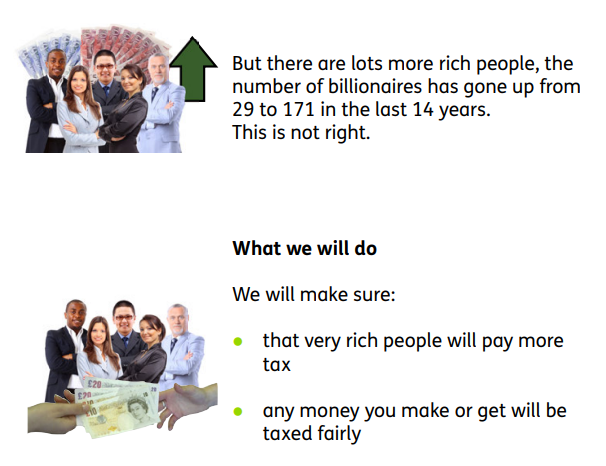
Who pays? Principally, a wealth tax on assets over ten million pounds, which the Greens cheerfully assume will yield fifty to seventy billion a year. Assets, of course, being the most mobile things in the modern economy.
Anyone who has spent ten minutes with an accountant knows what happens when you announce a two per cent annual levy on a billionaire's balance sheet. The balance sheet relocates to Monaco. The accountant becomes Swiss. The yield does not materialise. The hospital does not get built.
This is the first and deepest fracture in the Green worldview. They have declared war on the growth machine and drawn up a budget which only a roaring growth machine could finance. They borrow the spending model of Norway and reject the engine which paid for it. Norway can afford free personal care because it spent forty years drilling North Sea oil. The Greens intend to do neither. They intend to tax what moves, and will be surprised when it moves.
The Heating System Designed By Someone Who Has Never Been Cold
The energy chapter is where the manifesto collides most directly with the laws of physics. The Greens want seventy per cent of British electricity from wind by 2030. They want to ban all new oil and gas extraction. They want a carbon tax starting at £120 per tonne and rising to £500. They want to phase out petrol cars by 2027 and diesel entirely by 2035. And they want to shut down nuclear power, the one proven source of firm, carbon-free baseload generation available to an advanced industrial state.
The Greens describe nuclear as "a distraction." The distraction, in this case, being the thing keeping the lights on when the wind drops. Their replacement plan, consists of interconnectors to Europe, grid-scale batteries which do not yet exist at the required scale, and green hydrogen, at present a laboratory curiosity dressed up as industrial strategy.
The childish prose reads:
We want to shut down nuclear power as it is unsafe and much more expensive than green power.
What this means is a country which on a still, cold February evening becomes entirely dependent on French nuclear reactors and Norwegian hydropower delivered through an undersea cable. The Greens call this "resilience." A less charitable term is hostage-taking in reverse. We will shut down our own firm power and trust Paris and Oslo will be generous when the wind stops blowing over the North Sea in January.
Notice also the casual authoritarianism of the supply-side plan.
- Mandatory Passivhaus standards.
- Compulsory solar panels.
- Mandatory heat pumps.
- Mandatory end-of-life dates for petrol vehicles.
The language is local and communitarian. The machinery is dirigiste. This is a pattern throughout the document. The Greens dislike hard authority when it wears a uniform, and love soft authority when it wears a high-vis jacket and hands you a leaflet about your boiler.
The Justice System For People Who Have Never Been Burgled
The law chapter reads like it was drafted in a seminar room on the Brighton seafront, which, in fairness, it probably was. A presumption against custodial sentences under two years. Decriminalisation of drug possession. Routine stop and search abolished. The Prevent counter-terrorism programme scrapped. Sex work decriminalised. Misogyny made a hate crime.
Notice the order of the priorities:
allow trans and non-binary people to say who they are
help the public trust the police more
pay for new courts.
Notice what is missing. There is no serious proposal for how to deter crime, only how to treat it after the fact. There is no acknowledgement of how some people respond to incentives and others simply do not. The Greens have designed a justice system for the redeemable, and quietly assumed the irredeemable will go away if we are nice enough to them. They confuse compassion with permission.
The assumption throughout is therapeutic. Offenders are victims of circumstance. Police are the problem. Prison is cruel. The state's job is to heal, not to deter, incapacitate, or punish. A robust challenge to this worldview is provided nightly by any woman walking alone through a British city centre after ten at night, but the Greens are unlikely to be represented in this focus group.
Borders As A Moral Filter, Not A Capacity Constraint
On migration the manifesto achieves a kind of policy purity rarely seen outside a theology seminar. Safe and legal routes from anywhere. Asylum seekers with the right to work from day one. The ten-year settlement route abolished. Minimum income requirements for spousal visas scrapped. Immigration detention ended for all but the most dangerous. All visa holders voting in all elections. Free movement with the EU restored.
But this one is the crown turd in the punch:
Abolition of the ‘no recourse to public funds’ condition that exacerbates social, economic, and racial inequalities.
Simultaneously, the same manifesto commits to the largest expansion of welfare entitlement in British history. Universal Credit up by forty pounds a week. The two-child cap gone. Disability benefits uprated. A universal basic income trialled. One hundred and fifty thousand new social homes a year. Free social care. Free personal care. Free school meals. Free school breakfasts. Free dentistry. Free GP access.
Both offers draw on the same thing, which is finite state capacity:
A party serious about welfare generosity has to be serious about who can access it. A party serious about open-handed migration has to be serious about the services those migrants will need. The Greens are serious about neither. They have promised everything to everyone and left the scheduling problem to someone else. Borders, for them, are a process problem.
In reality, they are a capacity constraint.
The Rights Machine With No Off-Switch
This brings us to the most revealing fracture in Green politics, which is the internal civil war over gender. The manifesto supports gender "self-identification," legal recognition by "self-declaration," and an "X" marker on passports. This is presented as a simple extension of rights, costless and obvious.
Meanwhile, in the real world, the Greens have spent the last two years expelling and suspending members who raised sex-based concerns about single-sex spaces, sporting categories, and safeguarding.
This is not a side dispute: it is the entire Green political method failing in tiny version. The Green theory of rights is simple: rights should be expanded indefinitely, to everyone, in every direction.
What the theory lacks is any mechanism for deciding what happens when two rights collide.
When the "rights" of "trans women" (men) and the rights of women are both affirmed as absolute, and the two come into conflict in a changing room or a prison ward, somebody has to decide. The Greens cannot decide, because decision implies hierarchy, and their entire moral architecture is built on the rejection of hierarchy.
They are comfortable expanding rights. They are unable to rank them. And a state which cannot rank rights cannot govern, because government is, in the end, the business of telling people which of their competing claims will prevail.
Eco-Jihad: The Alliance Of Opposites
The modern Green Party is not the ecology party of 1985. It is a broad activist coalition in which environmentalism is, according to recent YouGov work, now a secondary motivation for voting Green. What is the primary motivation? A package of left-wing social positions: Palestine, migration, identity, redistribution, suspicion of the West.
This has produced some remarkable bedfellows.
Green activists now routinely appear at the same demonstrations as groups whose social views are, to put it mildly, not obviously compatible with the LGBT inclusion the Greens also champion.
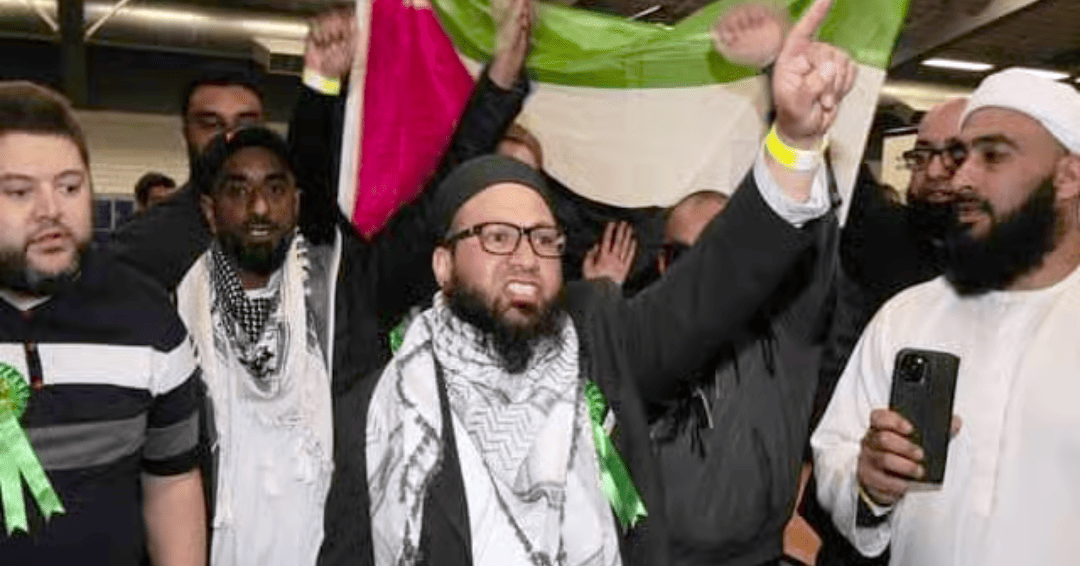
The protest coalitions around Gaza have brought the party into the same marching ranks as political Islam, a worldview which does not share the Greens' views on women's rights, "gay rights," blasphemy, secular education, or the separation of mosque and state.
The Greens do not have a formal alliance with militant Islamism. What they have is something subtler and in some ways more telling, which is a shared vocabulary of grievance against the Western liberal order, maintained by the polite agreement not to discuss what each side would actually do if it won. It is the diplomatic style of two people on a first date who have agreed not to mention their ex-partners. They share the same protests, but not the same society.
Oh, and they both hate Jews.
The Moral Identity Vanity Trap
Here the Englishman must pause and resist an obvious temptation, which is to call Green voters stupid. They are not. Fine, OK, they are. But they're not. They are responding rationally to their environment, and any serious opposition to Green politics has to begin by understanding this environment.
The Green voter is disproportionately urban, graduate, under forty-five, and works in the knowledge economy or the public sector. This is the same demographic likely to be susceptible to an intoxication of luxury beliefs.
It matters because these are the parts of British life least exposed to the consequences of Green policy.
- Energy is a direct debit, not an industrial input.
- Crime is a headline, not a nightly presence on the street outside.
- Migration is a moral question, not a queue for a GP appointment.
- Wealth is something other people have.
The further you stand from the constraint, the easier it is to redesign it.
But there is something more dangerous than insulation at work here, and it is the reason Green politics is growing rather than merely persisting. The Green vote is not a policy vote. It is an identity vote. I am the kind of person who votes Green. Thoughtful. Educated. Kind. Future-oriented. Not tribal. The policies are secondary to the self-portrait.
This is why the Green vote has grown even as climate has receded as its leading motivation. The party is no longer selling carbon reduction. It is selling a worldview in which systems are flexible, trade-offs are negotiable, and the right people, meaning people like you, can redesign the country into something gentler. It is aspirational morality offered as a substitute for political reasoning.
A vote cast this way is almost impossible to argue with on policy grounds, because the policies are not the point. The vanity is.
Tell a Green voter a wealth tax will not raise fifty billion pounds a year and they will nod politely and continue voting Green, because the vote was never about the wealth tax. The vote was about being the kind of person who thinks rich people should pay more. The vote is an expression, not an instrument. And expressive voting, at scale, is extraordinarily difficult to dislodge, because it cannot be falsified by evidence.
This is the deep danger of the Green stirring. A politics in which voting is about self-definition, rather than consequence, is a politics which has loosened its connection to reality.
It does not matter whether the energy plan works; or whether the wealth tax collects. It matters only whether voting for the plan makes you feel like the kind of person you want to be. And when enough of the electorate votes this way, the country will eventually have to live with the results, whether or not the voters were ever paying attention.
The Times reported this week Green candidates are on track to unseat three cabinet ministers. New York, a city who lived through the Islamic murder of 3000 people, voted in a Muslim socialist. London yet again voted for the despicable midget Sadiq Khan against all reason.
The Green fantasy is not protest vote spreading thinly. It is a surgical operation in specific constituencies because they're learning Colonel Blotto and how FPTP works: university towns, inner-London seats with large graduate populations, parts of Bristol and Brighton and Norwich.
The Greens are doing to Labour's left flank exactly what Reform is doing to the Conservatives' right. Both are punishing the main parties for being insufficiently themselves.
It is working because the ground operation is real. The Greens have five times as many councillors as they did five years ago. They run or co-run over forty councils. They have credibility in local government, of a sort, which they are converting into credibility at Westminster. They are no longer a conscience vote. They are a destination.
Take The Green Stupidity Seriously
The Green Party does not lack sincerity, intelligence, or moral seriousness. It lacks a theory of government. It has no mechanism for resolving conflicts between competing goods. It treats trade-offs as evidence of bad faith. It moralises limits rather than managing them. It promises the output of an economy it proposes to dismantle. It designs institutions for the cooperative citizen and hopes the adversarial one will not show up. It expands rights without ranking them, opens borders without building capacity, and phases out firm power without engineering a replacement.
Its leader believes, or once believed, breasts can be enlarged by thinking about them. This is funny, and it is worth a laugh, but it is also a metaphor precise enough to be useful. The manifesto is a document written in the same spirit. If you concentrate hard enough, the hospital will be built. The wind will blow. The money will arrive. The migrant will find a flat. The offender will reform. The adversary will de-escalate. The cupboard will fill.
The Greens are not radical because they are extreme.
They are radical because they quietly remove every hard edge of the state and call the result virtue.
Less coercion. Less production. Less deterrence. Less sovereignty. Less firm power. And in exchange, a warm feeling of being on the right side of history, which does not, in the end, heat a home in February.
The cupboard is bare. The grocery bag is on the doorstep. The magic was never going to work. It rarely does.