Leviathan: A Dashboard Of State Takeover After 1900
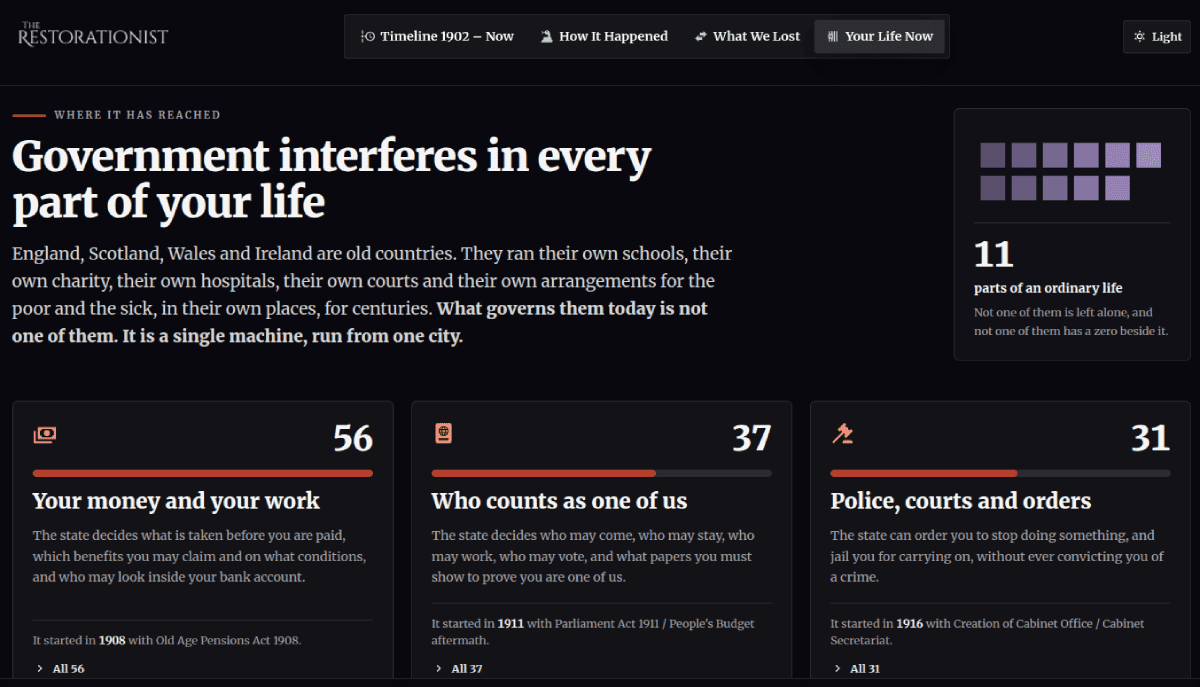
You were born into a system you never saw arrive. After Victoria died, the British state took over the country during WWI and never gave it back. For 126 years, the state has taken over more and more it has no business administrating. We call this monster Leviathan. And we have to kill it.

The great Thomas Hobbes was an English philosopher best known for his political treatise Leviathan (1651), written in the aftermath of the English Civil War. and beginning with the state of nature (human life without any effective government or common authority). He infamously described as a condition in which life is “solitary, poor, nasty, brutish, and short.”
His solution, and what came after via the appalling Rousseau, is the so-called social contract: individuals agree to surrender much of their natural freedom and transfer political power to a strong, unified, and final sovereign capable of enforcing peace. The title Leviathan refers to this sovereign state: an enormous artificial person created from the combined power of its citizens; a human invention designed to prevent violent disorder.
You might recognise this as the governing philosophy of Britain's political class, and their forerunners of India's Raj. They created it on the island. And it began when the liberal governments of Henry Campbell-Bannerman, Herbert Henry Asquith, and David Lloyd George decided to save the world with school meals, pensions, national insurance, and the Defence of the Realm Act. By the time the first socialist government had arrived in 1924 under Ramsey Macdonald, the trajectory was locked.
Why can you only drink until 11.30pm? Because Leviathan passed regulations from the First World War around conscription.
Why can you no longer freely bear arms despite it being in the English Bill of Rights? Because Leviathan was scared of a 1917-style communist revolution in Britain by alcoholic, traumatised soldiers who were armed, so it licensed firearms.
The right to own firearms was enshrined in the 1689 Bill of Rights (the Americans had to get their ideas from somewhere) and as late as 1900 the Prime Minister, Lord Salisbury, was happy to declare how much he would “laud the day when there was a rifle in every cottage in England”.
The legislation had less to do with armed robbery and more to do with the Lloyd George Government’s fear that a combination of disaffected soldiers returning from the Western Front, the 1917 Bolshevik Revolution in Russia and the surge in trade union membership might be harbingers of trouble. It was thus better if firearms were monopolised by the State and the more responsible classes.
It Hatches (1902 - 1913)
In 1902 the state took the schools from their boards and put them under authorities of its own. In 1906, under Campbell-Bannerman, it took the feeding of children out of the hands of parents. In 1907 it put its doctor into the school and made the child's body an object of official inspection. In 1908, under Asquith, it took the care of the old and made a man's last years a matter for the Treasury, and it built its own courts for the young. In 1909 it took the finding of work, the setting of wages in whole trades, and the first powers to plan another man's land.
In 1911 the Parliament Act broke the Lords' power to refuse the money, and the National Insurance Act, Lloyd George's, seized mutual insurance for sickness and unemployment together; breaking the friendly societies to do it, turning the working man's own institutions of mutual aid into collection agents for a national fund. In 1913 it took the power to classify a mind as deficient and lock it away.
It fed, and it grew.
It Begins To Feed (1914 to 1918)
In August 1914 came the war, and with it the Defence of the Realm Act. The state stopped asking. It gagged the newspapers and read the post. It sealed the borders it had never before thought to guard, registered every foreigner on the island, and made the passport the price of leaving. It suspended gold and put its hand on the exchange of money. It took the pubs' hours, the strength of the beer, and then the pubs themselves in whole districts. In 1915 it froze rents by decree and forbade the munitions worker to leave his job.
In 1916 it took men's bodies as its property, conscripting them by law and marching them into the guns, eight hundred and eighty thousand of them to their deaths, and in the same year it took the clocks, moving the hours of daylight by statute.
By 1917 it set the price of bread and the wage of the farmhand, rationed the food on the table, requisitioned the ships at sea, and taxed away the profits of any firm it judged excessive. In 1918 it claimed the child's schooling to fourteen, put the midwife and the infant under municipal welfare, and enrolled the whole adult nation onto its electoral register.
In four years it had outgrown the nation which kept it.
It Learns It Can Stay (1919 -1938)
The war ended. The powers did not. In 1919 Lloyd George's coalition built a Ministry of Health to superintend the nation's body and a Ministry of Transport to command its movement, took housing as its charge through the council estate, put commissioners over the electricity, courts over industrial disputes, and made the wartime alien controls permanent in peace. It nationalised the terms of every police force in the land.
In 1920 it put the gun a man's father had kept without a thought onto a police certificate, put opium and cocaine under Home Office licence, put the motorist onto a register and under an excise, put the working foreigner under a permit, and wrote itself a standing Emergency Powers Act for peacetime use, proclaimed within a year against the miners. In 1921 it forced a hundred railway companies into four. In 1922 it handed the airwaves to a single licensed broadcaster, made a chartered corporation in 1927. In 1923 it made the emergency constable a permanent reserve.
In 1925, under Baldwin, Churchill forced sterling back onto gold at the old rate and strangled the export trades, and the state extended its compulsory pension over the widow and the orphan. In 1927, after the General Strike, it outlawed the sympathy strike.
In 1924 Ramsay MacDonald formed the first socialist Labour government, and the party built to enlarge the state took its levers for the first time. In 1929 the state absorbed the Poor Law into itself. In 1931 it fell off the gold it had chosen. In 1932 it ended a century of free trade with a general tariff.
Through the thirties, under MacDonald and Baldwin in turn, it took the planning of land beyond the towns, the relief of the unemployed under a national means test, the clearance of streets it deemed slums, and the designation of whole regions as its special charge. In 1937 it ordered every locality to prepare for war.
In 1939 it stamped every man, woman, and child with a number and an identity card carried by force of law, and conscripted in peacetime for the first time in English history.
If Feasts Again (1939 - 1945)
The second war took what the first had only borrowed. Chamberlain and then Churchill directed labour into the mines and factories by order, rationed the food on every table, blacked out every window, billeted strangers in private homes, evacuated children from their families, interned suspects without trial under Regulation 18B, fixed the prices, and censored what remained of the press.
In 1943 the state reached into the pay packet itself, deducting its tax at source before a man ever touched his own wages. In 1944 it took the whole of secondary schooling.
In 1945 it began paying the family for its children. The state stood in the kitchen, the street, the school, the household, and the wage.
It Takes The House (1942 -1951)
In 1942, with the war still burning, Beveridge published the plan. In 1945 Attlee was given a majority to build it, and the wartime state was made the permanent state. The creature was given the run of the house.
In 1946 it nationalised the Bank of England, the coal, and civil aviation, made National Insurance universal, and laid the legal foundation of the National Health Service. In 1947 it nationalised the railways, the canals, and the road haulage, guaranteed the farmer's prices and fixed his wages, took the electricity, and took every development right in every acre of land in England, so that no man has since built on his own ground without the state's permission.
In 1948 the NHS took the hospitals, the voluntary and the municipal alike, and the citizen's health became a thing the state dispensed; National Assistance buried what remained of parish relief; the state took the gas, took children into its own care through its new children's departments, and kept conscription running in peacetime as national service.
In 1949 it took the funding of justice itself through legal aid and designated the countryside under national parks. The rule of English life was inverted in a single decade. The government no longer justified laying a hand on a man. The man justified being let alone.
It Moves Into The Walls (1951 - 1979)
Its keepers changed. Its appetite did not. The state numbered every patient. In 1956 it reached the hearth itself, telling a man what fuel he might burn in his own grate. In 1962 it began rationing entry from the empire it had invited in, by voucher, then by ancestry in 1968, then by right of abode in 1971, having opened the door it now administered the queue.
In 1963 it closed a third of the railway it owned. In 1965 it made an offence of the private landlord's and the publican's discretion, extended across employment and housing in 1976. In 1967 it took the gatekeeping of the womb, licensing abortion by medical certificate, ten million ended since. In 1968 it put the shotgun on a certificate beside the rifle. In 1971 it rebuilt the drug laws into schedules and classes.
In 1972 it signed English law itself under a foreign community of states, and redrew a thousand years of counties by statute. In 1973 it turned every business into its tax collector through VAT. In 1974 it entered every workplace risk through the Health and Safety Executive and every household loan through consumer credit licensing. In 1975 it wrote the terms between employer and worker, and between man and woman in pay and treatment.
In 1976 it ordered the grammar schools comprehensive. In 1977 it made housing the homeless a statutory duty and consolidated the rent controls first frozen in 1915.
It Sheds Its Skin But Keeps Its Teeth (1979 - 1997)
Thatcher sold the industries and kept the whip. It had learned it need not own a thing to feed on it. Council houses were sold to their tenants while the rates were capped from the centre and the local tax base rewritten twice, ending in the poll tax. The unions were bound by ballot and stripped of immunity.
In 1984 police powers of stop, search, arrest, and detention were codified and enlarged, and the state's first Data Protection Act registered the keepers of records. In 1985 the tapping of telephones was put on a statutory footing and thereby made routine.
In 1986 the Public Order Act made insulting words in the street an offence and put marches under police notice, and the City was placed under statutory regulators in the same breath as its deregulation.
In 1988 the state entered the classroom itself with a national curriculum and national testing, and rewrote the private tenancy. In 1989 it codified its power over the family through the Children Act. In 1990 it took the waste stream and every food business under inspection. In 1991 it banned dogs by breed and built an agency to assess and collect child maintenance by formula.
In 1993 it licensed a national lottery to itself and broke the railway it owned into franchises it would regulate instead. In 1994 it criminalised the rave, the traveller, and the trespasser, and qualified the right to silence. In 1995 it funded the cameras now filling every high street.
In 1996, after Dunblane, the private handgun ended altogether.
It Grows Eyes And Ears (1997 - 2010)
Under Blair the creature grew eyes as a technocracy. In 1998 foreign-drafted rights were made enforceable in domestic courts, the kingdom was carved into devolved legislatures, and the ASBO criminalised the unconvicted. In 1999 the state took charge of dispersing asylum claimants across the country's towns.
In 2000 the Regulation of Investigatory Powers Act put the citizen's communications under warrant and notice, and the Terrorism Act made emergency law permanent. After 2001 came detention without trial for foreign suspects, then control orders in 2005, curfews without conviction. In 2003 Ofcom was set over all communications, the pubs passed from magistrates to councils, sentencing and evidence were rewritten, and extradition was made fast-track.
In 2004 the Civil Contingencies Act wrote a standing template for emergency rule, the student was turned into a debtor by tuition fee, and the shared house was licensed. In 2005 gambling was liberalised under a commission and the Court of Protection was set over the incapable.
In 2006 the state legislated a national identity card and register, banned smoking in every enclosed workplace and pub in the land, and built a central barring list for anyone working near children. It made the immigrant a biometric database object, required an energy certificate to sell a house, filed the child, the patient, the passenger, and the suspect, and swelled the DNA database with the innocent.
In 2008 it bound the whole economy to carbon budgets by law, centralised the permission for major infrastructure, nationalised failing banks, and adopted the psychology of the nudge.
In 2010 it consolidated the equality duties across every public body and wrote its first internet enforcement powers.
It Puts Its Mark On Every Door (2010 - 2019)
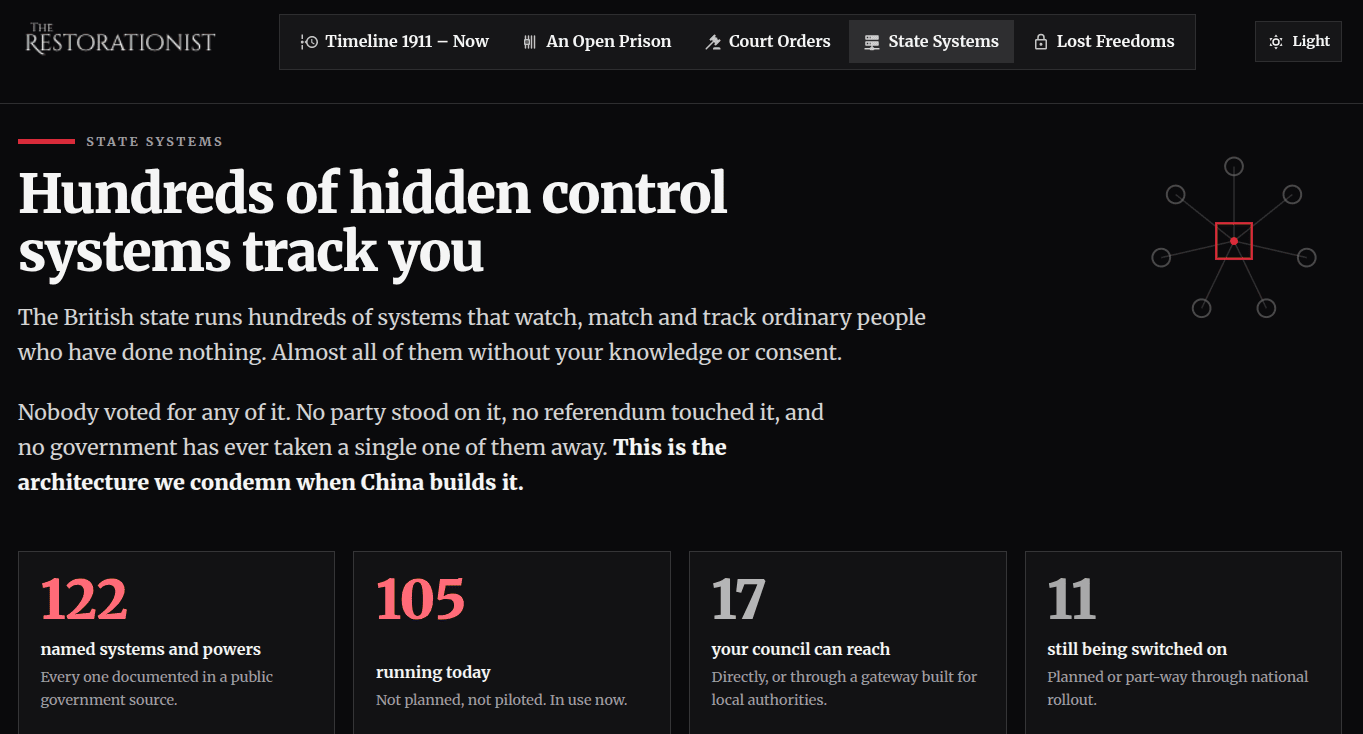
Then it grew hands that were not its own. Universal Credit put the household's income under digital conditionality while legal aid was withdrawn from whole areas of civil life. In 2014 the landlord was conscripted to check papers, in 2016 the bank to police accounts and the employer to verify status, the hostile environment made every private contract a border post.
In 2015 the Prevent duty bound the teacher and the lecturer to report the thoughts of those in their charge. In 2016 the Investigatory Powers Act legalised bulk interception of the whole population's traffic, and the Psychoactive Substances Act made every substance illegal until exempted.
In 2018 every organisation in the country became a data-compliance unit, and the state took powers to freeze assets by designation.
In 2019 net zero was made legally binding on the entire economy, and the ULEZ camera began charging the lawful car by number plate.
It Locks The Doors (2020 - 2022)
In March 2020 it rose to its full height. The state placed a healthy nation under house arrest. It forbade a man to leave his home, to work, to trade, to worship, to visit his dying mother, or to bury his dead in company. It bolted the church, the shop, and the school by decree, paid the wages of the workers it had idled, quarantined the traveller in hotels, and fined those who walked too far from their own doors. The powers were taken under an Act passed in four days.
It Makes The Cage Permanent (2022)
The emergency has not ended. It has multiplied. In 2022 protest was restricted, the vote was put behind photographic identity, citizenship was made revocable by notice, and the right to rent or work went onto a Home Office database checked by share code.
In 2023 the Online Safety Act put the citizen's speech under Ofcom, locking-on was made a crime, prayer near a clinic was zoned out of public space, and company formation itself came under identity checks. In 2024 political activity with foreign links became registrable and the terms of leasehold property were rewritten from the centre.
In 2025 the digital identity, refused by the country in 1952 and again in 2010, was assembled regardless through verification frameworks and eVisas, age checks gated the internet, and the state reached for the bank data of welfare claimants.
Meanwhile net migration was run up towards a million souls a year without a vote ever cast for it. Each emergency stands as a warrant for one more rule, one more register, one more thing a man may not do until he asks.
It no longer waits to be fed.
There is no corner of an English life left where the state has no claim. The money, the speech, the children, the body, the door of the house.
And the thing let in as a servant in 1906 has shown itself at last: a one and a quarter trillion pound leviathan, incubated for a century and a quarter, burst out of the nation's chest and loose in the room.
The tax burden is the heaviest since the Second World War. The army is the smallest in two centuries. The country grows poorer, head for head, than nations it once counted rivals, and still the creature feeds.
We must kill Leviathan.