It's Time For Us To Give Loyal Australia The Bomb
Britain spends a fifth of its defence budget nursing weapons it can't build again which are assembled and stored in America. Australia has the space, the resources, and now the threat of nuclear China. They can help us build our capability once again, and in return, this time we give them the bomb.
In November 2025 the Comptroller and Auditor General of the UK qualified the Ministry of Defence's accounts. He could not obtain evidence supporting £6.13 billion of assets under construction or almost all of it work carried out by the Atomic Weapons Establishment, because the records required to support the figure did not exist.
Of the total, £1.5 billion sat under the heading of legacy projects at a value which had not moved in years and which the department could not substantiate at all. This is, of course, on top of nuclear machinery which simply doesn't work.
Officials went before the Public Accounts Committee in the spring of 2026 and explained the money had been misclassified. Much of it early-stage feasibility work booked as capital assets and some of it dating to 2007; a good deal of it now destined to be written off.
The Committee's report called the failure completely unacceptable and concluded the accounts did not give a true and fair view of the department's finances. Its chair observed it was extraordinary to "forget" the existence of £6.1 billion.
Defence nuclear spending reached £10.9 billion in 2024-25, around 18 per cent of a departmental budget of £60.2 billion. The Committee expects the share to move towards a quarter.
Parliament is funding the largest undertaking in British government while being informed the paperwork from the last cycle has gone astray.
The physical estate tells the same story.
| Project | Function | Original figure | Latest published figure |
|---|---|---|---|
| MENSA, Burghfield | Warhead assembly and disassembly | £734m, in service 2017 | around £2.2bn, in service from 2023 |
| Pegasus, Aldermaston | Enriched uranium facility | £634m | around £1.7bn |
| Aurora, Aldermaston | Plutonium facility | early design | around £2.3bn |
| Core production capability, Raynesway | Submarine reactor cores | at least £474m | delayed by around two years |
| Primary build facility, Barrow | Submarine construction | £240m | delayed |
The National Audit Office found in January 2020 three of those projects had absorbed £1.35 billion of cost increases between them, with delays running from 1.7 to 6.3 years.
It noted with considerable restraint the department was repeating mistakes it had already made in the 1980s and 1990s. Construction started before designs were mature. Contracts left the taxpayer holding the risk and gave contractors little reason to perform.
Two years earlier the Public Accounts Committee had described deferred maintenance across the thirteen defence nuclear sites as a ticking time bomb.
Governments waste money constantly and the country endures it. The relevant question is what the waste reveals, and the answer is uncomfortable.
Britain has confused possession of nuclear weapons with possession of a nuclear-weapons capability. They are not the same thing.
A stockpile is an artefact. A capability is a living institution: scientists, engineers, manufacturing knowledge, working facilities, certification competence, experienced decision-makers, industrial suppliers, and the ability to produce the next generation rather than merely nurse the last one.
Britain unquestionably has the artefacts. Whether it still has the institution is the whole argument.
Nobody Has Seen A British Bomb Work
On 19th November 1991 a backbencher asked why Britain needed to keep testing nuclear weapons in Nevada. The defence minister, Archie Hamilton, told the Commons it was important to have effective warheads, then said something which reads very oddly today:
testing is the only way to establish whether warheads are effective.
Seven days later, on 26th November 1991, Britain conducted its forty-fifth and final nuclear explosion. Nobody marked the occasion, because nobody knew it was one.
Thirty-five years have passed.
The people who prepared those devices; who stood in the control rooms;who argued about the diagnostics afterwards and who learned the hundred things no procedure manual anticipates; are retired or dead.
Britain has moved from knowledge continuously generated by practice to knowledge inherited from the departed.
The regulators have been saying so for a very long time, in language chosen to avoid alarming anyone.
The Defence Nuclear Safety Regulator's annual report for 2013-14 named the supply of nuclear suitably qualified and experienced personnel as a long-standing issue and raised it again as the principal threat to safety across the entire defence nuclear programme. It warned the civil nuclear market would keep draining a small and highly skilled group, and was written when the last practitioners were merely approaching retirement.
The Nuclear Regulatory Review of November 2025 returned to identical ground, treating capacity, capability, and culture as a central failure of the whole British nuclear system; alongside a regulatory apparatus grown complex and slow enough to produce huge delay for marginal benefit.
The National Audit Office had already noted a shortage of technical skills inside the ministry led to gold-plated designs, because officials could not challenge regulators demanding overly complex specifications.
A department unable to argue with its own regulator is not commissioning facilities. It is accepting whatever it is handed and paying the invoice.
Britain holds an enormous archive from the testing era, including the Merlin database of more than twenty-eight thousand technical records now passing to the National Archives.
Archives are not the difficulty. A country can hold every drawing for an aircraft and lose the ability to build one.
Industrial capability lives in people who have done the thing, institutions which repeatedly perform hard tasks under scrutiny, and supplier networks which exist only because somebody keeps placing orders.
Capabilities of this kind survive by being exercised, and by nothing else.
And the anti-nuclear activists know this.
Disarmament By The Backdoor
Abolishing British nuclear weapons does not require a Prime Minister to announce abolition. There is a slower incremental method of decay, and it is working well.
- Prohibit testing.
- Restrict development.
- Resist replacement.
- Decline to renew certain facilities on grounds of cost.
- Prevent categories of practical work.
- Allow the experienced to retire without successors, since successors cannot lawfully be trained in activities the country has undertaken never to perform.
- Bind future governments through instruments which are politically ruinous to leave.
- Let supplier networks disperse because the orders stopped.
- Make resurrection expensive, illegal, and hazardous.
- Wait.
Eventually, leaving a treaty restores nothing, because nothing survives to be restored. The state carries on describing itself as a nuclear power long after the description has stopped meaning anything.
Call it disarmament by entropy.
This requires no conspiracy. The Campaign for Nuclear Disarmament openly publishes its objectives: elimination of British nuclear weapons, cancellation rather than replacement of Trident, opposition to development, manufacture, and testing, accession to the treaty banning nuclear weapons outright. It opposed investment at Aldermaston partly because those facilities might enable future warhead work.
From an abolitionist standpoint, making British capability progressively harder to recover is not sharp practice. It is the strategy, pursued in the open, with a patience the Ministry of Defence has never matched.
The failure belongs to governments.
Ministers profess absolute commitment to deterrence, announce triple locks, and simultaneously accept an institutional settlement whose long-run tendency is to destroy the option of regenerating the thing they claim to believe in.
Nobody in Westminster has ever been made to explain the contradiction, because nobody has put it to them in those terms.
Simulation Is Useless In The Real World
Britain is finally building a new warhead. Astraea (designated A21/Mk7) is funded within a £15 billion sovereign warhead programme this Parliament. The government states it will be the first British warhead developed in an era without underground testing, with confidence coming instead from modelling and simulation, supercomputing, materials science, hydrodynamics, shock and laser physics.
AWE completed its first Hydrodynamics Capability Demonstration Trial in October 2024.
- The Valiant supercomputer validates design and performance.
- The Orion laser reproduces extreme conditions.
- Radiography happens at EPURE, near Dijon, run jointly with France under the TEUTATES treaty signed at Lancaster House in 2010.
Nobody serious argues the computers are useless. Modern stockpile stewardship answers questions William Penney's generation could not have posed. France has taken the same road and shows no sign of regretting it.
Simulation preserves knowledge of a phenomenon Britain once demonstrated physically. It does not preserve the national institution which performs the phenomenon. Those are different assets and only one of them can be stored on a server.
A minister told Parliament in 1991 explosive testing was the only way to establish whether warheads work. The same state now certifies an entirely new warhead without one.
Perhaps the science genuinely closed the gap. Perhaps doctrine was permitted to evolve only inside a political and legal settlement which had already ruled out any return to testing, and the science was then invited to justify the position. Governments rarely announce the surrender of a capability. They announce it is no longer required.
The question has never been put to a British government with any force, and it deserves an answer under oath rather than in a glossy command paper.
Operational Independence Is Nonsense
Britain's deterrent is independent in the sense which decides everything in a crisis. No foreign government can veto a British launch. Only the Prime Minister can order one. Independence of decision is not independence of supply.
The Trident II D5 missile is American. British boats draw from a shared pool maintained at Kings Bay in Georgia. The warhead is sovereign and British-built, and Astraea (named after the Greek god of justice) is being developed in parallel with the American W93 with each country producing its own design. Yet the hydrodynamic experiments underpinning certification take place in France and the delivery system belongs to somebody else's industrial base.
A deterrent exists to function when every ordinary assumption has collapsed.
Which is precisely the circumstance in which foreign dependencies stop being convenient and start being fatal.
Building the national insurance policy against annihilation on components another government controls is a strange way to insure against annihilation.
The objective ought to be full-spectrum nuclear sovereignty: warhead science, manufacturing capacity, experimental competence, certification capability, specialist engineering, secure supply chains, a skills pipeline, resilient command arrangements, geographic redundancy, and the ability to replace major components without permission.
Britain possesses some of these. It has not seriously attempted to possess all of them since the 1960s.
Which raises the same practical problem from after WWII: Britain is a crowded island of eighty million people; its nuclear enterprise concentrated into a handful of sites in Berkshire, Cumbria, Derby, and the Clyde. Every one of them within a short flight of a hostile missile and within a shorter distance of a planning inquiry.
There is nowhere in the United Kingdom britannic isles to rebuild a genuinely exercised nuclear-weapons capability.
There is, however, somewhere else. Britain used it once before, for exactly this reason.
The British Bomb Was Born In Australia
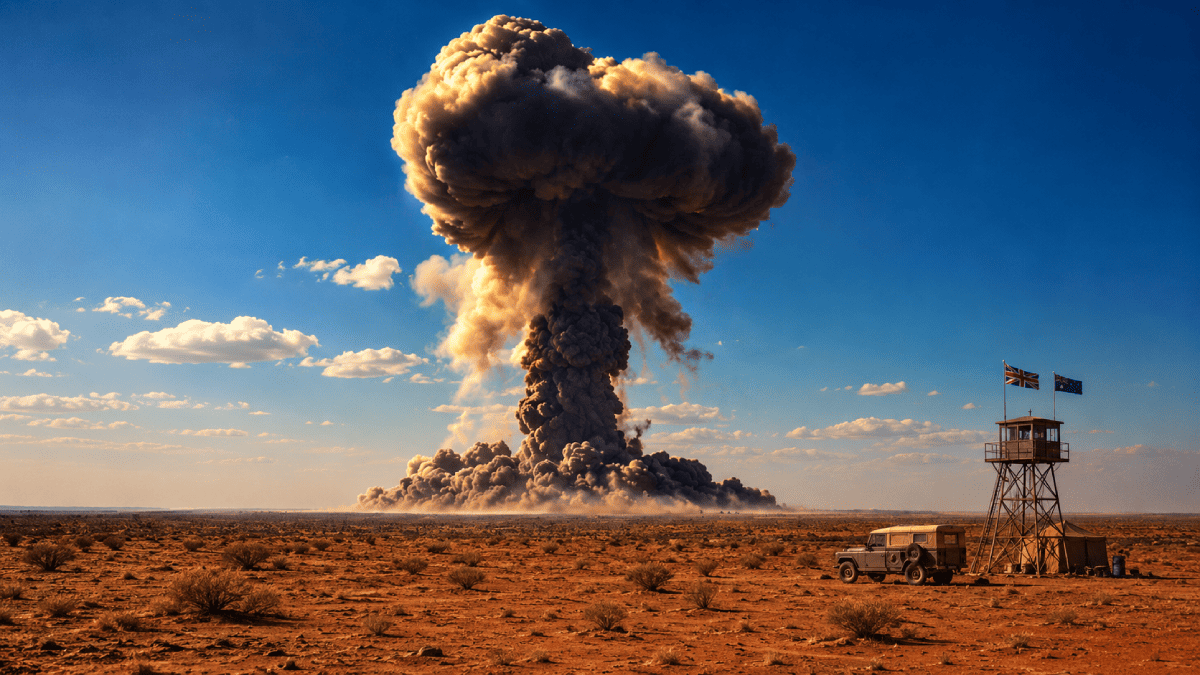
The Americans refused Britain the use of Nevada in 1950. Britain went south.
| Series | Site | Dates | Devices |
|---|---|---|---|
| Hurricane | Monte Bello Islands | October 1952 | 1 |
| Totem | Emu Field | October 1953 | 2 |
| Mosaic | Monte Bello Islands | May and June 1956 | 2 |
| Buffalo | Maralinga | September and October 1956 | 4 |
| Antler | Maralinga | September and October 1957 | 3 |
Twelve devices, with minor trials at Maralinga continuing into 1963. Britain became the world's third nuclear power on 3rd October 1952 off Trimouille Island, on a continent belonging to somebody else, because a crowded island could not conveniently conduct the experiments required to join the club.
The thermonuclear programme moved to the Pacific and later under the 1958 Mutual Defence Agreement to Nevada. It would overstate matters to claim the British deterrent was exclusively made in Australia. It is exactly accurate to say Australia was its birthplace.
The relationship did not end there, and its present form is stranger than the history.
Every British Prime Minister writes four identical letters by hand on taking office which are sealed into safes aboard the ballistic missile submarines and opened only if the British government has ceased to exist. Their contents are secret and will remain so.
The categories of instruction traditionally available to the author have nonetheless been described publicly for years, most prominently in the BBC's 2008 documentary The Human Button. One of them is to place the submarine under the command of an allied navy. The two navies conventionally named are the American and the Australian.
The letter will, under the relevant circumstances, be opened by the commander of the Trident submarine, who would have to assume that the prime minister was no longer in a position to take live command of the situation. The options are said to include the orders “Put yourself under the command of the US, if it is still there”; “Go to Australia”; “Retaliate”; or “Use your own judgment”.
Tony Blair, when asked to write and sign the letter, immediately went white, said onlookers. James Callaghan is said to have authorised retaliation. When John Major had to make the decision, he cancelled a weekend at Chequers and went home to Huntingdon.
Britain's doctrine for the extinction of British government already contains Australia. Not as an ally among many.
As one of two states to which the last functioning (thermonuclear) instrument of British power might be handed.
Canberra's Fifty-Year Bargain Is Breaking
On 6th July 2026, hours after Australia and Fiji signed a mutual defence agreement, China fired a nuclear-capable ballistic missile from a submarine into the South Pacific, landing it near Tuvalu. It was the second Chinese strategic missile test into the Pacific since September 2024.
The Australian Prime Minister called it destabilising and provocative. Pat Conroy described it as evidence of the largest military build-up in the region since 1945, unaccompanied by any transparency.
The Prime Minister of the Solomon Islands remarked it was not the act of a friend.
The Pentagon's annual assessment put China's operational stockpile above six hundred warheads, projected more than a thousand by 2030 and roughly fifteen hundred by 2035. SIPRI reached comparable figures and estimated growth of around a hundred warheads a year.
China remains far behind Russia and the United States, and treating Beijing as a pantomime villain would be both inaccurate and lazy. The harder truth is the arithmetic under which Australia settled its defence policy for fifty years doesn't work anymore. Everything has changed.
Australia's answer is greater self-reliance inside the American alliance, plus nuclear-powered submarines through AUKUS. Those boats will carry conventional weapons. Australia will remain a model non-nuclear state. Extraordinary diplomatic effort has gone into policing the distinction.
Australia is trusted with naval nuclear propulsion, with Five Eyes, with the most sensitive Anglo-American defence technology short of weapons physics. It is a stable continental democracy with deep resources, a growing nuclear-qualified workforce, and a position at the centre of the contest which will define the century.
It is nonetheless expected to accept (permanently and as a matter of virtue) a survival which depends on another country's willingness to trade its own cities on Canberra's behalf.
Why is Loyal Australia fit to operate nuclear reactors under the ocean and unfit, for ever, to deter the state pointing missiles at it?
A Deal Like No Other
Britain offers Australia a path to an independently controlled Australian nuclear deterrent. Not British warheads parked at HMAS Stirling. Not nuclear sharing with London holding the final say. Not another extended deterrence promise from a capital eleven thousand miles away.
Sovereign Australian control, exercised by an Australian government, answerable to Australian voters.
Australia offers Britain the one thing Britain cannot manufacture and cannot buy: continental strategic depth, physical space, resources, and a second geographic centre around which a genuinely exercised British nuclear enterprise can be rebuilt.
Four purposes, achieved simultaneously.
- Restoration of British sovereign experimental capability.
- Geographic redundancy for critical national expertise currently concentrated inside a small and highly targetable island.
- A second allied nuclear-industrial centre outside Europe.
- And an Australian deterrent against existential coercion in the Indo-Pacific.
There is a cyclical quality to it which ought to appeal to anyone with a sense of history.
In 1952 Britain went to Australia because it could not become a nuclear power at home.
In the 1990s Britain and Australia helped to close that era through the Maratonga test ban and the South Pacific zone.
The strategic conditions which made the closure sensible have now evaporated, while the largest nuclear expansion on earth proceeds a few thousand miles to the north.
The partnership which produced one nuclear power could preserve two.
Maralinga Has To Be Addressed
The British programme left contamination, decades of political poison, and lasting harm to Aboriginal communities whose land was used. Their presence was inadequately accounted for, and their displacement was handled as an administrative detail.
There were royal commissions, clean-up operations, compensation fights, and arguments still running today. Britain's status as the third nuclear power was purchased partly at the expense of people never consulted, who bore the consequences for generations, and who received an apology considerably later than they received the fallout.
This is not an uncommon situation. The Chagossians were also expelled from their lands for British military purposes.
Any arrangement in the 2030s would bear no resemblance whatever to the assumptions of the 1950s, and could not be permitted to. Australian sovereignty over every aspect. Modern radiological containment, environmental regulation, independent monitoring, parliamentary scrutiny, compensation regimes, and clean-up obligations agreed in advance. Australian consent given by Australians through their own institutions.
There is no third option, and our history is the inescapable reason.
It Is Not Cold War 1968 Anymore
Under the Non-Proliferation Treaty, Article I forbids Britain from transferring nuclear weapons or control over them to any recipient and from assisting a non-nuclear state to acquire them.
Article II forbids Australia from receiving, manufacturing, or otherwise acquiring them.
Article X permits withdrawal where extraordinary events related to the treaty have jeopardised a state's supreme interests, on three months' notice.
Australia cannot be promoted within the system. The treaty defines a nuclear-weapon state as one which manufactured and exploded a device before 1st January 1967. The definition is frozen deliberately.
It was designed to prevent new entrants, and it works exactly as intended, which means Australia's status is fixed for ever by events completed before Harold Wilson devalued the pound.
Then comes Rarotonga. Australia is a party to the South Pacific Nuclear Free Zone Treaty in force since December 1986 prohibiting the manufacture, acquisition, possession, and control of nuclear explosive devices, restricting their stationing, and barring testing.
Britain ratified all three protocols on 19th September 1997, and Protocol 3 is a British undertaking not to conduct a nuclear explosive test anywhere inside the zone. Britain has already promised, in writing, not to do the specific thing it now needs to do.
Rarotonga is also harder to leave than the NPT. Its withdrawal provision is not built around a party's own supreme interests. The treaty is of a permanent nature, and the right to withdraw arises where another party has violated a provision essential to the treaty's objectives or its spirit.
This all happened before China's nuclear build-up, North Korea's demonstration of nuclear capability, and every other relevant event.
The Comprehensive Nuclear-Test-Ban Treaty is oddly the least of the problems, having never entered into force for want of the required ratifications. Britain and Australia have both ratified and both are politically bound to the moratorium. Removing the constraint would still leave Rarotonga in the way.
Those instruments divide the world into states permitted to modernise, expand, replace, improve, and threaten indefinitely, and states expected to treat a renunciation made two generations ago as irreversible regardless of what happens to them afterwards.
- The first group includes every power currently expanding its arsenal.
- The second includes every country now discovering it lives next door to one.
The calculus has changed, as every sensible person anticipated it would.
Non-proliferation has drifted from a strategic arrangement into a quasi-moral doctrine, in which the states which kept their weapons lecture the states which gave theirs up about the sanctity of a bargain the lecturers have not kept either.
Treaties are tools of statecraft. They exist to make states safer. When the circumstances which produced them change beyond recognition, states retain the right to reconsider deals struck by people who are dead.
Why should the nuclear order of 1967 govern Australia's survival in 2037?
Non-Proliferation Is Also Nonsense
An Australian bomb would put visible pressure on South Korea and revive a dormant argument in Japan. Indonesia would take a dim view of a nuclear-armed neighbour and say so loudly. Pacific island governments, which built Rarotonga precisely because their region spent two decades as somebody else's testing ground, would react with fury entirely earned by British and French behaviour.
Beijing, of course, would collect several years of free propaganda about Western hypocrisy and might cite the precedent while assisting a client of its own. The regime would take genuine damage.
Non-proliferation is valuable because proliferation is dangerous, and none of it is sloganeering. It is a means of increasing security rather than an end justifying any level of insecurity in its pursuit.
A system incapable of responding to radical shifts in relative power eventually generates the pressure which destroys it, and does so without anyone having argued the case openly first.
The comparison is between two dangers. Is a nuclear Australia more dangerous than an Australia exposed to coercion by an overwhelmingly nuclear China, depending permanently on another state's willingness to commit suicide on its behalf, in a region where the largest arms build-up since 1945 is under way? Serious people will answer differently, and should. What nobody should do is treat the answer as settled by a document drafted before the invention of the mobile telephone.
Australia Is Already Britain's Last Resort
Britain has been destroyed in a Russian attack in combination with middle eastern proxy groups – the exact people we are antagonising right now. The Prime Minister is dead and so is the designated deputy. Naval broadcasts have stopped for hours. A commanding officer opens an envelope containing instructions written by hand, perhaps years earlier, by a politician killed in the attack. Among the options traditionally available to the author of that letter is to take the boat to the Royal Australian Navy and place it under Australian command.
British nuclear doctrine already imagines Australia as one of the surviving authorities to which the final instrument of British power might pass. The relationship is taken seriously at precisely the moment when nothing can be done with it.
It's time to take it seriously now.
Britain should never again allow an indispensable sovereign capability to survive as a residual inheritance. Remaining a nuclear power requires more than missiles, warheads, and a Prime Minister's launch authority. It requires the people who understand the weapon, the industry which sustains it, the institutions which can replace it, and the political freedom to exercise all three when national survival demands it.
Australia has the opposite problem: the geography, the resources, the industrial potential, and now the reason, having deliberately denied itself the final instrument.
Two problems, one solution, and a treaty settlement written in another world standing between them.
Treaties serve our interests or we don't remain in them. We need leaders who are ruthless enough to tell the "international community" we are taking care of ourselves first.
The old Anglo-Australian nuclear relationship created one nuclear power. A new one could preserve two, and spare both the discovery of what happens when a nation's last argument turns out to have been a bluff.