Westminster’s Recent Record Of Crime, Bullying, And Corruption
Britain keeps no register of convictions and disciplinary findings among its politicians. Assembling one from court reports and parliamentary archives yields roughly one in forty MPs with a serious adverse history, alongside a far longer list nobody has ever bothered to count.
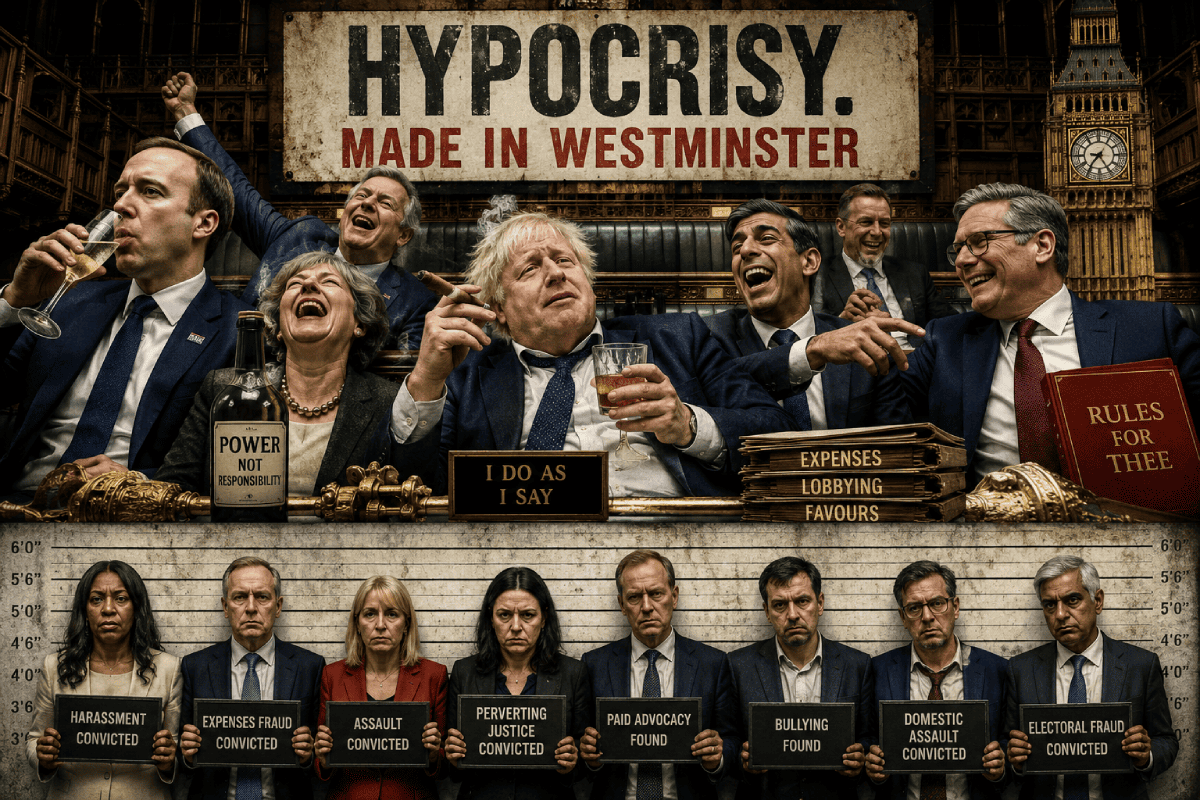
Parliament legislates ever more intimately into private conduct. It settles what employers may say, what landlords must install, what parents may permit, what businesses must disclose, and what citizens may smoke, drink, drive, build, rent, post, protest, or throw away. Ministers appear on breakfast television to explain not merely what is lawful but what is responsible, decent, inclusive, safe, healthy, or socially acceptable.
None of this rests on any formal claim of superior character. MPs are not ordained. Peers take no holy orders. A parliamentary pass certifies attendance, not virtue.
A moral assumption creeps in anyway, because the people writing behavioural rules for eighty or ninety million strangers must presumably believe themselves competent to judge behaviour.
Which invites an impolite line of inquiry: how many people admitted to Britain's political institutions carry an objectively documented fact in their own history which would give an ordinary employer pause over honesty, financial probity, self-restraint, treatment of subordinates, or use of entrusted power?
No national register exists.
Convictions sit in court reports, standards findings sit in parliamentary archives, ministerial rulings sit in letters published on gov.uk, and nobody joins them up.
Even a superficial look produces an uncomfortable preliminary answer: dozens of MPs and peers over the past decade with convictions or substantiated adverse findings bearing on character, plus a second population arrested, charged, or investigated without an established outcome.
4 Categories Of Moral Disorder
An arrest is not a conviction. An investigation is not a finding. A complaint is not evidence. A late declaration of hospitality does not equal fraud. A protest conviction from 1970 says nothing whatever about a person's expenses claims in 2019.
Four separate buckets are therefore required, and nothing may be quietly promoted from one to another.
| Category | Threshold |
|---|---|
| Established criminality | Conviction in a court |
| Substantiated misconduct | Adverse finding by a competent body |
| Lesser or technical breaches | Registration, declaration, or admin failure |
| Formal scrutiny only | Arrest, charge, or open investigation |
Spent convictions remain spent under the Rehabilitation of Offenders Act 1974. Recording a historic fact does not disturb the point. Rehabilitation is a legal status, not an instruction to forget.
The Commons Ledger On One Page
Everything in the first two buckets, for the Commons alone, over roughly a decade. The final column is the interesting one.
| MP | Adverse event | Status | What happened to them |
|---|---|---|---|
| Onasanya | Perverting justice | Convicted | Jailed, recalled, seat lost |
| Davies | False expenses documents | Convicted | Recalled, seat lost |
| Webbe | Harassment | Convicted | Suspended sentence, seat lost 2024 |
| Khan | Sexual assault of a boy of 15 | Convicted | Jailed, resigned |
| Ferrier | Culpable and reckless conduct | Convicted | Recalled, seat lost |
| Amesbury | Common assault | Convicted | Custody suspended on appeal, resigned |
| Haigh | Fraud by misrepresentation | Convicted, pre-office | Reached Cabinet, resigned 2024 |
| McMurdock | Assault | Convicted, pre-office | Elected 2024 |
| Hain | Anti-apartheid protest | Convicted, pre-office | Cabinet, then a peerage |
| C. Elphicke | Sexual assault | Convicted, post-office | Jailed |
| O'Mara | Fraud | Convicted, post-office | Jailed |
| Paterson | Paid advocacy | Substantiated | 30 days recommended, resigned |
| Bridgen | Paid advocacy, lobbying the Commissioner | Substantiated | Suspended, seat lost 2024 |
| Paisley | Undeclared foreign benefits | Substantiated | 30 days, recall failed, stayed |
| Benton | Lobbying sting | Substantiated | 35 days recommended, resigned |
| Morris | Paid advocacy | Substantiated | Remained, seat lost 2024 |
| Burns | Position used in private dispute | Substantiated | Suspended, later restored to office |
| Johnson | Deliberately misleading the House | Substantiated | 90 days recommended, resigned first |
| Zahawi | Ministerial Code, tax conduct | Substantiated | Sacked from Cabinet |
| Bone | Bullying, sexual misconduct | Substantiated | Suspended, recalled, seat lost |
| Coyle | Harassment | Substantiated | Suspended, re-elected 2024 |
| Pincher | Sexual misconduct | Substantiated | Suspended, resigned before recall |
| Bell | Sexual misconduct | Substantiated | Sanctioned |
| Anderson | Bullying and harassment | Substantiated | Apologised, re-elected 2024 |
| Kawczynski | Bullying, then non-compliance | Substantiated twice | Sanctioned twice, seat lost 2024 |
| MacDonald | Bullying | Substantiated | Appeal failed, still sitting |
| Raab | Bullying, ministerial inquiry | Substantiated | Resigned as Deputy PM |
| Patel | Bullying findings, Code breach not upheld | Contested | Stayed in Cabinet, now on the front bench |
Twenty-eight people. Eleven convictions and seventeen proved findings. Three of the convictions were already on the record when a party selected the candidate. Two more arrived after the person had left the Commons, which is a different problem and an equally awkward one.
Convictions Earned While In Office
Fiona Onasanya entered the Commons for Peterborough in 2017. She was convicted the following year of perverting the course of justice, having tried to shift the blame for a speeding offence. Driving too fast reveals very little about anyone. Lying to the courts to escape three points reveals rather more. She went to prison for it.
Chris Davies pleaded guilty in 2019 to offences involving false parliamentary expenses documents. Disputing whether a receipt was reasonable is one thing; forging the paperwork is another. His conviction triggered the machinery of the Recall of MPs Act 2015 and he lost the seat.
Claudia Webbe, a favourite of The Restorationist, was convicted of harassment in 2021 and received a suspended custodial sentence. Imran Ahmad Khan was convicted in 2022 of sexually assaulting a fifteen-year-old boy, and resigned. Margaret Ferrier pleaded guilty to culpable and reckless conduct after travelling the length of the country while knowingly infected with Covid-19. The state was fining everyone else for sitting on park benches at the time.
Mike Amesbury pleaded guilty to common assault. CCTV showed him punching a man to the ground in Frodsham, then continuing to strike him while he was down. An immediate custodial sentence was suspended on appeal, with punishment and rehabilitation requirements attached. The sentencing was contested. The assault was admitted.
Convictions Brought Through The Door
Louise Haigh pleaded guilty to fraud by misrepresentation years before Sheffield Heeley. The offence concerned a work mobile telephone reported stolen. She had been mugged and listed the phone among the items taken. It later turned out not to have been. She pleaded guilty on legal advice and received a discharge, and the conviction is long spent. The dishonesty was minor and the mitigation is real. The fact still belongs in the record.
James McMurdock is a stronger case. He was convicted in 2006 of assaulting his then girlfriend, eighteen years before Reform sent him to Westminster. Court records later reported him repeatedly kicking her while drunk. He served twenty-one days in a young offenders institution. Spent is not fictional. A civilised country lets a man rebuild his life without also agreeing to pretend a custodial sentence for domestic violence never happened.
Peter Hain sits at the opposite pole. His conviction arose from anti-apartheid direct action decades before his ministerial career. Including him in a complete historical record is honest. Weighting him alongside expenses fraud would be idiotic. Offence, age, circumstance, elapsed time, and subsequent conduct all bear on what a conviction is worth as evidence.
Selling Access Without Committing A Crime
Much of the behaviour capable of corroding public trust never reaches a criminal threshold, which is precisely why Parliament built itself a disciplinary apparatus.
Owen Paterson took consultancy money from private companies while sitting as an MP. The Parliamentary Commissioner for Standards and the Committee on Standards found repeated breaches of the paid advocacy rules, alongside failures of declaration and misuse of parliamentary facilities. The Committee called it an egregious case and recommended a thirty-sitting-day suspension. His party then tried to demolish the standards system rather than accept the verdict. Paterson resigned during the wreckage.
Andrew Bridgen breached the rules on paid advocacy and on registration of interests. He also attempted to influence the Commissioner investigating him. Forgetting to declare an interest can be carelessness. Leaning on the referee is a different species of conduct.
Ian Paisley Jr failed to declare substantial benefits connected with the government of Sri Lanka. He was found in breach of the paid advocacy provisions and drew a lengthy Commons suspension.
Scott Benton was filmed by undercover reporters. He discussed services he might supply to commercial interests, and his willingness to bend parliamentary rules on their behalf. The Commissioner did not establish every historic breach his boasting implied, and unproven claims cannot be laundered into facts. His conduct in the room was nonetheless found to have caused significant damage to the reputation of the Commons.
David Morris also appears in the paid advocacy record. Conor Burns was found to have used parliamentary resources and his position in aid of a private financial dispute.
Misleading Parliament And Mishandling Tax
The Committee of Privileges found Boris Johnson had deliberately misled the House over compliance with Covid rules in Downing Street. It called the conduct a serious contempt. Had he not already fled the Commons, it would have recommended a ninety-day suspension. Opinions about lockdown are irrelevant to the finding. Partygate as a social occasion is not the adverse fact; an official determination of deliberate deception by a serving Prime Minister is.
Nadhim Zahawi demonstrates why the Commons archive alone is insufficient. An HMRC investigation into his tax affairs produced tax due and a penalty imposed. The Independent Adviser on Ministers' Interests then found a serious breach of the Ministerial Code, criticising failures of honesty, openness, and exemplary leadership. Rishi Sunak dismissed him. Disputes with HMRC happen to blameless people. The finding concerned how a Cabinet minister handled and disclosed his.
Power Exercised Over Other People
Financial probity is one axis. Treatment of subordinates is another, and Parliament's Independent Complaints and Grievance Scheme has been busy.
Peter Bone was the subject of substantiated bullying and sexual misconduct findings, with a recommended suspension. Neil Coyle faced upheld harassment complaints involving drunken abuse. Christopher Pincher and Aaron Bell were each subject to sexual misconduct findings. Lee Anderson was required to apologise after an upheld bullying complaint.
Daniel Kawczynski breached the bullying and harassment policy. He then attracted a further sanction over his compliance with the remedy, which is a more revealing sequence than a single lapse. Angus MacDonald was found in breach after an incident involving a contractor's security pass. His appeal failed.
Ministers face a parallel system. An independent inquiry examined Dominic Raab's conduct across several departments. Findings on bullying produced his resignation as Deputy Prime Minister and Justice Secretary.
Priti Patel requires more careful treatment. An independent investigation found behaviour capable of being described as bullying. It concluded she had not consistently met the standards expected by the Ministerial Code. Boris Johnson then determined the Code had not technically been breached, and she stayed. The behavioural findings stand. The verdict was overruled by the man who appointed her.
Smoke But No Immediate Fire
A comprehensive record must also carry the MPs whose behavioural offences are minor, technical, or plainly inadvertent: Geoffrey Cox, Karl Turner, Nigel Adams, Margaret Hodge, Henry Bellingham, Kate Osamor, Greg Hands, Marcus Fysh, Rosena Allin-Khan, Natalie Elphicke, Roger Gale, Adam Holloway, Bob Stewart, Theresa Villiers, Alex Davies-Jones, Matt Hancock, Stephen Pound, Kevin Barron, and Rishi Sunak.
Sunak's breach was characterised by the process itself as minor and inadvertent. Alex Davies-Jones fell foul of rules mid-change.
Arrests, Charges, And Unfinished Business
Craig Mackinlay was interviewed under caution during the election spending investigation. He later faced criminal proceedings and was acquitted. Will Quince and David Morris were interviewed in the same inquiry.
Crispin Blunt was arrested and questioned over rape and drug possession, and denies wrongdoing. Conor McGinn has been charged with sexual assault. Dan Norris was arrested during a criminal investigation into rape. Patrick Spencer was charged and acquitted of sexual assault offences.
Two others have not been named are featured in the press.
- A former minister was arrested in 2020 over rape and sexual assault allegations. This is believed to have been the aforementioned Dan Norris.
- A second serving Conservative MP was arrested in 2022 on suspicion of rape and other sexual offences. This may or may not have been Crispin Blunt or Andrew Rosindell.
Chronology can also work the other way.
Charlie Elphicke was interviewed under caution while an MP, and convicted of sexual assault after leaving. Jared O'Mara was arrested on suspicion of fraud while serving, and convicted of fraud afterwards.
Names currently before the Commissioner include James McMurdock, Kevin Hollinrake, Nigel Farage, Richard Tice, and Sammy Wilson.
The matters include registration of interests, lobbying the Commissioner, and conduct capable of bringing the House into disrepute. None of it establishes anything yet.
An Upper House With Its Own Disgrace
The Lords maintains its own Commissioners and Conduct Committee. These guys are obviously older, but the record is just as grotesque.
Lord Maginnis of Drumglass was found to have bullied and harassed several complainants, drawing an unusually long recommended suspension. The Earl of Shrewsbury, Baroness Goudie, and Lord Dannatt were each found to have provided parliamentary advice or services for payment. Dannatt did so on multiple occasions, and expressed willingness to do more of it.
Lord Chadlington drew a lengthy suspension over parliamentary conduct connected with commercial interests in PPE procurement. Lord Evans of Watford drew a substantial one of his own.
Lord Stone of Blackheath accumulated multiple adverse reports involving harassment and later sexual misconduct. Repetition is evidentially different from a single incident. Baroness Meyer faced substantiated harassment findings, including one with a racial element. Lord Ranger and Lord Pendry were both subject to bullying findings.
Four further peers appear in the wider archive without severity yet assigned: Baroness Tonge, Lord Skidelsky, Baroness D'Souza, and Baroness Uddin. Appearing in a Commissioner's files is not itself evidence of anything.
Members of the Upper House convicted long ago also remain members.
| Peer | Offence | Outcome |
|---|---|---|
| Hanningfield | Expenses fraud | Imprisoned |
| Taylor of Warwick | False accounting | Imprisoned |
| Watson of Invergowrie | Wilful fire-raising | Imprisoned |
| Archer | Perjury | Four years |
| Black of Crossharbour | Fraud, obstruction (US) | Imprisoned |
| Ahmed | Historic sexual offences | Imprisoned |
Lord Bird belongs in the same list for the opposite reason. Youthful offending and imprisonment preceded a life of conspicuous rehabilitation and the founding of The Big Issue. His past was never concealed.
Local Government: Where Nobody 's Counting
Neil McEvoy became the subject of repeated Senedd standards proceedings. Angela Constance was found to have breached the Scottish Ministerial Code. The finding expressly described the breaches as unintentional, which places her firmly in the record and firmly outside any serious-character count. Steve Aiken breached Northern Ireland Assembly rules on handling information connected with a standards complaint.
This, of course, doesn't come close to the Alex Salmond affair or SNP chief executive Peter Murrell.
But the real chaotic disaster is the Rotten Boroughs, or the local authorities of the UK. They are truly a recordbreaking pustulent hotbed of corruption, dishonesty, and moral abdication. The kind which keep Hope Not Hate extremely busy.
Roughly twenty thousand council seats exist at any moment. No central register combines their convictions with their standards findings.
A basic thirty-second search yields a list like so:
| Councillor | Party | Offence |
|---|---|---|
| Tonia Ashikodi | Labour | Housing fraud |
| Muhammad Harun | Labour | Housing fraud, jailed |
| Mohammed Iqbal | Labour | False election eligibility information |
| Tom Dewey | Labour | Indecent images of children |
| Daniel Lee-Phakoe | Labour | Sexual assault |
| Sean Morton | Labour | Child sexual abuse images |
| Conor McGrath | Labour | Indecent images, incl. Category A |
| Adrian Hughes | Labour | Attempted child sexual offences |
| Rod Blyth | Lib Dem | Indecent images of children |
| Alan Salter | Lib Dem | Fraud and theft |
| Paul Ockelton | Lib Dem | Sexual assault of a child under 13 |
| Jonny Bucknell | Conservative | Housing law offences |
| John Humphreys | Conservative | Historic sexual offences against boys |
| Sukhi Sanghera | Conservative | Bankruptcy and concealment offences |
Humphreys raises separate questions about what local party structures knew, and when. He had been involved in children's services structures during his political career
Punishment, Promotion, And Everything In Between
Bone was suspended long enough for his constituents to remove him. Paisley drew a comparable suspension, survived the recall petition by a few hundred signatures, and served another six years. Coyle was found to have harassed people and re-elected. Anderson apologised for bullying, changed party twice, and increased his majority. Burns was suspended for using his position against a private individual, then returned to government and collected a knighthood. Patel was the subject of adverse bullying findings and remains among the most senior figures in her party. Haigh, whose offence was the least serious conviction on the entire list, lost a Cabinet post over it within months.
Recall works only when the sanction crosses ten sitting days and enough voters can be bothered. Everything below that threshold is settled by whips, by parties, and by whether a defection or a reshuffle happens to make the person useful.
The system does not distinguish reliably between a man who kicked his girlfriend and a woman who filed a form late.
Voters mostly do, when they get the chance, which is the strongest argument in the whole record for making the chance more frequent.
Twenty-Six Names In A Thousand
This isn't an exact science. Six hundred and fifty seats, three general elections, and the clear-out of 2024 have put roughly a thousand different people through the Commons in ten years. Twenty-five or twenty-six of them carry a serious conviction or a proved finding of the kind which should be fatal to any career.
One in forty. Ish.
The count is a documented minimum rather than a settled rate. It counts only offences which were detected, only allegations which were proved, and only cases which somebody bothered to publish.
It excludes every open investigation. It may exclude, for example, the two unnamed MPs arrested over rape allegations whose names never became public. It excludes whatever has been settled by a whip, a party lawyer, or a payment. The true rate cannot be lower than one in forty. It can only be higher.
Fold in the undeclared interests, the registration failures, and the expenses trouble which fall short of the serious test, and the number climbs steeply. By how much, nobody knows, because nobody keeps the record.
Comparing political parties on criminality is a waste of effort. Labour and the Conservatives have held far more seats than Reform or the Greens ever have, and six thousand councillors will always produce more offenders than six hundred, however honest both parties are.
The obvious retort is that one in forty may be no worse than any other thousand British adults.
Quite possibly true, but beside the point.
An accountant in Swindon does not claim the standing to tell forty million people how to rent, hire, drink, or speak to each other.
Parliament makes precisely that claim, several times a week, and authority of that kind is not earned by being statistically average.
Selection Rewards Sociopathy
Candidate selection for a party tests things like ideological reliability, campaigning stamina, media performance, loyalty, and networking. It rewards people willing to spend years persuading strangers to hand over power. None of those traits is disreputable in and of themselves, but neither are they synonymous with honesty, humility, self-restraint, or financial probity either.
Politics is not built as a filter for virtue. Success in this domain is about the ability to climb the greasy pole and obtain power.
- Paterson demonstrates what happens when a parliamentary pass acquires commercial worth.
- Benton demonstrates the appetite to monetise access.
- Johnson demonstrates how little the highest office in the country protects anyone from a formal finding of deliberate deception.
- Bone, Pincher, Coyle, Anderson, and Raab demonstrate what some people do with authority over their subordinates.
The common factor is entrusted power meeting ordinary human fallibility.
Five statistics gathered by Parliament would help. None of them currently exists.
| Measure | Counts |
|---|---|
| Criminal prevalence | Serious convictions, before or during office |
| Serious adverse prevalence | Convictions plus substantiated serious findings |
| Broader integrity prevalence | Lesser ethical and declaration breaches |
| Formal scrutiny rate | Investigations, never to be read as guilt |
| Repeat-adverse rate | More than one independent serious event |
The last may prove the most revealing. A single lapse can be an aberration, but a pattern is a track record.
Hypocrisy As A Constitutional Requirement
The machinery of self-policing in British politics is enormous. A Parliamentary Commissioner. A Committee on Standards. A Committee of Privileges. An Independent Expert Panel. A complaints scheme, registers of interests, ministerial ethics advisers, Lords Commissioners, and a Conduct Committee. Suspensions and recall petitions behind all of it, and the criminal courts behind those.
None of it was built because members are unusually virtuous. It exists because political office does not cure human character, and everyone involved knows it.
Parliament will, at some point, of course identify another defect in the behaviour of the British population.
The remedy will be yet another offence, regulator, statutory duty, reporting regime, mandatory code, inspection system, training requirement, licence, or levy.
Some of the people who design it will have been convicted of fraud. Some of violence. Some of sexual offences. Some will have been formally found to have bullied their staff, or to have sold parliamentary advocacy, or to have concealed their interests.
Most have done none of it. Or not been caught yet.
It's not all politicians. Just one in forty. Only sixty or so. Just enough to fill three classrooms or two police stations.
Before the next lecture on character, the moral case for something, or defaming working class people as an "ist" of some kind, Parliament might glance through its own files.