Perfidious MPs And Treacherous Lords Who Usurp & Reverse The Electorate's Will
Your barrister pleads for the Crown, calls you a bigot, and bills you anyway. At Westminster this is statesmanship. After a decade of wreckers, Brussels pensioners, and confidence tricksters from Makerfield to the Treasury, the voter has one question: why are these people still in the building?
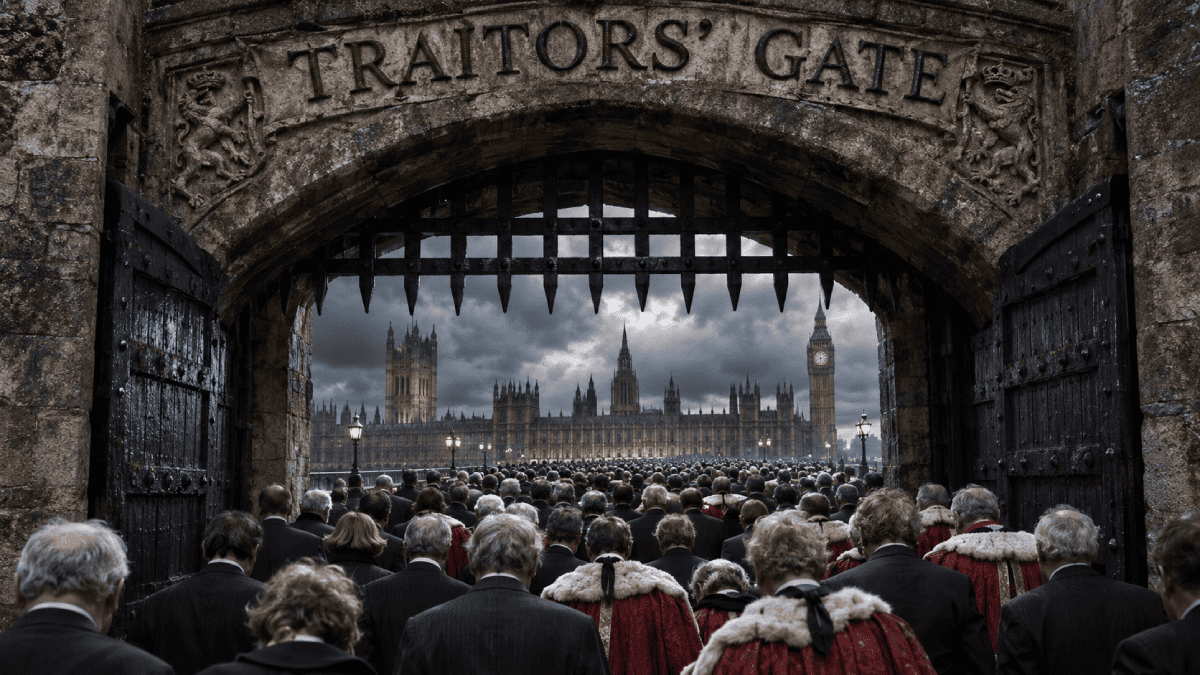
You are in the dock at Leeds Crown Court. An hour ago, in a windowless room downstairs, you told your barrister you did not do it. He wrote it down, looked you in the eye, and swore to fight for you as your representative and advocate.
The trial opens. He rises, tugs at his gown, and tells the jury the Crown has much the better case. Your defence, he adds, rests on "falsehood and prejudice", and you are just a sort of bigot.
You shout from the dock.
The judge asks counsel what in God's name he is doing. "I owe my client my judgement," he replies with a small and patient smile, "and I should betray him if I sacrificed it to his opinion."
You are convicted.
He sends his bill.
Then he sends a colleague from the same chambers to explain how much you still have to learn.
Such a man would be before a tribunal within the week. At Westminster he is a conviction politician, and the conviction is yours.
The British voter has spent decades in this dock, and the people who put him there knew precisely what they were doing.
They never accepted the instruction of 2016. They never meant to.
They smiled through the promise, plotted through the delay, sulked through the defeat, and came back with a new form of words. Their careers are the proof, and they have earned no benefit of the doubt.
One question stands for every one of them.
You know what your clients told you. You are working for the other side.
What makes you think you still have the job?
An MP Who Betrays His Client Gets A Peerage
The rules binding your advocate would fit on a beer mat. A solicitor acts only on a client's instructions. A barrister must fight fearlessly for the client's best interests, with no regard to his own, and may not parade his personal opinion of the facts before the court.
The Bar puts him in his place in a single line:
it is not for you to decide whether your client's case is to be believed.
The Court of Appeal finished the job in R v Turner in 1970: the accused, having heard his lawyer's advice, must have complete freedom of choice over his own plea.
Your barrister may tell you downstairs your alibi is rubbish. He may beg you to change your plea.
He may not change it for you.
If he cannot stomach your instructions, the rules show him the door: he explains himself, returns the brief, and leaves. Should he stay and work for the prosecution, he can lose the right to practice.
Anybody who has paid a solicitor to convey a semi in Doncaster enjoys better protection than a nation does from its legislature.
Ten Years Spent Breaking A Promise
In April 2016 the government spent £9.3 million putting a leaflet through every door in the country. It called the referendum "a once in a generation decision". Then it made the promise:
This is your decision. The government will implement what you decide.
The client decided.
| EU referendum, 2016 | Leave | Remain |
|---|---|---|
| Votes cast | 17,410,742 | 16,141,241 |
| Constituencies, estimated | 410 | 240 |
| MPs Article 50 vote | 154 | 443 |
Nearly two in three constituencies went one way. Three in four declared MPs had gone the other. Counsel lost the case to his own client, and took it very badly.
Tony Blair needed eight months.
On February 17th 2017 he told an Open Britain audience "the people voted without knowledge of the true terms of Brexit", and it was time "to rise up in defence of what we believe".
Those voters had been sent the government's case by post at public expense. They were now being accused of ignorance by the man whose judgements on Iraq's weapons were, in the words of Sir John Chilcot,
presented with a certainty that was not justified.
In June 2017 Labour's candidates stood on a manifesto declaring "Labour accepts the referendum result". Keir Starmer was one of them.
On September 25th 2018 he told Labour's conference "nobody is ruling out remain as an option."
By 2019 the manifesto promised a referendum "alongside the option to remain".
Accepted, in the sense a burglar accepts your right to a front door.
The same man, seeking Labour members' votes in 2020, pledged to "defend free movement". Seeking everybody else's in January 2021, he found no argument for reopening the matter, and explained his focus was on "winning an election in 2024".
The instructions changed with the jury. The appetite for the job never did.
The client finally got a word in on December 12th 2019.
Labour lost 60 seats, among them Bassetlaw, Bishop Auckland, Blyth Valley, Don Valley, Great Grimsby, Wakefield, Workington, and Leigh, which Andy Burnham had held for 16 years until 2017.
The lesson was absorbed in full.
Five years later Labour came back promising "no return to the single market, the customs union, or freedom of movement".
It had learned nothing about the voter and everything about the wording.
Edmund Burke Promised Nothing, and Bristol Threw Him Out Anyway
Corner any of these people and out comes Burke, who told Bristol in 1774 a representative "betrays, instead of serving you, if he sacrifices" his judgement "to your opinion". They quote the line the way a shoplifter quotes the Magna Carta.
A few sentences earlier Burke demands a member must "ever, and in all cases" prefer his constituents' interest to his own.
Shortly afterwards he explains his licence: "I have never promised you any thing." He warned against "a positive and precipitate engagement". He had been nominated after the poll opened and sold nobody a pledge.
Modern candidates sell nothing else.
Print the leaflet honestly: Vote for me. I promise you nothing. I shall do as I think fit. The first MP elected on those words may quote Burke until his teeth fall out.
After six years of defying Bristol he could not win there, withdrew from the poll in 1780, and scuttled to a safe seat from his patron, Lord Rockingham.
The apostle of the independent conscience finished up in a rich man's pocket.
Burke's adopted home of Beaconsfield has seen the sequel. The loathsome Dominic Grieve sat for it for 22 years, stood in 2017 for a party promising to take Britain out of the EU, and devoted the following two years to one procedural device after another for stopping any exit he disliked.
He signed a call for another referendum.
His own association voted no confidence in him, by 182 to 131.
He arrogantly declined to go, stood as an independent, and thankfully Beaconsfield threw him out. Even the sage's own town had read the small print.
35 Votes for Rejoin, 24,927 Burnham
Makerfield voted about 65 per cent Leave. Andy Burnham had told Labour's conference he wanted Britain back in the EU. He then needed Makerfield as his route to Downing Street, and his conscience was suddenly open to negotiation.
On May 18th, in Leeds, he delivered his plea to the jury.
I am not proposing that the UK considers rejoining the EU. I respect the decision that was made at the referendum and it's going to undermine everything I've said about strengthening democracy if we don't respect that vote.
On June 18th he took 24,927 votes.
The Rejoin EU Party took 35.
No client has ever written a plainer letter of instruction.
On the night he promised a "Makerfield test at the heart of British politics". On July 20th he became Prime Minister. The test has since been marked.
| Date | Burnham on Europe |
|---|---|
| May 18th | "I am not proposing that the UK considers rejoining the EU" |
| September 30th, reported | "we could go all the way" |
| October 25th | An "honest discussion" about free movement |
| October 26th | Rejoining? "I would like to see that happen in my lifetime" |
| October 27th | Officials to discuss options with Brussels, free movement among them, before the summit of November 20th |
About a hundred days separate the Makerfield count from "all the way". Burnham told Good Morning Britain "I am respecting what I said to the voters in Makerfield".
Counsel wishes the court to know he will not change sides until after the adjournment.
This is a confidence trick in a northern accent, and the voters of Makerfield were the marks. Nigel Farage said so in May. Melanie Onn, the only non-dysgenic MP in Parliament, whose Grimsby seat backed Leave, can see it from Labour's own benches, and warns trust is "hard-earned and easily lost". Burnham has spent his in a season.
No-One Doubted Reeves Wanted To Rejoin
Burnham sacked Rachel Reeves as chancellor. On November 1st she repaid the favour by endorsing him in the Sunday Times, declared Britain's future lies in the EU, and supplied the most revealing sentence of the decade: "No one in the Treasury ever doubted where my instincts were."
For two years she ran the Treasury for a government elected on a manifesto ruling out any return, and the people in the building knew the whole time it was a costume.
The voters got the manifesto. The officials got the "instincts."
Her old seat of Leeds West voted an estimated 53 per cent Leave. She stood in 2017 on the promise to accept the result, voted down the deal, and in February 2019 hosted a People's Vote debate in her own city.
Her economic strategy, after two years of weak growth, came down to one idea: the biggest prize is the EU.
Having failed at the job, she has concluded the country is too small for it.
Her colleague Lord Livermore, a Treasury minister who sits in Parliament by appointment, supplied the theology in June: "my personal view is that that is an inevitability."
Inevitability is the vocabulary of Calvin and Marx.
A believer in predestination needs no mandate and no argument. The outcome has been decreed, the heretic is merely late, and the vote is a temporary lapse by the unsaved.
Here is the British Europhile in full: a member of a sect, immune to evidence, speaking to his own countrymen like a curate explaining the Resurrection to a slow child.
The imagination on display would embarrass a parish council.
What Britain might build with its own energy, its own laws, and its own borders lies outside the catechism.
Twenty years of these people have produced one thought, which is to attach the country to something larger and draw a pension from it. Unable to conceive of any other future, they have decided anybody who can must be wicked.
Hence the sneer. Gillian Duffy, a lifelong Labour voter who had spent thirty years at Rochdale Council escorting disabled children, raised immigration with Gordon Brown in April 2010. He climbed into his car and called her "just a sort of bigoted woman", on a microphone he had forgotten to remove.
No more honest statement of the governing class's opinion of its clients has ever been recorded, and we owe it to a technical error.
Vote No To Immigration, Get Net 944,000
| Date | What voters were told, and what they got |
|---|---|
| 2010 manifesto | Net migration of tens of thousands a year |
| 2015 manifesto | The same ambition |
| 2017 manifesto | The same again |
| 2019 manifesto | Overall numbers to fall |
| Year to March 2023 | 944,000, the highest on record |
| Year to December 2025 | 171,000 |
Fourteen years, five Conservative prime ministers, and a peak nobody proposed and nobody voted for. The Conservatives told the voters one thing at four elections and did the reverse, and they would like you to know they have learned from the experience.
Ministers now wave the last line as a triumph. It still breaks the promise of 2010, and it is distorted by the departure of a net 136,000 British nationals.
Net arrivals from outside the EU came to 350,000.
Only at Westminster could citizens leaving count as a policy success.
Piddington in Oxfordshire has around 350 residents. The Home Office wants to put up to 1,256 male asylum seekers on a former military site half a mile away for ten years, more than three times the population of the village. "Andy Burnham did say that he's willing to listen," the parish council's vice-chairman reported, "but we've had no formal contact. No consultation, nothing from the Home Office."
On September 15th 92 per cent voted in a symbolic referendum to leave the United Kingdom altogether, which is what a client does when his letters go unanswered. A
Cabinet minister's reply was a patronising lecture: every part of the country must be prepared to take its share. His own street went unmentioned.
Entering A Guilty Plea For 80 Million Clients
On October 30th Burnham announced in the Guardian he was open to a formal apology "on behalf of the British state" for the slave trade. Until that day British governments had refused one. This week in Antigua the UK signed up to a "time-bound" dialogue with the affected countries. The complainants have a seat at the table.
The 80 million people in whose name the plea will be entered do not.
No general election has been fought on it.
No client has been asked.
A man who sits in Parliament on 24,927 votes from one corner of Greater Manchester proposes to stand up and plead guilty on behalf of a nation, for acts committed by nobody alive, to people who will never be satisfied with it.
Reparations are not "compensation". They are explicitly a form of punishment.
Any pupil barrister could tell him what an admission is for. Burnham insists Britons cannot be held liable and rules out reparations, while the host of the summit, Prime Minister Gaston Browne, has made clear the Caribbean's position on them has not moved.
The campaigners have never hidden the order of events.
"It starts with an apology," says the founder of The Repair Campaign.
Counsel is about to sign the confession and assure the court his client will not be paying the fine.
Like Schrödinger's feminist, Schrödinger's colonial is empowered and independent when things are going well, but a victim without agency needing a bailout from the motherland when they're not.
He also boasts Britain led the world in abolition. Only a British politician could enter a guilty plea and a character reference in the same column.
Ex-Commissioners On A Brussels Pension
Your solicitor may not act where his own interests conflict with yours, or where there is even a significant risk of it. Nobody has to prove the money changed his advice. The risk alone disqualifies him.
A peer drawing a pension from the other side of the case faces no such test.
Neil Kinnock, a European Commissioner from 1995 to 2004, held an EU pension estimated at £87,794 a year when he pronounced on the decision of 17.4 million people:
The referendum was won by falsehood and prejudice.
Chris Patten's was estimated at a sad £39,845. When Kinnock asked the Lords authorities in 2015, he was told such pensions do not normally need declaring in proceedings of the House.
Your conveyancer would be finished. The noble lord was reassured.
Dark Lord Peter Mandelson left Hartlepool for the trade commissioner's job in 2004 and holds a pension of about £31,000. As his country prepared to negotiate, he advised the Europeans through Die Zeit:
forget Britain and take care of your own interests.
He wrote to Michel Barnier, the man negotiating against his country, offering to "brief you on the current pressures in British politics", and assuring him he was:
deeply committed to the future of the EU.
He told Australian readers in 2017 "all the signs are that it [Brexit] is going to happen", then demanded a People's Vote against "the Brextremists" in 2018, while his firm sold clients advice on preparing for Brexit.
He claims to be, by his own description, "a patriot, not a nationalist".
Picture your barrister slipping into the prosecutor's room at lunch to brief him on your state of mind, and insisting he did it out of love.
Danny Alexander lost Inverness to the voters in 2015 and was a vice-president of the Beijing-based Asian Infrastructure Investment Bank within a year, a posting whose advertisement wanted 20 to 25 years of leadership in multilateral development banks or equivalent.
David Miliband left South Shields in 2013 for the International Rescue Committee in New York, where his 2022 package came to $1,253,728 plus a $150,000 bonus, at a charity which received over £30 million from British taxpayers in a single year.
South Shields has yet to report a comparable rescue.
Every rung of this ladder is in Brussels, Beijing, or New York, and none is in Makerfield.
An ambitious politician learns early which opinions keep the next rung within reach, and which get a man called a little Englander over the canapés.
In a solicitor's office this would be a matter for the regulator.
At Westminster it is a career plan.
Follow The Brief or Recuse Yourself
In August 2014 the venerable Douglas Carswell left his party, resigned his seat, and asked Clacton for its verdict. It gave him 59.75 per cent. Of the 29 sitting MPs who defected to the SDP, exactly one did the same.
The other 28 kept the salary and called it... principle.
The law protects them.
The Recall of MPs Act 2015 cunningly requires a custodial sentence, a suspension from the House, or an expenses conviction before a petition can open, and constituents cannot start one themselves.
The statute will remove a member who fiddles his expenses. It has no interest in a member who fiddles his constituency.
In January 2025 the Leader of the House assured Parliament the Act was "broadly operating as intended".
Doubtless it is. It was written by the defendants.
A fourth trigger is overdue.
Any member who campaigns against the promises on which he stood should answer to the same 10 per cent as a member who lies about his rent.
Until it exists, every one of them is on notice from every voter they have taken for a fool.
- You asked for this brief.
- You knocked on the door, shook the hand, and printed the promise.
- You took the salary, the allowance, the pension, and the peerage.
- You know what your clients told you, because they told you in 2016, in 2019, and in a village hall in Oxfordshire.
You called them bigoted, then ignorant, then late.
Return the brief or face the client. What makes you think you have any other choice?