Opening Up British Paradise To Ordinary Britons
Britain owns plenty of underdeveloped Caribbean paradise and locks its own working class people out with poor infrastructure. A family holiday in the BVI costs eight grand. It should cost nine hundred. And the government can afford a gesture increase in quality-of-life with its loose change.

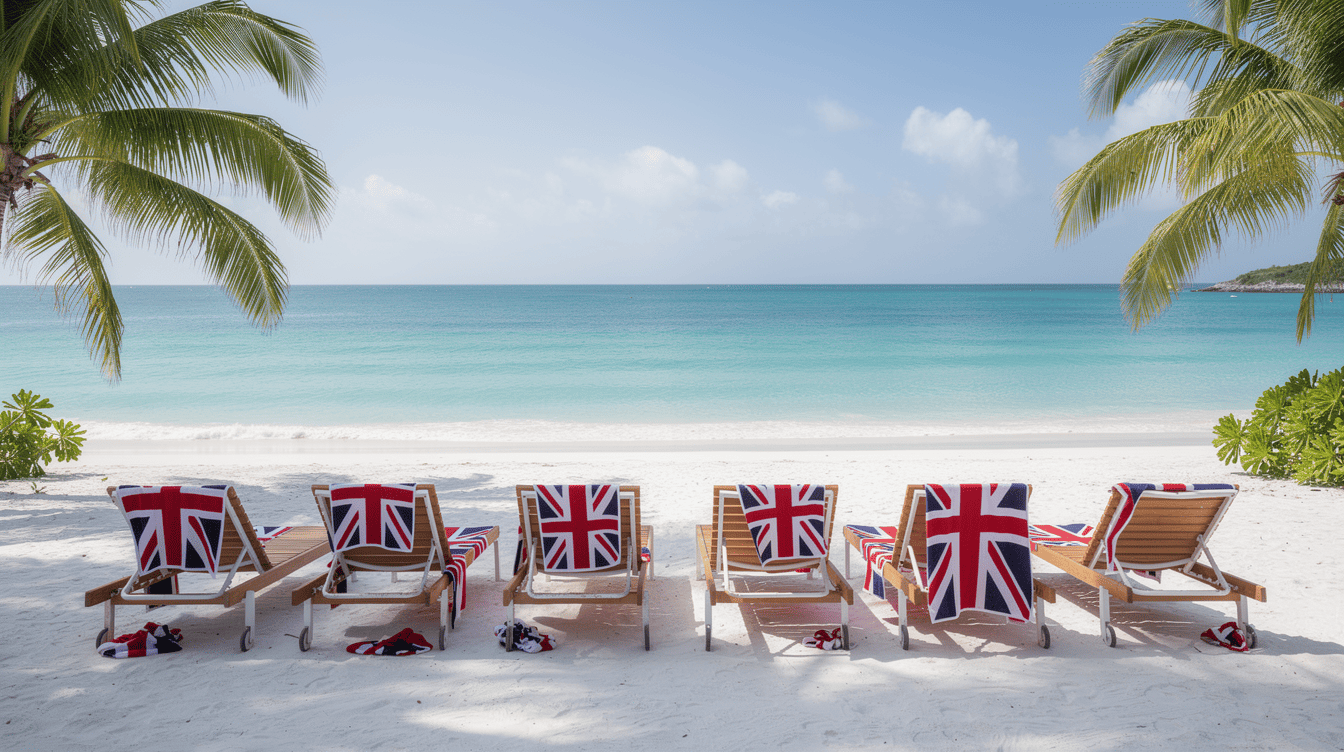
You might not know them, but they're there. Anguilla. The British Virgin Islands. Turks and Caicos. The Cayman Islands. Bermuda. The British government tried to transform them into the West Indies Federation. White sand, turquoise water, coral reef, year-round sunshine. All British. All constitutionally bound to the Crown. All diplomatically underwritten and militarily defended by the British taxpayer.
A family week in any of them costs four to eight thousand pounds. A nurse from Sunderland has a better chance of affording a fortnight in Benidorm than a long weekend on a beach her own country owns. A postman in Stoke can save all year for the Algarve but will never set foot on Anguilla. A retired couple in Wolverhampton know more about the Costa del Sol than about Turks and Caicos, a British territory whose governor is appointed by the King and whose defence budget comes out of their taxes.
The British government should subsidise flights and build affordable accommodation across its Overseas Territories until a family of four can holiday in the Caribbean for under a thousand pounds. Two adult returns at £70 each. Two children at £50. Seven nights across two rooms at £50 per night. Total: £940. Not a slogan. A costed target. And one the Treasury could fund from down the back of the sofa.
In 2024, British residents made 94.6 million trips abroad and spent £78.6 billion doing it. Seventeen million of those trips went to Spain alone. Britain runs a tourism deficit of roughly £46 billion a year: the gap between what its people spend overseas and what foreign visitors spend in Britain. That is £46 billion flowing annually out of the British economy into foreign hotel chains, foreign airlines, foreign restaurants, and foreign tax bases.
Meanwhile, some of the most beautiful coastline on Earth sits under the British flag, economically stagnant, serving luxury tourists from New York, and producing almost nothing for the people who actually pay to keep it British. Grace Beach has consistently been voted the most beautiful in the world.
Something about this ought to make somebody angry.
The British Holiday: An Institution
In the early 1920s, a young fairground showman called Billy Butlin took a holiday at a boarding house on Barry Island in South Wales. The experience was miserable. Guests were pushed out after breakfast and forbidden to return until lunch. After lunch they were expelled again until dinner. When it rained, which in Wales it reliably did, families trudged the streets with their children, wet and wretched, killing hours until they were allowed back inside a building they were paying to sleep in.
Butlin looked at these families and thought something so simple it changed the country: ordinary people deserve better than this.
In 1936 he opened his first holiday camp at Skegness. All-inclusive accommodation, meals, and entertainment for 35 shillings a week (about £150–£170/week today). He placed a single half-page advertisement in the Daily Express. Ten thousand people replied. The camp was fully booked before it opened its doors.
- Lesson learned: demand in Britain isn't a problem if the price is right, because Britons love holidays, and having fun together in community spirit. We have a strong sense of "we".
- Another lesson learned: Britain invented the summer camp, the resort, and the summer holiday.
Two years later, Parliament passed the Holidays with Pay Act 1938, the product of a twenty-year union campaign, granting millions of workers their first legal right to a paid week off. Before it, roughly half the employed population had no paid leave at all. Manual workers, factory hands, agricultural labourers: the people whose bodies needed rest most received it least.
The Act did not solve everything. Many of the lowest-paid still could not afford to go anywhere even with a week's wages in their pocket. But it established a principle so elementary it is startling anyone ever had to argue for it: working people are entitled to rest, rest costs money, and the state has a role in making it possible.
Butlin grasped something the political class of his era accepted only grudgingly. Pleasure is not a luxury. It is infrastructure. Escape from industrial monotony is not indulgence. It is maintenance. A civilisation in which ordinary people never see beauty, never feel warmth, never experience the plain animal relief of open sky and warm water, is one grinding itself to dust.
By the 1950s his camps were a national institution. Skegness, Clacton, Filey, Bognor Regis, Minehead, Ayr, Pwllheli, Barry Island, even one in the Bahamas. Fred Pontin followed with his own chain. Trade union cooperatives had been running holiday camps since before the First World War. The whole movement rested on a conviction now almost extinct in British public life: government and the private sector should actively conspire to give working people a good time.
Then cheap flights to Spain arrived. The boarding houses emptied. The camps contracted. And Britain quietly abandoned the idea leisure for ordinary people was a matter of national concern.
The package holiday revolution of the 1960s and 1970s was, in its own way, a triumph. It democratised Mediterranean sunshine for millions. But it also redirected an entire country's leisure spending outward, into foreign economies, foreign hotel chains, foreign airlines, and foreign tax bases. Enormous airport investment, vast mid-market hotel construction, competitive airline pricing, and decades of coordinated state support turned the Spanish and Greek coasts into mass-access sunshine zones for northern European workers. Ryanair and EasyJet did not merely move passengers. They restructured entire regional economies. Obscure Croatian coastal towns and secondary Italian cities became affordable escapes for people who a generation earlier would never have left the country.
Britain's own sunshine territories received none of this. No low-cost carriers. No mid-market hotel development. No route subsidies. No aviation corridors built for volume. The islands drifted upmarket by default, becoming luxury enclaves and offshore finance adjuncts while the people whose taxes defend them packed onto budget flights to someone else's coastline.
A hotel room in Benidorm is cheap because there are thousands of them. A room in the BVI is expensive because there are almost none at the mid-market level. Bermuda became a billionaire's playground. Grand Turk became a footnote. And the government never noticed the absurdity.
Royal Atlantic
The first requirement is a dedicated territorial carrier. Call it Royal Atlantic, Crown Caribbean, British Atlantic Airways: whatever survives the branding committee. A subsidised network connecting the UK to its Caribbean and Atlantic territories with the economics of EasyJet and the route map of an imperial island-hopper.
The state does not need to run an airline. It just needs to write the cheque for one to people who can. And don't forget, it's our money.
Long-haul trunk routes from London on high-density A321XLRs or 787s. Regional spokes between the islands on ATR 72s and Dash 8 turboprops, which burn less fuel, need shorter runways, cost less to operate, and suit the small airstrips dotted across the territory network.
None of this is fantasy. The World Bank have written about it.
interCaribbean Airways already operates across the Caribbean from a Turks and Caicos base. Caicos Express runs subsidised domestic routes because some island links will never be commercially viable on ticket revenue alone. Small-island aviation already functions more as public utility than free market. Norway subsidises flights to remote northern communities. Scotland subsidises air links to the Highlands and Islands. Canada underwrites routes to Arctic settlements. The principle is established and unremarkable. What would be new is attaching it to a national purpose larger than regional connectivity: the deliberate reintegration of the British Overseas Territories into the ordinary lives of ordinary British citizens.
At 300,000 travellers per year the network requires roughly 1,200 long-haul flight legs annually. About three and a half departures daily. Scale to half a million and you need five or six. These are not large numbers. This is a focused, mid-sized airline operation serving a defined route network, not a logistical moonshot.
Air passenger duty on a long-haul economy flight currently runs to about £90 per person. A family of four pays £360 in tax before they even board. Abolishing APD on territorial routes alone would cut the cost of access substantially, before a single pound of direct subsidy entered the equation. The Treasury collected £4.6 billion in APD receipts in 2025-26. Waiving duty on flights to the Overseas Territories would cost it almost nothing in proportional terms, and would send an unmistakable signal: these are not foreign destinations, they are British, and the state means to treat them as such.
Better still, abolish this crap altogether.
Beautiful Holiday Villages
Flights without affordable beds achieve nothing. The reason a Caribbean hotel room costs £400 a night is not the sand or the sunshine. It is supply. Nobody built mid-market hotels because nobody created the demand to justify them, and nobody created the demand because there were no affordable flights. The cycle is vicious but it is not mysterious. The Mediterranean broke it fifty years ago through sheer volume and deliberate state coordination. The same logic applies here.
The target is roughly 8,000 to 9,000 mid-market rooms spread across multiple territories, built in phases over years as demand materialises. For context: Las Vegas has 150,000 hotel rooms. Benidorm has over 40,000. The entire proposed programme would not register as a village camping ground in Nevada.
Not high-rises. Not mega-resorts. Not Cancún sprawl or Dubai absurdity. Beautiful low-rise apartment hotels, family villas, affordable beachfront rooms built for repeat visits by ordinary families rather than once-in-a-lifetime splurges by the wealthy. State-backed development loans, planning acceleration, designated tourism zones. Everything dependent on beauty and aesthetics. The mechanisms are entirely conventional. Every Mediterranean country used them. The Netherlands already does it. What would be new is applying them to territory Britain already owns.
Again, the state does not need to build hotels. It simply needs to write a cheque to those who want to, and can. It runs the territory, administrates the law, and owns the land. What territory objects to a law which states it must be developed as the most beautiful country on Earth?
Construction follows demand, not speculation. Roads, hospitals, water treatment, and energy systems expand gradually, phased to match actual visitor numbers rather than optimistic projections. Residents benefit first: jobs, wages, healthcare investment, ownership stakes, infrastructure improvements they would otherwise wait decades to receive. Without visible local gain the model is extractive and it collapses. Nobody wants another Cancún. But Grand Turk, currently running on cruise ship visits and government payroll, has coastline sitting idle, an economy going nowhere, and a population watching paradise generate nothing for them. Something has to change, and it is not going to change by accident.
The Money
At 300,000 annual travellers with an average flight subsidy of £350 per return, the aviation component costs roughly £105 million a year. Scale to half a million and the figure reaches about £175 million.
Those numbers are nothing against what Britain actually spends on complete bullshit.
HS2 has consumed £46.2 billion so far. Forty-six billion pounds for a truncated railway whose northern leg was cancelled, whose Birmingham terminus was downgraded, whose original budget of £33 billion has nearly doubled with no end in sight, whose opening date has slipped from 2026 to some unspecified point in the 2030s, and whose own management cannot produce a reliable cost estimate for completion. Parliament's Public Accounts Committee called it a "casebook example of how not to run a major project." The estimated final cost sits somewhere between £54 and £66 billion, assuming nothing else goes wrong, which on the evidence of the past sixteen years is not a safe assumption.
Yes, the inability of our government to manage even a spreadsheet is a concern. Let's park that for a minute and stay in the realm of ideas first before we do the British thing of tearing a plan to pieces before it's been even been budgeted.
The entire annual cost of subsidised Caribbean flights for half a million British families, at full scale, would represent roughly 0.38% of what has already been spent on HS2. One year of this programme costs less than HS2 burns through in a slow month. Run it for a decade and the total outlay would still be dwarfed by a single railway whose primary achievement to date has been the destruction of ancient woodland and the enrichment of consultancy firms.
The government spent billions per year housing asylum seekers in hotels during the Channel crisis. The BBC licence fee settlement runs to billions annually. Defence procurement routinely loses sums exceeding £175 million on individual cancelled programmes without a syllable of public debate. APD itself raises £4.6 billion a year, a tax levied overwhelmingly on ordinary families trying to take their children somewhere warm.
Yes, that is correct. This programme would cost 3.8% of what the government raises in holiday flight tax every year and is not entitled to in the first place.
Not fifty per cent. Not ten per cent. Not five percent.
3.8%. Of your money. The money we are already raising from taxes on holiday flights.
The money is there. It has always been there. Britain does not have a spending problem. It has a priorities problem. And the priority, for as long as anyone can remember, has been everything except the material happiness of working people.
The Return On Investment
The airline is not where the value sits. It is the demand generator. Three hundred thousand visitors spending modestly, say £1,000 each across accommodation, food, and local activity, produce £300 million in direct annual tourism expenditure across the territories. Real tourism multipliers, the ripple effects through wages, supply chains, construction, transport, and local services, run between 1.5 and 2.5 times direct spend. Local economic activity generated by a mature programme could approach £500 to £750 million per year.
For small islands those figures are not merely helpful. They are transformative.
- Grand Turk gains a functioning tourism economy.
- Anguilla diversifies beyond the ultra-luxury segment whose customers disappeared overnight when COVID hit and took years to return.
- The BVI rebuilds after devastating hurricane damage on a broader and more resilient economic base instead of waiting for another insurance payout and another round of slow decline.
- Bermuda breaks its dependence on offshore finance and the shrinking international business sector by developing a second economic pillar.
And critically, much of this money circulates inside British-linked territories rather than flowing to foreign hotel chains in Spain or Greek island oligarchs.
The £78.6 billion spent by British travellers abroad in 2024 went overwhelmingly to countries with no constitutional connection to Britain whatsoever. Redirecting even a small fraction of it toward the Overseas Territories is not consumption. It is investment within a British network. It deepens economic integration, strengthens the practical relevance of the territorial relationship, and gives the islanders themselves a reason to value the connection beyond a governor they did not choose and a flag they did not ask for.
If that sounds far-fetched, it's worth looking at the GDPs of these territories.
| Territory | GDP (nominal) | Population | GDP per capita |
|---|---|---|---|
| Bermuda | $8.98 bn (2024) | ~64,600 | ~$138,935 |
| Cayman Islands | $7.14 bn (2023) | ~73,000 | ~$97,750 |
| Turks & Caicos | $1.75 bn (2024) | ~46,500 | ~$37,507 |
| British Virgin Islands | $1.51 bn (2023) | ~38,000 | ~$39,700 |
| Anguilla | $416 m (2023) | ~14,400 | ~$28,850 |
Combined GDP across all five territories is roughly $19.8 billion. £500-750m in annual tourism activity would be material for TCI, BVI and Anguilla in particular, where it would represent 30-100% increase in income.
Why Should Taxpayers Fund Holidays?
They shouldn't, and the question misunderstands what is being proposed. This is aviation and tourism infrastructure investment, structurally identical to the rural rail subsidies, ferry route guarantees, and regional airport support programmes the Treasury already funds without controversy. The state intervenes in transport markets constantly. It subsidises rail so people can commute. It underwrites ferries so Scottish islands remain inhabited. It guarantees air routes so remote communities stay connected. Extending the same principle to territorial connectivity is a policy decision, not an economic novelty. If the government can justify subsidising a train from London to Birmingham, a journey already served by an existing railway, it can justify subsidising a flight from London to Grand Turk, a journey currently served by nothing at all.
But the objection is worth sitting with because it reveals something about modern British political culture. Spending £46 billion and counting on a railway nobody asked for is considered serious. Spending billions housing people in hotels while asylum claims are processed is considered necessary. Spending a fraction of either to give exhausted working families a week of sunshine on British soil is considered frivolous.
The hierarchy tells you everything about whose comfort is taken seriously and whose is not.
What About Emissions?
Aviation emissions are real. Any honest proposal acknowledges them. But Britain already supports nearly 95 million outbound trips a year. This programme does not increase total aviation demand. It redirects a portion of existing demand toward British territories. The family flying to Grand Turk is not a family who would otherwise have stayed home. It is a family who would otherwise have flown to Tenerife. The carbon footprint changes; the fact of the flight does not.
Let the Left explain to ordinary people why they can't have a holiday, or they need less holidays. And let them find out how it plays in an election year.
If the objection is philosophical, a blanket opposition to all aviation on climate grounds, then the critic must explain why 17.8 million annual trips to Spain are tolerable but half a million to the BVI represent an environmental emergency. The selective application of climate concern to proposals benefiting working people while leaving untouched the aviation habits of the professional classes is not environmentalism. It is snobbery.
Britain is not a country of people who agree. The Left must be won over. And occasionally, it means having to waste tedious time discussing their apocalyptic Millenarian religion.
Why Not Fix Britain Instead?
Build beautiful towns. Restore public spaces. Fix housing. Raise wages. Improve the built environment. Yes. All of it. Urgently. A country whose high streets look like they do, whose housing is as cramped and expensive as it is, whose public realm has been degraded as systematically as it has, needs domestic renewal desperately.
But a country capable of spending £46 billion on a railway can do more than one thing at once.
This is complementary. It does not replace domestic investment. It sits alongside it. And it offers something domestic improvement alone cannot provide: warmth, ocean, and a horizon beyond the end of a grey terrace in February. You can build the most beautiful town in England and it will still rain in November. You can raise wages and people will still need, periodically, to escape. The two objectives are not in competition, and treating them as though they are is the kind of false dilemma beloved by politicians who intend to deliver neither.
Building Over Years, Not Overnight
Nobody sensible proposes building something like this overnight. Infrastructure takes time and careful planning. But you have to start somewhere; anywhere, in fact.
- Phase one is connectivity. Subsidised flights, route guarantees, airport modernisation, APD abolition on territorial routes. The islands remain mostly unchanged. Accessibility increases. Demand becomes measurable rather than theoretical.
- Phase two is accommodation. Booking patterns reveal which islands absorb volume comfortably, where environmental pressure emerges, where new hotel stock makes sense. Development follows evidence rather than projection. State-backed loans fund construction. Planning frameworks are agreed with territorial governments in advance. Local ownership is prioritised.
- Phase three is integration. A full island-hopper network linking the territories to each other as well as to the UK. Citizen-rate travel schemes. A functioning British Atlantic tourism economy connecting the UK to its own possessions as naturally as rail connects London to Edinburgh.
Las Vegas built 150,000 hotel rooms over decades, not overnight. The Mediterranean package holiday industry took twenty years to reach maturity. Phasing is not an excuse for timidity. It is how serious infrastructure actually gets built, by people who understand the difference between ambition and fantasy.
Something On The Other Side
Billy Butlin built an empire on a premise so radical it embarrasses modern politics: working people deserve to have a good time. Not as a reward for productivity. Not as a behavioural incentive. Not as a line item justified by economic multiplier effects, though the effects are real and substantial. Simply because a country with any decency in it does not ask everything of its people and offer nothing pleasant in return.
Modern Britain taxes heavily, demands resilience, and talks ceaselessly about fiscal headroom and managed decline. Citizens are addressed technocratically as taxpayers, labour inputs, service users, carbon emitters, and demographic units. Very little political language asks the simplest question of all: what would actually make ordinary life feel better?
People tolerate hardship when there is something on the other side of the effort. A country offering no beauty, no aspiration, no warmth, no escape, no visible generosity toward its own people, becomes psychologically brittle. You can squeeze people. You can tax them into exhaustion, house them in boxes, let their towns decay, price them out of joy, and lecture them about carbon when they try to take their children to see the sun. But you cannot do it indefinitely without consequences. Something breaks. Turnout collapses. Trust evaporates. The social contract frays not with a dramatic rupture but with a slow, grey, grinding withdrawal of consent.
Half a million families. £175 million a year. Under a thousand pounds each. British sand, British water, British sunshine.
It is not the answer to everything. But it is the kind of thing a country does when it still has some kindness left in it.
Or put more simply: isn't about time our country did something nice for its people, for a change?