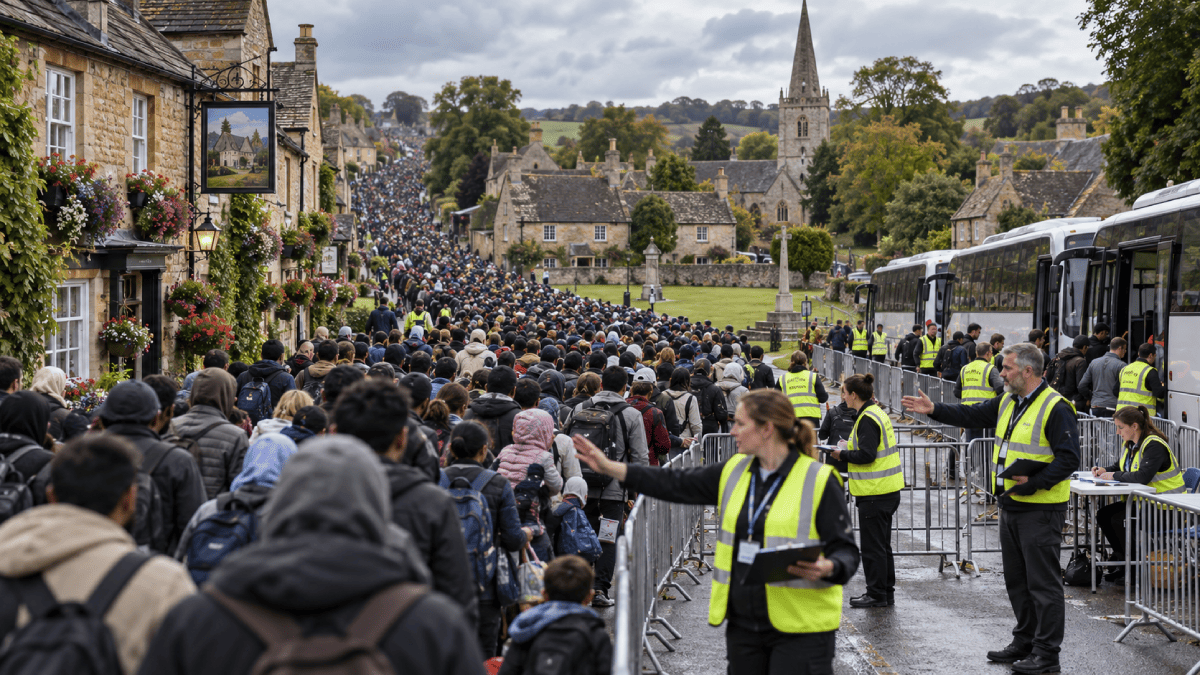
The Government's Answer To Illegal Immigration? More Immigration.


Foreign tyrant Shabana Mahmood, who has publicly declared her intention to develop Britain into a panopticon, is learning a difficult lesson about the Home Office: it doesn't matter what party you come from, the Civil Service always get its way. This time, it's employing pressure from the Green left.
She wanted her migration underling, Mike Tapp, fired for promoting the Treasury line. Naive at best, but it demonstrates how powerless ministers really are.
Although we could overrule the human rights lawyers in thirty minutes with anti-ECHR primary legislation and send what's left of the Navy to sink illegal small boats, Mahmood has tabled a sensible bill to deal with statutory problems, which ultimately ends up with the Home Office needing... the Treasury's bad default ideas of more immigration. The bill itself isn't obviously entirely bad: it does away with what tripped up Sunak. It's what is required to sell it which is the problem, and how's it been cleverly abused as a trojan horse.
This is a rather classic trick related to the shell game, three-card monte, or the Magician's Choice (Bernard actually explains how this works in "The Grand Design" episode). Tapp and Mahmood fell right into it; the former, probably willingly.
Hacker: How many people do we have in this department?
Sir Humphrey: Ummm... well, we're very small...
Hacker: Two, maybe three thousand?
Sir Humphrey: About twenty-three thousand to be precise.
Hacker: TWENTY-THREE THOUSAND! In the department of administrative affairs, twenty-three thousand administrators just to administer the other administrators! We need to do a time-and-motion study, see who we can get rid of.
Sir Humphrey: Ah, well, we did one of those last year.
Hacker: And what were the results?
Sir Humphrey: It turned out that we needed another five hundred people.
Link: 6 min 15 s here: https://youtu.be/tAp8t7KNc_w?t=375
Not content on borrowing merely some of Canada's bad ideas (e.g a National Suicide Service), Labour is now copying its Private Sponsorship of Refugees and its Economic Mobility Pathways Pilot. Canada is the world's second largest country by land mass, and has been receiving plans to reach a population of 100 million since 2009.
I will open new legal routes for genuine refugees, while closing loopholes that have been too often abused. My goal is simple: to ensure we have an asylum system not just today, but for generations to come.
One can stop after "I will open new legal routes..." This is to bribe and pay off passage for the bill with the activist Left; attempting to do two opposite things at once with a single proposal. It is supposedly a furthering of the Ukrainian immigration scheme which collapsed into catastrophic failure.
The British public haven't authorised this. They have said the exact opposite now for almost thirty years across elections, referenda, and protests. They want illegal immigration stopped and legal immigration reduced – if not reversed entirely. They did not ask for more. Neither the current government, nor the Home Office, have any mandate whatsoever for playing games with the immigration system.
And the Right has missed the obvious connotation: why would the left be unhappy at these measures and need compensatory ones for their "refugees" unless migrants were abusing them? Mahmood, and the government as a whole, is tacitly admitting wide-scale abuse has occurred.
How did this happen? Very cleverly.
The Civil Service, under Mike Tapp, did its "impact assessment" of the Visa Brake policy in March 2026. The Visa Brake is a temporary 18-month shut-off of Skilled Worker visas to Afghans, and study visas to people from Afghanistan, Cameroon, Myanmar, and Sudan. It is expected to reduce about 1,400 asylum claims: 1,300 from Study visas and 90 from Skilled Worker visas. It also says it prevents about 4,300 Study visas and 90 Afghan Skilled Worker visas during the period.
This inevitably requires a bloated 39-page "risk assessment" report full of technocratic nonsense and corporate twat-speak ("stakeholders, " etc).
This is a very dirty report, but it's actually a fascinating insight into the Whitehall groupthink.
- It is a tiny asylum-claim brake targeted at a few high-ratio cohorts, while assuming universities can replace much of the lost student intake with other foreign students.
- The model is not designed around reducing total student immigration, but around swapping out the nationalities with high asylum-conversion ratios for other nationalities thought less likely to claim asylum.
- It assumes because the brake applies only to certain nationalities, student places may be filled by students from other countries and uses the term replacement explicitly. Its central case assumes 25% replacement during the 18-month brake, models 960 replacement Study entrants, and says that over the longer term it expects sponsors could adapt so the impact reduces.
- It compares visas issued in a period with asylum claims lodged in the same period, even though the asylum claims may relate to visas issued earlier (i.e. false cohort tracking).
- The affected countries are not the largest sources of visa-linked asylum claims. The Commons Library says the largest numbers in YE September 2025 were Pakistan, Bangladesh, India, Nigeria, and Sri Lanka, and that the largest single route was Pakistani nationals on study visas: 5,570 claims, but that was 14% of Pakistani study visas, just below the 15% threshold.
The government admitted a February 2022 MoD breach exposed personal information linked to 18,714 Afghan ARAP / ex-gratia applicants, led to an “unprecedented superinjunction,” and triggered a secret resettlement route.
The Public Accounts Committee says the MoD estimated up to 27,278 people affected by the breach could be resettled in the UK. That includes 7,355 through the Afghanistan Response Route, plus a further 16,108 already eligible under ARAP, plus further reviewed cases.
They pulled off the dirty trick here by selecting by ratio, not total volume. Entire country shut-offs sound good on the BBC, but they are tiny, temporary, and the assessment has been used as a platform to reinforce and justify immigration economics.
This trick is repetitive across civil service departments. Hotels were about 35% of asylum accommodation residents but around 76% of early 2024–25 contract costs. Another example of manipulating ratio vs volume can be found in rape gang reporting.
if universities and employers can sponsor refugees, then “asylum reform” becomes a pipeline redesign. It shifts from spontaneous claims and small boats to pre-authorised routes administered by approved sponsors. That may reduce visible chaos for politicians, but it does not reduce numbers, costs, settlement pressure, housing pressure, or institutional incentives.
The government is "braking" immigration. It is transferring discretion. The old model allowed people to enter on Study or Skilled Worker visas and then claim asylum. The new testing model restricts some of those high-ratio cohorts, but then creates sponsored refugee routes through universities, employers, and community groups. In other words, migration does not disappear; it is laundered through trusted institutions. The visa brake is the front door being theatrically closed. The sponsorship scheme is the side door being professionally installed.
This is dirty; it's dishonest; and it's cooking the books. Business as usual.
Mass Immigration Is About Pensions
The rationale behind mass migration is not a "replacement" conspiracy; it is not "cheap labour" for corporations; it is not "GDP"; it is not brinkmanship; and it is not left-wing ideological electioneering of the vote. These are side effects which work as gifts to the left, keeping the battle on their terms and turf.
The reality is much worse. The government publish the reason in plain sight.
...because the age structure of inward migrants to the UK is skewed towards those of working-age, net migration reduces the dependency ratio over our 50-year horizon and thus reduces age-related pressures on the public finances.
This word salad can be translated simply: we don't have enough workers to pay pensions for retirees, and it will get worse over the next 50 years.
Mass immigration is to pay pensions guaranteed by law.
The state pension works like a chain letter: today’s workers pay today’s retirees. If there are too few workers for each pensioner, the sums break. Immigration adds working-age people to keep the worker-to-retiree ratio up.
Three workers pay for one pensioner. If Britain only has two, the Treasury wants another worker. Immigration supplies the missing worker.
The People Who Did This Wrote It Down
It all begins with the Treasury's 2007 paper on immigration, which admitted migration works on the economy chiefly by enlarging the working-age population, and credited incoming workers with adding around half a percent a year to that workforce between 2001 and 2006 – worth 15 to 20 percent of the country's output growth, roughly £6bn in 2006 alone. The government had already done the sum: more young arrivals, more output, more tax. It simply wrote it down quietly.
The people who came up with this were:
- Gus O’Donnell (Cabinet Secretary / Head of Home Civil Service)
- Nicholas Macpherson (HM Treasury Permanent Secretary)
- David Normington (Home Office Permanent Secretary)
The Migration Advisory Committee made the substitution explicit in 2016. When public spending is squeezed, it observed, the result is often more immigration. And it named the jobs: nurses, paramedics, carers, science and maths teachers. In plain terms, rather than train and pay British staff, the state plugs the gaps it has starved of funding with people brought in from abroad.
The people responsible were:
- Jeremy Heywood (Cabinet Secretary / Head of Civil Service)
- John Manzoni (Cabinet Office Permanent Secretary / Civil Service Chief Executive)
- Tom Scholar (HM Treasury Permanent Secretary)
- Mark Sedwill (Home Office Permanent Secretary)
- David Metcalf (MAC Chair, d.)
When the Home Office designed the post-Brexit points system in 2018, it modelled exactly how a migrant's income, age and economic activity feed through into tax paid and services consumed, and therefore into current funding and future spending. Human beings became fiscal line items in a government spreadsheet.
The Office for National Statistics spelled out the reason in 2019. Britain is ageing; working-age migrants slow that ageing down. Under a zero-migration scenario, it warned, the population ages twice as fast as under high migration. The honest caveat sat at the bottom: keeping older Britons in work would matter more than any of it. An admission the state has comprehensively ignored.
The people responsible during this time were:
- Mark Sedwill (Cabinet Secretary / Head of Civil Service)
- John Manzoni (Cabinet Office Permanent Secretary / Civil Service Chief Executive)
- Tom Scholar (HM Treasury Permanent Secretary)
- Philip Rutnam (Home Office Permanent Secretary)
The Office for Budget Responsibility supplied the engine in March 2024. Tucked into Box 2.3 of its Economic and Fiscal Outlook was the scenario every later paper would lean on: net migration running around 200,000 a year above or below the central assumption, and what each does to the public finances. This is the number the rest of Whitehall borrowed. Higher inflows, the OBR found, improve the long-term fiscal position by holding down the dependency ratio: though it was careful to say it was modelling the effect, not recommending the policy.
The people responsible were:
- Simon Case (Cabinet Secretary / Head of Civil Service)
- Alex Chisholm (Cabinet Office Permanent Secretary / Civil Service COO)
- James Bowler (HM Treasury Permanent Secretary)
- Matthew Rycroft (Home Office Permanent Secretary)
- Richard Hughes, David Miles, Tom Josephs (OBR Committee)
The Migration Advisory Committee's 2025 net migration report is the smoking gun. It cited an OBR scenario in which an extra 200,000 arrivals a year raise receipts by £18bn and cut debt-to-GDP by 3.1 percent by 2028/29, if spending is left unadjusted. The same committee reckons one recent year's intake of Skilled Worker migrants will hand the Treasury a net £47bn over their lifetimes: with arrival age, employment and wages named as the levers that decide it.
The people responsible were:
- Chris Wormald / Antonia Romeo (Cabinet Secretary / Head of Civil Service)
- Cat Little (Cabinet Office Permanent Secretary / Civil Service COO)
- James Bowler (HM Treasury Permanent Secretary)
- Matthew Rycroft (Home Office Permanent Secretary)
- Brian Bell (MAC Chair)
By 2026 the Home Office was saying the quiet part in writing. Its Visa Brake impact assessment, authored by its Migration and Citizenship Policy group, states plainly a migrant's net fiscal worth is their tax weighed against the public-service pressure they create, swinging on employment rate, income, age and service use — and cites the OBR again: 200,000 more arrivals a year shifts GDP by between 1 and 2.5 percent by the end of the decade.
The people responsible were:
- Antonia Romeo (Cabinet Secretary / Head of Civil Service)
- Cat Little (Cabinet Office Permanent Secretary / Civil Service COO)
- James Bowler (HM Treasury Permanent Secretary)
- Simon Ridley (Home Office Permanent Secretary)
- Mike Tapp (Parliamentary Under-Secretary of State for Migration and Citizenship)
Read Mr Ridley's CV. It is a catalogue of British crises.
These are the politicians who were responsible for immigration, migration, or borders since the Treasury's key 2007 policy.
| Date | Name | Final title before leaving brief |
|---|---|---|
| 2007–2008 | Liam Byrne | Minister of State for Borders and Immigration |
| 2008–2010 | Phil Woolas | Minister of State for Immigration |
| 2010–2012 | Damian Green | Minister of State for Immigration |
| 2012–2014 | Mark Harper | Minister of State for Immigration |
| 2014–2016 | James Brokenshire | Minister of State for Security and Immigration |
| 2016–2017 | Robert Goodwill | Minister of State for Immigration |
| 2017–2018 | Brandon Lewis | Minister of State for Immigration |
| 2018–2019 | Caroline Nokes | Minister of State for Immigration |
| 2019 | Seema Kennedy | Parliamentary Under-Secretary of State for Immigration |
| 2019–2021 | Kevin Foster | Parliamentary Under-Secretary of State for Future Borders and Immigration |
| 2021–2022 | Tom Pursglove | Minister of State for Immigration |
| 2022–2023 | Robert Jenrick | Minister of State for Immigration |
| 2023–2024 | Tom Pursglove | Minister of State for Legal Migration and the Border |
| 2023–2024 | Michael Tomlinson | Minister of State for Countering Illegal Migration |
| 2024–2025 | Seema Malhotra | Parliamentary Under-Secretary of State for Migration and Citizenship |
| 2024–present | Alex Norris | Minister of State for Border Security and Asylum |
| 2025–present | Mike Tapp | Parliamentary Under-Secretary of State for Migration and Citizenship |
From 2007 to 2013, immigration was concentrated in the UKBA model under Lin Homer, Jonathan Sedgwick and Rob Whiteman. After Theresa May abolished UKBA in 2013, responsibility fragmented across UKVI, Immigration Enforcement, and Border Force, with Sarah Rapson becoming the key UKVI figure.
From 2015, the system acquired a clearer senior-official owner through the Second Permanent Secretary model: Olly Robbins, then Patsy Wilkinson, then Shona Dunn. By the 2020s, that had evolved into Simon Ridley’s Migration and Borders System, with specialist DGs beneath him, including Glyn Williams, Emma Churchill, and Dan Hobbs.
The senior civil servants working for their permanent secretary masters during this period were:
| Date | Name | Final title before leaving brief |
|---|---|---|
| 2007–2011 | Lin Homer | Chief Executive, UK Border Agency |
| 2011 | Jonathan Sedgwick | Acting Chief Executive, UK Border Agency |
| 2011–2013 | Rob Whiteman | Chief Executive, UK Border Agency |
| 2013–2016 | Sarah Rapson | Director General, UK Visas and Immigration |
| 2015–2016 | Olly Robbins | Second Permanent Secretary, Home Office |
| 2016–2018 | Patsy Wilkinson | Second Permanent Secretary, Home Office |
| 2018–2021 | Shona Dunn | Second Permanent Secretary, Home Office |
| 2018–2022 | Glyn Williams | Director General, Migration and Borders Group |
| 2022–2023 | Emma Churchill | Director General, Migration and Borders Group |
| 2022–present | Simon Ridley | Second Permanent Secretary, Home Office |
| 2023–present | Dan Hobbs | Director General, Migration, Borders and International Policy and Programmes |
Mass migration is not an accident, nor a plot, nor a favour to business. It is how Westminster intends to pay for your pension, your GP, and your care home. Because it will not ask you to work longer, will not raise the taxes to cover it honestly, and will not tell you to your face the Beveridge model mathematics stopped adding up decades ago.