The Island That Forgot It Is Slightly Mad
A Devon woman pregnant with the Messiah at sixty-four. Two London tailors declaring God embodied. A taxi driver speaking for Venus. A civil servant reassembling witchcraft in the New Forest. An island of prophets, visionaries, forgers, and ecstatics. Technocratic Blairism is the weirdest chapter.
In a house in Bedford, a wooden box sits waiting. It has been waiting since 1814. Inside, according to its custodians, are prophecies sealed by Joanna Southcott, a Devon farmer's daughter who announced at the age of sixty-four she was pregnant with the new Messiah. The box may only be opened in the presence of twenty-four bishops of the Church of England. They have not come. The Panacea Society, which guarded the box from a villa on Albany Road, kept bedrooms prepared for the bishops' arrival throughout the twentieth century. The last member died in 2012. The bedrooms are still made up.
This is England. You though America was mad. Well, they got it from somewhere, didn't they?
Not all of England, and not the only England, but an England we have almost entirely forgotten. A country where a middle-aged woman in a provincial town could declare herself the mother of Christ and gather a hundred thousand followers before her death. Where those followers would still be sending out packets of blessed linen, stamped with cryptic sigils, a century and a half later. Where the movement would outlast two world wars and the collapse of empire, staffed by respectable spinsters who answered correspondence, kept accounts, and tended a garden they believed to be Eden.
Nobody remembers them. Nobody remembers any of it. This is the first strange fact.
England Invents: The Civil War Uncorks the Country
We start in the 1640s. Charles I loses his head in January 1649 and something remarkable happens in the vacuum: not anarchy, not silence, but an eruption of religious invention so intense it has no parallel in European history. For roughly twenty years, with censorship collapsed and the bishops in retreat, the country simply opens up.
The Ranters declare sin abolished. God is in all things, therefore nothing is forbidden, therefore one may swear, fornicate, and drink with a clean conscience. Abiezer Coppe publishes A "Fiery Flying Roll" in 1649 and is imprisoned for it. The Muggletonians, founded by two London tailors, announce God is six feet tall and lives in a body. They will continue, quietly, until 1979. The Fifth Monarchists believe Christ's literal thousand-year reign begins imminently and take up arms in 1661 to help him along. Thomas Venner and his men are hanged, drawn, and quartered.
The Diggers occupy St George's Hill and declare the earth a common treasury. The Seekers refuse all churches and wait for a true one. The Grindletonians in Yorkshire hold the spirit overrules scripture. The Familists teach love makes doctrine unnecessary. The Behmenists follow a German cobbler's visions into English translation. The Quakers, quietest of them all, shake with the presence of God in meeting houses across the north. George Fox walks barefoot through Lichfield crying "Woe unto the bloody city."
A country of perhaps five million people, generating sects at a pace it has never matched since. Pamphlets printed at a rate a modern content farm would struggle to replicate. Men and women declaring themselves God, declaring God dead, declaring the apocalypse imminent, or already arrived, or secretly underway beneath the surface of ordinary things. Milton is writing. Bunyan is writing. Winstanley is writing. The bishops, when they return in 1660, find a country they no longer recognise.
Most of it gets suppressed. Some of it goes underground. None of it disappears.
Scotland Fractures: Doctrine as Blood Sport
Scotland does the opposite thing with the same fervour. Where England invents, Scotland divides.
The Covenanters bind themselves to God by written contract in 1638, signed in Greyfriars Kirkyard, in blood where the ink runs short. When Charles II breaks the terms, they take to the hills and preach in the open air. Field conventicles, dragoons, massacre at Bothwell Brig. Richard Cameron rides out with sixty men and dies at Airds Moss in 1680. His followers, the Cameronians, refuse to recognise any monarch who will not sign the Covenants. They are still refusing in 1743. They are arguably still refusing.
The pattern repeats.
In 1733 the Erskines lead the First Secession. In 1761 the Relief Church breaks away. In 1843 comes the Disruption: four hundred and fifty ministers walk out of the General Assembly of the Church of Scotland in a single afternoon and form the Free Church. The Free Church then splits into the Free Presbyterian Church in 1893. The Free Presbyterian Church splits again in 1989 over whether a senior minister may attend a Catholic requiem mass. A gentleman named Lord Mackay of Clashfern attended the funeral of a colleague. The church split.
In between, the Glassites gather in small upper rooms to share a weekly meal of broth and bread, believing Christian fellowship demands literal table communion. The Sandemanians, their English cousins, hold that faith is bare assent to fact and nothing more. Michael Faraday is a Sandemanian elder when he discovers electromagnetic induction; he spends Sundays preaching in a chapel in Paddington and weekdays inventing the modern world.
Meanwhile in the Highlands, second sight persists under the Calvinist overlay. Men see funerals before they happen. Coffins appear in the air. The Reverend Robert Kirk of Aberfoyle writes The Secret Commonwealth in 1691, cataloguing fairies with the diligence of a naturalist, and then disappears, the locals say, into the fairy knoll behind his manse. His ghost is reported for a century afterwards.
Wales Converts by Chorus: A Country Sings Itself Awake
Wales will not argue with you. Wales will sing at you until you join in. Howell Harris is converted in Talgarth church in 1735 and begins preaching across the hills. Within a decade the country is alight. Daniel Rowland in Llangeitho sets off services where the congregation leap, weep, and cry out for hours. These people are called the Jumpers. In Methodist circles further south they are called the Shouters. Neither name is meant unkindly.
Then 1904. A young miner named Evan Roberts, studying for the ministry, announces God has told him to go home to Loughor and preach. He returns in November. By Christmas the revival has swept Wales end to end. A hundred thousand converts in five months. Pit ponies refuse to work because the miners have stopped swearing and the animals no longer recognise the commands. Football matches are cancelled for want of spectators. Public houses close for want of drinkers. Courtrooms stand empty. The South Wales Daily News runs daily revival bulletins. Entire chapel congregations sing for twelve hours without stopping.
It burns out. Most of it. But not before it crosses to India, to North Korea (!!!), to Los Angeles where a black preacher named William Seymour takes it to Azusa Street and invents Pentecostalism. Half a billion believers now, descended in a line from a Welsh miner who went home for Christmas.
Beneath the chapel culture sits something older. Iolo Morganwg, a Glamorgan stonemason with a laudanum habit, spends the late eighteenth century forging a complete druidic tradition and convincing most of Wales it is ancient. He holds the first Gorsedd on Primrose Hill in London in 1792. The Eisteddfod adopts his inventions as genuine. The robes worn by the Archdruid of Wales today were designed by a man who also forged manuscripts attributed to Dafydd ap Gwilym. Nobody minds. The tradition is real now because enough people believe it.
Ireland Witnesses: When the Sky Looks Back
Ireland does something different again. Ireland looks, and the sky looks back.
On the evening of 21 August 1879, fifteen villagers at Knock in County Mayo watch the Virgin Mary appear on the gable wall of the parish church, flanked by Joseph and John the Evangelist, with a lamb on an altar before them. It rains heavily. The apparition does not get wet. The witnesses are interviewed by a commission, their testimonies taken down, cross-examined decades later when some are very old. They do not change their accounts. A million pilgrims a year now visit. John Paul II came in 1979.
This is not an isolated event. It is a tradition. Ballinspittle, 1985: a statue of the Virgin in a roadside grotto begins moving. Within weeks statues are moving in thirty locations across Ireland. Entire villages gather at dusk to watch. Reporters fly in from London. The bishops, cautious, say nothing. The statues, eventually, stop moving. Nobody quite explains what happened.
Before Knock there were the holy wells, thousands of them, predating Christianity and quietly absorbed into it. Pilgrims perform the rounds, walking sunwise seven times, leaving rags tied to the thorn tree, drinking water older than any saint. In Donegal, Lough Derg holds Station Island, where for a thousand years penitents have fasted for three days and walked barefoot on stones in penance. In Achill, a prophetess named Alice Cashel predicts the Easter Rising.
The country holds belief the way peat holds water. Nothing drains away.
The Industrial Age Builds New Gods
Then comes the nineteenth century, and Britain, now industrial, now imperial, now supposedly rational, begins producing new religions at a rate that embarrasses the century before.
The Agapemonites build a chapel in Clapton in 1895 called the Church of the Ark of the Covenant, with bronze beasts at each corner representing the evangelists. Their leader, John Hugh Smyth-Pigott, announces in 1902 he is the Messiah returned. The chapel stands today as a Georgian Orthodox church. He took multiple "spiritual brides" from the congregation.
The Jezreelites build an enormous unfinished tower in Gillingham, Kent, meant to house the 144,000 elect at the end times. Their founder, James Jershom Jezreel, was a private in the 16th Regiment of Foot who received prophecies and grew his hair long. The tower stood derelict for decades. It was demolished in 1961.
The British Israelites teach the English are the literal descendants of the lost tribes of Israel. Queen Victoria is secretly the heir of David. The Stone of Scone is Jacob's pillow. This belief is held, at its peak, by cabinet ministers, generals, and the Astronomer Royal. It persists, in attenuated form, among people who should know better.
The Peculiar People, an Essex sect founded in 1838, refuse medical treatment, trusting prayer alone. Child deaths lead to criminal prosecutions into the 1930s. They still exist, renamed, still in Essex.
The Christian Israelites, the Swedenborgians, the Irvingites with their restored twelve apostles, the Catholic Apostolic Church whose cathedral in Gordon Square stood waiting for Christ's return. The Sandemanians, the Plymouth Brethren in their exclusive and open varieties, the Cooneyites, the Two-by-Twos who have no name because the name is "the truth."
The Theosophists arrive in 1875 with Madame Blavatsky and her Himalayan mahatmas. Annie Besant takes over the Theosophical Society and discovers Jiddu Krishnamurti in Madras, announces him the World Teacher, and builds him a global movement he eventually dissolves in 1929 with the words truth is a pathless land. Rudolf Steiner breaks off and invents anthroposophy. The biodynamic wine in your local organic shop traces its lineage to a series of lectures in Silesia in 1924.
The Ghost Club, founded in 1862, meets in London to investigate hauntings. Members include Dickens, Yeats, Conan Doyle, and assorted clergy. It still meets. The Society for Psychical Research forms in 1882 with Cambridge dons at its head and publishes peer-reviewed studies of telepathy for the next century. William James, the Bishop of Ripon, and two Prime Ministers (Gladstone, Balfour) are members.
Mages, Poets, and Mandarins Rewire the Cosmos
In 1888 three Freemasons found the Hermetic Order of the Golden Dawn in London. Within a decade it has absorbed W. B. Yeats, Arthur Machen, Algernon Blackwood, Maud Gonne, Bram Stoker's wife, and a young Cambridge graduate named Aleister Crowley. They wear robes. They perform rituals in a rented room above a Blackfriars chemist's. They believe themselves in contact with Secret Chiefs who direct the spiritual evolution of humanity by post.
Crowley takes the tradition, quarrels with its founders, and builds his own. In 1904 in Cairo his wife enters a trance and transmits The Book of the Law in three sessions. Crowley spends the next forty years elaborating Thelema, founding the Abbey of Thelema in Cefalù, being expelled from Italy by Mussolini, and ending his days in a Hastings boarding house drinking heroin and tea. The tabloids call him the wickedest man in the world. He is probably not. He is a poet, a mountaineer, a chess player, and a British eccentric of the old school who happened to declare himself the prophet of a new aeon.
Before him the Hermetic Brotherhood of Luxor had been running correspondence-course initiation by post. Members across three continents received lessons in the mail and performed rituals alone in their parlours. An English occult tradition delivered by the Royal Mail.
After him, Gerald Gardner. A retired civil servant, customs officer in Malaya, collector of ceremonial daggers, announces in 1954 he has been initiated into a surviving coven of pre-Christian witches in the New Forest. He calls the religion Wicca. Almost none of it is old. Most of it is assembled from Crowley, from Margaret Murray's discredited anthropology, from Freemasonry, and from Gardner's own imagination. It does not matter. The religion works. Within fifty years it has several million adherents worldwide. Britain has done it again: reassembled the past into something the past never quite was, and made it real by force of belief.
It's still going on among teenage girls and whackjob spinsters as #WitchTok.
Taxi Drivers, Capes, and Devon Mountains
The Aetherius Society is founded in 1955 by George King, a London taxi driver, who announces he has been contacted by a Venusian Master called Aetherius and appointed Primary Terrestrial Mental Channel. Members climb eighteen holy mountains across the world, including Holdstone Down in Devon, to charge spiritual batteries with prayer energy for later release during cosmic emergencies. The society still operates from Fulham. It has charity status.
The Process Church of the Final Judgement begins in a Mayfair Scientology office in 1963, breaks away, and evolves into a cult worshipping Christ and Satan as reconciled brothers. The members wear black capes with silver crosses. Their magazine, designed in a style thirty years ahead of its time, features interviews with Mick Jagger alongside articles on universal reconciliation. They set up in New Orleans, in San Francisco, in a ruined Yucatan resort. Timothy Wyllie's memoirs of the group read like a dispatch from an alternate twentieth century.
Meanwhile the Findhorn Community on the Moray Firth grows forty-pound cabbages from sandy soil, claiming cooperation with plant devas. The Emissaries of Divine Light gather at Mickleton Manor. The School of Economic Science teaches Vedic meditation and Plato to London accountants. The Bruderhof farm in Sussex. The Jesus Army in the Midlands drives double-decker buses painted with scripture and sleeps forty to a house. Kevin Logan, an Anglican vicar in Blackburn, runs exorcisms in his parish hall into the 1990s.
Our Greatest Export: Wild Religious Madness
Pause here and look at what has accumulated. A Devon woman pregnant with the Messiah at sixty-four. Two tailors declaring God embodied. Ministers walking out of assemblies. Miners refusing to swear in front of their ponies. Villagers watching the sky gable of their church for the mother of God. A civil servant reassembling witchcraft from a New Forest cottage. A taxi driver speaking for Venus. Forty pound cabbages in Morayshire. A tower in Gillingham for the end of the world. A wooden box in Bedford awaiting twenty-four bishops.
None of these people were stupid. Many were clever. Some were accomplished: scientists, poets, lawyers, generals. They built institutions, kept records, raised funds, wrote constitutions, printed pamphlets, composed hymns, performed rituals, argued doctrine, ran soup kitchens, tended gardens, awaited visitors who never arrived. They did this across four hundred years, in every county, in every social class, through war and plague and industrial revolution and the collapse of empire.
This was the texture of ordinary life. Every market town had its peculiar sect. Every region had its visionary. Every decade produced new religions and revived old ones. The Church of England presided over this from its pulpits, tolerating, condemning, absorbing, splitting, holding the centre while the edges boiled.
Four nations, four instincts, the same underlying human impulse pressed through different cultural machinery.
England engineers belief. It constructs systems, drafts constitutions, invents rituals, assembles traditions from spare parts and declares them ancient. Wicca is not a survival. It is a successful forgery. Thelema is not a discovery. It is an authored religion. The Muggletonians were founded by two tailors who sat down and worked out a theology. English belief is something you build, and the building is the point. This is the country of antiquarians, committees, lodges, orders, and elaborate filing systems for the supernatural. The Ghost Club investigated hauntings by minutes and resolutions. The Panacea Society guarded their prophetic box with a procedure. Where other cultures received their faith, England drafted it.
Scotland hardens belief into absolute terms and then splits over the precise wording. Scottish religious history is not a story of reform. It is a story of fracture. Covenants signed in blood. Ministers walking out in their hundreds. Churches dividing over a single attended funeral. Scottish belief does not bend. It breaks, and each fragment claims total legitimacy. The instinct is doctrinal purity carried to its logical conclusion, which is that doctrine must always be purified further, which means the number of true churches tends towards one, which means eventually the one. This is a country that takes belief seriously enough to die for a hymn.
Wales feels belief into existence. Welsh religious history cannot be understood through doctrine because the doctrine is downstream of the experience. What matters is the collective state, the shared saturation, the entire valley converted in a night. The 1904 revival was not argued. It was sung. The Welsh language itself is part of the machinery, an amplifier of feeling within a closed cultural loop. Where English belief is constructed and Scottish belief is enforced, Welsh belief is entered. You do not reason your way into it. You are carried.
Ireland witnesses belief. Irish religious history is a history of the sky breaking open, of statues moving, of wells that heal, of suffering made meaningful by the visions that accompany it. Fifteen villagers saw the Virgin on a gable wall in 1879 and a million pilgrims now come every year. Thirty statues moved across Ireland in the summer of 1985 and no one has properly explained it because no one needs to. Irish belief is neither constructed nor enforced nor felt. It is seen, witnessed, testified to. The country holds sacred narrative the way peat holds water. Nothing drains away.
Four instincts, then. Engineered, fractured, felt, witnessed. They are not fashionsor accidents of history. They are how each culture does the thing human beings cannot stop doing, which is the construction of meaning and the enforcement of it on reality.
This is the country we come from. An island of prophets, visionaries, forgers, mystics, ecstatics, cataloguers of ghosts and charters of fairies. An island where belief was not a private preference but a public activity, and where the activity produced things: chapels, towers, wells, robes, pamphlets, fellowships, gardens, liturgies, visions, songs.
Technocratic Socialism: The Most Boring Era In British History
Now look at what has replaced all of this. An impact assessment. A consultation document. A lanyard. A net zero pathway. A dashboard of wellbeing indicators. A diversity statement. A carbon footprint calculator. A mandatory module. A public inquiry lasting nine years and producing four thousand pages. The moral seriousness of dietary choice. The earnest apology for historical harm. The working group on language. A ribbon for each cause, worn in sequence.
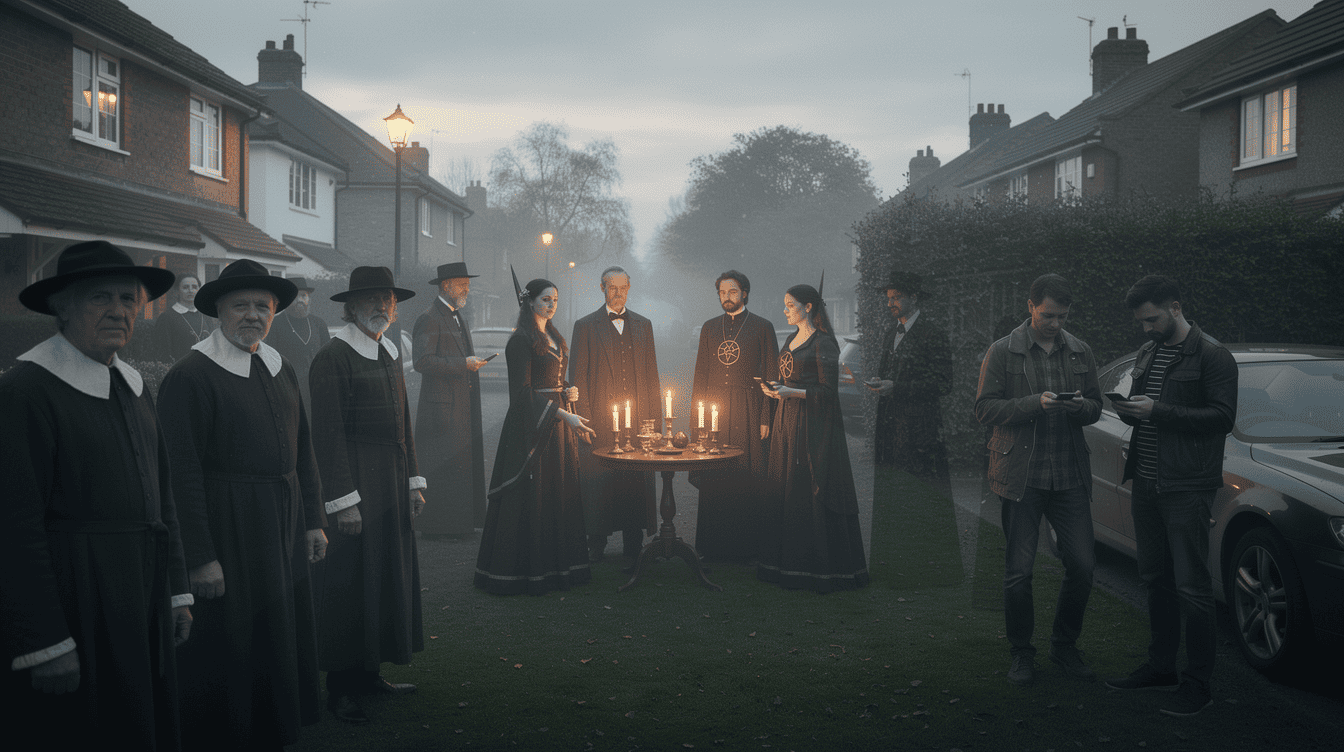
It is not nothing. It is not secular either, whatever it tells itself. It is the same country doing the same thing it has always done, only without the costumes and without the self-awareness.
Climate is the clearest case because the structure is textbook millenarian:
- Imminent catastrophe.
- A narrow window for repentance.
- An elect who see clearly.
- Deniers who do not.
- Salvation through behavioural change.
- Children deployed as prophetic witnesses.
Deadlines that arrive and quietly recede and are replaced by new deadlines, which is exactly what happened to Joanna Southcott's followers, and to the Fifth Monarchists, and to the Jezreelites waiting in their tower, and to every apocalyptic movement in recorded history. The theology has been stripped out and replaced with climate modelling, but the form is identical. A Muggletonian would recognise it instantly. The Agapemonites had better architecture.
The four instincts are all still there, only flattened into spectres no one is allowed to name.
England still engineers. The lodges have become think tanks. The orders have become frameworks. The rituals of initiation have become onboarding modules and accreditation courses. The construction of new belief systems continues at industrial pace, only now they are called strategies and pathways and the priesthood wears lanyards instead of robes. Crowley knew he was building a religion. The modern equivalents do not, which makes them less self-aware than a man who declared himself the Great Beast 666.
Scotland still absolutises, and still splits. The doctrinal purity has migrated from theology into procedure, into language, into the moral terms in which public questions are framed. Heretics are still excommunicated, only now through professional sanction rather than ecclesiastical discipline. Wee Free ministers split their churches over a funeral attended by the wrong person. Modern equivalents split institutions over a sentence spoken in the wrong tone. The mechanism is the same. So is the seriousness.
Wales still synchronises feeling. The revival has migrated from chapel to platform. The mass emotional convergence that once swept through valleys on a tide of hymn-singing now sweeps through populations on a tide of algorithmic sentiment, and has much the same effect: rapid conversion, collective moral clarity, inability to articulate the experience outside its own emotional register. Evan Roberts ran four meetings a day across South Wales in 1904. Any modern viral moral cause runs thousands simultaneously. The feeling is the point. The doctrine can be back-filled later.
Ireland still witnesses. The visionary tradition has migrated from the gable wall into the framing of history itself, where suffering becomes sacred, where the past is read through a lens of revealed meaning, where the testimony of witnesses is treated as beyond challenge because to challenge it is to deny the vision. Knock required fifteen witnesses whose testimony could not be shaken. Modern equivalents require fewer, but the structure of belief in the account, and the moral weight placed on the account, and the consequence of doubting the account, are continuous with the tradition.
None of this is less religious than what came before. It is more religious, in the sense that it is less questioned, less examined, less held at the arm's length that four hundred years of chapel and lodge and coven trained us to maintain. The Muggletonian knew he was a Muggletonian. The Wiccan knows she is a Wiccan. The technocrat does not know what he is, which is the first condition of being captured by it.
This is the bargain we struck. We gave up the costumes and the songs and the visions and the elaborate filing systems for the supernatural. In return we got a belief system that does not know it is one, enforced by people who do not know they are clergy, on a population that does not know it is being catechised. The Agapemonites wore bronze beasts on their chapel and openly declared a man the Messiah. There was an honesty to it. You could walk past the building, read the inscription, and decide.
Ozzy Osbourne Vs Karen From Accounts
We think of ourselves as late arrivals in a long story of secularisation. We have it the wrong way round. The four hundred years between the Civil War and the present day were a period of continuous religious creativity without parallel in European history. Forty thousand Muggletonians. A hundred thousand Southcottians. A hundred thousand Welsh converts in five months. Every market town with its sect, every county with its visionary, every generation with its prophets. This was not the fringe. This was the country.
What we are living through now is the anomaly. A generation of Britons has grown up believing the default state of the country is dashboards and tax forms and earnest technocratic anxiety, punctuated by a vague sense something is missing. Something is missing. Four hundred years of it. An entire inheritance of eccentric genius, engineered by Englishmen, fractured by Scots, sung by the Welsh, witnessed by the Irish, buried under a layer of procedural seriousness so thin you can almost see through it to the country underneath.
The instincts have not gone. They cannot. They are what we are. England will keep engineering belief systems whether it calls them religions or policies. Scotland will keep fracturing over the precise terms. Wales will keep synchronising into collective emotional states. Ireland will keep witnessing sacred meaning in the unfolding of events. These are not habits to be broken. They are the operating systems of four cultures, and they run whether we acknowledge them or not.
The question is only whether we recognise what we are doing. The eccentrics recognised it. Crowley signed his name to Thelema. Gardner signed his name to Wicca. Southcott sealed her box and named the conditions for opening it. Even the Muggletonians, meeting quietly for three hundred and twenty-eight years in upper rooms, knew what they were and said so. They left records. They expected to be remembered.
We will not be remembered as secular. We will be remembered as religious without knowing it, which is the strangest posture any generation has taken in the history of these islands.
The Muggletonians met for the last time in 1979, in a room in Bishopsgate, three elderly members closing down a three hundred and twenty-eight year tradition. Joseph Smith the younger, a greengrocer from Kent, held the archive. When he died the papers went to the British Library, where they sit on Floor 3, Rare Books and Music Reading Room, available on request.
The bedrooms in Bedford are still made up. The box is still sealed. The bishops have still not come. Somewhere in Gillingham the foundations of the Jezreelite tower lie under a housing estate. Somewhere above Holdstone Down the spiritual batteries are still charged. Somewhere in the mountains of Snowdonia the robes designed by a laudanum forger are worn each summer by men who believe themselves bards in a tradition running back to the druids, which in a real sense it now does, because belief has a way of making itself true if you give it long enough.
This is who we are. The lanyards are a very short interruption.