The Magic Tax With A Customer Service Number
Sizewell C costs £38 billion, will not generate power until 2039, and may not repay consumers until 2064. Households began paying for it last November anyway. The charge sits on your electricity bill, buried among network costs and policy levies. Nobody asked permission.
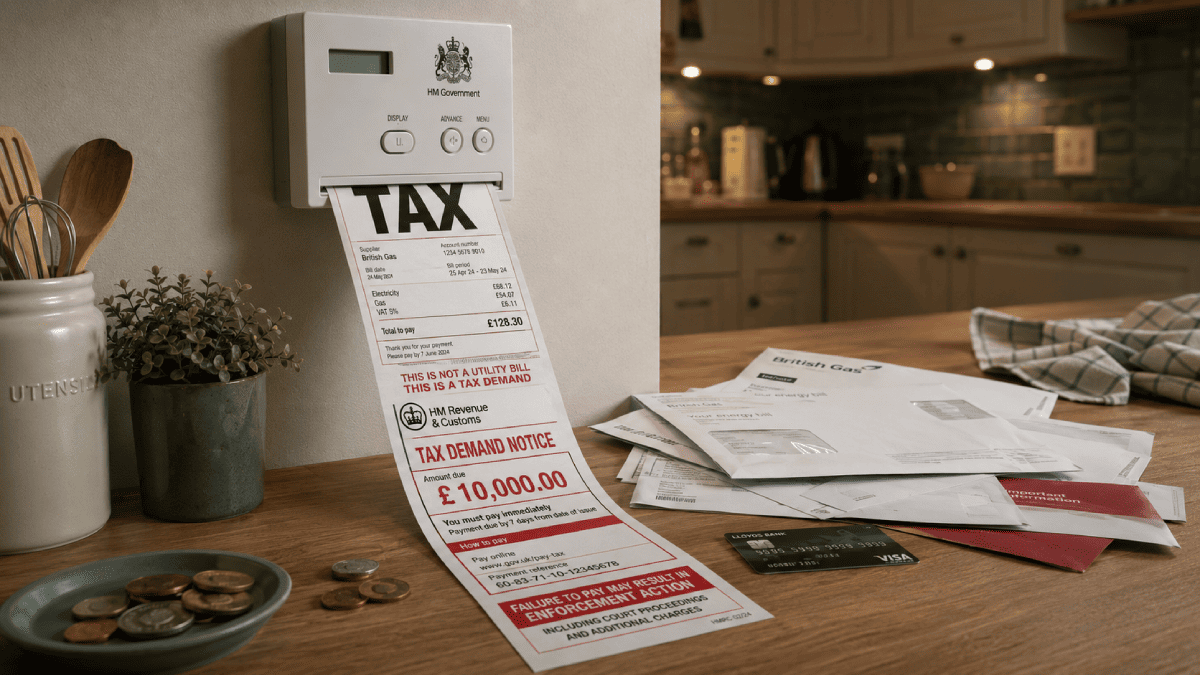
The cleverest tax in England arrives in a branded envelope, or as a push notification from an app with a chatbot. It carries a logo, a tariff name, a meter reading. It looks commercial. It feels private. And because it feels private, it does not trigger the political reflexes a tax would. It's unmistakably British because of how clever and Machiavellian it is.
Only an English mind could have conceived and engineered something this utterly cynical. It makes one feel slightly proud. The gentlemen involved (Greg Clark, Greg Hands, Kwasi Kwarteng, Dieter Helm, Cambridge’s Energy Policy Research Group) need to be briefly celebrated, then summarily hanged with their spiritual godfather, John Major. As is appropriate, proper, and expected In England for this flavour of villainy.
They wanted to find a way to fund nuclear power: good. They did it by sneaking a stealth tax onto your home energy bill in a cost-of-living inflation crisis: bad.
No chancellor stands up in Parliament to announce it. No opposition frontbencher attacks it. No tabloid headline screams about a raid on household income. It is wickedly clever and actually redefines cynical.
The obligation is the same. You pay, or the lights go off.
Britain has discovered something politically exquisite: if voters resist taxation and governments fear borrowing, you can fund enormous public infrastructure projects through household bills instead.
The money still flows from citizen to state-backed enterprise. The cost is still compulsory. The mechanism is still a transfer of wealth from the public to private investors. But because it wears the costume of a utility charge, it escapes almost all democratic scrutiny.
This is how it works. And the catastrophic disaster of Sizewell C is the clearest example in a generation.
What Your Electricity Bill Actually Pays For
Most people assume an electricity bill reflects the cost of electricity. It does, partly. Wholesale energy costs make up roughly 40 per cent of a typical household bill under Ofgem's price cap. The rest is a stack of charges, levies, network costs, policy obligations, operating margins and regulated returns so layered they would take a forensic accountant a morning to untangle.
Here is what a typical annual dual-fuel bill looked like in the second quarter of 2026, under Ofgem's price cap of £1,641:
| Component | Approximate share | Annual cost |
|---|---|---|
| Wholesale energy | ~40% | ~£670 |
| Network costs | ~25% | ~£438 |
| Supplier operating costs | ~15% | ~£279 |
| Policy costs | ~7% | ~£110 |
| VAT and other | ~5% | ~£78 |
| Profit margin | ~5% | ~£67 |
Network costs alone jumped 17 per cent in April 2026, driven largely by Ofgem's new RIIO-3 price control settlements for electricity transmission, gas transmission and gas distribution. Transmission network charges within the electricity standing charge rose 65 per cent in a single quarter. The standing charge itself, a daily fee levied regardless of how much electricity you use, was 57p per day for electricity and 29p per day for gas. Combined, a dual-fuel household paid 86p a day simply for the privilege of being connected to the grid, before consuming anything at all.
And from December 2025, a new line appeared. The Nuclear RAB levy: £3.46 per megawatt hour, expected to rise to around £4.50. Every business electricity bill in the country now carries a surcharge to fund the construction of Sizewell C, a nuclear power station on the Suffolk coast nobody will be able to switch on for at least thirteen years.
The bill is no longer simply a record of energy consumed. It is an infrastructure finance document.
Taxpayer To Bill-Payer: A Political Conjuring Trick
For most of the twentieth century, big public infrastructure in Britain was funded by government. The state borrowed money, built things, and repaid the debt through general taxation. Voters could see the spending. Parliament debated it. If costs overran, somebody was accountable, at least in theory.
The Private Finance Initiative, launched in 1992 under John Major, broke this link. PFI allowed private companies to build hospitals, schools and prisons with private money, then lease them back to public bodies over decades. The state avoided upfront borrowing. The debt sat on private balance sheets, cosmetically distant from the public accounts. In return, private investors received guaranteed annual payments from taxpayers, typically for 25 to 30 years. By 2018, when PFI was officially killed off, over 700 deals had committed the public to future charges of around £199 billion stretching into the 2040s.
This is was another wicked and cunning scheme by Major, who created the scam known as the National Lottery Service and backdoored the country in the European Union.
PFI made future taxpayers the collateral for present-day construction. But at least the mechanism was legible. Public bodies signed contracts. Auditors could examine them. Parliamentary committees interrogated the terms. The cost appeared, eventually, in departmental accounts.
The bill-payer model is more elegant.
Instead of binding taxpayers through government contracts, it binds households through regulated utility charges. The infrastructure company receives a guaranteed revenue stream approved by a regulator. Consumers pay through their bills. And because the charge looks commercial rather than fiscal, it escapes the political constraints imposed on taxation.
Taxation requires a chancellor to stand up and own the decision. A regulated bill requires only a regulator to approve recovery of costs. The ministerial announcement says "investment." The regulator says "allowed revenue." The supplier sends the invoice. The household pays. Accountability dissolves somewhere in the chain.
Regulated Asset Base: A Plain-English Explanation
The key mechanism is called a Regulated Asset Base, or RAB. If it sounds like jargon designed to induce sleep, consider the possibility it was meant to.
A RAB works like so:
- A company proposes to build a piece of infrastructure: a power station, a tunnel, a water treatment works, a grid upgrade.
- A quango regulator approves the project and determines how much the company can spend and recover.
- Once approved, the company is entitled to earn regulated revenue on its asset base, meaning the capital it has invested, plus approved costs, plus an allowed rate of return.
- Consumers pay for this through bills or charges set by the quango.
The appeal is obvious.
Investors put money into an approved asset and receive a predictable, regulated income stream. Because revenue is guaranteed by regulation rather than market forces, the risk is lower, so investors accept lower returns than they would demand in a purely commercial venture. Government argues this makes infrastructure cheaper to finance.
And here is the political beauty: none of this appears on the government's balance sheet.
The debt belongs to the infrastructure company. The revenue comes from bills, not taxes. The minister gets to announce a major project without announcing a major cost.
The trade-off is equally obvious, once you look at it directly. Lower risk for investors means higher exposure for bill-payers. RAB does not eliminate risk. It moves it. Construction delays, cost overruns, demand uncertainty, regulatory changes: these do not vanish because the financing model changes. They shift from investors, who can walk away, to bill-payers, who cannot.
You cannot choose a different electricity grid. You cannot shop for an alternative nuclear power station. You cannot opt out of water.
It's another political scam. And it's a very clever one.
Sizewell C: Paying for Power Before It Exists
Sizewell C is a planned 3.2-gigawatt nuclear power station on the Suffolk coast. The government describes it as critical to energy security and net zero. Once operational, it could generate enough electricity for the equivalent of six million homes and run for at least 60 years.
None of this is in dispute. Neither is the utter catastrophe farce attempting to complete it or the absurd idiotic quangos trying to protect fish. What deserves scrutiny is how it is being paid for.
In July 2025, the Department for Energy Security and Net Zero announced it had reached a deal with EDF and other investors to finance Sizewell C using the nuclear RAB model, regulated by Ofgem. Under this model, consumers began contributing to the cost of Sizewell C from November 2025.
Did you vote for that, or authorise the government to do that?
Here are the numbers, from the National Audit Office's May 2026 report:
| Baseline cost estimate | £38.2 billion |
| Construction completion expected | Summer 2039 |
| Consumer payments began | November 2025 |
| Household bill impact, 2025–26 | ~£4 per year |
| Household bill impact by opening | £17–£19 per year |
| Investor returns cost to consumers | Over £4 billion |
| Net consumer benefits (if successful) | Up to £18 billion |
| Benefits outweigh costs | Not before 2064 |
The NAO says the financial benefits of Sizewell C are not expected to outweigh consumer costs until after 2064. By which point many of the households currently paying for it will have been paying for four decades. Some will be dead.
The government's case is clear.
Nuclear provides firm, low-carbon baseload power. Intermittent renewables need something reliable underneath them. The RAB model reduces financing costs compared with the alternative. Under the previous Contract for Difference model (God help us), used for Hinkley Point C, the developer bore all construction risk and consumers paid nothing until the plant generated electricity. The strike price for Hinkley, set in 2013 at £92.50 per megawatt hour in 2012 prices, has inflated to roughly £136 per megawatt hour, with lifetime consumer costs now estimated at up to £50 billion. RAB, the argument goes, brings in more investors at lower returns, reducing the total cost.
The critical case is equally clear.
Households have been conscripted as construction financiers for a power station carrying novel risks, a project the NAO itself describes as warranting close monitoring. The NAO warns the financing model places more risk on taxpayers and consumers than other electricity projects. Consumers are paying now. Benefits arrive, perhaps, in the 2060s. And every household in the country carries a small but growing surcharge on every electricity bill, with no ability to refuse.
Sizewell C has not yet generated a single electron. It has already generated a charge.
Hinkley Point C: When Nuclear Goes Wrong
To understand the stakes at Sizewell, look west to Somerset. Hinkley Point C was supposed to demonstrate the viability of new nuclear in Britain. Approved in 2016 at an estimated cost of £18 billion, with completion expected around 2025, the project has become a monument to optimism.
By February 2026, EDF reported costs of £35 billion at 2015 prices, translating to roughly £48–49 billion adjusted for inflation. The first reactor will not generate power until 2030 at the earliest. The strike price, originally set at £92.50 per megawatt hour, has inflated to around £136 per megawatt hour in current money. When the plant finally opens, consumers will pay over £2 billion annually in above-market electricity costs for 35 years.
Under the Hinkley model, EDF bore the construction risk. Cost overruns were its problem. Consumers paid nothing until electricity flowed. This was expensive for investors, but it contained public exposure.
RAB reverses this bargain. Under Sizewell's model, consumers pay during construction. If costs overrun, the question of who absorbs the excess becomes a matter of regulatory negotiation, with bill-payers sitting on one side and well-resourced investors on the other. The government retains a 44.9 per cent equity stake. EDF holds 12.5 per cent. The remainder is split among pension funds and infrastructure investors.
The comparison illuminates the shift:
| Hinkley Point C | Sizewell C | |
|---|---|---|
| Financing model | Contract for Difference | Regulated Asset Base |
| Consumer payments begin | When plant generates | During construction |
| Construction risk borne by | Developer (EDF) | Shared: investors, consumers, state |
| Original cost estimate | £18 billion | £20 billion |
| Current cost estimate | ~£48–49 billion | £38.2 billion (baseline) |
| Government equity stake | None | 44.9% |
Hinkley's lesson is not necessarily against nuclear. It is against optimism in the absence of accountability. RAB was designed partly in response to Hinkley's ballooning costs. But it solves the problem by moving the risk, not by reducing it.
Thames Tideway: It Began In A Sewer
Sizewell C is not the first use of bill-payer financing for major infrastructure. The precedent was quieter and less politically visible: a 25-kilometre sewer under London.
The Thames Tideway Tunnel, at a cost of around £4.6 billion, was built to stop raw sewage overflowing into the Thames from London's Victorian sewer system. The project was not funded by government, but by 15 million Thames Water wastewater customers, whose bills rose by up to £25 per year to cover construction and financing costs. The company delivering the tunnel, Tideway, is owned by a consortium of investors including Allianz, Amber Infrastructure, and Dalmore Capital. Three million pensioners have indirect exposure through UK pension funds managed by those investors.
The government published a formal support package for the project in 2015, designed to cover "exceptional, highly unlikely risks." In regulatory language, this is a backstop. In plain English, it means the public underwrites extreme downside while investors collect regulated returns.
Tideway is a useful infrastructure project. London needed a better sewer. But the financing model established a template. Water customers became captive infrastructure financiers. They could not refuse. They could not negotiate. They could not switch providers. They paid, because they had no alternative, and because the charge appeared on their water bill alongside the cost of the water itself, inseparable and unremarkable.
The sewer taught the trick. Sizewell scaled it.
Network Charges, Standing Charges, and Infrastructure Hidden In Plain Sight
Sizewell and Tideway are large, visible projects. But the bill-payer model extends far beyond single megaprojects. It is embedded in the entire architecture of regulated energy and water networks.
Ofgem's RIIO price controls, the framework governing what energy network companies can spend and recover from consumers, now run in five-year cycles.
- RIIO-T3 for electricity and gas transmission and RIIO-GD3 for gas distribution cover 2026 to 2031.
- RIIO-ED3 for electricity distribution runs from 2028 to 2033.
Each cycle determines how much companies like National Grid, UK Power Networks and regional gas distributors can invest and how much they can charge households to recoup those investments plus an allowed rate of return.
The money goes to real things which should all be underground, but aren't: pylons, substations, cables, gas mains, metering systems, grid reinforcement for renewable connections, futile net zero infrastructure. The grid must be upgraded if electrification and decarbonisation are to happen. Nobody serious disputes this.
But the funding mechanism deserves more attention than it receives.
Every pound of approved capital expenditure becomes part of the regulated asset base, earning a regulated return for investors over the asset's lifetime. Consumers pay through network charges baked into their bills.
The allowed rate of return on capital, the weighted average cost of capital, was set at 4.03 per cent in Ofwat's most recent price review. Ofgem's RIIO settlements determine equivalent figures for energy networks. These are reasonable rates by market standards. But they are guaranteed, in a world where few investments carry guarantees.
In water, the same pattern is even more pronounced. Ofwat's 2024 price review approved £104 billion of spending by water companies between 2025 and 2030, funded through bill increases averaging 36 per cent over five years. Household water bills in England and Wales rose by an average of £86 in 2025 alone. Southern Water customers face a 53 per cent increase by 2030. Thames Water, currently clinging to solvency through emergency lending at 9.75 per cent interest, asked for a 53 per cent rise.
The stated purpose is infrastructure renewal, sewage reduction, leakage repair, environmental compliance: all necessary. But the households paying are not investors exercising choice. They are captive customers of regional monopolies, paying whatever the regulator permits, with no ability to switch, negotiate or refuse.
The bill has become a fiscal instrument in all but name.
Why Capital Loves Regulated Infrastructure
None of this is mysterious to the people allocating money. For pension funds, insurance companies, sovereign wealth funds, infrastructure funds and private equity, regulated UK infrastructure is among the most attractive asset classes in the world. The appeal is structural: long-life assets, predictable revenue, inflation-linked or regulated returns, political backing, low demand risk, limited competition, and customers who cannot opt out.
A regulated water company or energy network looks, to an investor, like a bond with property characteristics. Revenue is protected by regulation. Demand is guaranteed by human necessity. Duration is measured in decades. Downside is limited by political unwillingness to let essential services fail. The UK's independent regulatory framework provides a credibility premium: international investors trust Ofgem, Ofwat and the broader British regulatory settlement in a way they might not trust political promises from less stable jurisdictions.
This is, in many respects, rational. Britain's pension funds need long-duration assets to match long-duration liabilities. Infrastructure offers exactly this. Three million pensioners are indirectly invested in the Thames Tideway Tunnel. Sizewell C's investor consortium includes pension capital. The regulatory model works precisely because it makes infrastructure boring, predictable and financeable.
The problem is not private investment in infrastructure. It is the disappearance of democratic control over what is, in substance, public expenditure channelled through private instruments.
Where Accountability Goes To Die
The government decides Britain needs a new nuclear power station. It creates a financing model backed by regulated consumer charges. It passes primary legislation enabling the RAB. A quango, Ofgem, determines how much consumers pay. A consortium of private investors provides capital. A French state-owned energy company, EDF, manages construction. The cost appears on household electricity bills as a line item most consumers will never notice, much less understand.
Who decided the public should pay during construction rather than after? The government, through legislation. Who approved the charges? The quango, through its settlement. Who sends the bill? The energy supplier. Who pays? You.
Who is accountable if the project costs twice as much, takes five years longer, and delivers benefits only to people not yet born?
In theory, the quango. In practice, accountability is so distributed across government, quango, developer, investor and supplier, it becomes functionally absent. No single institution owns the decision in the way a chancellor owns a tax rise. The cost is real, compulsory and growing. The ownership is nobody's.
This is the central political achievement of the bill-payer state. It makes public spending feel like a commercial transaction. The household believes it is paying a company for a service. In reality, it is often paying for political choices the government did not want to present honestly as taxation.
Stated Honestly, RAB Has A Case
It would be dishonest to pretend the argument is one-sided. RAB can, in principle, reduce the total cost of major infrastructure. If investors receive regulated revenue during construction, they require lower returns than they would under higher-risk models. Lower financing costs on a £38 billion project translate into real savings for consumers over the asset's lifetime. The government's case is not absurd.
Britain needs firm base load power. It needs upgraded grids. It needs water infrastructure not built during the reign of Queen Victoria. It needs to invest at a scale not seen since the postwar period, and it needs to do so without triggering a sovereign debt crisis.
RAB offers a way to mobilise private capital at lower cost than pure private finance. If Sizewell C works, delivers on time, and generates electricity for 60 years at competitive cost, consumers will eventually benefit – probably. The NAO acknowledges potential net benefits of up to £18 billion.
These are real arguments. They deserve engagement, not dismissal.
But they also deserve honesty.
If the government wants to fund nuclear through household bills, it should say clearly: we are asking every electricity consumer in Britain to help finance a construction project carrying significant risk, with returns possibly decades away.
It should explain why bill-payers rather than taxpayers are the appropriate funding base. It should acknowledge the distributional consequences: a flat charge on electricity bills is regressive, hitting lower-income households proportionally harder than wealthier ones.
And it should be prepared for the question nobody in power seems willing to answer. If this is public infrastructure, funded by compulsory public charges, delivering public goods on a multi-decade timescale, in what meaningful sense is it private?
A Bill Used To Be Payment Afterwards
There was a time when a utility bill was simple. You used electricity. You paid for the electricity you used. The price reflected the cost of generation, transmission and supply, plus a margin and a tax.
Now a bill pays for wholesale energy, transmission network reinforcement, distribution network maintenance, smart meter rollout, balancing costs from managing intermittent supply, the Renewables Obligation, the Warm Home Discount, Contracts for Difference for offshore wind, nuclear construction levies, bad debt from supplier failures during the 2021–22 energy crisis, supplier of last resort costs, ECO insulation schemes, regional cross-subsidies, and regulated returns to network investors.
A water bill, similarly, pays for water supply, wastewater treatment, infrastructure renewal, environmental compliance, sewage overflow reduction, leakage repair, debt service from decades of leveraged buyouts by private equity owners, pension obligations, smart meter installation, and the returns demanded by whoever currently owns the pipes.
The household experiences these as monthly direct debits, unremarkable, unavoidable. The political system experiences them as off-balance-sheet infrastructure finance, invisible to fiscal rules, immune to parliamentary debate, and conveniently deniable as taxation.
This is the trick nobody voted for. Not because it is secret, but because it is dull.
It lives in regulatory price control documents, Ofgem appendices, NAO reports and infrastructure finance journals. It is explained in language designed to tranquillise. And it funds the physical fabric of national life through a mechanism with less democratic oversight than a parish council budget.
PFI turned public buildings into long-term annuities paid by taxpayers through government contracts. The bill-payer state turns public necessity into monthly direct debits paid by households through regulated charges.
The Treasury gets distance. Investors get certainty. The public gets a standing charge.
Next in The New Rentier State: how children's homes, asylum accommodation and social care became some of Britain's most reliable investment returns.