The National Tax On False Hope
Eight billion pounds a year flows through the National Lottery Service. Only a fifth reaches good causes. Nearly a billion goes straight to the Treasury. The rest vanishes into prizes, costs and profit. Britain invented a way to tax hope without calling it taxation, and then gave the losers a halo.
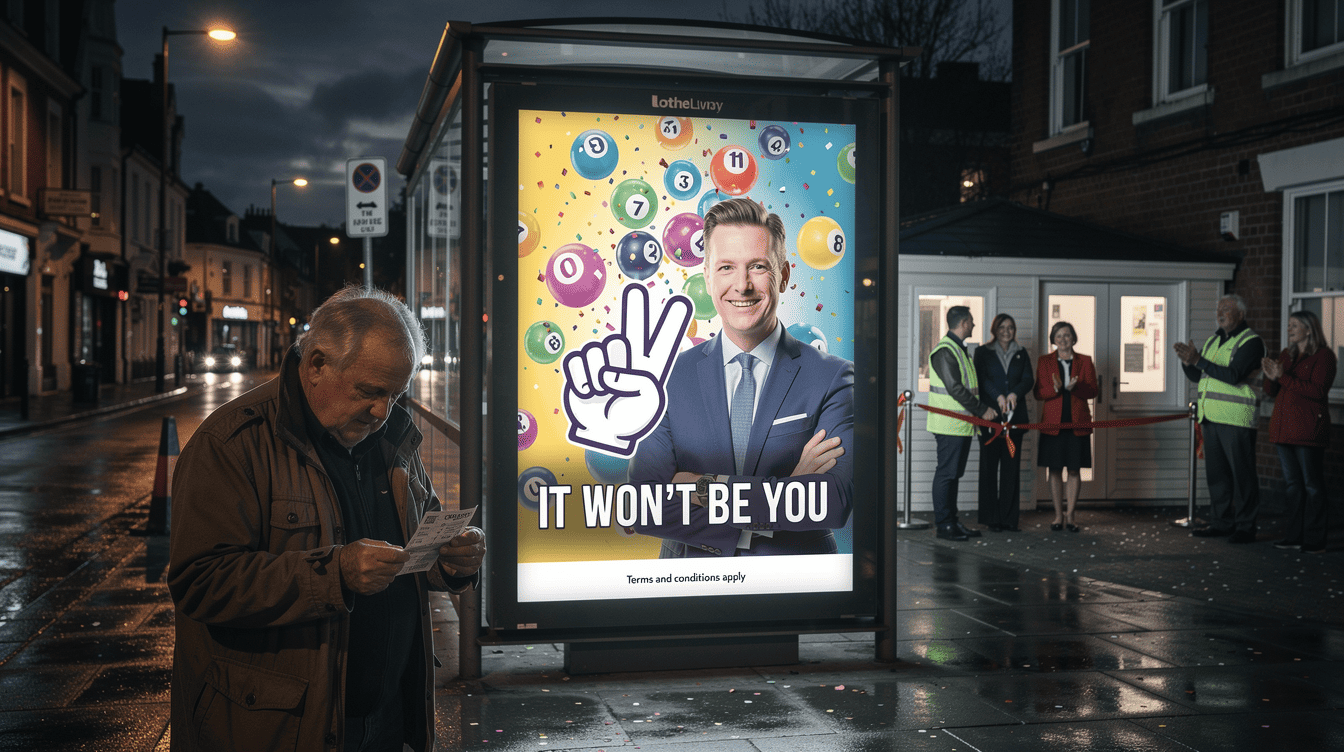
The National Lottery Service [sic] is sold as harmless fun with a civic conscience. Buy a ticket, fund an athlete, restore a village hall, keep a museum open. The crossed fingers, the Saturday night draw, the grinning winners, the grateful communities. It is one of the most successful pieces of moral packaging in modern British public life.
It is also a lie. Not a legal lie. A cultural and governmental one.
The British hope lottery is a state-licensed gambling operation which extracts roughly eight billion pounds a year from the British public, sends about a fifth of it to good causes, hands nearly a billion directly to the Treasury, and distributes the rest among prizes, operating costs, retailer commissions and operator returns. The whole thing is then advertised through the faces of its beneficiaries while the millions of losing tickets vanish without ceremony.
The state franchises a monopoly gambling product, takes its cut, distributes the scraps to popular causes, and calls the arrangement public virtue. For something your taxes should do already, if bureaucrats hadn't already squandered it on their vanities.
A Machine Built For Political Convenience
Our National Lottery Service [sic] was created by the National Lottery etc. Act 1993. Tickets went on sale on 14 November 1994 and the first draw took place five days later. Twenty-two million people watched it live on BBC1. This was not vice tolerated at the margins. It was launched as national theatre.
The architect was John Major's government, who also sold the country to the EU: post-Thatcher, fiscally cautious, culturally sentimental, and desperate for a stealth way to fund popular causes without the political cost of taxation.
Yes. That last sentence is worth pausing on. And reflecting on. They couldn't add more taxes at the time for what they should have been doing.
As was reported merely five years later when it had become obvious:
Chris Smith, the Culture Secretary, yesterday denied that the latest National Lottery good cause, the New Opportunities Fund, was intended to replace government funding of health and education programmes.
However, opposition parties yesterday poured scorn on the Government's pledge. Conservative culture spokesman Peter Ainsworth described the NOF as a "stealth tax", while his Liberal Democrat counterpart Robert Maclennan claimed lottery money could eventually end up paying doctors, building hospitals and equipping schools.
The new Department of National Heritage needed a money machine, and Major gave it one. Peter Brooke, the conservative Secretary of State who took the Bill through the Commons, described the Lottery as a "major new industry" whose "primary aim" was raising money for activities which would improve citizens' quality of life. Not a raffle. Not a modest flutter. A new national industry, created by statute, given a moral purpose, and wrapped in the language of civilisational uplift.
The original proceeds were split equally between five good causes: arts, sport, national heritage, charities and projects to mark the Millennium. Each category was chosen for its emotional appeal.
- Sport gives you athletes.
- Heritage gives you castles.
- Arts gives you prestige.
- Charities give you sanctity.
- The Millennium gives you destiny.
The National Gambling Service [sic] was not presented as gambling. It was a national renewal with spinning balls. The Centre for Policy Studies just called it larceny.
Dig for Victory. London Can Take It. Clap for our Carers. The same tedious, manipulative BBC-sponsored national morale drill to cheer on the state like North Korean seals.
The doctrine underpinning the whole thing was called "additionality." Lottery money would fund things the government could not otherwise afford. It would supplement, never substitute for, normal public spending. That word sounds somewhat noble, if it sounds the kind of social science jargon which makes one nauseous at the stench. It is also a confession. It means: we have public goods we want to support, but we can't pay for them through the ordinary machinery of taxation.
Not Exactly A Magic Money Tree
The public face of the lottery is the good-cause cheque. The actual financial structure tells a different story.
In 2023/24, the money from each pound of lottery sales was distributed roughly as follows.
- 57p went to prizes.
- 20p went to good causes.
- 12p went to the Treasury as lottery duty.
- 11p went to running costs and operator economics.
That means the moral halo sits on one pound in five. The rest is machinery.
And somebody has yet to explain why the government needs a "lottery duty" for something which is supposed to fund good causes. Moreover, why on earth the state needs a "Lotteries Council" quango.
In 2025, under the new operator Allwyn Entertainment, National Lottery sales reached £8.1 billion. More than £1.7 billion was generated for good causes. But £967 million went directly to the Exchequer in lottery duty.
And Allwyn have yet to explain how and why the "IT upgrade" they are in charge of has doubled in cost to £500m.
A billion pounds a year from losing lottery tickets into the Treasury is not charity. It is fiscal engineering.
- Parliament determines the good-cause categories.
- The Treasury takes its statutory cut.
- A government-regulated franchise collects money at national scale.
- Public projects are funded from the proceeds.
The mechanism walks and talks like taxation but avoids the single feature which makes taxation honest: it is not based on ability to pay.
It is based on willingness to dream you, the serf, could be prosperous one day. And it's a sick joke.
Since 1994, the National Lottery has generated over £50 billion for good causes. That number is deployed constantly in its defence.
What is mentioned less often is the good-cause share of sales has been falling. A Commons committee found primary good-cause contributions dropped from 26.81 per cent of sales in 2008/09 to 20.57 per cent in 2020/21, only marginally above the statutory minimum. The moral marketing stayed golden while the actual share got thinner.
The Front Door To A Gambling Problem
Public Health England's gambling-harms review found in 2018, 24.5 million adults in England gambled, amounting to 54 per cent of the adult population. Exclude the National Lottery and the figure falls to 40 per cent.
The Lottery does not merely participate in British gambling culture. It is British gambling culture's front door.
The National Lottery drags gambling out of the betting shop and into the supermarket queue, the newsagent counter, the family errand, the Saturday evening ritual. It domesticates the wager.
The Gambling Commission's 2025 topic report found the weekly lottery-only group skewed heavily older: 35 per cent were over 65, compared with 18 to 22 per cent among other gambling-frequency groups. Only 8 per cent were aged 18 to 34. The weekly habit is not youthful extravagance. It is often quiet, routine, old-age hope purchased in small denominations.
And then there are scratchcards.
The draw-based lottery can be defended as a low-frequency flutter and a silly BBC project. Instant-win products are retail gambling sold under a national brand. The Gambling Commission's 2025 young people data found 9 per cent of young people had engaged in lottery-style games in the previous twelve months. National Lottery scratchcards were the most common exposure at 7 per cent. The wholesome crossed-fingers brand does not merely sell a Saturday draw. It sells instant gratification in cardboard form, and it is the leading lottery-style product reaching young people.
This is exactly the same argument made today about the problem of social media for children. Except the state authored this one three decades ago, and the US companies refuse to pay the "fair and proportionate" tax they want.
Moral Fuckery In Charitable Clothes
The genius of the National Lottery is not it made gambling respectable. It is it made losing feel generous.
Buy a ticket. Lose. But you did not really lose, because your money went to good causes.
You are not a mug. You are a patron of the arts, a supporter of Olympians, a funder of heritage, a benefactor of your community. You, the peasant, feel royal. Such is how the scam always works – the mug's vanity.
The emotional chain runs like this:
- Ticket buyer loses
- Good cause wins
- Government smiles nearby, and
- Nobody asks why the public good needed gambling losses in the first place.
This is moral laundering. The losing ticket becomes a charitable donation. The state gets to act as if a village hall, a sports club, a heritage site, a youth project or a community centre has been blessed by civic generosity. But underneath sits a state-franchised revenue system in which public goods are funded by private disappointment.
A country should not require pensioners, shop workers and the lonely to lose small sums repeatedly so a community centre can get a grant.
The Odds Are Not In Your Favour
The most famous lottery scheme in cinema, of course, is "The Island": clones are theologically indoctrinated with the false hope of "winning" their freedom to a mystical paradise – which turns out to be their death and organ donation.
The Lotto jackpot odds are approximately 1 in 45,057,474. EuroMillions jackpot odds sit at roughly 1 in 139,838,160. These are not life-changing opportunities in any ordinary sense. They are statistical fantasies sold at retail scale.
Just a bit of fun. A flutter.
Every week.
Sometimes a few times a week. Which you never win.
"It could be you" is the most cynical sentence in British public life, because the entire machine depends on the fact it almost certainly will not be you. The state does not sell its citizens a plan. It sells them a miracle priced at two pounds fifty.
Should you be able to have a flutter? Of course.
Do it at a private bookies not run by the state and donate the winnings yourself.
Blair's Cynical Exploitation Of The Obvious
The founding promise was clear. Lottery money would be additional. It would not replace what government ought to fund from general taxation.
Labour tested that promise almost immediately. The 1998 National Lottery Bill created the idiotic National Lottery Commission and the New Opportunities Fund, channelling Lottery money into health, education and the environment. These are not ornamental extras. They are core functions of the modern state.
Even John Major, in a rare moment of patriotism, attacked the move, arguing literacy, numeracy, science and technology were mainstream government expenditure and should be funded by taxpayers, not lottery players.
Major was right, though the irony was considerable; as it always is with British politicians. Like Blair, he had built the machine which was used to do the damage. Labour simply discovered how useful it was. Blair not only perverted charity, he started with the lottery.
The formal doctrine of additionality still stands, but the political reality is less certain. Once a visible national pot exists for arts, sport, heritage, community projects and now mainstream public services, the pressure on ministers to fund those things through honest taxation weakens. The pot is there.
The Art Newspaper (a ragingly-progressive publication one would never find a Restorationist dinner evening) puts it with unusual clarity:
Thanks to an austerity-induced accounting trick, the replacement of tax by lottery funding means that the least well-off increasingly shoulder the cost of rich people’s pursuits. A lot of well-meaning and progressive people continue to benefit from this arrangement, but it is not fair and needs to be questioned.
Well said. Why fight for a budget line when you can point to a grant programme underwritten by losing tickets?
Additionality is the promise. Substitution is the temptation. And the public has no reliable way to measure which one is winning.
Do A Prosperous People Play Lotteries?
The crude claim "only poor people play the Lottery" is false and easy to dismiss. The more careful version is harder to answer.
Theos argued in 2009 the National Lottery was regressive, with high levels of play and stake among people on lower-than-average incomes. Even where absolute spending rose with income, spending as a proportion of income was significantly higher among lower socio-economic groups.
You do not need to prove only the poor play. The structural point is sufficient. The Lottery raises money not according to ability to pay but according to susceptibility to hope. It is precisely most attractive where ordinary routes to advancement feel closed. That makes it morally regressive by design, regardless of who happens to buy the most tickets.
A high-trust country offers routes to stability: wages, housing, enterprise, savings, family formation, local dignity. A low-trust country offers scratchcards.
If Britons had real paths to wealth they could take, no lottery would be needed. If government weren't wasting their money on... everything – a lottery wouldn't be required in the first place.
The State Needs To Pay Its Own Way
The National Lottery Service is not a charity with a gambling problem. It is a gambling operation with a charity department. It lets the state fund popular causes without admitting the tax bill, normalise mass gambling under a public-good banner, take nearly a billion pounds a year in duty while calling the system voluntary, and claim moral credit for projects funded entirely by losers.
It is especially grubby and painful to almost agree with the Guardian on this.
Lotteries go back to the Roman empire. In England, the first state lottery was set up by Queen Elizabeth 1 in 1567, as an alternative to raising taxes, with profits to go to “reparation of the Havens and strength of the Realme”. Tickets cost a hefty 10 shillings, but along with a prize of £5,000, some pottery and “good linen cloth”, all participants were granted immunity from arrest, except for piracy, murder or treason.
Dubbed a “tax on stupidity” by Voltaire, lotteries have always had their detractors. “The Lottery, with its weekly pay-out of enormous prizes, was the one public event to which the proles paid serious attention,” George Orwell wrote in Nineteen Eighty Four. The national lottery has provoked sniffiness since 1994. As one commentator in the Art Newspaper put it in 2018, “It is seen as a benign form of play, a modest voluntary tax on the innumerate and deluded.” Is this cynical state-sponsored gambling, with preposterously long odds?
The official tax system pays for the hard state: debt, defence, welfare, health, pensions, policing, administration. The National Lottery Service pays for the emotionally photogenic state: athletes, memorials, village halls, museums, parks, community projects and plaques. It lets politicians stand beside the flowers without admitting they grew them in a casino.
A serious country funds public goods through public finance. It taxes openly, budgets transparently, and asks citizens to contribute according to what they can afford. A cynical country sells hope at two pounds fifty, clips the ticket, sprinkles the proceeds over photogenic projects, and calls the loser generous.
The ticket is small. The principle is enormous.
If there is one rule British politics needs to adopt in the next hundred years, it is a concrete straitjacket stopping politicians from creating "national" services like its a political Tourette Syndrome. Enough. Just enough.
The National Health Service
The National Fire Service
The National Blood Transfusion Service
The National Probation Service
The National Careers Service
The National Citizen Service
The National Education Service
The National Coal Board
The National Rail Service
The National Lottery Service
The National Bus Company
The National Crime Agency
The National Tutoring Programme
The National Living Wage
The National Youth Guarantee
And most recently, the National Suicide Service and National Police Service.
When is enough of this, actually enough?