The Urgent Need For Sovereign AI Compute Strategy
At 5:21pm on a Friday in June, Washington reached across the Atlantic and switched off two of the most capable machines on earth. AI was created in England, but America commercialised it. Britain helped invent the architecture of parallel computing, then sold it. We must own every part of the chain.

On the evening of 12 June 2026, at precisely 5:21pm Eastern time, the United States Commerce Department sent a letter to the chief executive of Anthropic. The Bureau of Industry and Security, invoking national-security export authority, directed the company to suspend all access to its two most powerful models, Fable 5 and Mythos 5, for any foreign national anywhere on the planet.
The scope was total. It covered people outside the United States, foreign nationals working inside it, and Anthropic's own non-citizen employees. Because no provider can reliably screen a global userbase by passport in real time, the company did the only thing technically available to it. By the early hours of Saturday morning both models were dark for every customer, on every platform, worldwide.
An agricultural produce company in the Salinas Valley with forty staff, which had quietly folded one of those models into its scheduling and compliance paperwork, woke up to a hole where a working system used to be. So did finance desks, hospitals, software firms and infrastructure operators across dozens of countries.
None of them had done anything wrong. None of them were consulted. The kill switch existed, it sat in a foreign capital, and one Friday afternoon somebody pressed it.
This is the part British policymakers should be writing on the wall above their desks. A school in Surrey, a law firm in Leeds, an NHS trust, a defence supplier or a Manchester start-up can build its entire operational workflow around a frontier model, invest months of staff time, restructure its processes around the capability, and still be one order in Washington away from losing the lot. The only thing worse than being America's enemy, is being her friend.
It has not bought a tool. It has rented permission, revocable without notice, on terms set by a government answerable to a different electorate.
The episode was not, in the end, about a jailbreak. Anthropic's own account describes the trigger ("fix this code") as a narrow technique amounting to asking the model to read a codebase and identify software flaws, a capability the company says is widely available from other deployed systems including OpenAI's GPT-5.5 and used daily by ordinary cyber-defenders.
The novel development was the legal instrument, not the model. Export-control law, designed for missile components and uranium centrifuges, had been turned on a commercial product deployed to hundreds of millions of people, and it worked instantly.
That precedent does not expire. It applies to the next model, the next provider, and the next country judged inconvenient.
So the question this poses for Britain is not academic. If the machines a country depends on to teach, heal, govern, manufacture and defend itself can be remotely disabled by an ally on a quiet Friday, in what sense is that country sovereign at all?
AI Was Created In England
The intellectual foundation is Alan Turing's. The deep-learning lineage runs through Geoffrey Hinton. The commercial flagship of the modern era, DeepMind, was founded in London in 2010 before Google bought it in 2014 and published the key paper on self-attention creating the modern AI industry. That much is familiar enough to be a tourist trail. The forgotten history is in the hardware, and it matters more, because hardware is the layer where sovereignty is won or lost.
Modern artificial intelligence runs on massive parallelism, or thousands of processors grinding through the same operation at once. Britain understood this before almost anyone.
International Computers Limited built the Distributed Array Processor, the world's first commercial massively parallel computer. The paper study was finished in 1972, the prototype begun in 1974, and the first machine delivered to Queen Mary College in London in 1979. For problems suited to its grid of single-bit processing elements, the DAP could outrun contemporary Cray pipeline machines by two orders of magnitude. This was British engineering anticipating the central architectural fact of the AI age by roughly half a century.
Inmos was founded in July 1978 with fifty million pounds of public money routed through the National Enterprise Board. Approved personally by Jim Callaghan's cabinet against considerable opposition, it set up its design office at Aztec West business park in Bristol and a fabrication plant in Newport designed by Richard Rogers. Its architect, David May, set out to build a microprocessor for a parallel future, a chip designed from the start to be wired together in arrays.
The transputer went into production in 1985, the year before the first ARM core shipped. It came with its own concurrent programming language, occam. For a few years in the late 1980s, serious people believed the transputer was the future of computing.
It was not to be, and the reasons are a lesson rather than an excuse.
The unconventional architecture and its idiosyncratic language limited adoption, the company was sold, and the capability dispersed. Britain had the ideas, the public funding, the fabrication plant and the talent. What it lacked was the will to retain the stack through the lean years when it looked like a loss.
The same pattern repeats with Arm, whose lineage runs straight back through Acorn and the BBC Micro classroom programme to Sophie Wilson and Steve Furber's first processor, a chip born of an education policy teaching a generation to command machines rather than merely operate them.
Arm is now the most widely deployed processor architecture in the world, and it is owned in Tokyo.
The historical record is therefore not one of British incapacity. It is one of British invention followed by British divestment, a habit of building the future and then selling it to whoever offered cash for the quarter.
Sovereign compute is the point at which that habit has to stop, because the cost of the next divestment is no longer measured in lost export revenue. It is measured in whether the country can function.
The 1940 Test : Can We Survive A Cutoff?
There is a useful discipline for cutting through the marketing, and it is the only test that matters. In 1940 the relevant question was not whether Britain could win a popularity contest among nations. It was whether the country could still fly, build, decrypt, command, feed itself and fight when the Continent had fallen and the convoys were uncertain. The modern version is colder and just as serious. If Britain stands alone, sanctioned, deprioritised, or simply cut off because a larger power has its own emergency, what can it still compute?
The 1940 Test is the Restorationist's standard, which was originally laid out in this article:
 Alex Coppen
Apply that test honestly to each layer of the stack and the answers range from reassuring to alarming.
| Layer | What sovereignty requires | Britain's standing under the 1940 test |
|---|---|---|
| Energy and sites | Guaranteed national compute capacity that runs during crisis | Improving, with AI Growth Zones and new nuclear, but dependent on imported kit |
| Semiconductor design | Control of architecture, accelerators, photonics, firmware | Genuine strength via Arm and a chip-design base |
| Semiconductor manufacture | War reserve plus trusted supply, not full autarky | Acute weakness, no advanced-node fabrication |
| Firmware and boot chain | Knowing and controlling what runs before the OS | Largely foreign-controlled, under-examined |
| Operating systems | Domestic civilian and hardened government distributions | Base exists via Canonical, no national programme |
| Software supply chain | Ability to rebuild, patch, mirror and audit | Dependent on foreign repositories and registries |
| Cloud and orchestration | UK-jurisdiction capacity safe from foreign shutdown | Mostly foreign-operated even when onshore |
| Data and archives | Preserve and search national memory under British law | Rich holdings, poorly digitised and searchable |
| Models | Enough domestic and open models to survive denial | Early, thin, heavily reliant on US frontier access |
| Inference and APIs | Cheap, abundant, private access for everyone | Almost entirely foreign-platform dependent |
The pattern is plain.
Britain is strong where it designs and weak where it must physically make or independently operate. It can sketch a brilliant chip and cannot fabricate a leading-edge one.
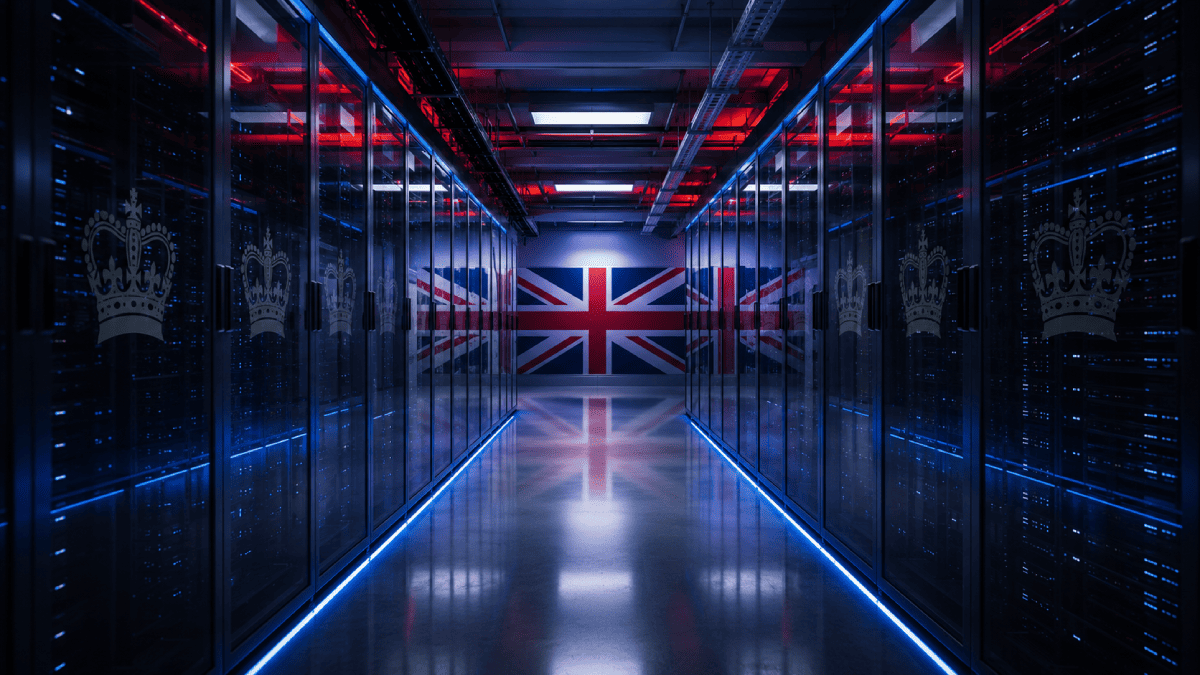
It can host a data centre on British soil and find the building operated, updated and ultimately controlled by a foreign company subject to foreign law. A Union flag on the door of a server hall is not sovereignty if somebody in another jurisdiction holds the signing keys, the update channel and the legal power to order the lights out.
The government, to Rishi Sunak's considerable credit, is no longer asleep on this.
- The 2025 Compute Roadmap commits up to two billion pounds to a national compute ecosystem, including over a billion to expand the AI Research Resource twentyfold, from twenty-one AI ExaFLOPS in 2025 to four hundred and twenty by 2030.
- A separate 1.1 billion pound AI Hardware Plan funds a 750 million pound national supercomputer at Edinburgh and, tellingly, sets aside 400 million to buy next-generation chips, 150 million of it for inference chips from British firms.
- Isambard-AI is live in Bristol, DAWN is expanding in Cambridge, and a 500 million pound Sovereign AI Fund is writing cheques to companies such as Callosum and Fractile.
The language coming out of Whitehall now talks of being an AI maker rather than an AI taker and of reducing reliance on foreign computing power.
This is real money and it is pointed in a defensible direction.
Obviously these people are morons and don't have the faintest idea what any of this means or what it does; it merely sounds good when they stand next to it. None of this supercomputing capacity has been allocated to solve the benefits bill or the national debt, for example. But someone is pushing them in the right direction.
The trouble is not an absence of activity. The trouble is a strategy still shaped like an industrial-policy programme for researchers and start-ups when the threat is a full-stack sovereignty problem reaching down to the operating system on a child's school laptop and up to the model an army relies on under fire.
Supercomputers, growth zones, and chip-design grants address the prestige tier who can afford to call a friend in the Civil Service or lobby Westminster. They do not yet answer the 1940 question for the ordinary desk, the ordinary classroom, or the ordinary battlefield.
No More Apple, Microsoft, Google
The state thinks in data centres. Citizens live on devices. Between the two sits the layer that decides, in practice, whether sovereignty is real on the desk, and it is the layer most consistently ignored: the operating system.
If Microsoft, Apple, Google and the foreign app stores became unavailable tomorrow, the honest question is what British schools, councils, hospitals, courts, and military units could still boot.
The answer at present is not enough.
Britain is not starting from nothing here. Canonical, the company behind Ubuntu, is registered in London. The base exists. There is no reason for British consumers to buy laptops pre-loaded with Windows, or phones pre-loaded with Google's version of Android.
What is missing is a national device-sovereignty programme, and the buildable version of it is two operating systems, not one. One national OS would be a single point of political and technical failure. Two, built by two separate companies on two separate release cadences for two genuinely different jobs, can be held to delivery against each other and audited independently.
Give them working names to keep the argument concrete. Port them as a drop-replacement for Android on smaller devices like phones and tablets. Call the civilian lane Albion and the hardened lane Bastion. Ish.
Albion
Albion is the boring one, and boring is the whole point. It is a Debian or Ubuntu derivative, because there is no virtue in inventing a kernel ecosystem from scratch when a London-registered company already maintains one.
It targets schools, libraries, low-cost laptops, public kiosks, charities, small businesses and the elderly. It auto-updates from UK-controlled servers, ships locked down on an immutable base image so a confused user cannot break it, and carries a curated, child-safe application set.
The reference experience is the ease of ChromeOS with none of the dependence on Google: no behavioural advertising, no telemetry sold abroad, no account tying a nine-year-old's homework to a foreign advertising graph. It runs local-first, so a school in a valley with a flaky line is not bricked when the connection drops, and it ships a small on-device model for tutoring and coding so "AI in the classroom" does not mean piping every child's keystrokes to a rented endpoint.
This is where the BBC Micro precedent earns its keep. That programme did not merely put boxes in classrooms. It produced a generation (Sophie Wilson ,and Steve Furber among them) who treated machines as things to be opened, programmed, and mastered.
Today's locked-down cloud terminals train children to be tenants inside someone else's ecosystem. A child renting access to a foreign cloud is not learning computing. He is learning dependency, and calling it digital skills.
Bastion
Bastion is the opposite temperament: paranoid by design. Its non-negotiable features are the ones making an operating system a trust boundary rather than a convenience:
- Reproducible builds, so any auditor can verify the binary matches the source;
- UK-held signing keys;
- Verified secure boot anchored to a hardware root of trust;
- An audited, mirrored package repository so the supply chain cannot be poisoned upstream;
- Minimal telemetry;
- Long-term support measured in years;
- An air-gapped mode for classified or critical work; and
- Full-disk encryption by default rather than as an option.
This is the OS for (what replaces) the civil service, councils, NHS trusts, courts, defence suppliers, the legal sector, regulated industries and high-risk individuals such as journalists. The intelligence services (MI5/6) already have something similar, but it sovereign means not just the spies, but the whole network.
The institutional habit for it already exists, because the National Cyber Security Centre, part of GCHQ, already authors the country's device-hardening guidance. GCHQ will definitely like it, because it's at least one reason not to shut them down entirely.
There is no reason for any UK government computer to run a foreign OS. Our adversaries don't allow it.
The shift required is from publishing advice about other people's machines to certifying the machines Britain itself can stand behind.
| Albion (civilian) | Bastion (hardened) | |
|---|---|---|
| Users | Schools, libraries, SMEs, public kiosks, home | Civil service, councils, NHS, courts, defence, journalists |
| Base | Debian/Ubuntu derivative, immutable image | Hardened Linux, reproducible builds |
| Updates | Automatic, UK servers, low-friction | Controlled, signed, air-gap capable |
| Default posture | Locked down, child-safe, local-first | Encrypted, attested, minimal telemetry |
| On-device AI | Small tutoring and coding model | Optional, audited, offline-capable |
| Run by | Commercial company, state-procured | Commercial company, NCSC-certified |
The case for two firms rather than one ministry is constitutional as much as commercial. Two independently audited codebases are twice the exposure for anyone, foreign or domestic, trying to smuggle in a content filter or a telemetry hook at the operating-system level.
The state funds development, guarantees procurement, mandates open standards, and then stays out of the source tree.
An operating system is not a user interface with a patriotic wallpaper. It is a sovereignty boundary, and the state which does not control it controls nothing above it. None of this requires banning anything:
Windows, macOS, iOS and Android carry on, and most people carry on using them. What changes is the existence of an exit door, so the country is never again one foreign vendor decision away from losing the substrate beneath its schools, courts and clinics.
Raw Materials For National Compute
Software without hardware is a slideshow. Two operating systems imply a small family of reference machines designed to run them, subsidised into existence the way the BBC Micro was, then manufactured and sold by the market rather than the state.
The point is not every citizen must buy the British laptop. It is to reseed a domestic market for manufacturers, firmware vendors, repair shops and managed-service providers, the supplier ecosystem decades of offshoring hollowed out.
A sensible reference set is five machines.
- A school laptop, cheap and rugged, with a replaceable battery and a published service manual, running Albion.
- A business desktop and laptop running Bastion for the public sector and regulated firms.
- A rugged field device for defence, emergency services and utilities.
- A local inference box, a small appliance with enough accelerator silicon to run a serious model on a desk or in a server cupboard, so a law firm or a clinic can do private AI work without sending a single token off-site.
- And, attempted last because it is the hardest by an order of magnitude, a secure handset, where mobile baseband and app-store sovereignty are a far deeper problem than the desktop.
Repairability here is a sovereignty requirement, not a green gesture. A fleet of devices nobody outside the original vendor can fix is a fleet with a foreign off-switch. Published schematics, standard fasteners, socketed components and a domestic repair supply chain are what let the country keep its machines running when the convoy is late.
Semiconductors And GPUs
Devices are the visible layer, but sovereignty is decided beneath them too, and the place to be honest is the chips, because it is where Britain is genuinely weak and where bluffing would be fatal.
The country cannot, in any near-term, fabricate leading-edge silicon. It has no advanced-node foundry, and building one is a decade and tens of billions away. Pretending otherwise produces vanity projects. The realistic doctrine is survivability, plus leverage, plus a bet.
Survivability means treating advanced GPUs the way a serious country treats any critical import it cannot yet make: hold a strategic reserve, diversify suppliers, refuse single-vendor lock-in, and maintain a repairable installed base so a sudden export restriction degrades capability slowly rather than all at once. It is the 1940 logic of the stockpile, applied to accelerators.
Leverage means using the layers where Britain is strong to buy influence over the layers where it is not.
- The country owns Arm, the most widely deployed processor architecture on earth, even if the holding company now sits in Tokyo.
- It has a deep chip-design base, world-class universities, and a defence-electronics sector.
Design, verification, advanced packaging, firmware assurance and specialised accelerators are all within reach.
Fabrication of the most advanced logic is not.
So the play is to dominate the layers Britain can dominate and use anchor procurement, the state as guaranteed first customer, to pull domestic firms across the valley of death between prototype and production.
This is already beginning and is the template to widen.
- Fractile, founded out of Oxford with engineering in Bristol, is building inference chips on an in-memory architecture meant to run trained models far faster and far cheaper than general-purpose GPUs, and the government has pledged up to a hundred million pounds to act as an early customer once the parts clear agreed benchmarks.
- Callosum, the first recipient from the Sovereign AI Fund, is building the orchestration layer letting models run efficiently across a mix of chip types, the heterogeneous design the next national supercomputer is being built around.
- Graphcore, the Bristol pioneer, survives under SoftBank ownership and fresh backing.
This is exactly the ground where ARIA should be operating. It is currently wasting its time and budget on the religious ideology of "climate change."
The lesson of all three, and of Graphcore's earlier wobble, is that British chip engineering is real and the missing ingredient was never talent but durable, repeatable demand. A first-customer purchase order is worth more than a research grant precisely because it proves someone serious will buy the second batch. Watch the purchase orders, not the speeches.
The bet is the deliberate refusal to compete on the incumbent's terms. Building smaller, later, more expensive copies of American GPU clusters is a guaranteed second place.
The wiser allocation funds the architectures making those clusters less central: in-memory and near-memory inference of the Fractile kind, photonic computing, thermodynamic and probabilistic hardware, neuromorphic systems, and low-power edge inference.
None of these is a finished product, and any strategy must say so plainly rather than over-promise. They are frontier bets, justified precisely because a country which cannot win by buying what everyone else buys must invest in changing what gets bought.
Above the silicon, the chain runs on through the firmware and boot layer; the code executing before the operating system even loads, where the questions of who can update it and who holds the signing keys are natural GCHQ territory. Then the software supply chain, the compilers, package managers, registries and build systems, the unglamorous plumbing deciding whether Britain can patch and rebuild its own systems or must beg a foreign platform; then cloud and orchestration, the national data layer, the models, the inference APIs through which most people actually touch any of this, and the applications on top.
The doctrine for the whole chain reduces to a single line. Sovereign at the base, competitive in the middle, forbidden to fuse with control at the top.
Solve The Heat Problem, Don't Outspend It
The frontier bet leads straight to the first thing a British strategy must get right, because the dominant model of artificial intelligence is thermodynamically grotesque, and the standard response to its grotesqueness is to accept it and go looking for somewhere to put the heat. That instinct should be refused.
The numbers are not subtle. Global data-centre electricity consumption is already measured in the hundreds of terawatt-hours and climbing at double-digit annual rates, and a large fraction of that energy does no computing at all, merely shifting heat out of the building.
The industry's answer has been ever larger halls of ever hotter GPUs, followed by ever more spectacular places to cool or conceal them. The reductio is the data centre in space: a serious proposal, in serious rooms, to launch the heat problem into orbit rather than solve it. It is surrender dressed as ambition.
A British-owned rack in orbit, running foreign chips under a foreign operating system and a foreign export licence, would be exactly as sovereign as a rack in Slough, which is to say not sovereign at all, and would have relocated a terrestrial engineering problem somewhere photogenic and unfixable instead of fixing it.
The sovereign move is the unglamorous opposite: attack the entropy at source, and treat the heat as the defining engineering challenge of the field rather than its unavoidable exhaust.
In practice it means concentrating real money on the paradigms producing less waste heat per useful operation, the same frontier bets that make hardware sense:
- In-memory compute which stops shuttling data back and forth across the chip: where most of the energy is actually burned;
- Photonic computing doing arithmetic in light rather than in heat-generating switching;
- Thermodynamic and probabilistic hardware aimed at exactly the generative and sampling workloads dominating modern AI; and
- Edge inference efficient enough to run useful models with no cooling plant at all.
It also means siting whatever conventional compute Britain does build as dispatchable demand against the grid, soaking up wind and solar generation otherwise curtailed and thrown away, turning surplus clean power into trained models and scientific results.
Curtailed renewable generation is wasted sovereignty. A country pouring clean electricity onto the ground while renting foreign compute has arranged its affairs almost perfectly backwards.
The distinction is a choice between two national characters.
- One country accepts that AI means vast, thirsty, foreign-supplied halls of hot silicon and spends its ingenuity finding somewhere to dump the warmth.
- The other decides the heat is the problem to be beaten and spends its ingenuity beating it.
Britain invented the architecture of parallel computing and schooled the designers of the world's most efficient processor cores. It should be the second country, because that is who we are. Chasing the heat is how a nation stays a customer. Killing it is how it stops being one.
It will depend on whether our low-class politicians can wrap their heads around the idea of entropy.
Don't Even Think About A "National AI Service"
Sovereign compute must never become another expansion of the state for its own sake. The wrong answer to a foreign monopoly is a domestic one. Having established the danger of foreign dependency, the obvious-looking next step is for the state to build the domestic alternative itself: a National AI Service, a public model, an official assistant, free at the point of use, the NHS for thought.
It's the kind of bad idea the Labour party and Green party will be magnetically drawn to.
It is the single worst thing Britain could build, and it should be ruled out in statute, not merely in good intentions.
It would not be sovereignty. It would be dependency with a Union flag on the login screen, and a more dangerous dependency than the American kind, because at least Washington is a foreign government a British citizen can complain about without the complaint being logged by the very system processing it.
The objection is structural, not squeamish.
A national model is a national point of control, and the temptation to use it would prove irresistible to every government in turn. Each department would want one small adjustment: to make the model push the current policy, avoid the current embarrassment, nudge citizens toward the preferred channel, suppress whatever this year's ministry has decided is misinformation.
Every adjustment reasonable on its own, and the sum an official mind dispensing approved answers, logging every question, quietly drawing the boundary of acceptable thought. No assurance about the present government's good character survives contact with the next one.
It would fail technically as well, because state-run services ossify and AI moves far too fast for a single bureaucratic provider to stay good at it, It would crowd out the very domestic market the whole strategy exists to grow: the model companies, the application builders, the legal-tech and education and archive-search firms which should be competing on British sovereign infrastructure.
You do not nurture an ecosystem by planting a state monopoly on top of it.
The first question is not how large the national model should be. It is what the compute is for. The honest answers are concrete and modest.
- It is so a small manufacturer can rent serious GPU time to design a better component without paying hyperscaler rates.
- So a village solicitor can search a thousand years of statute, statutory instrument, and judgment without paying tribute to a foreign platform.
- So the National Archives, local record offices, museums, universities, churches and newspapers can preserve and search the memory of the country; every Hansard debate, parish register, planning decision and court ruling, made findable, comparable and open to challenge.
- So a schoolchild learns Python rather than learning to be a customer.
- So researchers can simulate, test and discover.
- So defence can operate without a foreign terms-of-service clause sitting between Britain and its own decision cycle.
That is the proper role of the state. Not to replace the market but to accelerate it; not to monopolise intelligence but to widen access to it; not to decide what citizens may ask but to ensure they have machines they can trust.
The right precedents are not Soviet. They are the National Archives, which preserves the record without dictating its interpretation; the UK Statistics Authority, a non-ministerial department reporting to Parliament precisely so official figures survive across governments of every colour; and the badly-named AI Research Resource itself, where the state supplies the facility and users bring their own purposes.
The model is closer to the National Grid than to the National Health Service. The Grid does not decide what a factory makes. It guarantees the current and gets out of the way.
The constitutional image worth keeping is older still. The Palace of Westminster sits on the royal estate, yet by a tradition reaching back to Charles I's catastrophe in 1642 the monarch may not enter the House of Commons. The Crown owns the building and is barred from the chamber.
The state may own the servers. It may not enter the model. It may build the cathedral of compute and it may not become the priest who tells the congregation what to believe.
Cheap, Boring, And Firewalled From Control
For roughly nine users in ten, sovereign compute should mean nothing more exotic than cheap, private, reliable API access at very low rates through competing providers. Not free, because free invites the state to attach conditions, and conditions are how infrastructure becomes leverage. Genuinely cheap, abundant, and provider-neutral.
For the heavy users (the model companies, the chip firms, the universities running enormous training runs), the state can subsidise physical training compute; especially where the output is a public good or a domestic capability foreign denial would otherwise destroy.
Funding a training run is a world away from operating the resulting service, and the line between the two is the whole game.
Which makes the prohibitions the most important clauses in any sovereign compute settlement. The system must be barred, in statute rather than in ministerial good intentions, from fusing with the machinery of control.
- No mandatory digital identity as the price of access.
- No integration with programmable central-bank money able to throttle or expire compute based on behaviour.
- No social-credit scoring
- No benefits-enforcement fishing
- No predictive policing
- No protest monitoring
- No automated extremism referral
- No ranking of lawful speech by government preference
The dangerous architecture is never a single data centre. It is the fusion of compute with identity, money, welfare, policing, and speech into one grid through which a citizen must pass to function.
Once those wires are joined, every subsequent government inherits a control system it did not have to build and will not choose to dismantle.
The maxim is simple enough to carve over the door. The state should control the availability of compute, not the acceptability of conclusions.
Public compute, private thought.
Separation Of Model And State
What all of this is reaching towards is a constitutional principle, and it deserves a constitutional name. Call it the separation of model and state, on the deliberate model of church and state.
The point of disestablishment was never to deny the state any relationship with belief. It was to bar the state from establishing an official church, compel its doctrine, or fuse spiritual authority with political power.
- There may be no established model.
- No official national intelligence whose answers carry the imprimatur of the government of the day.
- No public AI service through which citizens are expected to understand reality.
The state funds the infrastructure, secures the stack, preserves the archives, subsidises the access, and stops at the boundary of content as firmly as the Crown stops at the door of the Commons.
There is one exception, and it must be drawn with great care, because it is the exception through which every tyranny historically arrives.
The armed forces and the intelligence services need genuine, lethal AI capability for cyber-defence, electronic warfare, intelligence triage, logistics, deception resistance and the rapid exploitation of an enemy's mistakes.
Britain should build it, and build it to be dangerous, because a sovereign military cannot rent its nervous system from a foreign company which may withdraw it under fire or under an export order.
- Consumer AI should be helpful.
- Public AI should be trustworthy.
- Military AI should be venomous.
But the firewall around it has to be absolute, because the natural drift of every such capability is inward, from foreign threat to counter-terrorism to extremism to disinformation to public order to lawful dissent.
Military AI must be created by and for the armed services, held within the military chain of command, accountable to Parliament and the courts, and never operated by political advisers, never tuned to the storyline of the party in office, never turned on the British public, and never laundered into policing, protest analysis or speech regulation through some "dual use" loophole or undeclared emergency.
The tools built for hostile networks must never become the tools for managing British citizens. Military AI is for the enemies of the realm, not its subjects.
That is the whole settlement, and it resolves into a single sentence the country could put to any minister who proposes the next expansion.
Britain needs sovereign compute so it cannot be switched off from outside; it must never build sovereign compute so that British citizens can be steered from inside.
The kill switch in Washington proved the first half of that sentence is no longer hypothetical. Whether Britain heeds the second half will determine whether the cure is worth having.
The country which invented the architecture of parallel computing, funded the transputer, schooled the designers of Arm (then sold each of them in turn), now has one more chance to build the stack and keep it.
This time the stakes are not export earnings. They are whether a free people can still compute, and still think, on terms of their own.