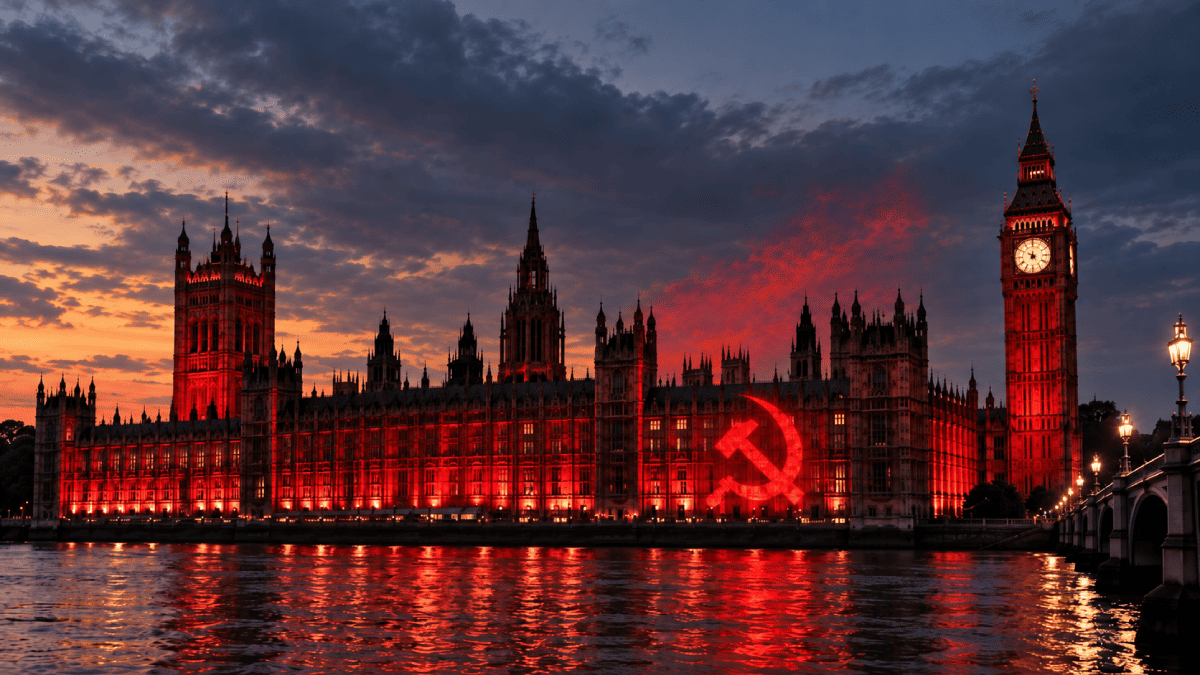
Who Will Rid Us Of This Tiresome Ambulance Chaser?
What will it actually take for this ghastly cardboard zombie to resign? As wipeout in the May 7 local elections approaches (those he tried to block), we can only hope an unprecedented bloody nose focuses this grey man's mind. If he does not dream, does he not experience shame?


It may be arguable, but Henry II did not directly ask for Becket's murder. He asked a question. The knights who heard it understood what he could not bring himself to say: something had to give. England could not be governed by a priest who placed canon law above the authority of the Crown.
Nearly nine centuries later, the same structural failure has returned. Britain is not governed by a statesman. It is governed by a solicitor. The results are everywhere: in shattered alliances, surrendered territories, record taxation, diplomatic humiliation, and a country diminishing on the world stage. Not because it lacks power, but because it lacks anyone who knows how to wield it.
Sir Keir Starmer KCB KC is the most credentialled man ever to occupy Downing Street. He is also, the person who actually made Parliamentary history in the last week by uttering these words in his own defence from the dispatch box whilst throwing yet another junior law associate under the bus to staggering laughter and jeers:
I know many members (of parliament) will find these facts to be incredible, to that I can only say they are right.
A lawyer reads briefs. He applies precedent. He constructs arguments within frameworks built by others. He does not create. He does not improvise. He does not read a room full of hostile actors and calculate, in the space of a breath, what leverage he holds and what he is prepared to lose. He follows procedure.
Statecraft is the opposite of procedure. It is the art of acting decisively in the absence of rules — or, when the rules exist, knowing which ones to break. Palmerston understood this. Disraeli understood this. Churchill understood it profoundly. Starmer does not. He cannot. His entire formation is against it.
Jimmy Savile: Nothing To See Here, Probably
Before he was Prime Minister, Starmer was Director of Public Prosecutions. During his tenure, the CPS reviewed allegations of sexual assault against Jimmy Savile (one of the most prolific child abusers in British history) and declined to prosecute. Starmer says the highest profile case in the institution's contemporary memory never crossed his desk. The CPS says its own records were destroyed. An independent review found the approach "unjustifiably cautious." Three of the four cases could have been prosecuted.
He apologised. He reformed the guidance. He called it a "watershed moment."
The pattern matters more than the particular. A bureaucrat who presides over catastrophic failure, discovers it only after the perpetrator is dead, destroys his own records, then rewrites the procedure — then calls this "leadership" — is not a man fit for statecraft. Starmer's instinct, when confronted with failure, is to change the process. Never the people. Never the culture. Never himself.
Public Anger And The Truncheon
On 29 July 2024, three little girls were murdered at a dance class in Southport. England erupted. Starmer reached for the truncheon. His Attorney General, Lord Hermer, oversaw prosecutions so grossly disproportionate they became an international scandal. Lucy Connolly, a mother with no previous convictions, was imprisoned for thirty-one months for a tweet. Meanwhile, Hermer declined to refer for review sentences given to a rapist, a paedophile, and a terrorist fundraiser; all of whom received less prison time than Connolly.
Vice President Vance cited Britain's speech laws as evidence of European intolerance. The image broadcast to the world: Britain as an authoritarian backwater, jailing mothers for tweets while predators walk free. Starmer created it.
No Democracy Until We Gerrymander
In December 2025, the government postponed local elections across thirty councils, disenfranchising 4.5 million voters, on the pretext of "local government reorganisation." The Electoral Commission said the reasoning did not constitute exceptional circumstances. A mega-poll revealed the real motive: Labour stood to lose ninety-three councillors while Reform stood to gain a hundred and twenty-nine.
It took Nigel Farage to defend the franchise. Reform launched a judicial review. The government folded within weeks, paying Reform's legal costs.
When asked why he reversed himself, Starmer said:
We took further legal advice, and as you would expect as a government, having got further legal advice, we followed that legal advice.
Not: we were wrong to cancel elections. Not: the democratic rights of millions should never have been in question. We followed legal advice.
The Appointments
A Prime Minister is defined by the people he elevates. And where do we even begin here? The list has grown so list it's hard to keep track.
Lord Hermer: a human rights barrister from Matrix Chambers with no political experience, who previously represented Gerry Adams and argued for Shamima Begum's return to Britain. Within months he had compared calls to leave the ECHR to the rise of Nazism, approved the prosecution of Lucy Connolly while declining to review lenient sentences for violent criminals (see above), and provided the legal advice blocking allies access to British bases. Robert Jenrick put it precisely: Hermer had replaced the sovereignty of Parliament with the rule of lawyers.
In December 2024, Starmer announced Peter Mandelson as Ambassador to Washington before security vetting had been completed, despite his infamous record. The vetting committee recommended against clearance. The Foreign Office overruled it.
Olly Robbins, the sacked permanent secretary and arch villain, later told Parliament there had been an "atmosphere of pressure" and a "dismissive attitude" to vetting from Downing Street. Mandelson was "Starmer's candidate."
In September 2025, after emails emerged showing Mandelson offering supportive messages to convicted sex offender Jeffrey Epstein (and apparently leaking market-sensitive government information to him) Starmer finally fired Mandelson and accused him of lying. In February 2026, Mandelson was arrested on suspicion of misconduct in public office. The man sent to represent Britain in Washington is now on police bail.
An Attorney General who likens parliamentary sovereignty to fascism. An Ambassador who leaked state secrets to a paedophile. A Prime Minister who appointed them both, was warned about them both, ignored the warnings about them both, then blamed the civil service for both.
A War Against Our Own Military
While Hermer blocked allied military operations on legal grounds, his worldview was already destroying the forces from within.
SAS soldiers are resigning in significant numbers over fears of prosecution by human rights lawyers. 242 special forces troops, including 120 still serving, are now entangled in legal inquiries costing £1 million a month. The investigations span Afghanistan, Syria, and Northern Ireland. At least two SAS squadrons have been affected.
Former military chiefs wrote an open letter to Starmer warning:
Today every British soldier deployed must consider not only the enemy in front of them but the lawyer behind them. Make no mistake, our closest allies are watching uneasily, and our enemies will be rubbing their hands.
The Army has shrunk to just over 70,000 fully trained soldiers, its smallest since before the Napoleonic Wars. The Navy has seven frigates, six destroyers, and two aircraft carriers Trump called "toys." And now the elite of the elite are walking out because the government they serve has made the courtroom more dangerous than the battlefield.
This is the final consequence of rule by lawyers. The men who carry the weapons lose faith. Not in the mission, but in the state which sent them.
Allegiance To Foreign Pronouncements
Lawyers defer to courts. Statesmen hold territory.
In May 2025, Starmer signed a treaty to cede sovereignty of the Chagos Archipelago ( including Diego Garcia, one of the most important military bases in the Indian Ocean) to communist-allied Mauritius, for a 99-year lease at £101 million per year. The deal was driven by a non-binding ICJ advisory opinion, and irrelevant to any power with a functioning sense of its own interests. Trump called it "an act of great stupidity." The bill was pulled from the King's Speech under American pressure. The Heritage Foundation called it "a humiliating defeat."
Gibraltar is the same instinct applied by salami slice. In February 2026, Starmer published a draft treaty handing socialist-led Spain (via the EU) control over who enters a British Overseas Territory. British citizens flying to Gibraltar now face dual border controls, with Spanish officers empowered to refuse entry. The military base is subject to arms monitoring. The European Court of Justice has jurisdiction. A 1,000-page treaty placing a British possession under EU law.
The precedent is catastrophic: Britain will sign away effective control of its territories if the paperwork is complicated enough.
The Gentleman Only Has Reverse Gear
Starmer does not govern. He announces, retreats, and announces again. The endless u-turns are so extensive they are comic.
- Winter fuel payments stripped from millions of pensioners — then partially restored.
- Mandatory digital ID — scrapped after cabinet threatened mutiny.
- Inheritance tax on family farms — watered down after tractors blockaded Westminster.
- Business rates on pubs — reversed within weeks.
- Day-one unfair dismissal rights — abandoned.
- The two-child benefit cap maintained as a point of principle, then scrapped at a cost of £14 billion.
- Income tax thresholds promised unfrozen, then frozen again.
- The welfare reform bill — gutted by backbenchers.
- Local elections — cancelled, then uncancelled.
- The Chagos deal — signed, championed, then pulled.
- The grooming gangs inquiry — blocked for six months, then conceded.
- Jury trial limitations — floated, then abandoned after a backlash from his own profession.
Two-thirds of Labour's own members told Survation the government had made too many U-turns. Even a sympathetic minister confessed the strategy was to "scrape the barnacles off the boat."
This is a lawyer drafting policy the way he would draft a brief — technically complete, strategically void — then redrafting when the client objects. The client, in this case, is the entire country.
Taxed Into Severe Poverty
The OBR forecasts the tax burden will reach 37.7 per cent of GDP by 2027/28, at the highest since records began in 1948. The OECD confirmed Britain recorded the largest increase in taxes on workers of any advanced economy last year. Borrowing remains at the fifth-highest run on record. Business confidence is at pandemic lows. Unemployment is rising.
What has the money purchased? Not growth. Not reform. Not a revitalised military. It has purchased the maintenance of a bureaucratic state so vast it requires ever-increasing extraction from the productive economy merely to sustain itself.
Harold Wilson's Tribute Act
There is a final indignity. This government is not even original.
Starmer has often been compared to Harold Wilson, and the comparison is apt. But not in the way he would like.
- Wilson kept Britain out of Vietnam. Starmer kept Britain out of Iran.
- Wilson legalised abortion. Starmer provided parliamentary time for unlimited abortion and assisted dying.
- Wilson's government entered the European Economic Community; Starmer is inching back toward the EU with "Swiss-style" arrangement, a customs union floated by his own cabinet, and a 1,000-page Gibraltar treaty placing British territory under ECJ jurisdiction.
- Wilson faced a run on the pound; Starmer faces a run on credibility.
The difference is Wilson was a skilled politician: sharp, witty, astute – and disastrous. He fought five general elections and won four. He outmanoeuvred the Powellite right and the Bennite left. He kept the Labour Party together and quit on his own terms.
Starmer cannot manage his own backbenchers. He has reversed policy at a rate approaching once a fortnight. His own members think he U-turns too much. His party is haemorrhaging support to Reform and the Greens. He lost a parliamentary by-election (Gorton and Denton) to the Greens, with Labour falling to third.
Wilson's domestic programme, whatever one thinks of it, was the product of political conviction applied with parliamentary cunning. Starmer's is the product of no conviction at all: a government reaching for the nearest precedent because it has no ideas of its own. Assisted dying, customs "alignment," welfare reform, abortion: each presented not as a worked-out programme but as a concession to whichever faction is shouting loudest at the time.
Wilson, at least, knew what he believed and chose his battles while destroying the country systematically. Starmer fights them all and wins none.
The Death Knell Of The Special Relationship
The United States asked Britain to open its bases for offensive operations during its Iran offensive. Starmer refused. On Lord Hermer's dirty advice, the government concluded the strikes were not authorised under international law. Britain's most important ally, engaged in the largest military operation since Iraq, asked for access to facilities the US had used for decades: and Starmer said no. Not because he had a strategic objection. Not because he had an alternative plan. Because his lawyer told him it was illegal.
Trump called Starmer "no Winston Churchill." Asked to characterise the special relationship, he responded: "With who?"
Starmer then partially reversed himself after Iran struck a base in Bahrain, narrowly missing British personnel. But the delay cost the US days of replanning. The Chagos deal, which would have provided unimpeded access to Diego Garcia, was now in jeopardy precisely because Starmer had tried to give the island away.
Reeves called America's lack of an exit strategy a "folly." As if Britain's own lack of strategy were someone else's fault.
The gulf visit in April was a farce. Starmer flew to Saudi Arabia, the UAE, and Bahrain. Nothing emerged. He could send only a single destroyer to the region. Putin sent a warship to escort sanctioned Russian oil tankers through the English Channel while a Royal Fleet Auxiliary tanker trailed behind.
Trump had said the Royal Navy's ships were "toys." He was not wrong.
And he's now threatening to punish us by withdrawing support for British ownership of the Falklands –- a fact it gives us at The Restorationist no pleasure at all to point out we predicted would be the next step several weeks ago.
Pretty Boys And Random Arson
In May 2025, three arson attacks targeted properties linked to Starmer in north London. Counter-terrorism police took over. Five men were arrested, including two Ukrainian nationals. The investigation uncovered possible links to Russian intelligence recruitment.
Britain's Prime Minister is a target of hostile state operations on his own soil, and the country's capacity to deter or retaliate has been hollowed out by decades of defence cuts Starmer has shown no urgency to reverse.
And of course, that outstanding superinjunction question remains: how did attractive gay escorts know where Sir Keir lived?
A lawyer sees this as a criminal matter. A statesman sees it as an act of war.
Britain Appointed Its Receiver
The common thread is not incompetence. Starmer is not stupid. He is industrious, disciplined, and methodical. The thread is something worse. It is a worldview.
Starmer believes in rules. He believes international law is law. He believes treaties are sacred. He believes process produces justice. He believes the correct response to every crisis is to commission a review, appoint a lawyer, and publish guidance. And when the guidance fails, he changes it — then calls the change a success.
None of this is true in the arena of nations. International law is not law. It is a set of conventions observed when convenient and ignored when not. Treaties are instruments of power, to be upheld when advantageous and renegotiated when they cease to be. Process does not produce justice. It produces delay. And delay, in diplomacy, is defeat.
The result is a Britain diminished on every axis. Diplomatically isolated from its principal ally. Surrendering sovereignty over its own territories. Taxing its citizens at record levels to fund a state producing nothing. Jailing mothers for tweets while hostile powers set fires on its doorstep. Prosecuting its own elite soldiers while its enemies rub their hands. Reversing its own policies at a rate approaching one a fortnight. Unable to send more than a single warship to defend its interests in a region where its energy supplies depend on freedom of navigation. Led by a man who appointed an Epstein associate as ambassador, a Begum advocate as attorney general, and blames the civil service when both blow up in his face.
This is not governance. It is receivership.
As C. S Lewis wrote of this kind of man:
Of all tyrannies, a tyranny sincerely exercised for the good of its victims may be the most oppressive. It would be better to live under robber barons than under omnipotent moral busybodies. The robber baron's cruelty may sometimes sleep, his cupidity may at some point be satiated; but those who torment us for our own good will torment us without end for they do so with the approval of their own conscience. They may be more likely to go to Heaven yet at the same time likelier to make a Hell of earth. This very kindness stings with intolerable insult. To be "cured" against one's will and cured of states which we may not regard as disease is to be put on a level of those who have not yet reached the age of reason or those who never will; to be classed with infants, imbeciles, and domestic animals.
Henry II's question echoes. Not as a call to violence — God forbid — but as a recognition of the ancient truth it expressed: a nation cannot be governed by a man whose first loyalty is to a system of foreign rules above the nation itself and a doctrine of aggression against its own people and military. Becket chose canon law over the Crown. Starmer chooses international law over British sovereignty, procedural propriety over strategic necessity, the brief over the country.
The knights understood what had to be done. The electorate, in time, will understand too.
Who will rid us of this tedious barrister?
The ballot box. And soon.