When The Empire Burned Its Own Dirty Laundry
During the Swinging Sixties and Disco Seventies, the British Establishment quietly burned, shredded, and dumped anything embarrassing across 37 different colonies it was leaving. The Foreign Office magically "found" boxes of them in 2011 after a long, drawn-out legal battle. Then, it just continued.
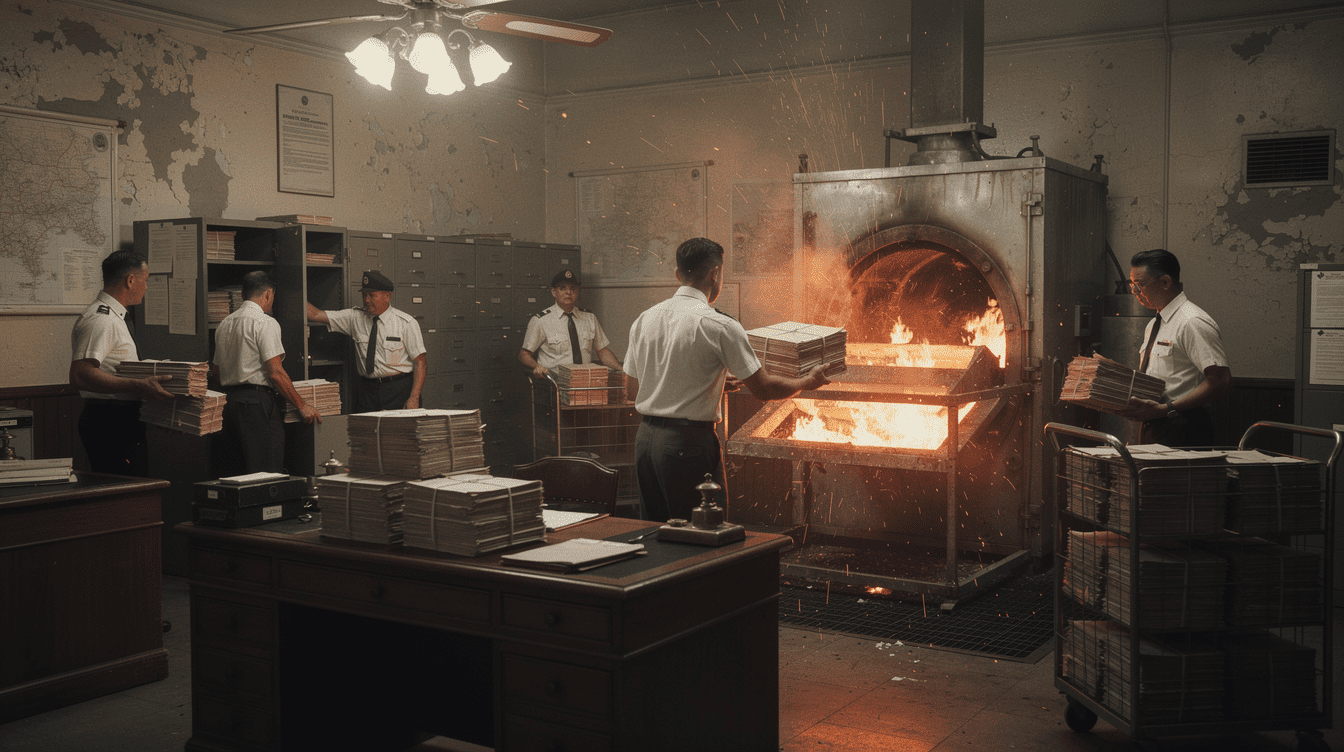
On 3 May 1961, Iain Macleod, then Secretary of State for the Colonies, sat down in London and dispatched a telegram to British embassies across the dying empire. The instructions were precise. Sensitive documents were to be retrieved, sorted, and disposed of. Anything liable to embarrass Her Majesty's Government, expose the identities of local collaborators, or reveal evidence of intelligence operations was to vanish. The work was to be done quietly, by men of a particular complexion, and the destruction was to be certified in writing.
The codename, eventually, was Operation Legacy.
It ran for two decades. It touched at least twenty-three countries, and arguably as many as thirty-seven. It involved bonfires on government lawns, weighted crates dumped in oceanic trenches, naval incinerators working overtime in Singapore, and a fortified compound in Buckinghamshire where the surviving evidence was buried under bureaucratic neglect for half a century. Most British people have never heard of it. This is not an accident. The point of Operation Legacy was, in part, to ensure they never would.
Why are we covering this? Because this practice has never stopped. The continued secrecy and cover-up behaviour never ends. This was happening sixty years ago, and it is still happening now. The government's tactics have moved on to superinjunctions.
A Bureaucracy of Arson
As each colony approached independence, colonial administrators were required to split their files into two categories. "Legacy" material would be passed to the incoming government (the boring stuff, the rates and the road repairs and the stamp duty). "Watch" material would be either flown back to the United Kingdom or destroyed in situ. The criteria for the latter were spelled out in declassified Foreign Office records: documents were to be removed or destroyed if they could "embarrass" Her Majesty's Government, expose intelligence sources, identify collaborators, or reveal "racial prejudice or religious bias."
The destruction guidelines themselves were a small monument to administrative absurdity. When documents were burned, "the waste should be reduced to ash and the ashes broken up", while any that were being dumped at sea must be "packed in weighted crates and dumped in very deep and current-free water at maximum practicable distance from the coast."
Officers in Belize, lacking the appetite for sustained incineration, simply doused everything in petrol with the help of the Royal Navy. Officers in Singapore burned five lorry loads of files at the naval incinerator in 1957. Officers in Aden, by 1966, were burning material a full year before British forces actually withdrew, preparing the ground, as it were, for an entirely fictitious historical record.
In some colonies, the volume of paper was so vast and the deadline so tight that local administrators wrote anxious telegrams back to London warning of "celebrating Independence Day with smoke." The phrase has stuck because it captures the moment perfectly: an empire in retreat, frantically setting fire to its own memoirs while the band tuned up for the handover ceremony.
To prove they had done the work, officers were instructed to send "destruction certificates" back to London. The bureaucracy needed proof its evidence had been destroyed. Civil servants do not stop being civil servants merely because they are committing arson.
A Whites-Only Affair
As the policy formalised in the late 1950s and crystallised in the early 1960s (particularly in East Africa) the work itself was racially restricted. In Uganda from 1961, regulations stated DG files could be viewed only by "a civil service officer who is a British subject of European descent" (where have we heard this one lately?) In Kenya, the same principle applied: only "a servant of the Kenya government who is a British subject of European descent" could participate in the sorting and burning of Watch files. Africans were forbidden from involvement, which is to say, forbidden from witnessing their own history being shovelled into the fire.
This produced some genuinely peculiar bureaucratic moments. On 3 March 1961 the resident of Buganda sent a letter to the chief secretary in Entebbe requesting "permission for Mrs. O.E. De Souza to be an authorised officer". Mrs De Souza was originally a Portuguese national from Goa, India (Goans in Uganda were reported to have been mostly Roman Catholics). Whitehall's racial filtering had run into the basic problem of the empire itself: it had spent four centuries mixing populations, and now its own filing cabinets were forcing it to define what "European" meant. The Goan Catholic problem was solved on a case-by-case basis. The principle, however, stood.
It was not a slip. It was not a regrettable lapse. The exclusion was deliberate and codified, on the explicit basis non-Europeans could not be trusted with knowledge of things the empire had actually done.
Why the Files Mattered
In 2011, after a sustained legal battle by five elderly Kenyans (survivors of the so-called Mau Mau Emergency) the Foreign and Commonwealth Office was forced to admit it had been holding, in secret, a vast cache of files at Hanslope Park, a fortified government compound near Milton Keynes which the FCO shares with GCHQ's communications wing and MI6. The FCO was forced to reveal the existence of some 1,500 government files secretly removed from Kenya on the eve of independence. These files described, in the bone-dry prose of British administration, the systematic torture of Mau Mau detainees: castration, sexual assault with hot bottles, beatings to the point of unconsciousness, the use of dogs and electric shock.
If any of this is sounding eerily familiar, it might be because the British Establishment recently had to pay an unknown amount of taxpayer money for being involved in the torture of detainees during the War on Terror.
One memorandum from June 1957 by Eric Griffith-Jones, the Attorney-General of Kenya, was particularly illuminating. Griffith-Jones advised the Governor of Kenya, Sir Evelyn Baring in no uncertain terms our Establishment doctrine:
If we are going to sin, we must sin quietly.
He was authorising specific forms of violence against detainees, including the placing of a foot on the throat and the stuffing of mud into the mouth, with knocking unconscious as the last resort. This was not a rogue official. This was the chief legal officer of the colony, advising the Governor on how to torture more discreetly.
The Hanslope cache was the tip of an iceberg.
The FCO held not only the Kenya papers but also comparable collections from another 37 former dependencies. The Cary Report (commissioned by the Foreign Secretary in 2011 to investigate "what went wrong and what lessons should we draw?" in yawningly-familiar terms) eventually catalogued an inventory described as "shocking in its extent." The full archive at Hanslope Park was estimated to comprise roughly 1.2 million documents, with material stretching back to the seventeenth century: slave trade, Boer wars, world wars, and the Cold War, all sitting in a building whose existence the government had previously denied.
That is what they kept. The unanswerable horror is what they burned.
The Greatest Hits Of The Bonfire
The list of colonies subject to the operation reads like an A-Z of grievance.
- Cyprus, where the British conducted a counter-insurgency against EOKA and where torture allegations have long circulated.
- Aden, where files were burned for a year before withdrawal.
- Malaya, where the Batang Kali massacre (an incident when twenty-four unarmed Chinese rubber tappers shot dead by Scots Guards in December 1948) has never been the subject of a public inquiry, and where when the British pulled out of Malaya in 1957, any incriminating evidence about the events of December, 1948 had been destroyed.
- British Guiana, where a democratically elected government was toppled by Britain in 1953, and where the secret "Personal" filing system originated as a means of keeping the operational details from the locals.
- Northern Rhodesia. Tanganyika. Uganda. Nigeria. Ceylon. Sarawak. North Borneo. Brunei. Belize.
The list extends across continents, climates, and races, and the common thread is uniform: when the British left, they took the evidence with them, or they burned it.
The Batang Kali case is particularly horrendous. The Scots Guards shot the men dead in 1948. After the massacre, British diplomats introduced Regulation 27A, which authorised "the use of lethal weapons" to "prevent escape from arrest", in an attempt to retrospectively legalise the Scots Guards' massacre of civilians. This new regulation was uncovered within secret documents which had been hidden from public view at Hanslope Park by the Foreign Office. The villagers were murdered first; the legal framework justifying their murder was invented afterwards. The British government has, as of 2025, finally apologised, after seventy-seven years of obstruction, deflection, and document destruction.
Hanslope Park And The Polite Fiction of Discovery
Operation Legacy did not emerge from nothing. It was, in part, a response to a previous embarrassment. As decolonisation progressed, British officials were keen to avoid a repeat of the embarrassment that had been caused by the overt burning of documents which took place in New Delhi in 1946, uncovered by Indian news sources. The Indian fire had been visible. Smoke had hung over the city for days, photographers had taken pictures, and the local press had reported it. By 1961, the lesson had been absorbed: burn quietly, or, better still, ship the evidence home.
This was not a moral revision, it was a public-relations refinement. The empire had not learned to stop hiding its conduct; it had merely learned to hide its hiding.
The official line, when the Hanslope cache was finally acknowledged, was the files had been mislaid. The FCO suggested, with a straight face, the existence of over a million documents in a high-security government compound had simply slipped its institutional mind. Officially, the FCO responded its own accidental neglect had resulted in the scandal.
This was nonsense, and the scholars who eventually got into the files said so plainly. In response to growing pressures from former colonies and international organisations, the FCO intentionally concealed "embarrassing" colonial administrative files from public view as a strategy to preserve the UK's diplomatic standing and political prowess amidst the geopolitical shifts caused by decolonisation and the Cold War. The concealment was a policy. The forgetfulness was a fiction.
This pattern of "losing" important paper is absolutely endemic.
Worse, even after the 2011 admission, the release was partial and slow. A piece by Caroline Elkins in the Guardian on the day of the first release conveyed the ongoing sense of suspicion and lack of transparency even as the records were being released to the public: the first tranche was thin precisely on the colonies where future lawsuits were most plausible. The state continued to manage the disclosure as if it were managing a wound, deciding which scabs to pick and which to leave.
This Cover-Up Instinct Has To Stop
It is tempting to treat Operation Legacy as a closed file: a regrettable episode of imperial twilight, now safely catalogued, now properly studied. This is a comforting view. It is also wrong.
The operation was an instance, not an exception. In 2013 the Ministry of Defence was holding more than 66,000 files unlawfully, and had been granted permission to retain another 8.5 million under the legal fiction that they were still in use. Some highly sensitive material had been destroyed under the unverified pretext files were damaged during an asbestos-decontamination exercise (a tactic literally described in Yes, Minister three decades before).
The Secret Intelligence Service has declassified none of its contemporary files. MI5 and GCHQ have released only what they choose. Private contractors performing government work fall outside the Freedom of Information Act entirely. The state has, in short, generalised the techniques pioneered in the colonies.
The Victorian 1889 Official Secrets Act created the legal architecture; Operation Legacy demonstrated the operational technique; the Hanslope cache showed the institutional appetite. And the modern surveillance state, with its sealed inquests, closed material proceedings, and immortal exemptions, has built upon all three.
If the files describing the torture of Mau Mau detainees could be hidden for fifty years inside a working government compound, with the cooperation of successive ministers, civil servants, and lawyers, then the question is not whether the British state can be trusted with its own records. The answer to that question was settled the moment Iain Macleod sent his telegram. The question is what else, right now, sits in similar buildings, awaiting a similar accidental discovery half a century from now.
Nobody knows.
That is the most damning thing about Operation Legacy: by its own logic, the catalogue of what was destroyed cannot exist. The destruction certificates record destruction occurred. They do not always record what was destroyed. An independent audit revealed there were more than 20,000 files taken from former colonies. Some files were also slated for destruction, and there is no way to know how many were destroyed.
The Mau Mau case was won because survivors carried scars on their bodies and memories in their heads, and because three historians (David Anderson, Huw Bennett, and Caroline Elkins) refused to accept the sanitised official record. The case turned on physical bodies and oral testimony, precisely because the documentary record had been engineered to defeat exactly that kind of claim. The five claimants who eventually received compensation in 2013 were lucky in a way thousands of others were not. The state was caught with the files it had failed to burn, not with the files it had successfully destroyed.
For every Kenya, there are colonies whose victims have no surviving litigants, no Hanslope cache, no expert historians fighting on their behalf. The bonfire worked. We do not know what was on the bonfire. That is the bonfire's purpose.
The State As History Editor
Britain has long preferred to think of itself as the sort of country in which this does not happen. The mythology insists upon a tradition of liberal openness, parliamentary scrutiny, an independent press, an incorruptible civil service, an empire administered with reluctant fairness and decolonised with magnanimous restraint. The state, in this telling, is a custodian of records and a guarantor of accountability.
Operation Legacy is the rebuttal in documentary form. Or rather, it would be, if the documentary form had survived. The state is not a custodian of records. It is an editor of them. Where the record threatens its own legitimacy, the state burns the record. Where burning is too visible, the state hides the record. Where hiding becomes impossible, the state pleads forgetfulness. Where forgetfulness fails, the state releases the record selectively, cushioned in apology, while quietly retaining whatever can still be retained. None of this is conjecture. All of it is documented in the files Whitehall failed to destroy.
The only honest response is to stop pretending. The British state has, for at least a century and a half, treated its own historical record as an instrument of statecraft. The bonfires of Operation Legacy were not a betrayal of British political tradition. They were one of its most thorough expressions.
The smoke has long since cleared. The ash, dutifully broken up, has long since blown away. And somewhere in the deep, current-free water off some unloved coast, weighted crates full of documents are still doing the work they were sent there to do.