£15.3 Billion On Hotel Rooms For Asylum Applicants
Asylum hotels cost £144.98 per person per night because the Home Office could not process claims at £23.25. Contractors took £383 million in profit. The department forgot to collect what its own contracts said it was owed. The total bill hit £15 billion.
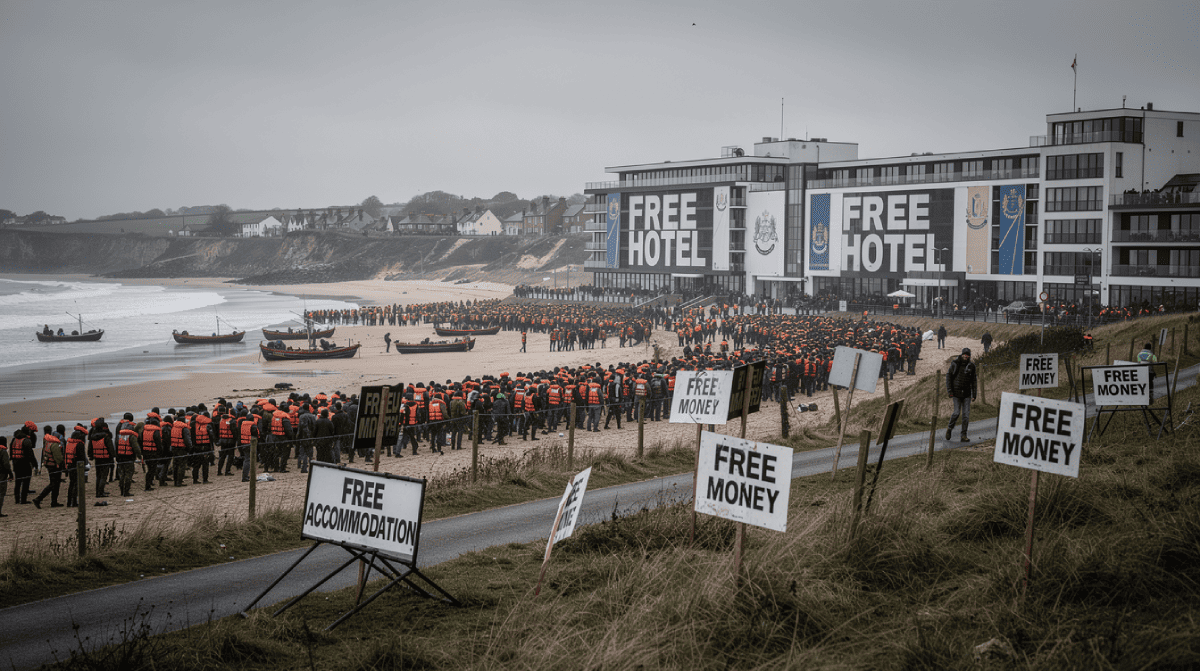
The British state spends £5.77 million a day on asylum hotels. Not on processing claims. Not on making decisions. Not on removals, integration, or any other activity which might one day reduce the number of people requiring accommodation. On hotels. Five point seven seven million pounds, every single day, to keep people in commercial rooms because the Home Office cannot do the one thing it exists to do: administer the system.
How much should this cost? The Home Office's own estimate puts dispersal accommodation at £23.25 per person per night. Contingency hotels cost £144.98. Six times the price. The difference is not explained by the quality of the hotel.
It is actually explained by the failure of the department: insufficient dispersal housing, unprocessed claims, an ever-growing backlog, and a government buying nightly capacity on the open market because it never built the infrastructure to do otherwise. Add catering, security, and laundry, and the figure rises further.
One senior Home Office manager, interviewed by the spectacularly-futile Independent Chief Inspector of Borders and Immigration which has no purpose or point, described the department's internal culture in three words: "just do things." Buy the hotel. Sign the contract. House the people. Send the invoice. Worry later.
The cost of the department's asylum accommodation contracts has tripled in a decade, from £4.5 billion to £15.3 billion. Annual asylum support spending rose from £739 million in 2019–20 to £4.7 billion at peak crisis in 2023–24.
The following year it fell to £4.0 billion, and the Home Office presented the reduction as progress for partisan radical "fact checkers" to manipulate. It is not progress. It is a department measuring competence by the distance between today's catastrophe and yesterday's slightly larger one.
The British asylum hotel state is so much worse than an immigration argument: it is a system so comprehensively broken it became its own industry.
How £23.25 Became £144.98
The Home Office has a statutory obligation to accommodate destitute asylum seekers while their claims are processed. In ordinary language, the law says the government must provide housing for applicants. One cannot simply "switch off" accommodation for migrants, because it is written into British law. To not do it, one must pass a different law to repeal it or be acting illegally.
The system appears humane and is simple enough in principle: people arrive, claims are assessed, decisions are made, and those granted protection move into settled housing while those refused are removed. What makes the system expensive is not the obligation. It is the failure to perform every step after the first one.
The number of people in Home Office accommodation rose from roughly 47,500 at the end of 2018 to 119,000 at the September 2023 peak, and was still approximately 103,000 in June 2025. Every unprocessed claim added a person. Every person needed a bed. The dispersal system, designed to place claimants in cheaper housing around the country, could not absorb the volume. Local authorities resisted. Contracts were weak. Forecasting was absent. And in the place where a functioning accommodation strategy should have been, there was nothing at all. The Home Affairs Committee found the Home Office's ten-year accommodation strategy had still not been published. It remained unclear what the strategy was, or whether one existed.
So the department did the only thing it could: it panic-bought hotel rooms. £8.3 million per day in 2023–24. £5.77 million per day in 2024–25. The Home Affairs Committee concluded the Home Office had failed to demonstrate any strategy, relying instead on "hasty, short-term responses" and wasting taxpayers' money.
The Committee also identifies the contributing factor most observers had already suspected.
The government's Rwanda deportation scheme actively paused asylum decision-making, deliberately swelling the backlog the department was already failing to manage. The state engineered additional delay into a system collapsing under delay. And it diverted resources to do so: Rwanda cost £290 million, relocated four volunteers, and at its peak absorbed 1,000 Home Office staff. Angela Eagle described a "10-point plan frenzy of trying to make Rwanda work," while the hotels filled and the contracts burned.
The department could not process claims. It could not manage the accommodation those unprocessed claims required. And it pulled a thousand staff off the job to pursue a scheme which moved four people, at a cost of £72.5 million each.
The Machine Where Failure Was Revenue
The asylum hotel system is not merely expensive. It is structurally self-reinforcing, and this is what separates it from ordinary government waste.
- Every unprocessed claim added a person to the accommodation system.
- Every person in the system generated a nightly cost.
- Every night in a hotel generated revenue for the contractor.
- And the Home Office, having failed to build sufficient dispersal housing, had no cheaper alternative to offer.
The result was a machine where administrative failure was the product.
- The longer claims took, the more accommodation was needed.
- The more accommodation was needed, the more hotels were booked.
- The more hotels were booked, the more the contractors earned.
The National Audit Office quantified the distortion. People in hotels accounted for roughly 35 per cent of those in asylum accommodation but 76 per cent of contract costs in the first seven months of 2024–25: £1.3 billion out of £1.7 billion.
A third of the residents were generating three-quarters of the bill. That is known as a Pareto distribution, and it is found everywhere on planet Earth.
The contracts were awarded to three regional providers: Clearsprings, Serco, and Mears. The original ten-year estimate was £4.5 billion. It is now £15.3 billion. Yvette Cooper told the Committee many were "signed in a rush" in summer 2022 and were not the most effective. The department panic-bought capacity on weak terms from a position of desperation and has been paying the premium ever since.
Even the NAO's view of contractor profitability carries a revealing caveat:
This briefing does not seek to evaluate the Home Office’s management or oversight of the contracts or to conclude on their value for money. It also does not examine the Home Office’s procurement of the contracts, which we covered in our 2020 report. This briefing uses historic data on performance and profitability reported by suppliers to the Home Office. We have not audited these data and they are subject to an ongoing audit by the Home Office.
The watchdog's picture of the system is partly painted by the companies being watched. Naturally, we can presume it is honest, because these providers always are.
They Forgot To Collect
The contractors reported £383 million in total profit since the contracts began, at an average margin of 7 per cent. Profit-share clauses in the contracts were supposed to claw back excess returns. Mears expected to repay approximately £13.8 million. Clearsprings expected to repay approximately £32 million.
The Home Affairs Committee found the Home Office had not validated the provider profit data. It described as "extremely disappointing" the fact the department only appeared to have started recouping excess profits in 2024, years after the contracts began generating them.
The scandal here is not simply profiteering. It is worse.
The Home Office wrote profit-share clauses into its own contracts, then failed even to enforce them.
The department could not process claims, could not manage accommodation, could not control costs, and could not be bothered to collect the money its own legal agreements said it was owed. It built a system where failure was profitable, then could not even administer the mechanism designed to limit the profit.
The Alternatives Were Worse
The obvious counterargument is: at least the government tried to get people out of hotels. It did. The results were, if anything, more embarrassing.
The Home Office pursued a large-sites programme as an alternative to commercial hotels. The NAO reported the department expected the programme to cost £1.2 billion, and by March 2024 it projected those sites would cost £46 million more than the hotels they were supposed to replace. Four sites were expected to cost £230 million by March 2024 while housing only about 900 people at the end of January 2024. The pointless Infrastructure and Projects Authority red-rated the programme three times, meaning successful delivery appeared to be unachievable.
The individual sites tell their own stories. Wethersfield was estimated at £132 per person per night, but the figure excluded £105 million in acquisition, lease, and setup costs. Northeye cost £15.4 million and was found unsuitable. RAF Scampton was cancelled after £48.5 million had already been invested.
The department did not find an alternative to failure. It diversified failure. It took a hotel problem, spent hundreds of millions trying to solve it with large sites, produced large sites more expensive than the hotels, and still had the hotels. The backlog did not shrink. The costs did not fall. The only thing produced in abundance was consultancy fees, feasibility studies, and ministerial announcements about grip.
How They Hid The Bill
If the spending is scandalous, the accounting is an education in how the modern British state conceals its own costs from the public and from Parliament.
The National Audit Office's 2025 analysis of the asylum system concluded Parliament needs a whole-system view of costs, constraints, and responsibilities. Without clear outcomes, it said, there had been no firm basis for departments to work together. Short-term improvements often shunted problems elsewhere. The system is not one machine. It is a series of failures passed from one ledger to another, and no single number captures the total.
Inside the Home Office accounts, hotel costs are folded into a line called "Asylum Support, Resettlement and Accommodation," recording £4.51 billion in Resource DEL for 2024–25. Hotels are not broken out at the top level. A parliamentary researcher looking at headline departmental numbers will find one combined figure with no immediate indication of how much went on hotels, how much on dispersal, how much on subsistence, how much on local authority grants, and how much on everything else the department would prefer you did not separate.
Further into the accounts, a clearer figure appears: £4.0 billion in asylum support, of which £2.1 billion was hotels. But asylum support, as the Committee itself notes, does not capture every cost the system imposes. Policing, health services, safeguarding, homelessness support, and the administrative burden on local authorities absorbing dispersal placements are all real, all ongoing, and all recorded somewhere other than the Home Office's books.
To appreciate the scale of what sits outside the ledger: the utterly absurd Office for Value for Money reported local authorities separately spent over £2.8 billion procuring short-term residential accommodation in 2024–25. Not all of it is asylum. But the figure illustrates the size of the wider public-sector accommodation market into which the Home Office's failure poured additional demand and additional cost.
Then there is the foreign aid budget.
How Asylum Hotels Ate The Aid Budget
Under OECD rules, certain first-year costs of supporting refugees and asylum seekers in a host country can be classified as Official Development Assistance. The Home Office used this provision with enthusiasm. ICAI, the futile quango for UK aid spending, reported the department declared almost £2.4 billion of in-donor refugee costs as ODA in 2022, with hotel accommodation alone accounting for nearly £1.9 billion.
The mechanics of this deserve spelling out.
- The Home Office failed to process asylum claims at a reasonable speed.
- The backlog grew.
- People were housed in commercial hotels at commercial rates because the department had no alternative.
- And then a large share of the cost was booked to the foreign aid budget.
ICAI's assessment was politely devastating. It found the UK was taking a "maximalist" approach to reporting in-donor refugee costs as ODA, claiming everything potentially eligible, with opaque pricing and limited transparency. The aid budget was not consumed by refugees. It was consumed by the Home Office's inability to administer its own caseload. British taxpayers were simultaneously funding commercial hotels for asylum seekers and cutting real aid programmes abroad, and both outcomes were products of the same administrative failure.
The fourth mechanism is simpler and almost quaint by comparison. The Home Office's 2026 Supplementary Estimates memorandum announces, with palpable self-congratulation, the department would not need Reserve funding for the first time in six years. Five consecutive years of emergency bailouts from central reserves. Five years of costs so badly forecast or so poorly controlled the Treasury had to provide top-ups. And the department now expects applause for stopping.
Hotel Rates At Prison Quality
The public might reasonably assume £144.98 per person per night purchases, at minimum, safe and humane conditions. It did not. And this is where the right fails, giving the left a massive open door to drive its own partisan wedge into the issue.
- Vulnerable people were placed in unsuitable settings.
- Referrals were delayed.
- Reports of abuse and harassment went unaddressed.
- Children were potentially placed in adult accommodation, and
- Providers faced no financial penalties for failing safeguarding requirements.
The department charged the taxpayer hotel rates and delivered neither administrative competence, public order, nor humane safeguarding. The system was not merely expensive. It was expensive and inadequate simultaneously: the worst possible combination for a government trying to justify the cost, and the worst possible outcome for the people it was supposed to be housing.
Guess Who Is In The Middle Of It
You already know. Dame Antonia Romeo served as Permanent Secretary of the Home Office from April 2025 to February 2026. She signed the 2024–25 Annual Report and Accounts on 14 July 2025, as Accounting Officer, recording £4.0 billion in asylum support and £2.1 billion on hotels within a department the Home Affairs Committee concluded had no demonstrable strategy. She approved the Supplementary Estimates memorandum on 10 February 2026.
Nine days later she was appointed Cabinet Secretary and Head of the Civil Service.
She did not create the contracts. The hotel explosion predates her tenure. But she held the accounting officer role for a department spending £5.77 million a day on emergency accommodation, six years into the emergency, with no published long-term plan, contracts the Home Secretary herself described as rushed and ineffective, a watchdog relying on unaudited supplier data, and profit-share clauses the department had only just started to enforce.
Romeo has been an unqualified disaster in every department she has touched. Moreover, she is an arrogant, pathological bully who has been groomed for the unelected position over a decade.
In any private company, signing off accounts for a division carrying a multi-billion-pound procurement failure of this kind would not normally precede promotion to group chief executive. In Whitehall, failure is not disqualifying. It is often just another posting.
A Cascade Of Incompetence
Every major British procurement and administrative scandal of the past decade follows the same structure.
- A department acquires an obligation.
- It fails to build the capacity to meet it.
- A backlog forms.
- Emergency measures are introduced.
- The emergency becomes permanent.
- Contractors are engaged on poor terms.
- Costs escalate.
- The bill is scattered across multiple accounting lines.
- The department claims progress by measuring reductions from the peak of its own crisis.
- Officials are promoted.
Nobody is held responsible.
The asylum hotel system is not a special case. It is the template. It is the Emergency Services Network, unable to replace Airwave. It is Ajax, unable to produce an armoured vehicle. It is the same institutional muscle memory: unable to plan, unable to deliver, unable to stop spending, and always, unfailingly, able to generate a press release about "lessons learned."
The Home Office did not solve an asylum backlog. It housed the backlog at hotel rates. It did not manage a crisis. It monetised one. When it tried to escape the hotels, it produced alternatives more expensive than the hotels. When contractors made excess profits, it forgot to collect. When the bill became too large for one budget, it spread it across four. And when the aid budget was consumed by domestic failure, it classified the failure as development and carried on.
Britain did not buy accommodation. It bought time, at £5.77 million a day. And it does not appear to have used the time for anything at all.