70 Years of British UFO Secrecy
Whitehall studied unidentified objects for half a century while telling Parliament it had no interest. It shredded files, planned to edit others, and now hides behind GCHQ rather than say what it holds. The alien spacecraft remain unproven. The concealment is signed, dated, and filed at Kew.
On 28th July 1952, Winston Churchill sent a minute to the Secretary of State for Air. "What does all this stuff about flying saucers amount to? What can it mean? What is the truth?" The original minute survives as PREM 11/855 at The National Archives.
Lord De L'Isle replied on 9th August. A full intelligence study had dealt with the matter in 1951, he wrote, and flying saucers could be put down to astronomical and weather phenomena, misidentified aircraft and balloons, optical illusions, delusions, and hoaxes.
The Flying Saucer Working Party, drawn from the Directorate of Scientific Intelligence and the Joint Technical Intelligence Committee, had produced a classified report (now DEFE 44/119) and recommended no further special investigation.
The public learned of it half a century later.
Britain's official dealings with unidentified objects have followed the same routine ever since: quiet study in private, a weary shrug in public, and files which turn up decades late, if at all.
The scientific case for alien visitors in the British record is thin. The documentary case for official concealment is not.
| Case | Date | Strongest evidence | Main weakness | Standing |
|---|---|---|---|---|
| Lakenheath-Bentwaters | 13th-14th August 1956 | Several radars, interceptor pilots, a sceptical US study rating it unexplained | Accounts written years later; British files destroyed | Unexplained |
| West Freugh | 4th April 1957 | Multiple radar units; surviving Air Ministry technical report | No raw radar data; no visual sighting | Unexplained |
| Broad Haven | 4th February 1977 | Fourteen witnesses; drawings made at the time | Children, no instruments, an admitted prankster | Weak |
| Rendlesham Forest | 26th-28th December 1980 | Senior officer's memo, audio tape, radiation readings | Lighthouse on the bearing; readings near background | Largely explained |
| Calvine | 4th August 1990 | An authenticated photographic print | No distance; witnesses unknown; negatives missing | Unexplained, poorly recorded |
| Cosford | 30th-31st March 1993 | Police and military witnesses across several counties | Rocket re-entry matched by Fylingdales and CNES | Explained |
| Alderney | 23rd April 2007 | Two professional pilots; written notes and sketch | No radar match; no distance | Unexplained |
The MoD's own spokesman put the unexplained remainder of all reports at around 5 per cent. An unexplained case marks a gap in knowledge and proves nothing further.
The interesting cases share one feature: instruments recorded something and nobody kept the data.
Two Decades Of Files Shredded
Until 1967, Ministry of Defence policy was to destroy UFO files at five-yearly intervals. The National Archives concedes most records from before 1962 are gone.
In 1967 ministers promised to preserve such files because of public interest. Desk officers treated the promise as optional. Releases in 2011 showed Defence Intelligence files of sighting reports for 1967 to 1975, 1976 to 1978, and 1980 to 1983 were destroyed anyway, along with an MoD note from 2001 confirming branches had carried on shredding in spite of the ministerial commitment.
Routine disposal is not proof of a plot. It does mean every claim about what the British state knew in the 1950s and 1960s rests on an archive with its foundations removed.
Incidents The Air Ministry Never Explained
On the night of 13th to 14th August 1956, radar operators at RAF Bentwaters and RAF Lakenheath in Suffolk, both run by the United States Air Force, tracked targets moving at extraordinary speeds. RAF Venom night fighters were scrambled. One pilot reported the target manoeuvring behind his aircraft. The American Condon Committee (established to debunk exactly this sort of thing), examined the case and rated the chance of a genuinely unidentified object as "fairly high". Coming from a study otherwise dismissive of the whole subject, the verdict carries weight.
The fullest account came from watch supervisor Forrest Perkins in a letter written twelve years later, and subsequent research found the events messier than Condon allowed.
Any British Air Ministry file from 1956 fell squarely within the five-year destruction cycle.
Less than eight months later, on 4th April 1957, radar at the West Freugh bombing range in Wigtownshire and mobile units nearby tracked unidentified targets. The station commander, Wing Commander Walter Whitworth, told reporters it was "an object of some substance". Air technical intelligence produced a report, Unidentified Objects at West Freugh, now AIR 20/9320.
When American researchers asked for it, the Air Ministry wrote back on 14th May 1957 declining to release any information at all.
Radar does not see objects. It measures reflected radio energy and a computer or operator turns the echoes into tracks. Temperature inversions bend radar beams and produce phantom targets, and joining unrelated echoes produces impossible speeds.
Agreement between independent radars, ideally with a visual sighting at the same moment, is far harder to dismiss.
Both cases offer some of this.
Neither left the raw recordings needed to settle the matter.
Rendlesham Forest And A Lighthouse
In the early hours of 26th December 1980, security patrolmen at RAF Woodbridge in Suffolk saw lights descending into Rendlesham Forest. Two nights later the deputy base commander, Lieutenant Colonel Charles Halt, led a party into the trees with a tape recorder and a radiation meter.
His memo to the MoD, dated 13th January 1981 and headed Unexplained Lights, reported three depressions in the ground and beta and gamma readings of 0.1 milliroentgens.
It also got the dates of both nights wrong.
Suffolk Police attended on the first night and saw nothing but the Orford Ness lighthouse.
The astronomer Ian Ridpath stood on the spot and found the beam appeared to hover a few feet above the ground, because the forest sits higher than the coast. The radiation readings were modest by any standard: elsewhere in the area the same military survey meter registered roughly 0.03 to 0.04, close to normal background.
A reading a little above background, taken at night by men expecting to find something, does not point to an exotic power source.
Rendlesham is superbly documented as a story of puzzled servicemen. As evidence of a landed craft, Britain's "Roswell" amounts to an American officer, some marks on a forest floor, and a lighthouse which had been flashing over Suffolk since 1792.
A Russian Rocket Stage Over Shropshire
In the early hours of 31st March 1993, police and military witnesses across the Midlands and the West Country reported a vast craft. At RAF Cosford a Ministry of Defence Police patrol watched bright lights, and at RAF Shawbury a meteorological officer described a large object sweeping a beam across the fields.
Nick Pope, then on the MoD's UFO desk, told his superiors an object of unknown origin appeared to have crossed British airspace undetected by radar and recommended further investigation.
The answer arrived from the RAF's own tracking station. RAF Fylingdales told Pope a Russian rocket had re-entered the atmosphere around the relevant time: the Tsyklon booster which had launched the Cosmos 2238 satellite the previous evening, breaking up as it fell. The French space agency, CNES, matched the same re-entry to sightings by gendarmes and pilots in France the same night.
The Shawbury officer, Wayne Elliott, later said his sighting came an hour after Cosford's and was probably a police helicopter.
Burning debris tens of miles up looks like a formation of lights much nearer. Assume the wrong height and a scatter of fragments becomes a structured triangle the size of a football pitch.
Cosford remains the best British lesson in why a wave of reports need not describe a single object.
Calvine: A Genuine Unidentified Object
On 4th August 1990, two men near Calvine in Highland Perthshire photographed a large diamond-like object in the sky with a jet aircraft below it. They passed six colour photographs to the Daily Record, which sent them to the MoD. The photographs then vanished from public view for three decades.
The MoD released poor photocopies in 2009 and withheld the photographer's identity until 2076.
In 2022 the researcher Dr David Clarke traced a surviving print kept by Craig Lindsay, a former RAF press officer, and Lindsay donated it to Sheffield Hallam University.
The university's photography specialist, Andrew Robinson, examined grain, focus, and the physical print. His 2024 analysis concluded the print was a genuine copy of the original image the MoD analysed in 1990, and his earlier report called it a genuine photograph of a scene before the camera.
Clarke's team has since identified a likely vantage point at Struan Point, and a former colleague claims the photographers were chefs at a Pitlochry hotel.
None of this establishes size or distance.
A model a few metres from the lens and a huge craft a mile away can fill exactly the same part of a frame. Without a measured range, apparent size is guesswork. Proposed explanations, from a hilltop poking through mist to an inverted reflection in a pond, remain contested.
The paper trail is now as interesting as the picture.
In March 2026 a freedom of information request asked The National Archives for any retention instrument allowing the MoD to keep back Calvine material, and for any correspondence about delayed transfer.
The answer was information not held.
Where the original negatives went after September 1990 is unknown.
Alderney And The Mile-Wide Object
On 23rd April 2007, Aurigny pilot Captain Ray Bowyer reported two brilliant yellow objects west of Alderney. A Blue Islands pilot, Patrick Patterson, reported something similar in the same position.
Bowyer's own account illustrates the central problem with eyewitness size estimates. He first judged the object about ten miles away and the size of a Boeing 737, then decided it was nearer forty miles off and possibly a mile wide.
The angle it filled in his windscreen never changed. Only his guess at distance did, and the size quadrupled with it.
Jersey air traffic control radar showed nothing matching the objects.
Its two best candidates, sunlight reflecting off a haze layer and geological "earthquake lights", each left problems unsolved, and the authors found press talk of giant radar-tracked craft greatly exaggerated.
An experienced professional saw something real and recorded it carefully. Nobody could measure what it was.
14 Schoolchildren And A Man In A Silver Suit
On 4th February 1977, fourteen pupils at Broad Haven Primary School in Pembrokeshire reported a silver craft in a field and, in some accounts, a silver-suited figure. Their drawings became the centrepiece of the "Welsh Triangle" press frenzy.
Clarke's review of the files shows the MoD kept a careful eye on the episode.
Years later a local businessman admitted to walking around the area in a silver suit as a prank.
His confession does not explain every detail the children described.
It does show how a sincere group of witnesses can converge on a shared account without any physical evidence ever existing.
DI55 And The Plan To Edit The Archive
For decades the public dealt with a modest secretariat known as the UFO desk. Behind it sat DI55, a branch of the Defence Intelligence Staff, which secretly collected sighting reports from 1967 until the end of 2000. The desk officers copied every report to DI55 and had no right to know what happened next.
Freedom of information requests by David Clarke and Andy Roberts, reported by The Guardian in September 2006, exposed how hard officials worked to keep the arrangement quiet.
One DI55 memo described consulting the Air Historical Branch on "ways of expurgating the official records" before they became eligible for release.
A proposal in the 1980s for a computerised database of reports was rejected because it could be "very embarrassing for us", since ministers had long told the public the MoD did no such work.
By July 1995 a DI55 officer saw no reason to keep denying the intelligence interest, but foresaw a different embarrassment.
Admitting the role would invite questions, and few people would believe the honest answer: lack of funds and higher priorities had prevented any proper study of the thousands of reports received.
The British cover-up, on its own officers' account, concealed an intelligence branch receiving thousands of reports without the money to study them, while officials discussed scrubbing its role from the historical record.
In August 2000, with UFO report files missing from its own archive, DI55 asked security staff to look into the researcher requesting them and anyone who might be leaking to him.
Project Condign Revealed In 2006
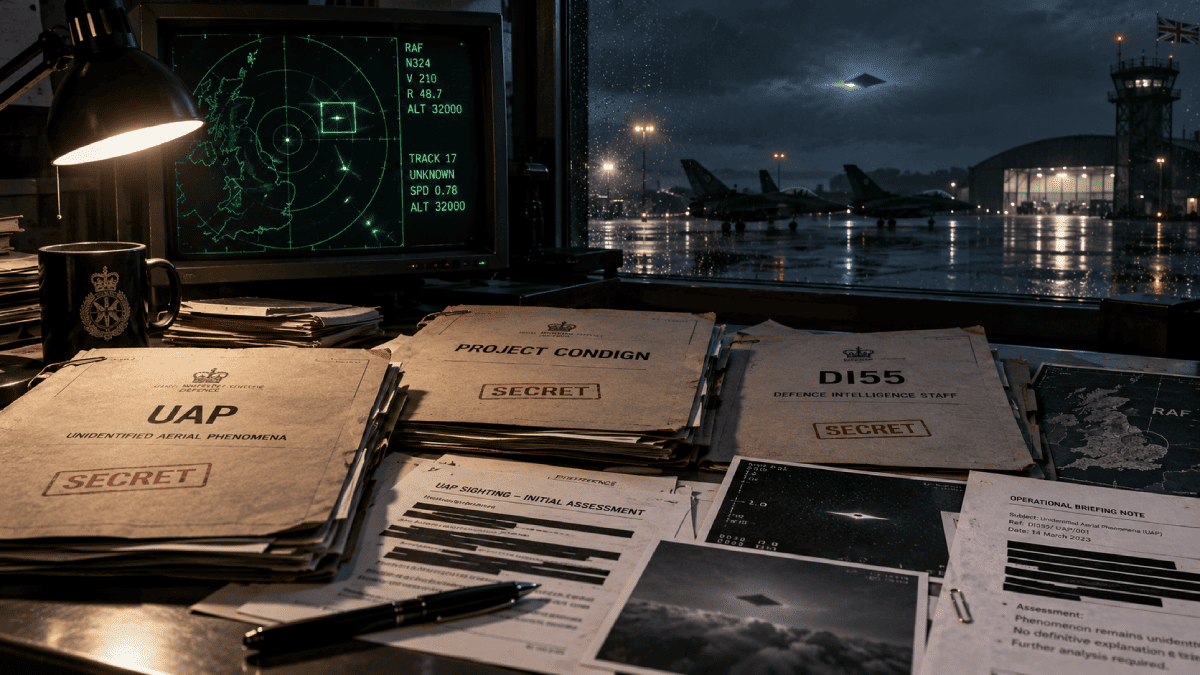
The one serious scientific effort came at the very end of DI55's involvement. Begun in 1996 and handed over in December 2000, the study carried the title Unidentified Aerial Phenomena in the UK Air Defence Region and was classified Secret UK Eyes Only.
Only eleven copies were made of its 460-plus pages. It drew on roughly 10,000 reports.
It found no evidence of hostile intent, foreign control, or an extraterrestrial source.
It then proposed "buoyant plasma formations", electrically charged atmospheric phenomena loosely akin to ball lightning, as the explanation for many sightings, and speculated their fields might distort the perceptions of witnesses.
- Plasma itself is ordinary physics, present in lightning and every neon tube.
- Ball lightning is reported by credible observers and reproduced only partially in laboratories, so a long-lived atmospheric plasma is a reasonable hypothesis.
- Large plasma bodies crossing the sky at speed and disturbing the perceptions of witnesses have never been measured, and the report offered no measurements of its own.
Nick Pope complained the author had explained one mystery by invoking another. The report nonetheless persuaded Defence Intelligence to stop receiving UFO reports altogether.
The public learned of Condign in May 2006, after freedom of information requests by Clarke and Gary Anthony.
The full report is now available.
Its underlying database is not.
It Ended With Chinese Lanterns
Between 2000 and 2007 the MoD logged an average of 150 sightings a year. The figure rose to 208 in 2008 and 643 in 2009, driven largely by the fashion for releasing Chinese lanterns at weddings and parties.
In November 2009 an RAF official, Carl Mantell, advised the defence secretary, Bob Ainsworth, to close the desk. His briefing stated no sighting reported to the MoD had "ever revealed anything to suggest an extra-terrestrial presence or military threat to the UK".
The hotline went dead on 1st December 2009. Police forces and air traffic control were told to stop forwarding reports.
The final tranche of files reached Kew in June 2013.
The verdict was a defence assessment. "No military threat" and "fully explained" are different claims, and the MoD only ever examined the first.
Officially Uninterested, Legally Unanswerable
On 11th December 2024 the armed forces minister, Luke Pollard, told the Commons: "The MOD ceased to investigate reports of UFO or UAP in 2009 and has not classified any new material on the subject since."
The department had conducted or commissioned no studies of unidentified anomalous phenomena. It had not joined any international grouping focused on the subject since May 2023.
The term might still appear in ships' logs, Defence Air Safety Occurrence Reports, and public correspondence, it conceded, in an answer on what information the department holds.
On 24th May 2023 two MoD officials attended a meeting at the Pentagon entitled the "FVEY Inaugural UAP Caucus Working Group", where each of the Five Eyes allies was asked to give a UAP update. The First-tier Tribunal set out the details in Curtin v Information Commissioner and Ministry of Defence, decided on 20th February 2026.
A department without a UFO desk can still send officials to an allied meeting about unidentified objects in military airspace.
The awkward questions concern what Britain told its allies, and why the MoD has fought so hard to keep it quiet.
The requester, Simon Curtin, asked on 21st August 2024 for the British contribution. On 4th October 2024 the MoD told him "we can confirm some information is held, but this still remains exempt."
On 24th January 2025 it withdrew the admission and retreated to a refusal to confirm or deny whether it held anything at all, relying on section 23(5) of the Freedom of Information Act 2000.
The section covers information supplied by or relating to MI5, MI6, GCHQ, and the special forces. It is absolute, so no public interest test applies.
The exemption does not prove any of those agencies took part. It needs only a likely connection between the agencies and whatever might be held.
In a closed session from which Curtin was excluded, the MoD told the panel its two attendees did not work for any such body, and Defence Intelligence is not one.
The tribunal examined a three-page closed bundle, which Curtin has never seen.
The Information Commissioner had accepted the MoD's position and the tribunal dismissed Curtin's appeal.
His broader request, for UAP material held since 2009, produced a stranger result. Here Curtin won his appeal: the tribunal found the MoD and the Commissioner had wrongly treated his narrowed request as a fresh one. It then substituted a decision letting the MoD refuse on cost under section 12.
A trial search of one network for terms including "national security", "threats", and "Five Eyes" had returned 20,020 links. Dropping the first two terms left 1,640, an estimated 82 hours of work merely to find out whether any concerned UAP.
Neither figure counts UAP documents. Both show how a broad search of a defence department can be priced beyond the reach of any member of the public, leaving nobody outside the building able to say how much material exists.
Meanwhile, between 20th and 26th November 2024, unidentified drones flew over RAF Lakenheath, RAF Mildenhall, and RAF Feltwell, the same Suffolk and Norfolk airfields at the centre of the 1956 and 1980 cases. Weeks later Pollard repeated the line about no UAP threat.
The Ministry of Defence Police opened a criminal inquiry and by August 2025 had put 46 officers on the operation, none full time, with RAF specialists advising.
No operator has been publicly identified.
The episode needed no alien technology to matter: unknown aircraft repeatedly crossed some of the most sensitive airfields in Europe. It was filed as a security and policing matter, and an unidentified object filed under drones, force protection, or air safety never appears in any count of unexplained phenomena.
Washington Legislates, Whitehall Shrugs
| Feature | United Kingdom | United States |
|---|---|---|
| Standing investigative office | None since 2009 | All-domain Anomaly Resolution Office |
| Law requiring agencies to find UAP records | None | Sections 1841 to 1843, National Defense Authorization Act 2024 |
| Dedicated archive | Scattered across DEFE, AIR, and PREM series | Record Group 615 |
| Deadline for releasable records | None | 30th September 2025 |
| Independent scientific review | Condign, classified, never peer reviewed | NASA independent study, September 2023 |
| Parliamentary scrutiny | Occasional written questions | Public hearings and statutory reporting |
The American system is hardly a model of candour. The law permits postponement of sensitive records and transfers have been slow. It remains disclosure machinery, not a guarantee of full access.
But it imposes a legal duty to search for and account for records.
NASA's panel, chaired by the astrophysicist David Spergel, found no evidence of anything extraterrestrial and called for better calibrated data. Both conclusions are compatible with taking the subject seriously.
The idiotic Public Records Act 1958 lets departments retain records with the Lord Chancellor's approval, and the Constitutional Reform and Governance Act 2010 cut the release threshold from 30 to 20 years, phased in between 2013 and 2022.
Records filed under air defence or intelligence headings helpfully never pass through any UFO-labelled door, and nobody is obliged to look for them.
No Reason Not To Declassify
A credible scientific standard for any case requires five things:
- More than one independent instrument recording the same object;
- A measured distance, so size and speed can be calculated rather than guessed;
- Physical evidence with a documented chain of custody;
- A genuine check against aircraft, satellites, re-entries, balloons, drones, weather, and equipment faults;
- Enough original data for an independent investigator to repeat the analysis.
No British case meets all five. Most fail the first two.
Several fail because the state lost, destroyed, or withheld the material needed.
Parliament could fix the archival half of the problem without believing in a single flying saucer. A statutory UAP records collection on the American model would compel the MoD and the intelligence agencies to identify and transfer what they hold, including the surviving DI55 working papers, the Condign source database, the Calvine negatives if they still exist, and any retention orders covering them.
Aggregate figures for unresolved air defence tracks and for pilot reports made through the Civil Aviation Authority could be published annually without compromising a single radar.
The British record contains no scientific proof of visitors from elsewhere.
It does contain classified studies, a deliberate effort to hide an intelligence branch's role, destroyed files, cases still unexplained, and a department which in 2026 persuaded a tribunal it need not even say what it told its allies about UAP.
Whether anything extraordinary ever crossed a British radar screen remains open.
Whether the public has been given a complete account of what its government recorded, studied, and kept is now the better test, and on present evidence Whitehall fails it.