Sir Humphrey's Poisonous Legacy
In 1854 the founders of the Civil Service warned of offices padded beyond their workload. Today half a million officials outlast every promised cut, Whitehall names its newest software after Sir Humphrey, and the bill for past borrowing now dwarfs what Britain spends on its armed forces.

In February 1854 Stafford Northcote and Charles Trevelyan delivered a damning verdict on the men who ran the British state. Government offices were filled through patronage. Promotion came with age rather than ability. Families with influence parked their least promising sons in comfortable clerkships and forgot about them.
The Northcote-Trevelyan Report proposed a cure: a permanent, politically neutral service, recruited by open examination and promoted on merit. A Civil Service Commission followed in 1855, and open competition became the normal route of entry after William Gladstone's reforms of 1870.
Each office was a sealed compartment, with clerks promoted inside it and unable to move to busier departments elsewhere. The result, they wrote, was departments kept "on a scale beyond their actual requirements".
The founding document of the modern Civil Service diagnosed bloat before the modern Civil Service existed.
The report counted no fewer than 16,000 civil servants.
The figure covered the Whitehall offices and the revenue departments. Colonial administrators and the armed forces sat outside it.
The Victorian state took on a fraction of today's duties: no state pensions, no national health service, and next to no welfare system. Its small size reflected a decision about how much government the country needed.
Today's bloated establishment is more than thirty times larger.
Growth arrived with the Edwardian Liberals. The Labour Exchanges Act 1909 put a state employment office in towns across the country, and by 1914 the service had swollen to 282,000.
Two world wars did the rest.
The Civil Service is currently up to its usual tricks. The storyline this time is the country is in such a terrible mess after ten years because of Brexit. Sabotage so predictably cynical critics were writing about it in 2016.
At its 1944 peak the Civil Service employed 1.16 million people, a total any reasonable person could forgive in a country rationing food, conscripting labour, and fighting on several continents at once.
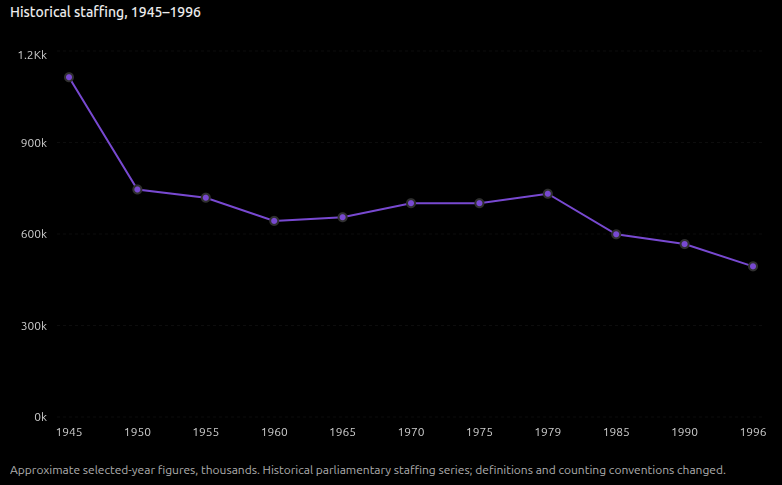
Clement Attlee's repulsive socialist government took the service from 1.11 million in April 1945 to about 740,000 by 1951, while building the welfare state at the same time. The numbers drifted for two decades and stood at roughly 732,000 when Margaret Thatcher entered Downing Street in 1979.
In 1980 Thatcher set a goal of around 630,000 civil servants within four years; by April 1985 the figure stood at 599,026. David Cameron's governments later cut a further 19%, reaching a postwar low of 384,230 full-time equivalents in June 2016.
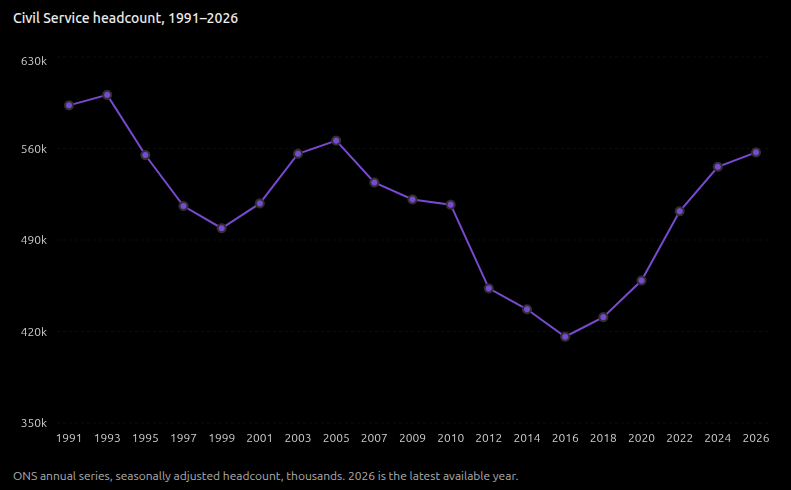
Then the Brexit referendum arrived, and four decades of reductions went into reverse.
How interesting.
| Year | Civil servants | Circumstances |
|---|---|---|
| 1854 | 16,000+ | Northcote-Trevelyan count |
| 1914 | 282,000 | Labour Exchanges in place, eve of war |
| 1944 | 1,160,000 | Wartime peak |
| 1951 | c. 740,000 | Attlee leaves office |
| 1979 | c. 732,000 | Thatcher takes office |
| 1985 | 599,026 | After the first Thatcher reductions |
| 2016 | 384,230 (FTE) | Postwar low, June |
| 2026 | c. 523,000 (FTE) | June, latest figure |
Sources: Hansard, 1978, House of Lords Select Committee on Public Service, Office for National Statistics, and the Institute for Government.
Industrial civil servants drift in and out of the totals. Whole functions migrate into executive agencies, arm's-length quango bodies, and private contractors, where they disappear from the Civil Service count while the taxpayer goes on paying for them.
A department which outsources a thousand posts reports a thousand fewer civil servants and an undiminished bill. Every official total is a "minimum."
Johnson's 91,000 Cuts Lasted 6 Months
In 1981 the BBC broadcast "The Compassionate Society", an episode of Yes Minister written by left-wing Boomers Antony Jay and Jonathan Lynn. Jim Hacker discovers a newly built hospital with no doctors, no nurses, no patients, and 500 administrative staff.
Sir Humphrey Appleby sees nothing wrong. The hospital is busy, and in his view activity is the measure of success, whatever the results. It's gloriously funny and one of the best arguments for keeping the BBC on life support.
Forty-five years later the joke reads like a departmental operating system.
The Brexit referendum handed Whitehall a genuine excuse: customs, trade, and regulatory functions previously run from Brussels had to be rebuilt at home.
Covid supplied another.
By the spring of 2022 the service had grown by roughly 91,000 posts since 2016, and ministers noticed.
In May 2022 Boris Johnson ordered his Cabinet to return the Civil Service to its 2016 size within three years, removing 91,000 posts and saving about £3.5 billion a year. He called the service "swollen". Jacob Rees-Mogg, then "minister for government efficiency", proposed a recruitment freeze, since almost 40,000 civil servants leave every year anyway.
As we endlessly say, an announcement is cheap.
Over the summer, permanent secretaries were told to model cuts of up to 40%. By August the Treasury had reportedly gone cold on the plan.
In early October Liz Truss's government dropped the 2025 deadline. Her Cabinet Office minister, Nadhim Zahawi, reportedly called the target a blunt instrument and warned redundancies would cost £6 billion to £7 billion up front, against annual savings of £3.5 billion.
A month later, her rival Rishi Sunak wrote to every civil servant to say top-down headcount targets were the wrong approach, scrapped the target altogether, and reinstated the graduate Fast Stream.
The order lasted 172 days. Six months, give or take.
No published record shows which functions any department proposed to abolish, which permanent secretaries argued against the cuts, or what their plans contained. Those documents exist somewhere in Whitehall, and Parliament has never seen them.
In October 2023 Jeremy Hunt announced a headcount cap.
It fared no better.
Instead of falling back towards 384,000, the total climbed past half a million.
Between June 2016 and June 2026 the Civil Service grew by 138,955 full-time equivalents, or 36.2%.
The most recent quarter shows a fall of 450 posts. Ministers may describe it as a turning point; it amounts to less than a tenth of one per cent.
Vote Differently, Get The Same Civil Service
Whitehall did not grow by itself. Ministers and Parliament kept handing it work, often in the same months they were promising to shrink it. Brexit brought a Trade Remedies Authority, a domestic chemicals regime to replace European registration, a subsidy control system under the Subsidy Control Act 2022, and an Office for Environmental Protection created by the Environment Act 2021.
Covid produced the UK Health Security Agency, which absorbed Public Health England and the remains of Test and Trace in 2021 and has stayed in business ever since.
In February 2023, three months after scrapping Johnson's target and eight months before Hunt's cap, Sunak dissolved the Department for Business, Energy and Industrial Strategy and replaced it with three departments:
- Business and Trade,
- Energy Security and Net Zero, and
- Science, Innovation and Technology.
Three departments need three permanent secretaries (Sir Humphries), three private offices (Bernards), three finance teams, three communications operations, and three sets of corporate overheads where one sufficed before.
It's the same old thing. Renaming, refurnishing, merging, rearranging. Zero progress whatsoever, by design.
Politicians create duties, bodies, and departments, then express surprise when the officials needed to run them appear on the payroll. Sir Humphrey takes the blame in public. The ministers signed the orders.
Inflation Favoured In Certain Places
According to the Institute for Government's Whitehall Monitor 2026, the junior administrative grades have collapsed while the middle and upper grades have ballooned.
| Grade or group | 2010 | 2025 | Change |
|---|---|---|---|
| Administrative assistants and officers | 224,000+ | c. 119,000 | −47% |
| Junior administrative share of workforce | 46% | 24% | Down 22 points |
| Grades 6 and 7 share of workforce | 7% | 17% | Headcount up 132% |
Over a shorter window, between 2016 and 2025, the "policy profession" grew by 116%. The Civil Service as a whole grew by about 35% across the same years.
Computers took over the typing pools, the filing rooms, and much of the routine processing. The savings did not come back to the taxpayer. Grades 6 and 7 include engineers, lawyers, analysts, and other specialists alongside managers and policy officials, and some of the growth reflects genuinely skilled work.
The Institute for Government also identifies grade inflation, meaning the same job now carries a grander title and a larger salary than it did fifteen years ago.
Taken together, Whitehall has built a far dearer workforce. It has published no evidence of output rising to match.
A department which cannot show what its extra Grade 7s produce has no business recruiting more of them.
Hospitals Without Patients
The absurd Cabinet Office exists, supposedly, in part to stop the rest of Whitehall duplicating itself. Since 2004 it has tried to persuade departments to share their payroll, finance, and HR systems. The latest strategy, launched in 2021, received £1.15 billion from the Treasury.
In March the National Audit Office reported nobody at the centre with the authority to make departments take part, and warned the programme was unlikely to arrive on time or within budget.
The Cabinet Office had advertised £4.3 billion in benefits over fifteen years. The figure was financial gross: it left out the cost of delivering the programme. Once costs were counted, the auditors put the expected net benefit at roughly £1 billion.
The Cabinet Office told MPs it could not say what the programme would cost in total.
Twenty-two years after the first attempt, the department created to coordinate Whitehall's administration still cannot consolidate Whitehall's paperwork.
In December 2025 the NAO published its first end-to-end map of the asylum system.
The auditors found no single point of accountability anywhere in the process and no overall budget for the system. Speeding up one stage simply moved the queue to another: appeals, accommodation, or the councils left with the consequences.
Imagine everyone's surprise.
In October 2024 the NAO judged the system poor value for money and financially unsustainable. It found no consistent improvement in outcomes since 2019. Half of all education, health, and care plans missed the 20-week legal deadline, and council deficits were forecast to reach £4.6 billion by March 2026.
Spending rose by more than half. The results did not.
Each case repeats Hacker's hospital. Busy, expensive, fully staffed, and failing at the one thing it exists to do.
More In Debt Interest Than On Defence
The Office for Budget Responsibility's figures for 2025-26 set out the scale of the state which Whitehall sits on top of. They are horrifying.
| Measure, 2025-26 | Amount | Share of national income |
|---|---|---|
| Total public spending | £1,368bn | 44.8% |
| Total public receipts | £1,235bn | 40.4% |
| Borrowing | £133bn | c. 4.4% |
| Public sector net debt | c. £2,900bn | c. 95% |
| Interest on the debt | £110bn | c. 3.6% |
| Welfare cash transfers | £333bn | c. 10.9% |
| Ministry of Defence budget | £62bn | c. 2.0% |
Defence figure: the Ministry of Defence's departmental expenditure limit, from the National Audit Office.
- For every £100 the country produces, the state spends almost £45 and borrows more than £4 of it.
- Interest alone costs £110 billion a year.
- The Ministry of Defence spent £62 billion. (On what???)
- Britain now pays its creditors almost twice what it pays to defend itself.
The Office for National Statistics counted 6.21 million public sector employees in June 2026, 18% of everyone in work. The public workforce is 556,000 larger than a decade earlier.
In March 2026 central government employment hit a record 4.07 million while local government fell to a record low of 1.96 million. The councils which empty bins and mend roads are shrinking.
No economy can carry a state which spends more than it raises every single year, treats each new duty as permanent, and pays for the difference on credit.
11 Warships For An Island Empire
In August 1945 the Royal Navy counted 990 major warships, frigates and larger, submarines included, swollen by a world war. In 1990 Britain had around 50 destroyers and frigates.
By August 2026 the escort force in commission consisted of six Type 45 destroyers and five Type 23 frigates, with fewer than eleven available at any given moment once refits and repairs are counted. By mid-2026, none of the five commissioned Astute-class attack submarines was at sea.
This is shameful.
| Year | Civil servants | Destroyers and frigates in commission |
|---|---|---|
| 1990 | c. 567,000 | c. 50 |
| 2026 | c. 523,000 (FTE) | 11 |
| Change | Down by less than a tenth | Down by almost four fifths |
(The 1990 Civil Service figure is a headcount and the 2026 figure a full-time equivalent, as the government's own counting methods changed in between.)
The Defence Secretary, John Healey, did the civil service's dirty work and told LBC the Navy had 17 frigates and destroyers, a fleet he appears to have borrowed from an earlier decade.
When MPs asked how many escorts the Navy would field in the years ahead, the Ministry of Defence refused to say, citing operational security. The government cannot tell Parliament how many frigates it will have, but iIt can tell you, every quarter and to the nearest thousand, how many people work in central government. Perhaps too many of the ships are rescuing third world invading migrants, for GDP and the fight against racism.
More importantly, the MoD apparently thinks answering the supreme body of the land is optional, and "operational security" is a recognised carve-out.
Bullshit.
Enough is enough with this.
Payroll and warships compete for the same finite pot of public money. For three decades, governments of both parties protected the payroll and let the fleet take the cut.
AI Models Named After Sir Humphrey
In January 2025 the absurd and unnecessary Department for Science, Innovation and Technology unironically unveiled a package of AI tools nicknamed "Humphrey", after the fictional permanent secretary.
Nobody in the department appears to have watched the programme to the end.
The package included:
- Consult, which analyses public consultation responses, work for which consultants had been billing around £100,000 a time.
- Minute transcribes meetings and produces summaries.
- Redbox summarises policy and prepares briefings.
- Lex researches the law.
- Parlex searches decades of parliamentary debate.
As Humphrey would say, months of fruitful work.
Governments should not be doing this. They should be buying it.
The then Technology Secretary, Peter Kyle, supposedly linked the programme to a government ambition of £45 billion in savings.
Summarising consultations, minuting meetings, drafting briefings, and researching legislation make up the daily work of the policy profession, which grew by 116% in nine years.
Something Zoom already does.
Software will not replace every policy official. Ministerial advice, legal judgement, negotiation, and accountability still need people. Routine summarising and drafting do not.
If the tools work as advertised, ministers should be able to publish the hours saved, the vacancies left unfilled, and the tasks no longer performed by hand. No such figures have appeared. Under Keir Starmer, and since 20th July 2026 under Andy Burnham, the total kept edging upwards until the latest quarter's token dip.
Without those figures, artificial intelligence becomes one more cost layered on top of the bureaucracy it was bought to streamline.
A machine called Humphrey does Sir Humphrey's paperwork, and Sir Humphrey keeps his office, his grade, and his pension.
A Welfare Program For Luvvy Graduates
Across the private economy, routine graduate work faces the sharpest pressure from artificial intelligence. Drafting, summarising, researching, and reporting are precisely the tasks software now performs in seconds, and firms which once hired rows of juniors to do them need far fewer.
Whitehall moves in the opposite direction.
Sunak's first act on scrapping Johnson's cuts was to reopen the graduate Fast Stream.
The policy profession more than doubled. Grade inflation lifted titles and salaries across the middle of the service. Officials enjoy secure employment, a defined benefit pension, and steady progression, funded through taxes on private sector workers whose own jobs carry none of these protections and whose employers are busy automating the same kind of work.
A state which expands its graduate workforce while the private sector shrinks its own, and which cannot show what the extra officials produce, is running a jobs programme. Its beneficiaries are the credentialed middle class. The poor see little of the policy teams writing strategies about them; the graduates paid to write those strategies see a great deal.
Leviathan Must Die To The Earth
Headcount caps fail for a simple reason: they leave the work in place. Johnson cut nothing because he abolished nothing. Every statutory duty, reporting requirement, and strategy stayed on the books, and the order collapsed within six months. Thatcher's lasting reductions came where functions were removed or moved out of departments entirely.
A government serious about shrinking Whitehall would act on the work itself.
- First, every administrative duty would carry a sunset date. Anything Parliament does not actively renew lapses, along with the posts attached to it.
- Second, every department would publish a costed list of its functions, from the statutory to the self-invented. Ministers would strike out everything without a demonstrated current purpose, in public, line by line.
- Third, any function marked for abolition would close to new recruitment. Almost 40,000 officials thankfully leave the Civil Service every year. Ministers who stopped replacing them in condemned functions would shrink Whitehall without the £6 billion to £7 billion redundancy bill Zahawi feared.
- Fourth, ministers would publish the papers behind the 2022 cuts: the departmental plans, the functions offered up, and the advice which killed the target. Voters deserve to know who stopped it.
- Fifth, the savings would go to the fleet. Johnson's own estimate put 91,000 posts at £3.5 billion a year. At the original contract price of the Type 31 frigate, roughly £250 million a ship, the sum would cover the build cost of more than a dozen frigates every year, before crews, weapons, and upkeep.
Northcote and Trevelyan designed a service to carry out the business of government competently. Deciding how much business government should carry out was never its job. Parliament kept the power to decide, and for a century and a half has predictably used it almost entirely in one direction: creating duties, departments, inspectorates, regulators, reporting requirements, and programmes, and seldom abolishing any.
The number of officials follows from the volume of work Parliament and ministers impose. Every headcount target which leaves the work untouched will fail, as Johnson's did.
Sir Humphrey will never close his own department. Parliament can, by repealing the duties which keep it open.
Or, we do it via democratic force, and replace it. On a simple reading of the history. it's probably better we skip the trial and error.