Playing The Great Game Again, Without An Empire To Pay For It
Victorian Britain gambled on buffer states with the Royal Navy and the Indian Army at its back. Its threadbare successor bankrolls Kyiv, slips paratroopers across the border, and courts Brussels for cash, while Moscow's paid saboteurs set fires in east London. We are playing a stupid game.
It was Arthur Conolly, an intelligence officer in the East India Company's cavalry, who gave the Great Game its name in the 1830s. In 1842 the Emir of Bukhara had him beheaded, along with Colonel Charles Stoddart, in the square below the city's citadel. The man who christened Britain's rivalry with Russia lost his head to it.
Rudyard Kipling later turned the whole business into an adventure story, and the British state has treated it as a vocation ever since.
The game is back on.
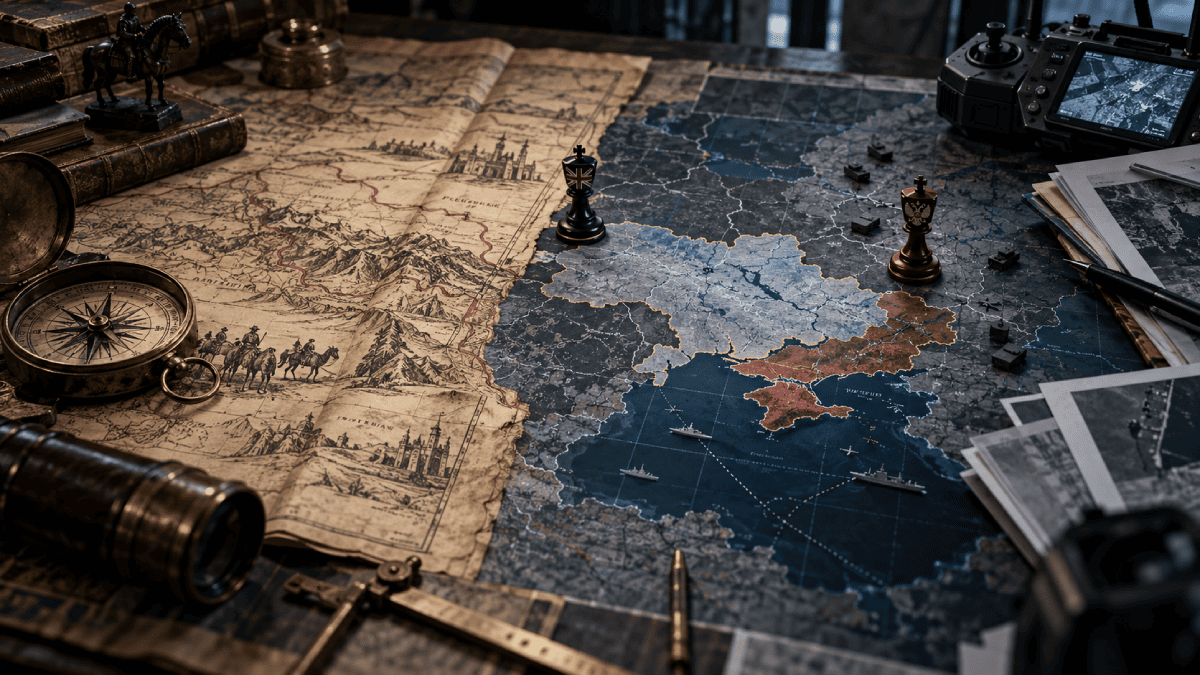
The board has shifted west from the Hindu Kush to the Dnieper, and Ukraine now plays the part Afghanistan once played: a buffer between Russian power and the interests of London.
The British methods would be familiar to any Victorian political officer. Money, weapons, training, intelligence, and a small number of soldiers ("advisors") whose presence ministers would rather not discuss.
Only the empire has gone missing.
Victorian Britain sat at the table with the largest navy on earth, the Indian Army, and the wealth of the first industrial economy. Its successor arrives with eleven frigates and destroyers, an Army smaller than at any point since the Napoleonic Wars, and a defence plan so underfunded the Defence Secretary resigned rather than sign it.
The Cold War was the same contest over the same kinds of territory, fought by the same indirect means.
Britain has now entered a third round of a two-hundred-year rivalry with Russia at the moment it is least equipped to win one.
Buffer States, Subsidies, and Retreats
Tsarist Russia pushed south and east across Central Asia, and British India feared the Cossacks would eventually appear at the Khyber Pass. London's answer was to own, bribe, or bully whatever lay in between. Business as usual.
In 1839 we invaded Afghanistan to install a pliant emir. In January 1842 the retreat from Kabul destroyed a column of roughly 4,500 soldiers and some 12,000 camp followers in the snow of the passes.
We went back in 1878 for a second war, and the Panjdeh incident of 1885 brought the two empires to the edge of open conflict over an oasis few Londoners could have found on a map.
When Britain and Russia did fight directly, we fought over the Black Sea. The Crimean War of 1853 to 1856 killed around 21,000 British servicemen, most of them through disease, cold, and incompetent supply rather than Russian fire.
As its prize, the Treaty of Paris neutralised the Black Sea.
Russia repudiated those clauses in 1870 while France was busy losing to Prussia, and the powers meekly endorsed the repudiation at the London Conference of 1871. Fourteen years of advantage, bought with a generation buried outside Sevastopol.
The game paused in 1907.
The Anglo-Russian Convention divided Persia into zones of influence and placed Afghanistan outside Russia's reach, with St Petersburg agreeing to deal with Kabul only through London.
Nobody asked the Afghans. Their ruler was not a party to an agreement about his own country and never accepted it.
Within a year of the Bolshevik seizure of power, British troops were fighting the new regime around Archangel and Murmansk, in an intervention which achieved nothing and ended in withdrawal in 1919.
The historian Barbara Emerson has since labelled the Victorian rivalry the First Cold War, and the label works just as well in reverse.
Cold War Containment Was Round Two
Textbooks present the Cold War as a struggle between capitalism and communism. The map tells a plainer story. Moscow pressed outward into the territories on its borders; Britain and its allies answered with garrisons, alliances, subsidies, and spies; and the two sides took great care never to fight one another directly.
When Soviet forces invaded Afghanistan in December 1979, British intelligence joined the American effort to arm and train the Afghan resistance, much as Victorian officials had once subsidised Afghan emirs to keep the Russians out.
The ideology had changed. The buffer state had not even changed its name.
| Round | Buffer territory | British methods | Result for Britain |
|---|---|---|---|
| Great Game, 1830s to 1907 | Afghanistan, Persia, and the Black Sea | Invasions, subsidies to rulers, political officers, spies, and one direct war | Two failed Afghan wars, Crimean gains reversed by 1871, and a carve-up agreed over Afghan heads |
| Cold War, 1947 to 1991 | Germany, the Middle East, and Afghanistan | NATO garrisons, nuclear deterrence, espionage, and covert aid to Afghan fighters | Soviet collapse, followed by a peace dividend spent on everything except defence |
| Ukraine, 2014 to the present | Ukraine, the Black Sea, and the Baltic | Weapons, finance, training, intelligence, and undisclosed personnel on the ground | Russian sabotage in Britain, nuclear threats, and armed forces at historic lows |
Ukraine Has Replaced Afghanistan
Britain's military involvement in Ukraine did not begin in 2022. After Russia seized Crimea, Operation Orbital sent British "trainers" into the country from 2015. Since the full-scale invasion the commitments have grown into something no Victorian Chancellor would have signed without a very long lunch.
The Ministry of Defence has now committed £16 billion in military support and promised at least £3 billion a year until 2030-31, within a total British commitment of £25 billion.
In mid-August, reports of British-made drones hitting targets inside Russia drew threats of retaliation from Moscow and a pledge from the Prime Minister, Andy Burnham, to back Ukraine "100%".
On 24th August he announced Britain would share Storm Shadow production technology with Kyiv, handing over the know-how for a cruise missile built to strike far behind the front.
A month earlier, on 24th July, Lieutenant General Tom Bateman took command of Multinational Force Ukraine, the force designed to deploy once the fighting stops, with a headquarters to follow in Kyiv.
If we are not at war with Russia, why are we heading up a military task force in the same war against her?
Reports have put the whole force at around 15,000 troops, with Britain supplying half.
Any standing deployment of 7,500 needs roughly three times as many soldiers once training and recovery are counted, which would swallow a large slice of an Army of 73,000.
Then there are the soldiers Whitehall prefers to leave unmentioned. In April 2023 leaked Pentagon documents put 50 British special forces personnel inside Ukraine, more than every other Western contingent listed put together. The Ministry of Defence responded by complaining of a "serious level of inaccuracy" in the leaks (which is good enough for anyone to know it was true), without specifying which figures were wrong.
In December 2025 the public discovered the Parachute Regiment was there as well.
Lance Corporal George Hooley, 28, was caught in an explosion on 6th December while watching Ukrainian forces test what the Ministry called a new "defensive capability", and died in a Kyiv hospital on 9th December. Keir Starmer told the Commons Hooley had served as one of a small number of British personnel in the country, a presence the government had never previously disclosed included paratroopers.
The inquest this month was conducted in writing and partly behind closed doors. The Oxfordshire coroner refused to reveal what was being tested or where, citing its sensitivity.
Today the Telegraph reported it had discovered spy trawlers and at least 500 incidents of Russian civilian vessels loitering above vital undersea cables.
The Ministry of Defence now says limited numbers of British personnel are in Ukraine to protect the embassy and support Ukrainian forces, and has offered no further account of what they do or who authorised it.
Parliament has never voted on any of it.
British voters now learn the deployments of their own Army from obituaries and inquests.
A Porous Buffer State Doesn't Work
The case for proxy confrontation rests on a comforting idea: bleed Russia cheaply on the Dnieper and Britain will never have to face it expensively at home. Russia has spent twenty years demonstrating otherwise.
In 2006 Alexander Litvinenko was poisoned with polonium in a Mayfair hotel, and a public inquiry concluded in 2016 the FSB operation had probably been approved by Vladimir Putin.
In 2018 GRU officers smeared Novichok on Sergei Skripal's front door in Salisbury and dumped the remainder in a counterfeit perfume bottle. Charlie Rowley found it and gave it to Dawn Sturgess, who died in July of the same year. Lord Hughes's inquiry found in December 2025 the attack must have been authorised by Putin himself, and judged the conduct of everyone involved, from the assassins to the Kremlin, "astonishingly reckless".
On 20th March 2024 a warehouse in Leyton storing aid and Starlink equipment bound for Ukraine was set alight on the orders of the Wagner Group. Its organiser, Dylan Earl, ran the operation from his bedroom in Leicestershire and received a 23-year sentence in October 2025. His follow-up plans included the kidnap of a Russian dissident in Mayfair.
On 13th October 2026 the Director General of MI5, Ken McCallum, named Russia "aggressor number one" and revealed his service now spends more on countering hostile states than it did during the Cold War.
Almost 1,000 expulsions of Russian intelligence officers since the invasion have left the Kremlin paying criminals to do its dirty work instead.
On 27th August the Russian Foreign Ministry's spokeswoman, Maria Zakharova, warned British military installations in Ukraine and beyond its borders could become targets.
Andrei Fedorov, an adviser to Putin, added British factories making drones and missile components might face attacks from "unknown sources".
A buffer state exists to keep the fighting at a distance.
This one has brought it to a Wiltshire cathedral city, an east London trading estate, and the gates of British arms factories.
Kaliningrad And A Nuclear Wager
Victorian ministers who blundered into the Crimea risked a few divisions and the reputation of Lord Raglan. Their successors are gambling against a nuclear power.
Speaking at the Valdai Discussion Club on 1st October 2026, Putin warned every weapon in Russia's arsenal would be on the agenda if NATO moved against Kaliningrad, and went out of his way to mention Britain and France by name as nuclear powers.
Russia's revised doctrine of 2024 treats an attack by a non-nuclear state with nuclear backing as a joint attack, a definition which fits Ukraine and Britain rather neatly.
Nuclear weapons raise the price of every miscalculation, and they reward whichever side will tolerate more risk for longer.
A Kremlin which has fought a war of attrition for nearly five years has shown its tolerance for risk and damage.
Britain has shown how much it will pay for its own defence.
The Poorest UK Military In Our History
The regular Army stood at 73,790 on 1st January 2026. Full-time trained strength across the three services fell by 600 over the previous year to 126,440, despite better recruiting.
When the Defence Secretary, John Healey, was asked on air how many frigates and destroyers the Royal Navy possessed, he answered seventeen.
The real figure was thirteen: seven ageing Type 23 frigates and six Type 45 destroyers.
In July the Navy retired two more Type 23s, Iron Duke and Richmond, leaving five frigates, one of them in deep maintenance.
At the end of the Cold War the Navy operated more than fifty frigates and destroyers.
The Chief of the Defence Staff, Air Chief Marshal Sir Richard Knighton, told MPs in January Britain was not as ready as it needed to be for full-scale war, which is English understatement at a heroic scale.
The Defence Investment Plan, meant to pay for the 2025 Strategic Defence Review and promised for autumn 2025, slid through the winter and spring.
On 11th June 2026 Healey resigned, writing the settlement fell well short of what the country needed. His armed forces minister, Al Carns, followed within hours and called the plan unfit for purpose.
It finally appeared on 30th June with an extra £15 billion over four years, against a reported £28 billion gap in the equipment programme. Knighton had already told peers to expect cuts or delays.
| Measure | Position in 2026 |
|---|---|
| Regular Army strength | 73,790, the smallest since the Napoleonic era |
| Frigates and destroyers in service | 11 after July's retirements, against more than 50 at the end of the Cold War |
| Frigates ordered since 5th July 2024 | None |
| Attack submarines at sea, June 2026 | None of five |
| New money in the Defence Investment Plan | £15 billion over four years, or £3.75 billion a year on average |
| Reported equipment funding gap | £28 billion |
| Military aid committed to Ukraine since 2022 | £16 billion, including £2.26 billion of loans backed by frozen Russian assets |
| Military aid budgeted for Ukraine in 2026-27 | £3.75 billion |
For 2026-27 the Ministry of Defence has budgeted £3.75 billion for Ukraine. The Defence Investment Plan adds an average of £3.75 billion a year to Britain's own forces.
Pound for pound, a foreign country receives the same sum as the rearmament of the British armed forces, and the Ukrainian commitment runs to at least 2030-31. Take out the loans backed by Russian assets and direct British funding for someone else this year still comes to £3 billion.
Lord Salisbury, mocking the "Russophobes" of his own day, told peers he wished people would study maps on the Ordnance scale. Today's ministers might try larger spreadsheets.
Defenders of the policy like to cite Pitt the Younger and his successors, who bankrolled coalition after coalition against Napoleon rather than raise a mass army of their own.
The subsidies mocked on the Continent as Pitt's Gold rested on a Royal Navy which commanded the seas after Trafalgar and on the deepest credit market in Europe. The paymaster also kept an army in the field, and from 1808 Wellesley led it through the Peninsula.
Modern Britain writes the cheques without the fleet, the credit, or the army.
Hiding Behind EU Institutions For Cash
Faced with an Army it cannot afford to grow and a Navy it cannot afford to sail, the government has looked across the Channel for money so it doesn't have to take any responsibility for itself. The EU's Security Action for Europe instrument, known as SAFE and adopted on 27th May 2025, lends €150 billion raised on the bond markets to member states for joint arms purchases.
As a non-member, Britain could never draw on those loans. The most on offer was permission for British firms to join joint purchases, with non-EU content capped at about a third.
For this privilege Brussels reportedly asked around €6 billion. Knowing we'd be stupid enough to pay.
Canada, an ocean away, got in for about €10 million.
Talks collapsed on 28th November 2025, ministers declared the terms poor value, and within two months Starmer was trying again.
The security and defence pact signed at Lancaster House on 19th May 2025, the gateway to SAFE, states the UK will consider taking part in EU military crisis management operations when Brussels invites it, under arrangements still to be negotiated.
Brexiteers who warned of British soldiers serving under the EU flag were dismissed as fantasists.
The text now opens the door to precisely this, at a moment when Britain cannot find enough soldiers for its existing commitments. There's no quicker way back into the EU than a handy war and a bunch of dead English boys in uniform.
Burnham wants to go further.
He has told the European Council's president Britain must be "bolder" about drawing closer to the bloc, with defence as the foundation, and has floated rejoining it outright. Defence sits on the agenda when he travels to Brussels for the summit on 20th November.
None of this produces a single extra frigate.
SAFE is a loan book for member states and a purchasing club with EU content rules. Entry would hand Brussels a say over where British defence money goes, and add a further list of possible missions to a depleted force already stretched across Estonia, the Gulf, and the approaches to Kyiv.
A country unable to crew its own escorts gains nothing by volunteering to crew someone else's.
Stop This Stupidity Brinkmanship
Every round of this contest has followed the same pattern. Britain identifies a territory between itself and Russian power, pours in money, arms, and agents, and then discovers the territory has interests of its own, the Russians have patience, and the bills keep arriving. This time, we have no reason to be there and we haven't rearmed. This is not a good bet.
- The Afghans took British subsidies and went their own way.
- The Crimean settlement evaporated in fourteen years.
- The Cold War ended with Britain cashing a peace dividend and dismantling the forces which had held the line.
The present round repeats the pattern with one alteration: the player has no reserves.
A Britain with eleven escorts, a shrinking trained Army, and a defence plan its own Defence Secretary refused to sign has appointed itself guarantor of a country at war with a nuclear power showing its teeth.
Meanwhile the same nuclear power runs arson, sabotage, and assassination campaigns on British soil, and openly names British factories as future targets.
We are like a yapping terrier antagonising a grizzly bear already covered in its own blood.
The order of priorities could hardly be plainer:
- Defend the home islands.
- Rebuild the Navy.
- Refill the magazines.
- Restore an Army large enough to lose a battalion without losing a capability.
Only then does a buffer state on the far side of Europe become something Britain can afford to underwrite.
Until then the new Great Game is a wager placed by a pauper, and Moscow has read the bank statements.