Abolish Ofsted Before It Attempts To Grade Children Next
Thirty-four years, endless rewrites, a coroner's finding, and still no proof it improves an ordinary school. As AI tutors begin logging every pupil's every mistake, the data will tempt England's inspectorate. Hand it over and the clipboard follows every child home.
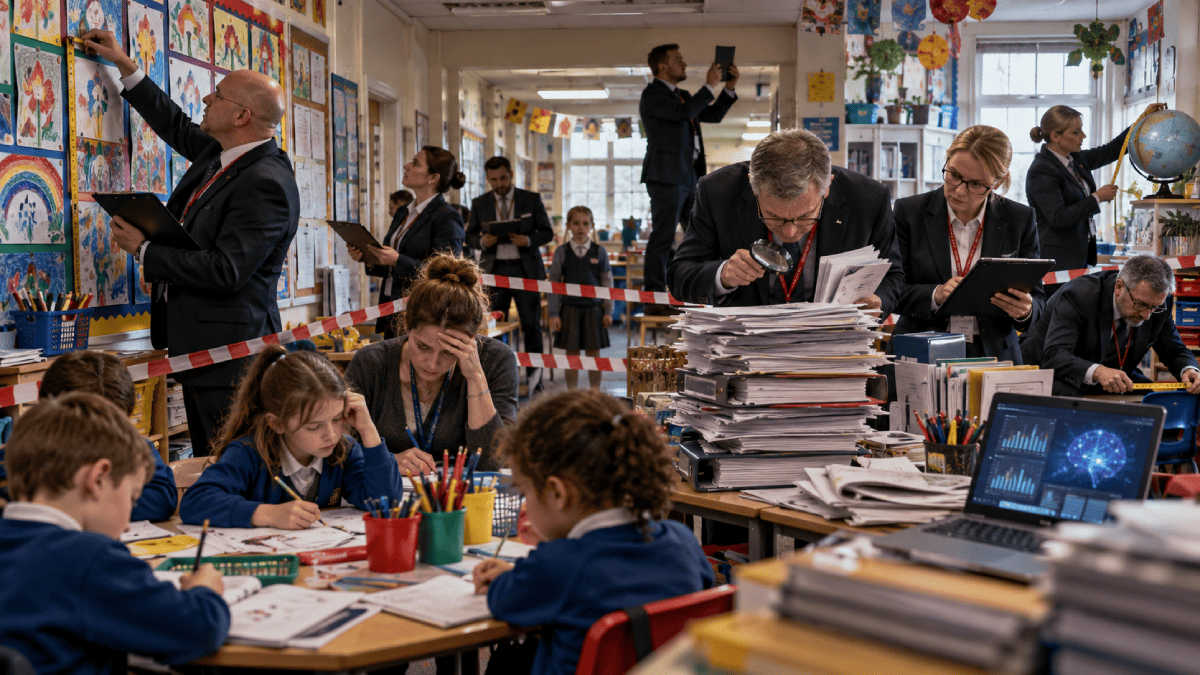
In September 2024 England's schools inspectorate abolished its one-word grades and promised a gentler future. A year later it replaced them with report cards carrying five grades across half a dozen categories. A year after that, more than 5,000 headteachers told their union the new regime was worse than the old one, and nearly three in four said inspection had deteriorated in a single year.
Ofsted has been reformed so often its own staff could be forgiven for losing count.
Every reform arrives with the same promise and leaves the same wreckage: frightened heads, distorted schools, and a profession which regards the inspectorate with something close to loathing.
The one thing Ofsted exists to do, making schools better, remains as unproven in 2026 as it was in 1992.
Formally, Ofsted is a non-ministerial government department rather than a quango, which is Whitehall's way of describing a quango with a better tailor. It also inspects nurseries, colleges, children's homes, and social care. Schools are where its grip on ordinary professional life is tightest, and where its failure is easiest to prove.
And schools are not going to exist in a few years. AI is will be replacing them faster than the communist teacher unions can complain about it.
Ken Clarke Divorced Judgement From Help
Before 1992, inspection in England was a working relationship. HM Inspectorate, founded in 1839, visited schools, surveyed standards across the country, and told ministers bluntly whether their policies were working. Below it, local authority inspectors and advisers worked with individual schools: they diagnosed problems, advised on remedies, and came back to see whether the remedies had worked.
The old arrangement had real holes though, which could not be ignored.
Opening the second reading of the Education (Schools) Bill on 19th November 1991, Kenneth Clarke told the Commons HMI produced about 150 public school reports a year, a pace at which every primary school would wait roughly two centuries for its turn. At least ten local authorities had no inspection policy at all. Parents almost never saw a report on their own child's school.
Clarke's cure was far more drastic than the disease. Every state school would be inspected on a four-year cycle, around 6,000 a year, by teams of registered inspectors bidding for the work under the Education (Schools) Act 1992.
He sneered at local authority inspection as "patsy" and "unquestioning". Some headteachers asked to be inspected by the advisers who already knew their schools; Clarke told the House such an arrangement "would not be a desirable system". The person who judged a school was, by design, never again to be the person who helped it.
Every team also had to include a lay member with no experience of running or providing education. Jack Straw, for Labour, observed the only qualification the Bill demanded of this person was "no qualification at all". He also predicted commercial inspection would make any consistent standard "well nigh impossible".
Ofsted spent the next two decades proving him right, then sacked its contractors.
Clarke rejected the obvious alternative of expanding HMI, since he wanted no "centralised civil service approach", which was desirable and sensible because of the civil service. His own officials' review had recommended around 380 HMIs for the new system.
He chose 175.
Quelle surprise, Ofsted later became precisely the centralised civil service inspectorate he refused to build, after a long and expensive detour through the private sector.
Forty-Two Box Files and the Birth of Dread
The first inspections were long, crowded affairs, led largely by former heads and deputies. The damage showed within a few years. In the Commons debate on 12th July 1999 on the Education and Employment Committee's report into Ofsted, one MP who had inspected schools himself recalled a head greeting his team with 42 box files of paper, the product of "nothing but panic".
The committee's own phrase for the mood in schools awaiting a visit was "anticipatory dread".
Seven years.
Seven years after Ofsted opened, every pathology teachers still complain about in 2026 was already on the parliamentary record: paperwork, over-preparation, preparation displacing teaching, and fear.
There were no deep dives. There were no report cards. The fault lay in the machine itself.
Once strangers deliver a published verdict with consequences, on a date the school can see coming, any sane headteacher prepares for the verdict instead of the pupils.
Goodhart's law finishes the job: a measure turned into a target stops measuring anything worth knowing.
Eight Attempts To Polish The Turd
Ministers never questioned the design. They tinkered with it, and every tinker manufactured the next crisis.
| Year | Change | Problem addressed | Problem created |
|---|---|---|---|
| 1992 | Universal four-yearly inspection by registered inspectors competing for contracts | Patchy coverage, no public reports | Advice cut off from judgement; mountains of preparation |
| 1998 | Lighter inspection for successful schools ordered by David Blunkett | Burden, teacher morale | Uneven scrutiny |
| 2005 | Short inspections at little noticeEducation Act 2005 | Disruption of week-long visits | Inspectors saw far less of lessons |
| 2009 | Delivery contracted to CfBT, Serco, and Tribal | Cost | An inspection lottery |
| 2012 | "Satisfactory" renamed "requires improvement" | Complacency in average schools | Higher stakes for thousands of schools |
| 2015 | Contracts ended; inspectors brought under direct Ofsted control | The lottery | The central civil service inspectorate Clarke refused to build |
| 2019 | Curriculum "deep dives" | Obsession with test data | A paid trade in deep-dive preparation |
| 2024 | Single-word overall grade scrapped | Careers riding on one word | Interim limbo |
| 2025 | Report cards with five grades across six or more areas | Crudeness of a single grade | Heads report more stress, not less |
The complaints about inconsistency grew so loud Sir Michael Wilshaw declared inspection too important for Ofsted merely to supervise third parties.
The market at the heart of Clarke's design was put down in September 2015, and nobody held a wake.
Ofsted has meanwhile spent a decade trying to smuggle working teachers back into its teams. The share of inspections including a serving practitioner rose from 15 per cent in 2011 to 56 per cent by late 2014.
In March 2026 it launched a pilot to recruit whole groups of serving school leaders from trusts and networks, paying their employers and branding the work professional development.
After 34 years, the inspectorate has reinvented the local adviser, minus the advice.
No Proof It Improves Anything After 30 Years
Ofsted calls itself a force for improvement. The evidence says otherwise, with one narrow exception. The exception comes from Rebecca Allen and Simon Burgess at Bristol, who compared schools which narrowly failed inspection with schools which narrowly passed. The near-misses improved over the following two to three years, by roughly a tenth of a pupil-level standard deviation.
Publicly branding a school a failure frightens its governors into action.
Nobody disputes the need for a stick against the genuinely bad school. Ofsted beats every school in England with it regardless.
For everyone else, the research is brutal.
A 2020 systematic review by Sarah Hofer, Doris Holzberger, and Kristina Reiss gathered 30 years of international studies. Of 222 effects measured against control groups, 24 per cent were positive, 18 per cent negative, and 58 per cent statistically indistinguishable from nothing.
Inspection, the authors concluded, can enforce policy. They found no strong sign it improves schools.
In 2018 the National Audit Office concluded Ofsted could not demonstrate its inspection of schools represented value for money, because it had so little information about its own impact.
Twenty-six years in, the body which demands evidence of impact from every school in England could produce none for itself.
Amanda Spielman, then Chief Inspector, replied judging Ofsted by school outcomes would "create perverse incentives". Heads who had spent their careers being judged by school outcomes will have appreciated the insight.
The Treasury bill is thankfully small: about £44 million in 2017-18, roughly 0.11 per cent of state school funding. The true cost is buried inside schools, in rehearsal inspections, hired consultants, evidence folders, and senior leaders who spend years arranging an institution around a visit which could come next Tuesday or in three years' time.
The Commons Education Committee heard in 2024 about schools striving to stay permanently "Ofsted ready", forever second-guessing what inspectors wanted to see.
Its difficult to tell the difference between that type of talk and a hostage situation.
Random Inspection Ratings Change Nothing
A regulator unable to prove it improves anything might at least grade consistently. Ofsted cannot manage this either.
| Claim | Evidence | Verdict |
|---|---|---|
| Inspection improves schools in general | Hofer, Holzberger, and Reiss, 2020 | Not demonstrated |
| Failing a school spurs improvement | Allen and Burgess, 2012 | Yes, for two to three years |
| Grades are consistent between inspectors | Bokhove, Jerrim, and Sims, 2023 | Partly down to who turns up |
| Grades help parents choose schools | Bokhove, Jerrim, and Sims, 2023 | Only a recent "outstanding" predicts anything |
| Inspection is value for money | National Audit Office, 2018 | Cannot be shown |
| Burden is proportionate | Big Listen, 2024 | 61 per cent of providers report undue workload pressure |
Analysing more than 30,000 inspections between 2011 and 2019, Christian Bokhove, John Jerrim, and Sam Sims found about 9.5 per cent of the variation in primary schools' overall grades lay between inspectors.
Permanent HMIs were harsher than contracted inspectors. Male lead inspectors were slightly softer on primary schools than female ones.
Headships, reputations, and forced academy conversions hung on verdicts partly determined by whoever happened to be free on the rota.
The same researchers then tested the promise on which Clarke sold the entire reform: do grades help parents choose?
For secondary schools, a companion study found almost no difference in later exam results, behaviour, leadership, or parental satisfaction between schools rated good, requires improvement, and inadequate.
Only an "outstanding" grade less than five years old told a parent anything useful.
Half the time, the report a parent relied on described a school under a different headteacher. The great consumer information system of 1992 turns out to inform the consumer of very little.
Ruth Perry And An Inspectorate Of Bullies
On 8th January 2023 Ruth Perry, head of Caversham Primary School in Reading, killed herself while awaiting publication of a report downgrading her school from outstanding to inadequate over safeguarding concerns. The Berkshire senior coroner, Heidi Connor, concluded in December 2023 the inspection had likely contributed to her death, and found parts of it had been conducted in a way which "lacked fairness, respect and sensitivity".
Ofsted told the inquest under oath it could pause inspections when a head was in distress. The coroner called this claim a "mythical creature".
An independent review by Dame Christine Gilbert later found the inspectorate's response "defensive and complacent".
When the one-word grade was finally scrapped, her sister, Julia Waters, called it just "the most visible feature of a fundamentally flawed inspection system", adding Ofsted's "reign of terror has caused untold harm to headteachers".
Ofsted's Big Listen confirmed the scale of the problem. Some 61 per cent of providers said inspection placed undue pressure on their workload. Nearly half of professionals, 47 per cent, said they would be uncomfortable raising a concern with an inspector.
Only 46 per cent of providers felt Ofsted had achieved its ambition of being trusted.
Its replacement for the single word arrived on 10th November 2025. Schools now receive report cards grading six or more areas on a five-point scale, from exceptional down to strong standard, expected standard, and needs attention to urgent improvement, with safeguarding marked met or not met.
Ofsted answered complaints about one crude word by issuing half a dozen more.
Presenting the plans, it brushed aside opponents of grading as "a small but vocal minority".
Ten months later, the National Association of Head Teachers, having already lost a legal challenge to the new system, surveyed more than 5,000 members. Nearly three quarters said inspection had got worse over the year. General secretary Paul Whiteman called the framework even more stressful than its predecessor and "possibly even a risk to life".
Amanda Hulme, head of Claypool Primary in Bolton, described inspectors working through predetermined bullet points under which much of what her school did "simply did not 'count'".
Five thousand headteachers make a peculiar minority.
Across the border, Wales's Estyn and Northern Ireland's Education and Training Inspectorate both publish written reports without grades.
Neither country has collapsed into anarchy. Yet. Well not because of that, anyway.
The Pattern Repeats In Every Quango
Ofsted is merely the most feared member of a large family of dysfunction. Over three decades English education acquired a specialist national body for almost every function, and they fail in the same ways.
| Body | Recurring error | What happened |
|---|---|---|
| Ofsted | Proxy replaces purpose | Schools organise themselves around inspectable evidence |
| Ofqual | Aggregate fairness imposed on individuals | The 2020 grading algorithm, built on schools' past results, was abandoned on 17th August 2020 after what the Education Secretary called far too many inconsistent and unfair outcomes |
| Office for Students | Remit growth and political capture | A Lords committee found in 2023 poor relations with universities and students, "a controlling and arbitrary approach to regulation", and weak independence from government |
| IfATE, now Skills England | Complexity breeding reorganisation | Abolished on 1st June 2025; the government admitted the arrangement for approving technical qualifications was complex, duplicative, and unresponsive to industry |
The cycle never varies.
- A real problem spawns yet another quango regulator.
- The regulator adopts a measurable proxy.
- Institutions bend towards the proxy.
- The regulator writes more rules to correct the bending.
- The rules pile up until ministers tear the whole thing down, give it a new name, and start again.
Its chair, Roger Taylor, later told MPs it was unlikely Ofqual could ever have delivered the policy successfully, whatever the model.
A statistical judgement about a population cannot become a judgement about a person, and no engineer alive can make it one.
Ofsted Grades Buildings As AI Teaches Children
In January 2026 the Department for Education announced plans for AI tutoring. In April it invited edtech firms and AI labs to bid to build "safe, personalised" tutoring tools, with up to eight companies testing them in schools under teacher supervision and national availability planned by the end of 2027. The target is up to 450,000 disadvantaged pupils a year.
The DfE and the government's AI incubator are meanwhile designing data systems to give such tools a rounded picture of each pupil's progress. Becky Francis of the Education Endowment Foundation has warned the evidence on AI tutoring remains in its infancy.
Ofsted grades the wrong unit
It judges institutions. As more learning happens one to one, with software adjusting to each child, a grade for the building says less about any given pupil than ever before. An "expected standard" for curriculum and teaching tells a mother nothing about whether her son's tutor spent six weeks drilling him in the wrong method for fractions.
The clipboard becomes a joke
AI tools log every attempt, error, and breakthrough, every day of the year. Ofsted turns up for two days every four years and samples a few dozen lessons. The same technology lets any school conjure a flawless self-evaluation, policy suite, and evidence pack in an afternoon, rendering document-based inspection worthless overnight.
Only direct observation, conversation with children, and seasoned professional judgement endured.
The data invites the Ofqual error on a national scale
An inspectorate which has spent 34 years converting judgement into metrics will not refuse a live stream of pupil-level data. Expect technocratic dashboards scoring every child, schools graded by aggregation, and teachers steering pupils towards whatever the tutor's metrics reward.
Goodhart's law would arrive at the level of the individual child.
August 2020 showed the result when population statistics pass judgement on persons. Ofsted with a pupil feed would rerun the experiment on every child in England, every day of the week.
Meanwhile nobody inspects the tutors.
The tools must meet the DfE's product safety standards, but no inspectorate examines what they teach, how accurately, or what they do with children's data. The most intimate teaching relationship many pupils will have in the coming decade could fall entirely outside inspection, while Ofsted leafs through exercise books.
Privatising Didn't Work, Twice
The fashionable alternative, private firms inspecting under contract with the state as customer, has already failed twice. The 1992 market of registered inspectors bidding for work lasted into the 2000s. The regional contracts with CfBT, Serco, and Tribal ran from 2009 to 2015.
Both ended with the state dragging control back in-house to fix the inconsistency the market had produced.
Some powers also belong to the state by their judicial nature. The 1992 Act gave inspectors rights of entry and made obstructing them a criminal offence. Compelling documents, entering premises, and triggering intervention in a failing school are exercises of public authority.
Contractors can gather evidence.
Only a body answerable to Parliament should own a judgement with legal consequences.
Fixing The Remains Of This Mess
Ofsted tries to do three jobs at once, and they sabotage one another. Separate them, and England keeps what 1992 genuinely added, universal coverage, and public information, while recovering what it destroyed.
| Function | Who performs it | Published? | Consequences |
|---|---|---|---|
| Continuous monitoring of attendance, attainment, exclusions, staff turnover, finances, and complaints | A small analytical unit using data England already collects, with AI flagging anomalies for human attention | Yes, as factual school profiles | None directly; it decides where to look, never what to conclude |
| Investigation of safeguarding failure, illegality, fraud, serious educational failure, and credible complaints | A compact statutory inspectorate on the old HMI model, a few hundred senior inspectors with compulsory powers and a genuine appeals route | Yes | Intervention where warranted |
| School improvement | Serving and recently retired heads and subject specialists, commissioned by schools and trusts as confidential peer review | No | None; candour is the point |
Most of the first job is already done. Government holds the data, and its February 2026 schools white paper proposes "School Profiles" giving parents attendance, attainment, and enrichment information in one place.
Once parents have a factual record, a graded judgement adds nothing but fear.
The second job is the one the state genuinely needs: finding the dangerous or dishonest school fast and acting hard.
Freed from grading 20,000 perfectly competent schools, a smaller inspectorate could spend longer and dig deeper where risk appears. It should inspect the AI tutoring tools too, examining what they teach, how accurately, and where the data goes.
The third job is the one Clarke abolished.
A head can confess a failing department to a peer reviewer precisely because the confession will never resurface in a published grade. Ofsted's own 2026 pilot proves the supply of willing practitioners exists. They belong in the service of schools, and no regulator should own them.
A Cure Worse Than The Problem
Clarke was right in 1991 about a closed professional world keeping parents in the dark. In 2026 the remedy is a public factual record, updated constantly, which no two-day visit can match.
He was right, too, to fear a centralised civil service inspectorate. For obvious reasons. Leviathan wants to feed.
Ofsted became one anyway, and then something worse: a centralised inspectorate with no proof it works, a coroner's finding against it, and a profession which dreads the phone call announcing the next visit.
Headteachers asked in 1991 to be inspected by people who knew their schools and could help them. Clarke told them it would not be a desirable system.
Thirty-four years later, Ofsted's boldest idea is to recruit serving headteachers to inspect their colleagues.
Abolish the grading machine before it gets its hands on the data of every child in England. Keep the inspectors, and send them back to the two jobs Clarke tore apart: the state catching failure, and the profession improving itself.