Another 500 Mothers Injured Or Dead On The NHS
Nottingham did not lose its way. It ran at a fixed level of danger for thirteen years while every board minute reported improvement. Mid Staffs said the same in 2013, Morecambe Bay before it, Shrewsbury after. The compensation bill is now the only part of the system that tells the truth.
The press has its version ready, because it is the same version every time. Largest maternity scandal in NHS history; more than 2,500 families; a hospital that lost its way; an apology from a chief executive; a promise of lessons that will be learned. The story files itself under tragedy and asks nothing of anyone beyond a moment of silence. A bad building in the Midlands. A few named managers. Move on.
Clap for our carers. The NHS is the best gift the nation has ever given itself. Free at the point of use. Do your collective loyalty-dance for TikTok. It just needs to be funded properly.
The word "unprecedented" does a great deal of work in this coverage, and none of it survives contact with the record. Donna Ockenden has now written two of these reports herself.
Before Nottingham there was Shrewsbury and Telford. Before Shrewsbury there was East Kent. Before East Kent there was Morecambe Bay. Before any of them, and outside maternity entirely, there was Mid Staffordshire, where Robert Francis QC concluded in 2013 the failure was not the hospital's alone but the whole system's, and issued 290 recommendations to fix it.
Nottingham is not a scandal, per se. It is a rerun, and the diagnosis was filed more than a decade ago.
The bigger question is when an entire system continues to produce the same catastrophes, anyone will conclude the problem is systemic, structural, and socialist.
A Foreword From Gary Walker
The system usually refers to scandals like Nottingham as a “bad apple”, but the NHS orchard is rapidly becoming rotten to the core.
Ockenden talks about a “culture of compounding of harm”. That phrase captures what happens when the original clinical error is only the beginning: families are disbelieved, evidence is contested, and the organisation’s reflex is to defend itself rather than confront the truth. Complaint systems, investigations and even regulators cease to be instruments of learning and become tools of reputational containment.
In Nottingham, as in Mid Staffordshire and other scandals, the pattern is identical. Warning signs were visible for years. Internal and external reports were managed away rather than acted on. Staff concerns were ignored, sometimes with vindictive managerial responses. Avoidable harm continued and the bodies accumulated. Yet the default response was not urgency but argument: over incident grading, playing with language and debating whether harm was really “avoidable”. Families had to fight for basic recognition that something had gone wrong. That is not a procedural glitch; it is a cultural decision.
Beneath this sits a deeper dynamic: fear and punishment of dissent. Ockenden records bullying, racism and “powerful leaders” allowed to “infect the unit”, with staff afraid to challenge unsafe practice or escalate concerns. When I gave evidence to Parliament on Mid Staffordshire, I described an NHS culture in which those who speak up about danger often pay a personal price, while those who minimise problems are seen as “team players”. Nottingham shows how that culture converts directly into clinical harm.
NHS staff do not come to work to hurt people. But years in a toxic environment create moral injury and desensitisation. Chronic understaffing, cancelled training and relentless pressure become normal. Cruel behaviour on wards, or casual discrimination towards women in labour, is absorbed as “how things are done here”. In that context, it is naïve to imagine that a new framework or action plan, on its own, will repair anything.
If culture is the problem, we have to reverse the behaviours it rewards and punishes. It must be safe to tell the truth, and there must be no reward for “managing the narrative”. At present, the career safe move is to keep bad news away from regulators, ministers and the media for as long as possible. That changes only if boards and national bodies actively reward those who surface serious problems early and heavily penalise attempts to bury safety concerns.
Culture is set by what happens to the next person who speaks up: if clinicians or managers raising concerns about safety, bullying or racism are ignored or punished, Nottingham will have taught us nothing.
Families and staff therefore need routes to escalate outside the local system when they are not being heard. Martha’s Rule, independent whistleblowing channels and regulators that act immediately on clear cultural red flags are essential if lives are to be saved.
A civilised health service is measured not just by the excellence it can showcase, but by the harm it refuses to tolerate. Until NHS culture makes it obligatory to confront that harm, and impossible to hide it, Ockenden will remain just one more report on an ever growing pile.
Serious Concerns For 13 Years
Ockenden's team graded thousands of individual cases from Nottingham University Hospitals between 2012 and 2025. In maternity, 444 were graded with significant or major concerns, meaning care where different management might reasonably have changed the outcome. In neonatal care, a further 76.
These are not near-misses.
They are cases where a mother or baby was harmed, injured, or killed.
The year-by-year figures are the part worth examining, because they demolish the idea of a unit that "lost its way" at some identifiable moment:
| Year | Maternity cases graded 2–3 | % of maternity cases | Neonatal cases graded 2–3 | % of neonatal cases |
|---|---|---|---|---|
| Pre-2012 | 26 | 32% | 8 | 10% |
| 2012 | 28 | 19% | 4 | 6% |
| 2013 | 37 | 24% | 5 | 6% |
| 2014 | 41 | 24% | 4 | 4% |
| 2015 | 30 | 20% | — | — |
| 2016 | 32 | 22% | 2 | 3% |
| 2017 | 45 | 29% | 3 | 4% |
| 2018 | 33 | 24% | 5 | 7% |
| 2019 | 31 | 23% | 6 | 10% |
| 2020 | 27 | 19% | 7 | 9% |
| 2021 | 36 | 22% | 13 | 15% |
| 2022 | 33 | 22% | 4 | 5% |
A fifth to a quarter of examined maternity cases carried serious concerns, every year, for thirteen years. The unit ran at a constant level of danger, and the level did not move whatever the board was told, because the board was being told what it wanted to hear.
Bureaucracy More Important Than Care
Ockenden's third letter to the Secretary of State contains the sentence which should retire the phrase "lessons will be learned". The core issues, she writes, had been known at Nottingham since at least 2010: a catalogue of basic notions which would end the existence of any private company overnight. Worse still, a total refusal to investigate.
Many of the issues described in this Report have been known about at NUH since at least 2010, including: insufficient staffing and funding across perinatal care settings; the inability of staff to undertake even basic (often, mandatory) training; a persistent failure to listen to and believe mothers and fathers; and a corresponding failure to investigate, and therefore learn from, mistakes.
Known since 2010. Published in 2026.
Between those dates sit six external reviews commissioned into Nottingham's maternity care, every one critical, every one available to leadership. The unit did not lack information. It was awash in it. What it lacked was any person with power obliged to act on what the information said.
Ockenden's term for the mechanism is exact and worth stealing: executives supplied "reassurance rather than assurance".
- Assurance means demonstrating a problem is fixed and requires evidence.
- Reassurance means persuading the committee it need not worry and requires only tone.
Serious issues were left to die in subcommittees, curiosity was absent where it was most needed, and risk was laundered upward through the governance structure until it reached the top as comfort.
Francis said something similar about Mid Staffs, thirteen years ago. His board had become, in his word, "obsessed" with Foundation Trust status and financial targets, and ignored clinical warnings and staff concerns to protect them.
The Trust looked compliant. It had been rated for risk management by the litigation authority. Local scrutiny committees detected nothing. The truth surfaced, Francis found, mainly because a determined group of patients and relatives refused to stop asking. Swap the names and the two are interchangeable. The institution learns to know just enough to protect itself, and not enough to protect the patient.
It is worth returning to what the Prime Minister said about mid-Staffs NHS Trust, as it is so mind-bogglingly awful it defies explanation:
Hundreds of people suffered from the most appalling neglect and mistreatment. There were patients so desperate for water that they were drinking from dirty flower vases. Many were given the wrong medication, treated roughly or left to wet themselves and then lie in urine for days, and relatives were ignored or even reproached when they pointed out even the most basic things that could have saved their loved ones from horrific pain or even death.
Millions From Box-Ticking Fraud
The NHS runs a Maternity Incentive Scheme through its own insurance arm: meet ten safety standards, recover a slice of your clinical negligence premium. It exists to reward genuine safety. At Nottingham, staff describe it being gamed.
This was also going on at Morecambe Bay. In 2021, seven NHS Trusts were forced to pay back millions in fraud.
One clinician told the review that during compliance work in 2018 the evidence for a safety standard simply was not there. Senior colleagues, on her account, told her she was being "too honest" and should "just tick the boxes". She refused to enter false evidence and the trust failed the standard honestly.
Another member of staff put it without decoration: they believed the incentive scheme had been falsified.
The state built a financial mechanism to convert safety into money. Where the safety was absent, the pressure was to manufacture the paperwork and bank the money regardless. A scheme meant to price danger accurately instead grew a second, fictional layer of assurance on top of the first: forms attesting to standards nobody had met, which the board could then cite as proof of safety.
A sealed loop, airtight against reality, with mothers and babies on the outside of it. This is everywhere in the NHS if you know how to look for it.
This is the same instinct Francis identified at Stafford, where the paperwork of compliance ran smoothly while the wards did not. The form is not a record of the thing. The form has become the thing.
Reporting Which Reported Nothing
The machinery for turning harm into learning was itself broken. Ockenden found under-reporting of incidents, misclassification of serious cases, failures to comply with the statutory Duty of Candour, and cases quietly managed outside the Serious Incident framework where no formal investigation would ever begin.
One staff account describes a major incident in which a baby died and a woman had her bowel removed, and obstetricians ruling this did not count as a Serious Incident at all.
A death and a catastrophic maternal injury, reclassified out of existence by the people whose work was in question. Governance midwives did the investigative labour, on one account, only for consultants at rapid-review meetings to shut cases down before they could proceed.
The mechanism built to force an honest reckoning with failure had been captured by the department it was meant to examine.
Knocking On A Closed Door
The public instinct, when a hospital fails, is to say: refer it to one of the 15,000 regulators or their regulators. Nottingham's families found what that referral buys.
They described:
- Lack of engagement from the professional councils;
- Investigations dragging for years;
- Cases closed without their involvement;
- The professional's word believed above the family's, and;
- Time limits shutting the door on older complaints.
Their own phrase, recorded in the report, was that they were knocking on a closed door.
The Hawkins case shows the full length of it.
Harriet Hawkins died just before her birth in April 2016, her death later confirmed avoidable and caused by the poor care her mother received. Her parents' search for a truthful account met, in Ockenden's summary, almost ten years of obfuscation, delay, callousness and incompetence. Their words are spine-chilling.
You can kill children then work in NHS the next day.
The bodies which failed the family were not confined to the hospital. The report names a list of quangos including the Nursing and Midwifery Council, the Human Tissue Authority, and the Care Quality Commission. Failures including ineptitude in basic regulatory functions, suppression of information, inadequate investigations, defensive conduct and care the parents described as cruel. Business as usual.
The Care Quality Commission is the body the public assumes stands outside the hospital, watching. The umpire was on the pitch, in home colours. The Restorationist has written about this specific quango in detail.
And this too is a rerun: in his letter to the Secretary of State, Francis described "a plethora of agencies, scrutiny groups, commissioners, regulators and professional bodies" which might have been expected to catch Stafford, and none of which did.
The oversight was elaborate then and it is elaborate now. Its record of stopping a hospital killing people is roughly unchanged.
Loved Ones As Clinical Waste
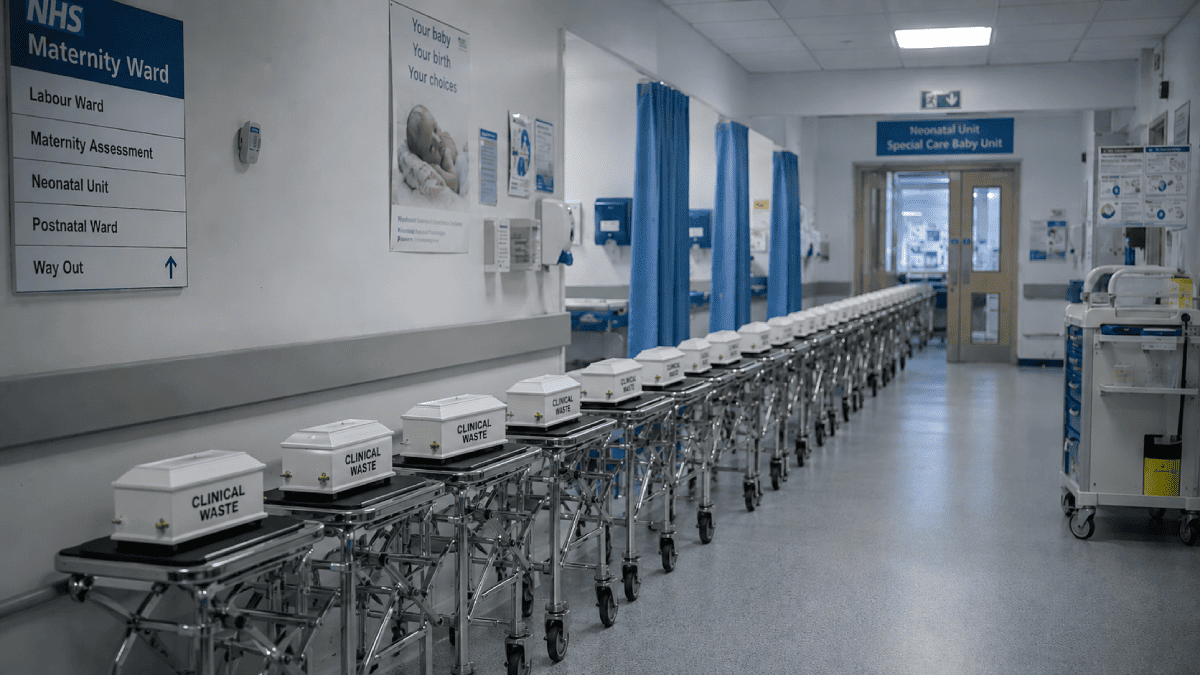
The report includes a review of post-death care which the coverage has reduced to a euphemism about dignity. The specifics are worse. Ockenden's team examined the care of seventeen babies and one adult who died, and found recurring failures to protect the dignity of the deceased.
Among them:
- An early-gestation baby disposed of as clinical waste.
- Dehumanising language from clinicians.
- Mortuary care in breach of legal requirements.
- Inadequate arrangements for paediatric post-mortems.
In a separate case, a family received harrowing post-mortem photographs of their son, sent to their home without warning. The Trust's first instinct was to lie. Then it claimed a "mistake" occurred.
There is a word for the disposal of a dead child as clinical waste, and it is not negligence. Negligence is a failure of care.
This is a failure of recognition, of the basic acknowledgement the thing being processed was a person.
When that faculty goes in an institution, no safety standard can be written low enough to catch what comes after. Stafford's patients were left in soiled bedclothes and denied help with eating and drinking. Different ward, same collapse of the instinct: the body in front of you is actually human.
51% Of Negligence Claims Involve Children
Clinical negligence now costs the NHS almost as much as delivering maternity care in the first place. On the report's cited figure, maternity is 51 per cent — some £2.5bn — of the total £4.9bn cost of harm across the health service in 2024/25, up from 49 per cent the year before.
NHS Resolution's own headline for 2024/25 is £3.1bn actually paid out in compensation and costs across all clinical schemes, of which £1.3bn related to maternity.
The larger figure Ockenden uses is the estimated future cost of harm; the actuarial shadow of injuries that will need care for decades. The proportion is the same either way, and so is the meaning: obstetric claims were 11 per cent of clinical claims by number and 53 per cent by value. A small share of cases, a majority of the money, because the injuries are catastrophic and lifelong. The average obstetric cerebral-palsy claim runs past £11m.
NHS Resolution's provision for future clinical liabilities now stands above £60bn, one of the largest single obligations anywhere in the government's accounts.
The health service is running two maternity budgets side by side. One delivers the babies. The other compensates the families of the babies it damaged delivering them.
The two are converging in size.
This is the number which connects the postcodes, because litigation is the one part of the apparatus with a hard incentive to be honest: a court eventually reads the notes, and no amount of board-level reassurance survives cross-examination.
Every other filter in the system can be satisfied with tone. The compensation bill cannot. It is the true state of NHS safety, priced in cash, and it is the size of the maternity service itself.
A Low-IQ Partisan Stooge Is Sent For
The Care Quality Commission's national maternity review of 2022 to 2024 concluded poor care had become normalised and failures were widespread rather than confined to the headline scandals. Not one inspected service was rated outstanding for safety.
On safety alone, 18 per cent were inadequate, 47 per cent required improvement, and 35 per cent were good. Two-thirds of English maternity units, on the regulator's own marking, were not safe enough.
That marking carries an awkward asterisk, since the regulator declaring the system unsafe is the same regulator Ockenden names among the bodies which failed the Hawkins family.
When the watchdog reports two-thirds failure but appears on the list of failures itself, the honest reading is that two-thirds is a floor. Compromised instruments understate.
The government has, in its actions, already conceded the point.
Ministers do not commission a national investigation into a handful of hospitals. In September 2025 they named an initial fourteen trusts for a rapid national investigation under Baroness Amos, later cut to twelve.
Its interim report, in February 2026, found persistent issues running through the entire system. Three of the trusts under review (Shrewsbury and Telford, East Kent, Morecambe Bay) are there precisely because they have already been investigated once. The state is now re-investigating the hospitals it investigated last time. If in doubt, commission another report to look like you are doing something. And then another report about the reports.
The final report was publishing on the 30th of June 2026. The contents are unsurprising, and it is full of abstract sociology garbage jargon ("systemic," "trauma-involved,") and feminist stupidity which helpfully undermines the entire scandal. It proposes, quelle surprise, more left-wing student politics, incentive technocracy, useless quangos for the civil service, and something to do with racism and trans.
1. Creating a statutory national Maternity and Neonatal Commissioner to drive the urgent, systemwide change identified by this Investigation and provide the oversight to drive accountability and implementation of a redesigned maternity and neonatal system. The legislation for the Commissioner must be included in the Health Bill currently in Parliament.
2. Systematically listening to the voices of women, birthing people and families.
3. Improving how the system responds and learns when something goes wrong.
4. Creating a Modern Service Framework which sets out national standards to consistently achieve high-quality maternity and neonatal care.
5. Tackling racism, discrimination and inequality.
Baronness Amos is the right kind of idiot for the moment. She is the perfect moron to produce the absolute pathological stupidity about "birthing people" no-one can or should implement, and can only be ignored by sensibly-minded people. Job done; trebles all round.
The Maternity Safety Alliance criticised the decision not to examine the regulators, and Amos confirmed she had not been given power to review bodies such as the Care Quality Commission and NHS Resolution. Because, of course.
An investigation launched because the oversight failed has been told to leave the oversight alone. Again. The one wall the families kept hitting is the one wall the review may not inspect. Someone has drawn the curtains on the part of the room that most needs the light.
This is the same sleight-of-hand at work in an another re-investigation forming a further grooming gang inquiry: investigators are not permitted to scruitnise central bodies; only local authorities. We also already have a report.
This has a name: corruption.
The One-Bad-Apple Theory Is Dead
Ockenden is candid about the futility engineered into her own genre. Similar findings and recommendations, she writes, have been made in earlier inquiries, yet sustained change has not always followed.
The Amos investigation is now formally reviewing the recommendations issued since 2015 to work out how many were implemented and why the rest were not. A review of reviews. An inquiry into the fate of previous inquiries.
Francis alone produced 290 recommendations in 2013, and here we are, counting mothers again.
The pattern is legible at every level and it is always the same.
- A mother notices something is wrong and is not believed.
- A midwife raises the alarm and is bullied, outranked or ignored: at Nottingham only 11 per cent of staff reported sufficient staffing for the workload, and 59 per cent said they routinely worked longer than was safe for the service.
- An incident occurs and is misclassified.
- A family complains and meets delay, defensiveness and the vocabulary of learning.
- The board receives a report and converts the risk into reassurance.
- The regulator inspects late, or misses the pattern, or lacks the teeth.
- The professional council processes the referral into silence.
- The ombudsman receives the unresolved complaint too late to matter.
Years afterward, NHS Resolution writes a cheque. The institution survives every stage intact, and the next mother arrives to begin again.
Every year, we dump £200 billion pounds into this corrupt failure because it is the only thing socialists have left as a temple.
Britain has not underbuilt its oversight. It has built a cathedral of the stuff: the Care Quality Commission, NHS England, integrated care boards, trust boards, the incentive scheme, the safety-investigation programmes, the ombudsman, the professional councils, the royal colleges, coroners, duty of candour, safety champions, dashboards, ratings and action plans beyond counting.
The apparatus is vast, costly and perpetually busy. Across Mid Staffs, Morecambe Bay, Shrewsbury, East Kent, Nottingham and now Leeds, it has produced the identical failures on loop: not listening, not staffing, not escalating, not investigating, not learning, not disciplining, not telling the truth.
The oversight has become the ritual by which failure is absorbed, renamed and survived.
Each catastrophe generates its report, its recommendations, its pledges and its improvement programme, and the machine metabolises all of it into a soothing account of a system now learning at last.
Then another five hundred mothers and babies join the tally, and the next report is commissioned to explain why the previous four were not enough.
The failure was diagnosed at Stafford in 2013, written down 290 times, filed, cited, re-announced and never once enforced. It was diagnosed again at Nottingham this summer. It will be diagnosed at Leeds. The lesson has never been the missing ingredient. What is missing is anyone, anywhere in the structure, who pays a price when the lesson is ignored.
If the NHS cannot deliver children without killing or injuring them, it has to be replaced. Not reformed; not measured; not changed. Replaced wholesale. You cannot "reform" an organisation which has stopped caring about whether mothers are important or whether their infants should live.
This is not a difficult conclusion to reach for anyone who is uncomfortable with children dying. The argument about socialist "healthcare" is over.