The US And Its Ukrainian Biolabs
For 3 years the polite position was anyone saying "biolab" was a Kremlin stooge. Then America's own spy chief declassified slides listing the funding, the pathogens, the builders, and the wartime panic. Moscow's wildest claim stays unproven, but the silence indicates questions need answering.
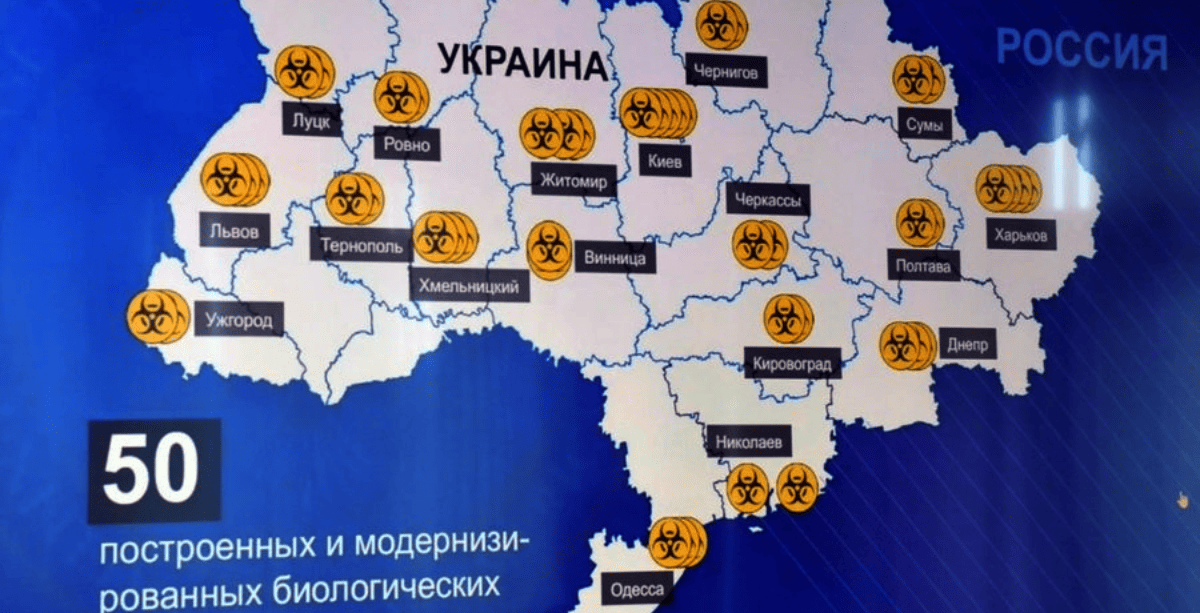
Cast your mind back to the spring of 2022. Russian tanks were rolling towards Kyiv, and a strange word began surfacing in the online froth around the invasion. Biolabs. American biolabs, in Ukraine, stuffed with terrible diseases. The response from every respectable quarter was instant and identical. Russian disinformation. A conspiracy theory.
Anyone repeating it was, at best, a useful idiot, and at worst something closer to a traitor. Fact checkers rated the claim false. The word itself became a tripwire, a signal marking whoever used it as a person who had wandered off the reservation.
Now jump to 23 April 2026. Tulsi Gabbard, the Director of National Intelligence, quietly declassified four slides from America's own spy agencies. And there, in the government's own cautious prose, sits the thing everybody was told did not exist.
It is now the official position of the United States government, it was, in fact, responsible for a network of at least 129 biolabs. Of which 40 were located in Ukraine.
Over forty Ukrainian laboratories, built and supported with American money. Hundreds of dangerous pathogens. Soviet biological weapons in the family tree. Safety failures. A wartime scramble to destroy the contents before the Russians arrived.
Two things need saying at once, because the whole affair collapses into nonsense if you drop either.
Russia's grand accusation, of America secretly cooking up bioweapons in Ukraine, remains unproven. That much of the denial holds.
But the other half of the denial, the half treating the entire subject as a hallucination and the word "biolab" as a mark of Cain, was rubbish. The labs were real. The money was real. The pathogens were real.
One caricature came out of Moscow. The other came out of Washington, and a great many clever people repeated it because repeating it looked sensible. Along with the usual "ackshually" people editing Wikipedia.
What US Intelligence Released
Precision keeps the whole business standing when the pushback arrives, and the material deserves an exact description. This is no smoking gun. Four slides, clearly cut from something larger, the page numbers running 10, 2, 3, 5 rather than one to four. Somebody pulled them from a bigger stack.
Read them for yourself: https://www.dni.gov/files/BIOLAB_Slides.pdf
The markings differ across the pages, and the difference earns a moment.
- Page one reads "Declassified by DNI Gabbard on 23 April 2026" and comes thick with black redaction bars. It looks like a genuine intelligence assessment.
- Pages two to four read "Approved for public release" and are altogether glossier, assembled from contractor invoices, embassy permit records and a diagram of who was connected to whom.
Page one carries the analysis. The rest is the show-and-tell wrapped around it. The strongest single admission sits on the sober page. The loudest shouting sits on the glossy ones.
The Laboratory in Kharkiv
The first slide concerns a mouthful of an institution: the Institute of Experimental and Clinical Veterinary Medicine, in Kharkiv, a city bound to spend much of the war under Russian bombardment. Its own internal heading is a small marvel of having things both ways. The place is called an "ongoing target for Russian misinformation, other potential operations." America's analysts were saying, in one breath, both that Russia would lie about the facility and that the facility carried real risk. Both together. Neither one standing in for the other.
The assessment then gets down to business.
The institute "probably houses at least some dangerous pathogens" and "almost certainly remains vulnerable to long-standing Russian information operations, seizure or damage." Founded in the 1920s, it "may have had Soviet biological warfare ties" and "may have directly or indirectly supported Soviet BW efforts." Its stated work was diagnostics and vaccines, which sounds reassuringly medical, until you remember what building a vaccine requires: a working stock of the very thing you are vaccinating against. Public health and biosecurity risk are not opposites. They are frequently the same room.
Then comes the sentence the three-year shouting match was arranged to keep out of view. As of the early 2010s the institute:
held hundreds of pathogens and was one of over forty Ukrainian-owned and operated laboratories which received assistance under DoD's Biological Threat Reduction Program.
Ukrainian-owned. American-assisted. Programme named outright. Hundreds of pathogens. Over forty labs. Every clause of it was jeered at as Russian invention for the better part of three years, and there it sits inside an American intelligence product.
The facility had modernised in places, the slide concedes, but "as recently as 2019 had at least some biosafety and biosecurity deficiencies," worst of all in the rooms handling contagious Brucella, a bacterium which passes between animals and people and shows no respect for a leaky door. So much for the picture of gleaming, faultless public-health suites. At least one held nasty organisms behind imperfect safeguards on the very eve of a war.
The custody problem was no hindsight invention. Analysts wrote of "working to better understand the current status of pathogens and biosafety conditions" because reporting suggested "laboratories were ordered to destroy holdings after Russia's invasion."
An order to destroy your holdings is not spring cleaning. It is what you do when the danger has grown sharp enough to warrant burning the evidence of your own good intentions.
Russia accused the Americans of running a bioweapons lab in the facility's basement. ODNI's own text notes, drily, that "information from 2012 indicates at least IECVM's virology building has a basement level."
A basement existing does not vindicate the weapons claim, obviously. But where the official rebuttal left the public with an impression of no basement, no relevant lab, no pathogen at all down there, the rebuttal became a hostage to fortune, and propaganda asks for nothing sweeter than a denial it can burst with a single true fact.
40 Labs, Counted Out Loud
The second slide drops the careful hedging and simply announces the scale: "Ukraine: Over 40 Labs Built and Supported." The bullet points list storage of Soviet-era biological warfare pathogens, American training of Ukrainian scientists in biocontainment, "Especially Dangerous Pathogen" certification, and a repository of warfare-grade and disease-causing bugs. The roll-call of agents runs anthrax, tularemia, tuberculosis, swine fever, Newcastle disease, MERS, SARS, Marburg, Ebola, Lassa, plague, and rickettsia.
The phrase chosen is "BW pathogens," biological warfare pathogens, not the blander "dangerous pathogens" or "select agents." It is technically fair, since anthrax, plague and tularemia carry long and horrible weapons pedigrees, and it is also a loaded choice, because a weaponisable bug is nowhere near a lab making weapons. The slide claims the network handled organisms with a warfare history. It proves nothing about production, delivery or intent, and the wording rather hopes you will let the second idea ride in on the back of the first.
The pathogen list itself gives the game away, in the other direction. It jumbles classic warfare agents together with farmyard threats like swine fever and Newcastle disease, high-consequence human horrors like Marburg and Ebola, and thoroughly ordinary organisms like tuberculosis.
No single enterprise looks like this. It is public health, animal health, crop and livestock security, old Soviet pathogen custody and outbreak surveillance, all crammed under one ugly label. Which is exactly why "biolab" is a crude word and a useful one at the same time. It nails the infrastructure and tells you nothing whatever about the purpose.
Following The Money
The third slide is the concrete one, and for anyone who cares how governments actually operate, the most damning. It names four laboratories, with dollar figures, the firms which built them, and their pathogen permits.
- Kherson Diagnostic Laboratory
- Institute of Veterinary Medicine, National Academy of Agrarian Sciences
- Central Reference Laboratory (URAPI), Odessa
- Zakarpartska Diagnostic Laboratory
| Laboratory | American investment | Lead contractor | Pathogen permit |
|---|---|---|---|
| Kherson Diagnostic Laboratory | 1,728,822 USD | Black & Veatch | "In progress" on Ukraine Embassy site |
| Institute of Veterinary Medicine, National Academy of Agrarian Sciences | 2,109,375 USD | Black & Veatch | "In progress" on Ukraine Embassy site |
| Central Reference Laboratory (URAPI), Odessa | 3,492,551 USD | Black & Veatch | Issued by Health Ministry, 13 September 2010 |
| Zakarpartska Diagnostic Laboratory | 1,920,432 USD | Black & Veatch | Issued by Health Ministry, 2 March 2012 |
Four labs, a shade over 9.25 million dollars between them. Small change by Pentagon standards, and more than enough to prove direct American-funded building, upgrading and kitting-out. Every one names the same American engineering giant, Black & Veatch, as the firm pulling it together, with Ukrainian subcontractors doing the design and supply work underneath.
Black & Veatch describe their business as the:
delivery of human infrastructure projects that shape the fabric of organizations, populations and communities.
What the numbers actually show is American money, plus an American contractor, plus Ukrainian subcontractors, plus Ukrainian ownership and operation. "US built" reads true about the funding and the construction, false about the flag flying over the door.
America paid for and contracted the building, upgrading and equipping of Ukrainian laboratories through defence-linked firms, while the labs themselves stayed Ukrainian-owned and Ukrainian-run. No thriller material. Also nothing a fact checker can wave away, which is rather the point.
Two of these labs held formal Especially Dangerous Pathogen licences, issued by a Ministry of Health commission, dated to the exact day. Two more were listed as pending on the Ukrainian Embassy's own website. No GP surgeries here. They were officially cleared to handle the most hazardous category of organism on the books, and the paperwork proving it sat in public the entire time anyone was being told to shut up.
The Spider's Web
The fourth slide looks the most explosive and leans the flimsiest. It throws up a tangle of logos: Black & Veatch again, the US Department of Agriculture, the World Health Organisation, the US Army's own infectious disease institute, the CDC, the world animal health body, the US Navy's medical research arm, a clutch of American universities from Alaska to Tennessee to New Mexico, the Joint Genome Institute, and two names guaranteed to make the conspiracy-minded sit up, Metabiota and Orion Integrated Biosciences.
The full list:
- Black & Veatch
- USDA
- WHO
- University of Florida
- US Army Medical Research Institute of Infectious Diseases
- Ukrainian Ministry of Agrarian Policy and Food
- Ukrainian Ministry of Health
- FAO
- CDC
- Public Health Center
- Ukrainian veterinary/scientific institutions
- World Organisation for Animal Health/OIE
- Navy Medical Research Center
- University of Alaska Anchorage
- University of Tennessee Knoxville
- Joint Genome Institute
- University of New Mexico
- Helmholtz Centre for Environmental Research
- Kansas State University
- Metabiota
- Orion Integrated Biosciences
- State Forest Resources Agency of Ukraine
A diagram of who knew whom is not a charge sheet. It shows connections, not crimes, and honesty demands saying so plainly. The caption underneath makes the sharpest claim on the page: America paid Ukrainian scientists to study the genome of highly pathogenic bird flu and other highly infectious viruses, in biocontainment labs America had also paid for.
Sequencing bird flu is textbook outbreak-watching, the sort of work every serious public-health system does. It is also genuinely dual-use, because flu research shades quickly into how a virus jumps species, how it spreads in mammals, what makes it deadly, and the frontier between studying a virus and improving it runs thinner than any press officer will ever admit.
The slide proves no gain-of-function and no weaponry. It proves a deliberate change of costume by the intelligence community, from "ordinary public health" into "biological defence industry." The costume changed. One's scepticism should not.
| The slides support | The slides do NOT support |
|---|---|
| Over forty Ukrainian labs built or backed with American involvement | An active Ukrainian offensive bioweapons programme |
| Storage and handling of dangerous, warfare-relevant pathogens | American manufacture of deployable weapons on Ukrainian soil |
| Soviet-era biological weapons legacy at named facilities | Weaponisation with delivery systems |
| American training of Ukrainian scientists in biocontainment | Secret American control over Ukrainian-owned labs |
| Black & Veatch and subcontractors building and equipping named labs | Confirmed gain-of-function in the bird flu genome work |
| Especially Dangerous Pathogen permits, some issued, some pending | A single risk profile across all forty-plus sites |
| Known 2019 safety and security failings at Kharkiv | Every listed pathogen present at every named lab |
| Post-invasion worry serious enough to prompt destruction orders |
The whole scandal lives in the left-hand column. It has no need of the right-hand one, and every reach for the right-hand one hands a gift to the people who want the left-hand one buried too.
None Of This Was Actually Hidden
As the Soviet Union fell apart it left unsecured stockpiles of pathogens, a generation of newly redundant weapons scientists, and crumbling laboratories strewn across the successor states. The Nunn-Lugar programme, run by the Pentagon's threat-reduction agency, existed to lock the materials down, give the scientists honest work, and turn the buildings into ordinary disease-watching stations.
Back in 2005 the trade press reported American money flowing to Ukrainian facilities. Among them sites once tied to the Soviet anti-plague network which still held libraries of live pathogens. No madness in any of it. At birth it was sober, sensible containment.
The Department of Defense said plainly it had put roughly 200 million dollars into Ukraine since 2005, supporting 46 Ukrainian laboratories, health facilities and diagnostic sites. The whole effort grew out of the need to secure the biological mess the Soviet weapons programme left behind. It insisted the labs were entirely Ukrainian-owned, no gain-of-function work and no human experiments were sponsored, and Russia ran a daily disinformation campaign against the programme.
When American officials said, over and over, "there are no US bioweapons labs in Ukraine," they were answering Russia's wildest claim, and answering it fairly. The rot set in around the quieter, truer claim standing right beside it. Say, in early 2022, "America funds Ukrainian labs holding dangerous pathogens," a sentence lifted almost verbatim from the Pentagon's own paperwork, and the machine declined to argue the substance. It reached for the language of treachery.
The press release attached to these slides puts the mechanism in the government's own mouth: the labs' existence and funding was...
intentionally covered up by powerful people falsely claiming they do not exist and accusing anyone who says otherwise to be foreign assets and traitors.
Whatever you make of Gabbard, the machinery she describes is written plainly across the public record of 2022.
Where Are The Other 80?
The release boasts a number it declines to explain. More than 120 biolabs, across more than 30 countries, of which Ukraine supplies a little over forty. Upward of eighty facilities go unnamed, and ODNI has published no list. Until it does, no honest person can claim the full inventory. What the older public record allows is an educated sketch of where they likely sit.
| Region | What the public record shows |
|---|---|
| Former Soviet heartland | Central reference labs built in Azerbaijan, Ukraine and Kazakhstan, dozens of secured labs upgraded across Armenia, Georgia, Kazakhstan and Ukraine |
| Africa | A programme the agency now describes as spanning more than 30 partner nations, with documented pathogen projects across the continent |
| Middle East and South Asia | Work the programme openly describes as reaching beyond the old Soviet space into the Middle East and Asia |
| Southeast Asia | Disease-surveillance and biosafety partnerships repeatedly named in the agency's own material |
The original Biological Threat Reduction Program was active in Russia, Kazakhstan, Uzbekistan, Georgia, Azerbaijan, and Ukraine by 2007. The National Academies report says BTRP had carried out activities in those six countries and involved several dozen institutions.
The same report says U.S. spending through FY1998–FY2007 covered biosafety/biosecurity, cooperative biological research, biological infrastructure elimination, contractor support, and a Threat Agent Detection and Response network in Georgia, Azerbaijan, Uzbekistan, and Kazakhstan.
After that, the programme expanded well beyond the ex-Soviet heartlands. DTRA’s 2023 BTRP fact sheet says the programme supports more than 30 partner nations across Africa, Europe, the Middle East, and Asia, securing pathogen collections and strengthening public-health and veterinary systems.
A programme this vast, this reliant on private contractors, this entangled with lethal material, owes the public a map. "Trust us, they are perfectly safe" has run through its credit.
Was Putin Right?
The neat answer runs no. The honest answer arrives more awkward than either side would like. Russia took its case to the UN Security Council in March 2022, claiming to have uncovered dozens of Ukrainian labs working on anthrax, cholera and plague under American military funding, and painting the lot as a secret weapons plot. The maximal claim was denied by America, by Ukraine, and it stays unproven today. On the existence of a hidden bioweapons programme, Moscow earned no vindication.
On the plumbing underneath, though, the flat dismissal has aged badly. The labs existed. The American funding existed. The dangerous pathogens existed. The Soviet weapons ancestry existed. The military-linked infrastructure existed, and the wartime custody panic ran real enough for the World Health Organisation to urge Ukraine to destroy its samples as the tanks crossed the border, which the Ukrainian health ministry duly did.
Russia's propagandists sat nearer the underlying facts than the Western information managers cared to grant, for the plain reason those managers had decided the safest play was calling the whole category a fantasy.
A government answering only the maddest version of an accusation, while branding the moderate version as sedition, does not defeat lies. It digs the very hole the lies pour into.
The public was told the whole accusation was a fever dream. The same government's own people, at the very same moment, were losing sleep over who now held hundreds of pathogens in an active warzone. The distance between those two facts is no footnote. It is precisely why a four-slide deck, three years late, reads less like a bombshell and more like an itemised bill. Another win for the "conspiracy theorists."