Arms Dealers, Front Companies, And A Mythic Supergun
They kept the same soldiers on the payroll and changed who signed the cheques. Britain armed both sides of a war it swore neutrality in, ran mercenaries it claimed it couldn't control, built a supergun in plain sight, then quietly destroyed the one chairman who reported it by the book.
On 5 May 1980, six armed men abseiled down the front of a stucco building in South Kensington while the nation watched on live television. The Iranian embassy had been seized six days earlier. The Special Air Service went in through the windows, killed five of the six hostage-takers in minutes and freed the captives. Until that afternoon most British people had no idea the regiment existed. Afterwards it became a national myth: the men in black balaclavas of last resort who arrived when everything else had failed.
The myth was useful. It fixed in the public mind a picture of British special forces as a rescue service; disciplined and precise; deployed only in extremity against people who thoroughly deserved it.
What the cameras could not show was the older and far larger apparatus standing behind those six men, and the strange constitutional fact at the centre of it.
The organisations which ran Britain's covert power did not exist in any form of British law.
Secret Apparatus Without Authorisation
The Secret Intelligence Service was founded in 1909 to spy on the German Navy. For the next eighty years the British government neither confirmed nor denied it ran a foreign intelligence service at all. There was no Act of Parliament establishing it, no legal definition of what it could do, no mechanism by which a minister formally authorised its operations, and no committee empowered to examine them.
The recruiting system was simple: humanities students in homosexual networks identified by lecturers at Cambridge were invited to 3 Carlton Gardens for a screening interview about geopolitics, followed by a nice lunch at the Traveler's Club, and a few months of enhanced positive vetting before training at 296-302 Borough High Street and Fort Monckton. When they graduated, they were posted as a "passport control officer" at the embassy.
The same was true of GCHQ, the government signals agency at Cheltenham. It was very nearly true of MI5, which ran agents and tapped telephones inside the United Kingdom for decades on the strength of a secret Home Office memorandum (the Maxwell-Fyfe Directive) written in 1952.
Across the twentieth century the British state acquired nuclear weapons, a foreign intelligence service, a capacity for covert action to violently enact regime change, and the practical ability to kill people abroad.
It did all of this without Parliament ever passing a law defining the powers involved. The most consequential things the British state could do were the things with no statutory existence at all.
None of it was an accident.
A body which does not legally exist cannot be sued, cannot be summoned, and cannot be made to disclose anything. Its officers, if caught, can be disowned. Its budget hides inside other departments.
When a member of the public asked what the intelligence services were doing, the honest and the dishonest answers were identical, because the official position was there was nothing to discuss. For most of the century Britain ran three of the most powerful secret organisations in the world on the constitutional basis of a shrug.
An organisation answerable to no law tends, over time, to decide it is a law unto itself. By the mid-1970s the services had drifted somewhere close to that.
When Harold Wilson resigned as prime minister in 1976 he told two journalists a faction inside MI5 had spent years working against him, spreading smears he was a Soviet agent and plotting to bring his government down. For years this was dismissed as the paranoia of a tired man. Then in 1987 a retired MI5 officer named Peter Wright published Spycatcher in which he claimed officers of the service had indeed conspired against an elected prime minister.
Whatever the precise truth of Wright's account (and he was not a wholly reliable narrator), the episode made something undeniable. The state possessed agencies with the means, the secrecy, and the appetite to act against the government of the day. No law existed to stop them or even to define what they were forbidden to do. The apparatus was not merely secret. It had, in places, slipped its leash.
A body which cannot legally act still has to act. An organisation with no existence in law needs instruments in the visible world: things that can sign a contract, pull a trigger, or take the blame while the state which directs them keeps its own name off the paper.
Over the two decades from the mid-1970s to the early 1990s, Britain grew fluent in three such instruments. In Northern Ireland it worked through the agent, i.e. the informer turned inside a paramilitary group. Abroad it worked through the mercenary and through the company.
Each solved the same problem: how to exercise power while keeping responsibility for it somewhere else.
Keenie Meenie: Who Pays Wins
In 1974 Brigadier Mike Wingate Gray, Colonel Jim Johnson, Major David Walker, and Major Andrew Nightingaler set up a company with the deliberately obscure name of Keenie Meenie Services. The phrase was drawn from services slang for moving unseen like a snake through grass. Its founders were exactly who you would expect: SAS officers hardened in Oman, in Aden, and on the streets of Belfast. Men whose skills had no legal market once they left the army and who now offered them for hire.
KMS twisted the regiment's motto into a private joke. Who Dares Wins became Who Pays Wins.
What their company sold was the covert method turned into a product.
- Its people built and ran a praetorian guard for the Sultan of Oman, whom Britain had installed in a 1970 palace coup.
- They guarded British ambassadors in the world's danger spots on Foreign Office contracts.
- From 1984 in Sri Lanka they trained the police Special Task Force and flew helicopter gunships against the Tamil population. The atrocities which followed (villages burned, men thrown from aircraft, prisoners executed, etc) are the subject of a British war-crimes investigation which remains open decades later.
- In Nicaragua a KMS director worked with the American-backed Contras during precisely the period when such assistance was the object of a bitter political fight in Washington.
The firm was one of the first modern private military companies, and it existed to do the things a government wanted done but could not be seen to do.
It was not a rogue outfit operating beyond the state's control. It was the reverse.
In 1976, alarmed by the spectacle of British mercenaries fighting and dying in Angola, Harold Wilson's government tried to curb the use of private soldiers altogether. KMS sailed through untouched, because its founders had the connections to make the effort irrelevant.
One Foreign Office official noted if the firm were legislated away, no comparable protection would be available to the diplomatic service; the state found it too useful to lose.
Its principals had direct access to Downing Street. When officials had concerns about what the company was doing, they were asked to have a quiet word with its founders rather than commit anything to paper. When MPs asked ministers in the Commons what dealings the government had with KMS, they were told it was not the practice to discuss such things.
A private company, staffed by the state's own former soldiers, doing the state's work in places the state could not officially go, funded through channels which never appeared in any estimate, and disownable the instant it became an embarrassment.
The men were real and the killings were real. Yet the government could say truthfully it had sent no troops. It had merely declined to stop the private company which sent them.
What KMS did with soldiers, a different set of companies was about to do with weapons, on a far larger scale because in 1980 the perfect market arrived.
The Guidelines Were The Cover Story
In September 1980 Iraq invaded Iran. The war lasted eight years and killed perhaps a million people. For the arms industry of every developed nation it was a bonanza, and British policy towards it was a study in calculated dishonesty.
Officially, Britain was neutral.
In 1985 the Foreign Secretary Geoffrey Howe set out guidelines stating Britain would not supply lethal equipment to either combatant.
In reality with the knowledge of ministers and civil servants, British firms armed both Baghdad and Tehran throughout the war, routing the trade through third countries and disguising the cargoes as something harmless.
The guidelines were not a policy anyone intended to keep. They were a shield to be produced in public while the opposite was done in private.
The instrument which made this possible was the front company, and it is worth understanding exactly why the state reached for it rather than simply tasking MI6.
A private company can do things an intelligence service cannot:
- It signs contracts and insures cargo.
- It employs staff and moves money through ordinary banks.
- Its activity looks commercial, so it never appears in a defence estimate or a parliamentary answer.
- If something goes wrong, the liability falls on named directors, not on ministers.
- When it has served its purpose, it can be sold, wound up, or quietly bankrupted. Taking its records with it.
Deniability because the state did not own the shipment. Invisibility because the activity was commercial. Legal exposure carried by directors, not the Crown. And insulation, because a minister could stand at the despatch box and say the government had exported no weapons. Technically, it hadn't. The company had.
In practice this meant a web of obscure firms whose only real function was to launder the paperwork so no single document ever showed a British weapon reaching a banned destination.
- Naval artillery was sold to Singapore (a state with almost no navy) and travelled onward to Iran.
- Artillery fuses and propellant went to Jordan and Cyprus (in one recorded case disguised as chocolate) before continuing to Iraq.
Some of these companies barely existed at all. One of the busiest, the Allivane International Group, which shifted huge quantities of fuses to both combatants, was never even registered as a company.
They had a tendency to collapse and their collapses were not always accidents. Run in secret, stuffed with covert contracts and enormous hidden commissions. Allivane went under in 1987.
The arms dealer Jim Guerin's company ISC, set up to supply embargoed South Africa (and later Iraq), went bust in 1989; Guerin went to prison for fraud, but not before he had persuaded the blue-blooded British firm Ferranti to buy his company for so much more than it was worth Ferranti collapsed too. Taking thirty thousand jobs with it.
A vehicle which can be dissolved can carry secrets to the grave. This was the landscape into which one ambitious businessman walked, believing he was building an ordinary defence company with the blessing of the British state.
He was half right. It had the blessing of the British state.
It was not ordinary, but it was not really his.
The Man Who Bought A Front Company
Gerald James was a chartered accountant with an impeccable City pedigree and an enthusiasm for the intelligence world. In 1981 he led a buyout of a small pyrotechnics firm called Astra and set about turning it into a full defence manufacturer. Through the mid-1980s Astra bought companies across Britain, Belgium, Canada, and the United States.
By the end of the decade it employed four thousand people and could make almost anything, from grenades to naval gun propellant. James dined at a discreet club whose purpose was to introduce businessmen to intelligence chiefs. He believed he had arrived.
What he had actually done was inadvertently buy a set of covert operational platforms with a boardroom attached.
When Astra acquired its subsidiaries, it inherited along with them a hard core of MI5, MI6, and American intelligence agents who had been running covert operations inside those companies for years. Behind the backs of their own directors, regarding the men at the top as useful idiots.
Container loads of equipment moved through his Kent factory as a transit depot. There were contracts not entered in the books; secret commission arrangements; and parallel bank accounts, and whole operations conducted in Astra's name that its chairman knew nothing about.
This was the front-company system seen from the inside: nominally private firms functioning as covert arms of the state, and their legal owners kept ignorant precisely so the owners could never be made to answer for what was done through them.
One of the agents had been placed on Astra's board through pressure from the company's bank. His name was Stephan Adolphus Kock.
Kock was no ordinary consultant but a long-serving intelligence figure with access to the highest levels of government. He sat at the centre of the whole covert network and reported on the activities of the very company he was supposed to help direct.
What James was describing, in sworn evidence, was not a rogue individual but a technique. The state had learned to exercise power through legally separate private entities. It kept operational control while shedding political responsibility in exactly the way it had learned to work through mercenaries and agents. The chairman was the visible owner of a business the secret services were quietly using as their own.
Then James did the one thing the arrangement could not survive. He played by the rules.
Project Babylon: A Very, Very Large Gun
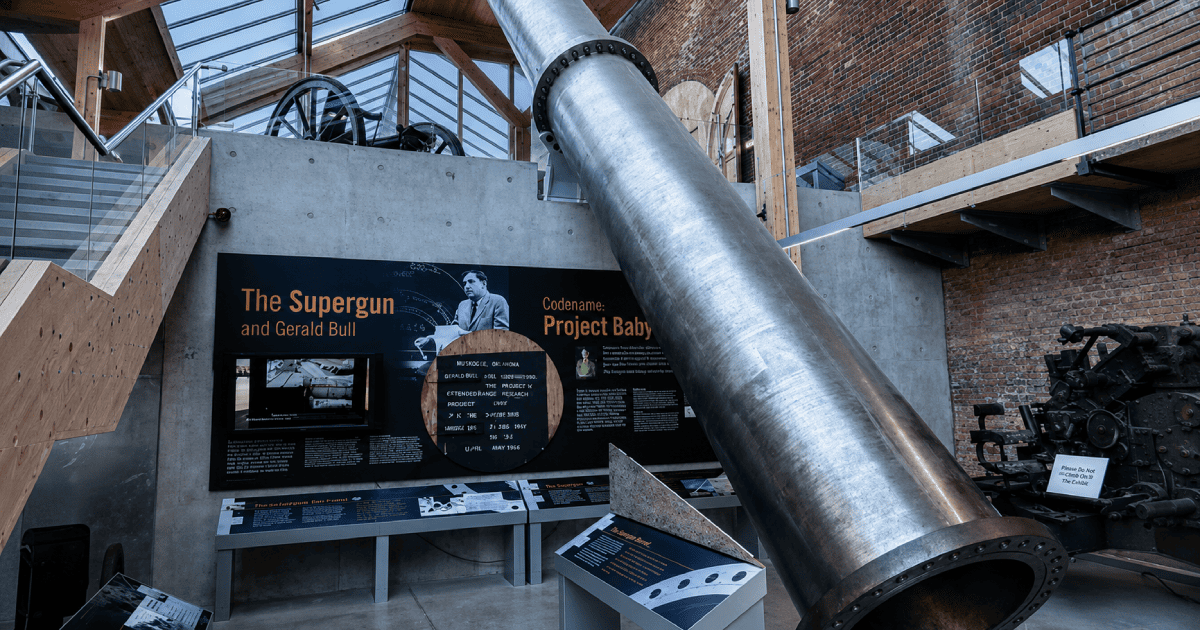
Gerald Vincent Bull was a Canadian artillery genius with a single obsession. He believed a payload could be fired into space from an enormous gun far more cheaply than by rocket. No respectable government would fund the idea, so Bull sold his talents to those who would. They included apartheid South Africa (for which he served a prison term), and finally Iraq.
For Saddam Hussein he designed Project Babylon, a gun so monstrously large its barrel had to be built in sections and disguised as petrochemical piping. Assembled, it would have stretched over fifty yards and could, in theory, have fired a shell at Israel.
The barrel sections were forged, in part, by British steel firms who were told (or chose to believe) they were making pipes. In 1989 James's company took over a Belgian subsidiary and discovered among its contracts one to supply the propellant for this insane gun. He knew supplying it broke the government's own guidelines. So he reported it, in good faith, to MI6, and the Ministry of Defence. Exactly as a responsible chairman should.
The intelligence officers he spoke to told him to proceed and honour the contract. Shortly afterwards the production line which made the propellant was destroyed in a freak explosion with at least one loss adjuster attributed to sabotage.
In its own files the state recorded what it thought of James for reporting the contract. He and his managing director were "the goodies" who had played their cards face up on the table. This was not a compliment.
A man who reported one embargoed contract because the rules required it, might report the colossal secret commissions attached to the others; one deal alone carried five million pounds in kickbacks to prominent people across three countries.
A chairman with a conscience was a liability to everyone at the table, and the table was crowded. What happened to Gerald James over the following year would prove the point, but he was not the first to learn it. The man who had designed the gun learned it earlier, and more finally.
Two Murders, Nine Days
On the evening of 22 March 1990, Gerald Bull was shot five times in the head and back at point-blank range outside his Brussels apartment. The pistol was silenced. The killer collected the spent cartridges and left roughly twenty thousand dollars in cash on the body, which rules out robbery and marks the killing as a professional execution. No one has ever been charged.
Gerald James contends the murder was either orchestrated or carried out by Stephan Kock.
The name most often attached to the murder in official channels is Mossad. Israel had the clearest motive since the gun was pointed at it, and Israeli intelligence sources later hinted at responsibility.
It is the conventional verdict and it may well be right.
But by the time he died, Bull was far more than the designer of one weapon. Like A.Q. Khan, he was a living archive of the entire covert trade: he knew the procurement routes, the brokers; the intermediaries; the banks, and the precise intelligence relationships through which Western firms and governments had been arming Iraq for a decade. He had spent those years working inside the traffic.
A man who carries so much in his head is dangerous to everyone he could name. London, Washington, and Brussels all had reasons to prefer him silent.
Five months before his death, in letters that survive, Bull recorded he had been warned through the British Foreign Office he might meet with an imminent accident and observed dryly accidents often happen in series.
In them, he complained that the Foreign Office was spreading false stories about him and he had been warned his life was in danger. 'I addressed a blunt memorandum to the Foreign Office on the whole matter,' he wrote. 'I was advised in a letter of an imminent 'accident'.' Following his memo, Bull says 'we were assured that the action was by a 'few irresponsible juniors and did not reflect the Foreign Office views of myself, our companies, the past etc'.'
What can be said with confidence is narrow and damning enough: several states wanted him dead; Britain's own arms secrets died with him; he had been explicitly warned of a fatal accident by way of the Foreign Office.
No one was ever held to account.
Eight days later, on the other side of the world, it happened again.
Jonathan Moyle was a twenty-eight year-old former RAF pilot and editor of a magazine called Defence Helicopter World. In late March 1990 he was in Santiago covering an arms fair and asking pointed questions about a Chilean dealer who was converting civilian helicopters into cheap gunships for a customer which looked very much like Iraq.
On 31 March he was found dead in the wardrobe of his hotel room. A pillowcase over his head; suspended from a rail five feet high while he himself was five feet eight.
Chilean police recorded suicide. British officials briefed journalists Moyle had died in a squalid sexual accident: a story which appeared to originate in the Foreign Office, appear consistent with British intelligence trademarks, and for which no evidence was ever produced.
His family refused to accept it. A needle mark on his body suggested he had been sedated with tranquilisers first, then injected with sodium cyanide.
When the British inquest opened it had to be adjourned because vital organs had been removed and the post-mortem could not be completed. It took years and the family's money, but in 1998 a reconvened inquest found he had been unlawfully killed and the authorities eventually apologised for the smear.
Who killed Moyle has never been established, and the likeliest hands are local ones hired to protect a lucrative deal from a nosy reporter.
In 2014 The Independent felt it had enough evidence to name the same perpetrator, identified within a reported CIA document of which a redacted official version is available online:
I wrote about Kock extensively back then. He was a dark figure, ex-Rhodesian special forces, Czechoslovakian, who was a consultant to Midland Bank. Kock died in Scotland, at his home near Oban, in 2008.
The report says that Sir John (later Lord) Cuckney, the industrialist and ex-MI5 who also died in 2008, arranged for Kock to work at Astra, entering into secret supply contracts with Nadir’s Unipac.
Kock is said to have become worried Bull was becoming dissatisfied and was threatening to blow the whistle, in the form of a law suit, on what he’d been doing. According to the CIA report, “Kock hired two ex-SAS men [Ian Jack and Terry Hardy] to eliminate Bull.” Kock also “found that defence journalist, Jonathan Moyle, possessed evidence of UK covert deals. Consequently, Kock and [Roger Holdness] eliminated him in Santiago, Chile.”
Parts of this document, CIA Research Paper SW91-10076X — “Project Babylon: The Iraqi Supergun” are available here:
- https://web.archive.org/web/20131030041131/http://jancom.org/DocumentsPDF/CIA%20Report%20Project%20Babylon.pdf
- https://web.archive.org/web/20130927011034/http://jancom.org/JANCOMOverview.html
The allegedly redacted pages were published and are available online.
The parent CIA report is authentic, and the CIA release proves material beginning at report page 23 was withheld. A separately circulated text claims to reproduce the withheld intelligence summary. A later private analysis found the copy visually and contextually plausible, but did not forensically authenticate it or establish a documented chain of custody.
Consequently,, as Kock executed the endgame, the UK Special Air Service (SAS) destroyed the PRB supergun propellant plant at Kaulille, Belgium. (S NF NC)
Kock brought in Roy Barber (MI5) to replace James and appointed new lawyers, hiring MI6 agent Robert Burrow, a partner with SJ Berwin.
It alleges:
- Project Babylon was allegedly used as a diversion to shield wider British and American covert arms dealings with Iraq.
- Stephan Kock was the organiser of an MI6 penetration of Astra and later of a coordinated “endgame.”
- The murders of Gerald Bull, Jonathan Moyle, informant Lionel Jones, and Belgian politician André Cools.
- Kock hired two named SAS men, Ian Jack and Terry Hardy, to kill Bull.
- Kock and Roger Holdness (originally from Defence Intelligence, Sunday Business 11 Oct 1998 Mark Watts) killed Moyle in Santiago.
- The SAS destroyed a PRB propellant plant at Kaulille.
- Arrests, prosecutions, corporate collapses and the supergun seizure were a coordinated cover operation.
A British journalist investigating the secret arming of Iraq turns up dead, and the government's first move was not to demand answers for a murdered citizen. It was to circulate a story sordid enough to make his family too ashamed to ask questions.
These two deaths were the visible edge of something that had been running, quietly, for most of the decade.
Twenty Dead Marconi Scientists
Neither man died in isolation. Through the same years a number of British scientists and engineers working on secret defence projects had been dying in circumstances which ranged from the unexplained to the baroque. Most worked for GEC-Marconi or its subsidiaries, on the Sting Ray torpedo guidance programme and on projects linked to the American Star Wars missile-defence scheme.
Between 1982 and 1990 the toll ran to more than twenty, with six dying in a single year across 1986 and 1987.
- A young guidance engineer fell from a Bristol bridge with unexplained puncture marks on his body.
- A Marconi computer expert was found with a rope running from his neck to a tree while his car drove away from it.
- A defence metallurgist died of carbon monoxide poisoning in his garage.
- One man drove a petrol-laden car into a building.
Most were recorded as suicide or accident.
Opposition MPs asked for a single coordinated investigation into the cluster. The Ministry of Defence refused, citing no evidence of any link, and no British government has opened one since.
The state's response to a suspicious cluster among its own scientists was identical to its response everywhere else: not to investigate, but to decline to. When a government which could easily commission an inquiry into two dozen dead weapons researchers repeatedly refuses to, the refusal itself becomes a fact worth recording. Silence is rarely neutral.
The Network Eats Its Own
By 1990 the political weather was turning, and the network began doing to its own vehicles what it had always been able to do: abandon them. Gerald James was the test case, and what happened to him shows the technique completing its cycle. The state did not silence him with a bullet. It did something quieter and, in its way, more instructive. It repossessed his company and dismantled the man, using nothing but the ordinary instruments of corporate life.
Between January and April 1990, as the supergun story broke, James and every original director of Astra except Kock were removed from the board. This was a capture of corporate governance conducted through entirely lawful means: shareholder pressure, boardroom votes, and the installation of compliant replacements.
Two men with no experience of the defence industry were brought in and paid enormous salaries (one taking a hundred thousand pounds in his first month); more than James had drawn in a decade of building the firm. The profitable Belgian subsidiary was sold within weeks for a fraction of its worth, burying whatever its contracts might reveal.
Over the next two years a company with a full order book won no new business, even during the Gulf War. It was steered into receivership in early 1992, on the eve of James giving evidence to a Commons committee about the supergun and arms to Iraq.
Meanwhile the Ministry of Defence police and Customs mounted seventeen raids on Astra's premises and carried away its sales correspondence, including every trace of its dealings with the unregistered front company Allivane. The documents were never seen again.
Astra was not unique. It was one of a series.
As the Cold War ended and the covert arming of Iran and Iraq became a political timebomb, the network collapsed the vehicles it had used. Company after company which had carried the secret trade was pushed under or hollowed out, and a selection of smaller firms and their directors were prosecuted.
Matrix Churchill, Ordtec, Euromac, and others were fed into the courts as the visible culprits while the officials and agents who had directed the whole thing melted back into the departments they came from.
This is the front company's final and most useful property. Whereas an intelligence officer who kills becomes a liability the state must protect forever, a company which breaks the law can simply be abandoned to it. The liability was designed from the start to be disposable.
The reason it worked so cleanly is the network was permanent while the governments above it were not. Over the years the intelligence services had built up commercial relationships, trusted brokers, shipping routes, banks, lawyers, manufacturers, and mercenary firms which outlasted any single administration.
Wilson had tried to curb the mercenaries in 1976 and failed. The guidelines of 1985 were designed to be broken. The denials over the supergun were exposed and changed nothing.
By the late Cold War the covert infrastructure of British foreign policy had become a permanent administrative capability, activated regardless of which party held Downing Street. Answerable, in practice, to no one who could be voted out.
The Scott Inquiry: Institutional Deceit
The reckoning, when it came, took the form of a trial the government never wanted. In late 1992 three executives of Matrix Churchill were prosecuted for breaking the embargo, and their defence was devastatingly simple: the government had known about their exports all along and had encouraged them.
It was true.
The trial collapsed, and the resulting Scott Inquiry into arms sales to Iraq spent three years laying out exactly how the machine had worked at the level of ministers and civil servants.
The picture Scott assembled was a chain of official deceit.
- Government had secretly relaxed its own export guidelines while telling Parliament they were unchanged.
- It had issued contradictory guidance to exporters.
- Ministers had signed Public Interest Immunity certificates which, had the trial judge accepted them, would have suppressed the very documents proving the defendants' innocence; sending men to prison to protect the government's secret.
- Parliament had been misled, and the courts had nearly been used as an instrument of the cover-up.
The whole apparatus was rendered visible for once: not a single conspiratorial room, but a settled administrative practice of saying one thing in public and doing the opposite in private. Reaching for the machinery of secrecy the moment either threatened to meet the other.
Scott exposed the method more completely than any inquiry before or since.
It changed.... almost nothing.
The Same Trick Nearer Home
The one thing the arms trade could obscure was how familiar all of this already was, because the covert state had been running an older and bloodier version of the same technique at home throughout these years.
The constitutional logic was identical: act through someone the state could direct and then disown, then arrange matters so responsibility never came to rest anywhere.
The results were on the record for anyone who cared to look.
In five weeks at the end of 1982, before the supergun was even a drawing, specially trained officers of the Royal Ulster Constabulary shot dead six men in County Armagh. Five of them entirely unarmed. When one officer admitted at trial he and others had been instructed to lie to justify opening fire, the resulting scandal forced the appointment of a senior English detective to investigate.
Stalker found evidence Special Branch had targeted the men, briefed the shooters, and manufactured the cover story. He learned MI5 had bugged the shed where a seventeen-year-old was killed. Shortly before he could report what he privately called six murders, he was removed from the inquiry and suspended on allegations later dropped.
Neither his report nor his successor's was ever published, and files were destroyed before an inquest could open.
The same reflexes surfaced elsewhere.
When the young constable Yvonne Fletcher was shot dead policing a demonstration outside the Libyan embassy in London in April 1984, the official conclusion (the fatal shot came from a first-floor window of the building) sat awkwardly with the steep downward angle of the wound recorded by the pathologist.
On Gibraltar in March 1988, three unarmed IRA members were shot dead by the SAS in an operation the European Court of Human Rights later found "unlawful." Not because it accepted the soldiers had set out to murder, but because the planning had been arranged so lethal force became all but inevitable.
Death did not require a murderer. Only a system built so death was the likely outcome and no one in particular was left holding it.
None of this required a single conspiracy to connect it.
What connects the mercenaries in Sri Lanka, the supergun, the bodies of 1990, the dead scientists, the shredding of Astra, and the killings in Armagh and St James's Square is a shared method.
- Identify an obstacle: whether a chairman, a journalist, a scientist, a Tamil village, or six men at a checkpoint.
- Act on it through instruments which can each be separately explained: a private contract, a boardroom vote, a fraud raid, an export guideline, a soldier's split-second decision.
- Then delay, obstruct, seize the documents, smear the dead, and let responsibility drain upward until it reaches ministers who authorised no specific crime, and....
- .... downward until it reaches agents, mercenaries, and companies which can be disowned.
At no point do the two ends meet, and every individual step in the sequence can be defended as something other than what it was. That is not a flaw in the system. It is the system.
By the early 1990s the pressure to do something about all this had become irresistible, and it came from several directions at once.
- The Spycatcher affair had shown the world a service which plotted against its own government.
- Cases were reaching the European courts arguing secret surveillance with no basis in law breached human rights, and Britain was going to lose them.
- Judges were saying openly the time had come to regularise the position of the intelligence services.
- Even inside MI5, officers had concluded operating with no legal existence had become more dangerous to them than the alternative. An agency which answers to no statute can be disowned, but it can also be blamed for anything, and it enjoys no protection when a government decides to throw it overboard.
The Security Service Act 1989 placed MI5 on a legal footing for the first time. The Intelligence Services Act 1994 did the same for MI6 and GCHQ, created a system of ministerial warrants, and set up a parliamentary committee to watch over them.
Which they completely ignored.
This was presented as the arrival of oversight. The moment the secret state was finally brought under democratic control. It was something of such a nature, in part.
But it was also something else, and the record of the previous twenty years should make one wary of the tidy version.
The men who had run agents in Belfast, hired mercenaries through Downing Street, and used private companies to arm both sides of a war were not being punished.
They were being regularised as Regulation 27A had regularlsed criminality in Malaya. The same conduct which had gone unexamined because no law reached it would now be conducted under warrants signed by a minister; examined by a committee sworn to secrecy; and protected by a statute which placed much of it beyond the ordinary reach of the courts.
Whether handing a machine like this an instruction manual makes it safer, or merely makes its work harder to prosecute, is the question the years after 1994 would answer.
The apparatus did not stop. It acquired a licence.
The British Murder Machine series is a stark reminder the cover-up of atrocities like Pakistani rape gangs is a long-established pattern. The obsession with secrecy has bred endemic corruption for a century. If we truly want to begin again, our country needs an era of public repentance and reconciliation, with external superinvestigators, to wash out the ugly truth of Establishment criminality.
 Alex Coppen