Tracing The Treasury's Immigration Economics Doctrine
The Treasury's groupthink has a clear and traceable lineage which begins during the Blair administration of the late nineties. By 2007 it was formalised as doctrine, and it still dominates bureaucrat thinking today. Why do voters always get more immigration when they vote against it?

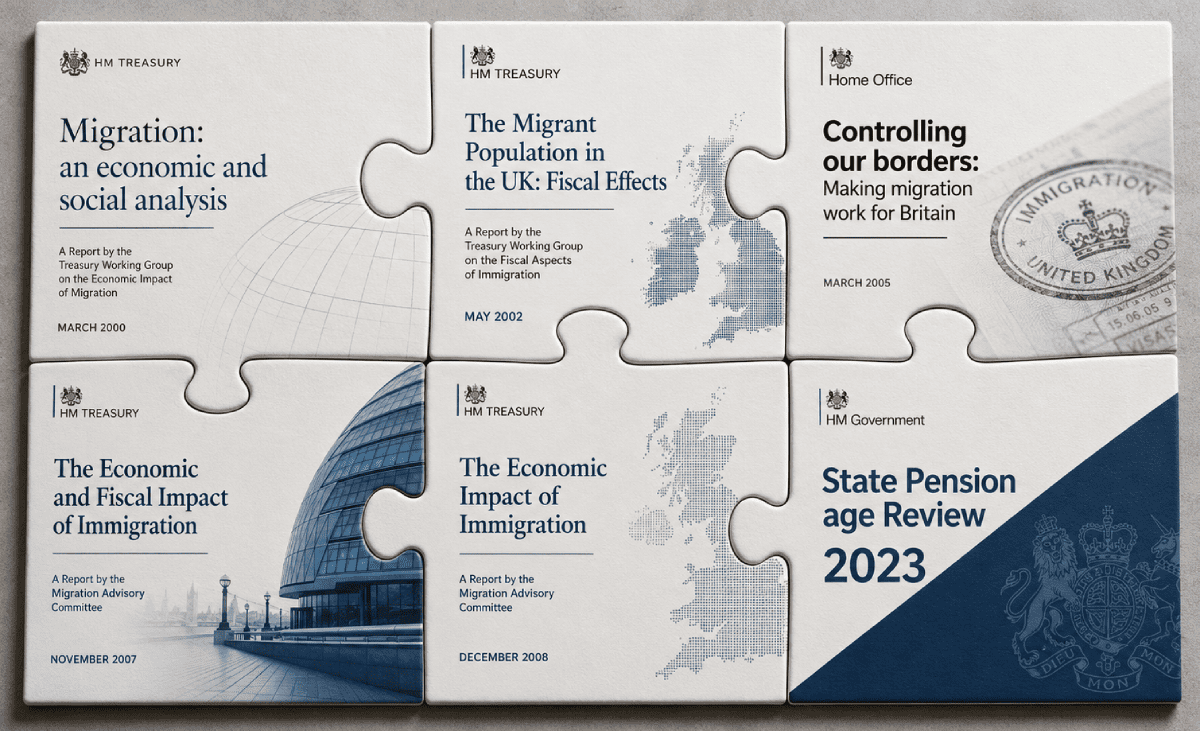
If one wants to deracinate and defenestrate something, one must first understand and catalogue it. The immigration = GDP thinking at the Treasury must be rooted out, hollowed out, torn up, and repented from. It is an anti-democratic menace. We intend to do the long work so anyone can.
Trace any modern defence of mass immigration back far enough and it stops being an argument. It becomes a habit. A department, a modelling assumption, a footnote in a Budget annex, repeated until it hardened into something nobody in the building any longer bothers to defend because everybody already agrees. The electorate has voted against it repeatedly, in every format available to them, and the machine has carried on regardless. Understanding why requires knowing where the conviction was manufactured, by whom, and in which documents.
The pedigree is traceable. It has names, dates, departments and command papers. What follows is a map, laid out in the order it was built.
1990 to 1998: Work Permits, And That's It
The older British posture on immigration was restrictive with exceptions. The state kept the front door shut and opened a side window when an employer could prove a specific shortage. The Work Permit system introduced in 1990 let firms recruit skilled people, but it operated inside a control paradigm. It was plumbing, not philosophy.
The scale tells the story of what changed later.
Work permits for skilled migrants ran at fewer than 30,000 a year in the mid-1990s. By 2001 to 2004 the average was over 80,000. That is not statistical drift. It is an institutional decision to open the tap, taken quietly and without much public argument about whether the electorate wanted it.
The 1998 White Paper "Fairer, Faster And Firmer - a modern approach to immigration and asylum" sat on the cusp. It was overwhelmingly a document about control: asylum backlogs, abuse of the system, administrative modernisation. It gestured at the "enormous economic and social benefit" of international movement, but it still described economic migrants largely as people gaming asylum routes. The door was ajar. The doctrine had not yet walked through it.
2000: The Intellectual Workshop Opens
The pivot arrives in November 2000 with a Home Office and Cabinet Office paper, "Migration: an economic and social analysis". This is where migration stops being a border question and becomes an economic phenomenon to be measured: labour markets, fiscal effects, skills, public services.
The paper is analytic and, frankly, justificatory. It is not yet polished Treasury scripture. It is the workshop where the raw materials were laid out on the bench.
Those raw materials mattered because the same paper flagged the fiscal work being carried further in a companion study. That study became the seed citation for everything downstream.
2002: The Net Contributor Migrant Is Born
"The Migrant Population in the UK: Fiscal Effects", by Ceri Gott and Karl Johnston, appeared as Home Office RDS Occasional Paper 77 in 2002. It produced the number every later document would lean on: migrants made a net fiscal contribution of £2.5 billion in 1999 to 2000, and while forming 8 per cent of the population they generated 10 per cent of GDP.
This is the origin of the "immigration equals net contributor" idea inside Whitehall. One occasional paper, two civil servants, one headline figure, and a governing assumption was born.
The same year rebuilt the policy machinery to match the analysis. The Highly Skilled Migrant Programme, launched in 2002, let people come to Britain without a job offer at all, scored on qualifications, experience and earnings.
The state was no longer filling named vacancies. It was importing human capital on the assumption the economy would absorb it. That is a different thing entirely, and a far larger claim about how growth is produced.
2003 to 2004: Fusion With Pensions
Running alongside the growth argument, a second and more technical current was flowing, and it is the one that gives the doctrine its grip. Ageing.
The Government Actuary's Department and the Treasury's long-term public finance work fused immigration with pension sustainability. The logic is mechanical and, once installed, almost impossible to dislodge from within:
Immigration expands the working-age population relative to those of state-pension age, which lowers the old-age dependency ratio, which softens the fiscal arithmetic of an ageing society.
The Treasury built the machinery first. The "Long-Term Public Finance Report: Fiscal Sustainability with an Ageing Population" was published alongside the 2003 Pre-Budget Report, with the migration variants supplied by the Government Actuary's National Insurance Fund quinquennial review, and Annex A of the 2003 Budget Report carrying the same material.
The 2004 government response to the House of Lords report on ageing then spelled the logic out.
Increasing net immigration expands the working-age share and reduces the dependency ratio.
The same response, to its credit, admitted immigration alone could not maintain that ratio because the numbers required would be enormous. By 2004 the fiscal and pension component was explicit and on the record.
2005: The Doctrine Goes Public
By the 2005 plan, "Controlling our borders: Making migration work for Britain", the subtlety was gone. Tony Blair's foreword called the movement of people into Britain "vital" to the economy, and managed migration "essential" to continued prosperity.
Our vital public services depend upon skilled staff from overseas. Far from being a burden on these services, our expanding NHS, for example, would have difficulty meeting the needs of patients without foreign-born nurses and doctors. The expertise of IT and finance professionals from India, the USA and the EU help maintain London as the financial centre of the world. Managed migration is not just good for this country. It is essential for our continued prosperity.
The paper supplied a figure with real reach: net inward migration was said to contribute 10 to 15 per cent of forecast trend economic growth. It stated plainly without migration the rate of growth would be much lower.
The NHS was invoked, its foreign-born nurses and doctors held up as proof the expanding health service could not staff itself otherwise.
This is the bridge. The analysis of 2000 to 2002 had become a public governing commitment.
2006: Migration Becomes Trend Growth
The Treasury's Trend Growth: New Evidence and Prospects, published with the 2006 Pre-Budget Report, folded migration into potential output. It revised assumed working-age population growth from 0.4 to 0.6 per cent on the strength of new migration data.
The machine was now converting arrivals not merely into more people, but into a higher trend growth rate. Every subsequent Budget would inherit the assumption.
2007: The Full Doctrine Is Adopted
The pieces were assembled separately across three departments. In October 2007 they were bolted together in a single command paper: "The Economic and Fiscal Impact of Immigration", Cm 7237, jointly issued by the Treasury, the Home Office and the Department for Work and Pensions.
It remains the cleanest statement of the whole doctrine.
It gave the lifecycle spine in plain terms:
- Children are net fiscal costs.
- Working-age adults are net contributors.
- Pensioners return to being costs through state pension and health spending.
- Import people at the contributing stage of that cycle and the books look better.
The paper cited the Home Office claim migrants paid £31.2 billion in taxes against £28.8 billion in benefits and services, cited IPPR figures, and leaned on the Government Actuary to argue migration reduces the National Insurance burden.
The pension modelling was where the argument bit hardest. The paper conceded there were no published UK estimates of immigration's direct effect on the pension funding shortfall, then reached for theory and the actuaries anyway.
- Under low migration, the joint Class 1 National Insurance rate needed to balance the Fund in 2060 to 2061 would be 27.9 per cent.
- Under high migration, 26.3 per cent.
- On growth, it credited migration with adding 0.5 per cent a year to the working-age population between 2001 and 2006, contributing 15 to 20 per cent of output growth and roughly £6 billion in 2006 alone.
Every strand of the modern argument is present in one document. Taxes, services, National Insurance, trend growth, pensions. It is the full equation, and it was published under three departmental crests.
2008: Defending the Faith After the Lords Struck
The doctrine's first serious institutional challenge came from the House of Lords Economic Affairs Committee, whose scepticism forced a reply. That reply, The Economic Impact of Immigration, Cm 7414, appeared in 2008 and is revealing precisely because it is defensive.
It conceded the government's case was under attack on three fronts: growth, skills shortages, and fiscal benefit. It retreated to GDP per head as the honest measure and claimed migration still contributed positively there.
On pensions it produced the most quotable official admission of the entire lineage: immigration alone cannot solve ageing, but "may be able to play a part".
Without migration, it said, the old-age dependency ratio would be "considerably worse", rising from 30.5 per cent in 2007 to 47.9 per cent by 2076 under zero net migration, against 38.3 per cent on the central projection.
Challenged directly, the machine did not abandon the doctrine. It trimmed the boldest claims and dug in.
2013 Onward: Nested Within The OBR
Here the story takes its cleverest turn. After 2010 the argument stopped being political and became actuarial, which is to say it was placed beyond ordinary democratic reach. The Office for Budget Responsibility, created to lend independent authority to the public finances, absorbed the migration assumption wholesale.
OBR long-term projections depend on population projections, and higher net migration improves the fiscal outlook in those projections because migrants skew working-age.
Annex A of the 2013 Fiscal Sustainability Report reviewed the migration assumptions; the 2014 report set out what was modelled and what sat outside the OBR's remit.
The effect was to move the doctrine from the Budget speech, where a minister could be argued with, into the sustainability model, where it hums along as a technical input nobody debates.
This is the quiet genius of the arrangement.
Once "higher migration improves the fiscal outlook" is an assumption inside an independent forecaster's model, every projection of the national debt silently rewards immigration and penalises its absence.
The voter never sees the toggle. The toggle was set years ago.
2018: The MAC Update, With A Buried Warning
The doctrine was refreshed twice in recent memory, and both updates are worth noting because one adds caution the machine has largely ignored.
The 2018 study commissioned for the Migration Advisory Committee, "The Fiscal Impact of Immigration on the UK", refreshed the contribution accounting and found EEA migrants contributed more favourably than the average adult in 2016 to 2017, chiefly through income tax and National Insurance. Useful ammunition, duly deployed.
The MAC's own 2018 final report on EEA migration, however, added the caveat the growth lobby prefers to forget: migration is much less effective at addressing a rising old-age dependency ratio than simply raising the pension age.
The people closest to the evidence were narrowing the claim even as the wider machine kept broadcasting it.
2023: The Same Logic, Renamed
The modern Department for Work and Pensions version survives in the State Pension age Review 2023. The old-age dependency ratio remains a key metric for state pension sustainability, driven by life expectancy, fertility and migration, and upward revisions to net migration lower the ratio because the working-age population is larger.
The 2002 logic is still running in 2023, dressed in different clothing and no longer even called immigration policy. It is now a variable in a pensions calculation.
The Lineage in One Table
| Year | Document | Department | Contribution to the doctrine |
|---|---|---|---|
| 1990 | Work Permit system | Home Office | Employer-led shortage recruitment inside a control model |
| 1998 | Fairer, Faster and Firmer | Home Office | Control paradigm; economic benefit gestured at, not adopted |
| 2000 | Migration: an economic and social analysis | Home Office / Cabinet Office | Migration reframed as an economic phenomenon to be measured |
| 2002 | The Migrant Population in the UK: Fiscal Effects (RDS Occasional Paper 77) | Home Office | "Net fiscal contributor" frame born; £2.5bn headline |
| 2002 | Highly Skilled Migrant Programme | Home Office | Human capital imported without a named job |
| 2003 | Long-Term Public Finance Report / Budget Annex A | HM Treasury | Migration variants entered fiscal sustainability modelling |
| 2004 | Response to Lords ageing report | Government / GAD | Dependency-ratio logic made explicit |
| 2005 | Controlling our borders | Home Office | "Vital" and "essential"; 10–15% of trend growth claimed |
| 2006 | Trend Growth: New Evidence and Prospects | HM Treasury | Working-age growth assumption raised 0.4% to 0.6% |
| 2007 | The Economic and Fiscal Impact of Immigration (Cm 7237) | Treasury / Home Office / DWP | Full synthesis: tax, NICs, services, growth, pensions |
| 2008 | The Economic Impact of Immigration (Cm 7414) | Government | Doctrine defended after Lords criticism |
| 2013– | Fiscal Sustainability Reports | OBR | Doctrine embedded as an independent modelling assumption |
| 2018 | Fiscal Impact of Immigration on the UK | Oxford Economics / MAC | Contribution accounting refreshed |
| 2018 | EEA migration final report | MAC | Caution added: weak tool against ageing |
| 2023 | State Pension age Review 2023 | DWP | Same OADR logic, now a pensions variable |
The People Who Built It
The doctrine is not the property of one minister, which is exactly why it has proved so durable. It was assembled across a Labour decade and inherited without revision by every government since.
Gordon Brown's Treasury supplied the intellectual temperament: an obsession with trend growth, fiscal rules, employment rates and labour-market flexibility, into which working-age migrants slotted as a countable input.
These are are the A-Z (by surname) of the Brown treasury period:
- Terence Burns (Permanent Secretary until 1998)
- Jon Cunliffe (senior macroeconomic and international finance official; later Second Permanent Secretary)
- Michael Ellam (Director of Communications and Strategy; later Director of Policy and Planning)
- Joe Grice (senior Treasury economist, including public services economics)
- Mary Keegan (Managing Director, Government Financial Management)
- John Kingman (Managing Director, Public Services and Growth)
- Nicholas Macpherson (senior tax and welfare official; Permanent Secretary from 2005)
- Mark Neale (Managing Director, Budget, Tax and Welfare)
- Gus O’Donnell (senior macroeconomic official; Permanent Secretary from 2002 to 2005)
- David Ramsden (senior economist; later Chief Economic Adviser)
- Tom Scholar (senior Treasury official responsible for ministerial support)
- Nicholas Stern (senior economic adviser and Head of the Government Economic Service)
- Jonathan Stephens (Managing Director, Public Services)
- Andrew Turnbull (Permanent Secretary from 1998 to 2002)
Gus O'Donnell, Permanent Secretary at the Treasury from 2002 and Cabinet Secretary from 2005, presided over the institutional home where the growth and the pensions arguments were fused. By far, this man is more responsible than the others.
Tony Blair supplied the public rhetoric of vitality and essentialness in 2005.
None of these men imposed a single decree. They created conditions in which a particular assumption became the path of least resistance, and then they staffed the departments that kept the assumption alive.
- The Home Office analysts wrote the fiscal case.
- The Government Actuary supplied the pensions dependency arithmetic.
- The Treasury converted arithmetic into growth.
- The OBR later converted growth into an unchallengeable model input.
Each handoff made the doctrine harder to question, because each department could point to another as the source.
These are the politicians who were responsible for immigration, migration, or borders since the Treasury's key 2007 policy.
| Date | Name | Final title before leaving brief |
|---|---|---|
| 2007–2008 | Liam Byrne | Minister of State for Borders and Immigration |
| 2008–2010 | Phil Woolas | Minister of State for Immigration |
| 2010–2012 | Damian Green | Minister of State for Immigration |
| 2012–2014 | Mark Harper | Minister of State for Immigration |
| 2014–2016 | James Brokenshire | Minister of State for Security and Immigration |
| 2016–2017 | Robert Goodwill | Minister of State for Immigration |
| 2017–2018 | Brandon Lewis | Minister of State for Immigration |
| 2018–2019 | Caroline Nokes | Minister of State for Immigration |
| 2019 | Seema Kennedy | Parliamentary Under-Secretary of State for Immigration |
| 2019–2021 | Kevin Foster | Parliamentary Under-Secretary of State for Future Borders and Immigration |
| 2021–2022 | Tom Pursglove | Minister of State for Immigration |
| 2022–2023 | Robert Jenrick | Minister of State for Immigration |
| 2023–2024 | Tom Pursglove | Minister of State for Legal Migration and the Border |
| 2023–2024 | Michael Tomlinson | Minister of State for Countering Illegal Migration |
| 2024–2025 | Seema Malhotra | Parliamentary Under-Secretary of State for Migration and Citizenship |
| 2024–present | Alex Norris | Minister of State for Border Security and Asylum |
| 2025–present | Mike Tapp | Parliamentary Under-Secretary of State for Migration and Citizenship |
From 2007 to 2013, immigration was concentrated in the UKBA model under Lin Homer, Jonathan Sedgwick and Rob Whiteman. After Theresa May abolished UKBA in 2013, responsibility fragmented across UKVI, Immigration Enforcement, and Border Force, with Sarah Rapson becoming the key UKVI figure.
From 2015, the system acquired a clearer senior-official owner through the Second Permanent Secretary model: Olly Robbins, then Patsy Wilkinson, then Shona Dunn. By the 2020s, that had evolved into Simon Ridley’s Migration and Borders System, with specialist DGs beneath him, including Glyn Williams, Emma Churchill, and Dan Hobbs.
The senior civil servants working for their permanent secretary masters during this period were:
| Date | Name | Final title before leaving brief |
|---|---|---|
| 2007–2011 | Lin Homer | Chief Executive, UK Border Agency |
| 2011 | Jonathan Sedgwick | Acting Chief Executive, UK Border Agency |
| 2011–2013 | Rob Whiteman | Chief Executive, UK Border Agency |
| 2013–2016 | Sarah Rapson | Director General, UK Visas and Immigration |
| 2015–2016 | Olly Robbins | Second Permanent Secretary, Home Office |
| 2016–2018 | Patsy Wilkinson | Second Permanent Secretary, Home Office |
| 2018–2021 | Shona Dunn | Second Permanent Secretary, Home Office |
| 2018–2022 | Glyn Williams | Director General, Migration and Borders Group |
| 2022–2023 | Emma Churchill | Director General, Migration and Borders Group |
| 2022–present | Simon Ridley | Second Permanent Secretary, Home Office |
| 2023–present | Dan Hobbs | Director General, Migration, Borders and International Policy and Programmes |
Why the Voter Keeps Losing
The electorate has been remarkably consistent. Poll after poll, referendum result after referendum result, the public has asked for less. The machine has delivered more, and it has done so with a clear conscience, because inside the building the economic case was settled two decades ago and filed under "evidence".
The pattern is a ratchet.
- An analytic paper becomes a policy programme.
- A policy programme becomes a command paper.
- A command paper becomes a modelling assumption.
- A modelling assumption becomes an independent forecast nobody is allowed to call political.
At no point in that sequence does anyone have to win a public argument, because the argument was won internally before the public was consulted. The 2007 command paper did not persuade the country. It persuaded Whitehall, which was the only audience the doctrine ever really needed.b
The doctrine's weakest points are on the record and were conceded by its own authors. Immigration cannot actually fix the dependency ratio without absurd numbers, as the 2004 response admitted. It is a poor tool against ageing compared with raising the pension age, as the MAC said in 2018.
The headline benefit shrinks to almost nothing once you measure GDP per head rather than GDP, which is why the 2008 defence quietly switched measures. The case is more fragile than its longevity suggests.
Longevity, though, was never about strength of argument. It was about placement. Lodge a claim deep enough in the machinery of forecasting and it no longer needs to be right. It only needs to be assumed. Two decades of assumption is what the country has been governed by, and the electorate has never once been given the toggle.
The Restorationist will be systematically dismantling all of this, line by line, from every publication they've released. The state's ideas about opening the doors to hundreds of thousands of invading foreigners to fix pensions must no longer be an intellectual fortress.