The British Murder Machine: When The State Embraced Killing
Before Belfast there was Palestine, Malaya, and Kenya. The villagers shot in the night and the files quietly burned the next morning all had a colonial rehearsal. Three decades before British soldiers reached the Falls Road, the state had already built the method and learned to hide it.
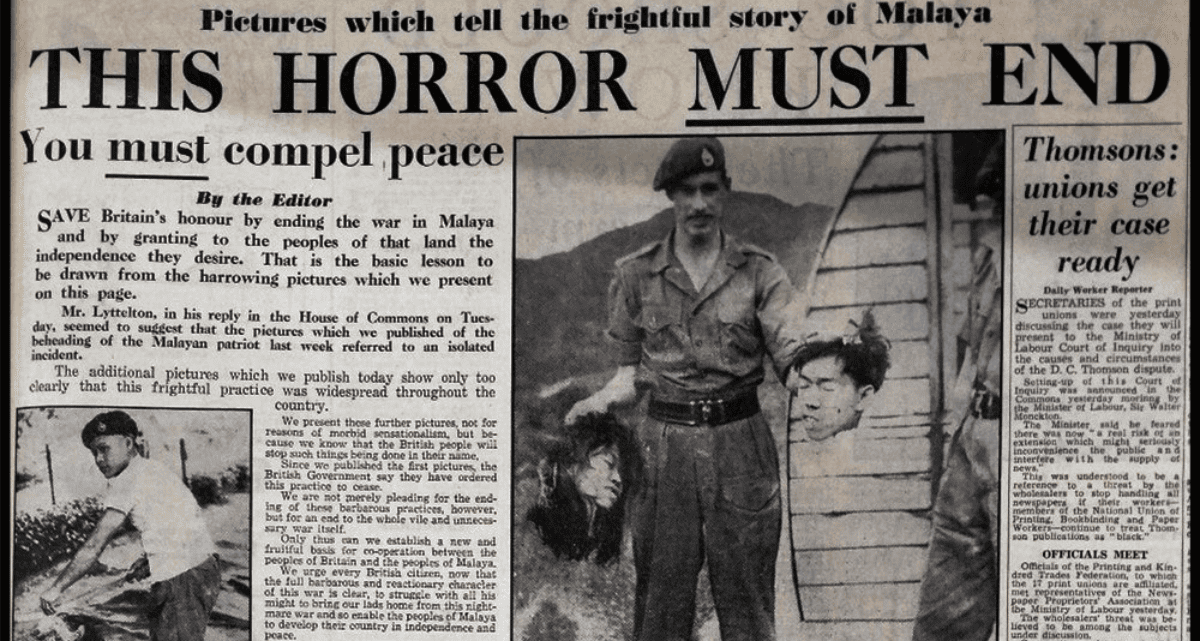
In April 2025 a British minister did something the Foreign Office had refused to do for seventy-seven years. Catherine West, Minister for the Indo-Pacific, acknowledged in writing that on 11 and 12 December 1948 soldiers of the 2nd Scots Guards had killed twenty-four unarmed men at Batang Kali in colonial Malaya, and the story told ever since had been false.
The men were separated from their wives and children, subjected to mock executions, and shot in cold blood. Their homes were burned and the survivors abandoned in a nearby town. For decades London had insisted the victims were insurgents with a cache of ammunition, gunned down while attempting a pre-planned escape.
The apology was carefully worded and came wrapped in a refusal. No fresh inquiry, the government judged, would have a realistic prospect of reaching definitive conclusions about what happened. The evidence, in other words, was old and the men who fired were mostly dead.
This is the characteristic form of British accountability for state killing. It arrives decades late, in the passive voice, and only once every route to prosecution has silted up.
This same pattern repeats in military establishments with bullying and suicides.
Batang Kali is a good place to begin because the core facts are no longer seriously contested. Scots Guards shot two dozen rubber tappers who posed no threat. What remains disputed is whether the word "massacre" applies, whether the men were really running, and why no independent inquiry was ever completed.
That gap between an undeniable act and a permanently unlocatable responsibility is not a quirk of this one case. It is the design.
The killings at Batang Kali did not come from nowhere.
By December 1948 the British state had already spent a decade refining a particular way of doing violence at the edges of empire, a method which fused intelligence collection, undercover soldiering, the recruitment of turncoats, and the selective application of lethal force into a single working machine.
The Troubles in Northern Ireland, beginning in 1969, are usually written as the moment Britain turned dirty methods on a population inside the United Kingdom. In their invention they were nothing of the sort. Almost everything deployed in Belfast and Armagh had been prototyped abroad, on people whose deaths generated no scandal at home because they happened a very long way from Westminster.
Palestine: Birth Of The Commando Night Raid
The first recognisable component appears in the hills of Galilee in 1938. Britain was struggling to contain the Arab revolt against its Mandate, and a young intelligence officer named Orde Wingate proposed something contemporary British doctrine explicitly warned against which David Stirling also spotted about desert warfare: small mobile units operating at night, striking on precise intelligence rather than waiting to be attacked.
The Special Night Squads were a joint British-Jewish formation, drawing British infantry together with men from the Jewish Supernumerary Police and the Haganah paramilitary. Wingate selected and trained the men personally.
Among his recruits were Yigal Allon and Moshe Dayan, later architects of the Israeli military who absorbed his methods and carried them forward.
What made Wingate significant was less the tactics than the escalation baked into them. His squads moved from interdicting armed bands to pre-emptive strikes on suspected sanctuaries to outright reprisal.
When a mine killed a Jewish settlement leader near Ein Harod in September 1938, Wingate carried out a punitive raid on the Arab quarter of Beisan and, by one account, ordered the killing of every Arab found near the site of the explosion.
British officials variously described his units as well-oiled killing machines. The colonial frontier had produced an officer who treated a civilian population as an intelligence problem to be solved with organised, deniable force, and who was rewarded for it. The template was set: identify, penetrate, strike, deny.
Malaya: Regulation Written To Cover Killing
A decade later the template reached the rubber estates of Malaya, and with it a refinement that matters enormously for everything that followed. After the Scots Guards killed the men at Batang Kali, British diplomats did not merely lie about the event. They tried to make it retrospectively lawful.
Regulation 27A, introduced after the shootings, authorised the use of lethal weapons to prevent escape from arrest. The purpose was transparent. A killing which looked like murder could be reframed as the lawful prevention of flight, and the official account (i.e. the men had been shot running) slotted neatly into the new legal category built to receive it.
The regulation was uncovered decades later among documents hidden from public view at Hanslope Park, the Foreign Office repository which would become notorious in its own right.
Set the two frontier episodes side by side and a progression is visible.
| Element | Palestine 1938 | Malaya 1948 |
|---|---|---|
| Method | Night raids on intelligence, escalating to reprisal | Round-up, separation, mass shooting |
| Cover story | Operations against armed bands | Victims killed attempting escape |
| Legal manoeuvre | Latitude granted informally by commanders | Regulation drafted afterwards to legalise the act |
| Accountability | None sought | Inquiry opened in 1970, shut down as "political" |
The Malayan innovation was not the shooting. Colonial armies had been shooting civilians for centuries. It was the instinct to reach for the statute book, to convert a crime into a category of permitted conduct.
That reflex, criminal at home may be lawful when performed for the state, is the seed from which the entire later architecture of authorisation grows. In 1948 it took the crude form of a hastily written regulation in Selangor. Half a century on it would take the polished form of Acts of Parliament.
More than twenty years after the killings, six of the soldiers involved came forward, first to the press and then to Scotland Yard, to say plainly they had murdered the villagers. A police investigation opened.
An incoming Conservative government closed it down.
The bodies were never exhumed and the officers in command that day were never interviewed. The men who did the killing were prepared to confess; the state declined to let the confession proceed. Responsibility did not fail to attach because the truth was unknown. It failed to attach because the machinery for locating it was switched off.
Kenya: Kitson's Doctrine Of The Turncoat
If Palestine supplied the night raid and Malaya the retrospective cover, Kenya supplied the mind which turned scattered techniques into a system. His name was Frank Kitson, and he arrived in 1953 as a district military intelligence officer attached to Special Branch, at the height of the campaign against the Mau Mau revolt.
Kitson's contribution was the pseudo-gang, and the value of his 1960 account of it, "Gangs and Counter-gangs", is he explains the machinery himself in a chatty, self-satisfied tone which reveals more than he can have intended.
Rather than hunt insurgents through the forests of the Aberdares, he took captured Mau Mau and turned them (through inducement, payment, fear or the simple fact a captured gang member would hang anyway) into men who would black up, dress as fighters, and walk back into the movement on his behalf.
He renamed the interrogation post at Kamiti the Special Methods Training Centre and set his converts to mixing with real gangs at night to gather names and locations.
His own description is alarming. Kitson crouches behind a bush fifteen yards from a hut while his pseudo-gangsters, led by a turned man he calls James, go inside posing as senior Mau Mau. Voices rise. Kitson hears the unmistakable sound of a hippo-hide whip on human skin and a man crying, and starts to get up to intervene, only to be pushed back down and told to keep still by his own subordinate. It transpires James, to maintain his cover as a Mau Mau officer, had convened a mock trial of two drunk gang members, come within a hair of sentencing them to death, and settled for having them whipped and fined.
Kitson records the evening as a success. They got their intelligence, and they took the fine money, which was useful because funds were short and informers had to be paid.
The tactical logic he lays out is precise and cold.
The temptation, he writes, was to use each night's information at once to kill, but he understood if security forces struck a gang immediately after every pseudo visit, the terrorists would soon tumble to the idea. Intelligence came first; killing was rationed so as not to burn the source.
Around this sat everything else: the breaking-down of prisoners through interrogations which ran until three in the morning; statement contradicted against statement until a man was judged useless, cooperative, or capable of being tricked into indiscretion; the paying of informers; and, at the mass level, the hooded identity parade.
Kitson describes watching, at the Langata holding camp during the round-up of Nairobi's entire African population, three Africans in white hoods walking a line of a hundred thousand suspects and silently pointing out who should be taken aside. He thought it a highly effective weapon.
This was intelligence-led killing organised as a self-feeding cycle, and its author became the pre-eminent Western thinker on counter-insurgency. What matters is not only the technique but the man, because Kitson did not merely describe the method and retire into theory. He carried it, in person, up the chain of British command and, eventually, onto British soil in Northern Ireland.
His methods sat inside a far larger apparatus of coercion whose full extent was concealed for fifty years.
During the Kenya Emergency the colonial authorities detained an enormous share of the Kikuyu population in camps and fortified villages where torture, sexual abuse and other mistreatment were documented.
Kitson himself notes in passing the government's expectation of detaining ten thousand men in one operation alone. The camps and the counter-gangs were two faces of the same enterprise. One broke the population through detention; the other penetrated and killed through deception.
Both depended on the certainty the records would never be read.
Burning The Evidence In Secret
They very nearly were not. What happened to the Kenya archive is the third great component of the machine, and the one which most cleanly connects 1950s Africa to the present day.
As Britain withdrew from its colonies, officials conducted a systematic purge of the record. Under a programme later known as Operation Legacy, documents judged capable of embarrassing the government, incriminating officials, or exposing informers were destroyed or spirited back to Britain rather than handed to the incoming independent states.
The destruction was itself bureaucratic, logged and signed off; an archive of erasure which generated its own paper trail. A 1961 Colonial Office telegram set out the logic without embarrassment: files should be withheld because they might embarrass the government, members of the police and military, public servants and police informers.
What survived was hidden. For decades the Foreign Office denied holding colonial-era records at all. Only in 2011, under pressure in the High Court from elderly Kenyans suing over their treatment during the Emergency, did it finally admit to a secret cache at Hanslope Park in Buckinghamshire. Thousands of files from dozens of former colonies.
Among them were the minutes of British war councils where interrogation and "screening" policy was set, and the advice of Kenya's own Attorney General to the Governor on the treatment of detainees: if we are going to sin, we must sin quietly.
The consequence of the admission was a court case Britain could no longer win by pretending the evidence did not exist. In 2013 the government settled, paying £19.9 million to more than five thousand Kenyan claimants and expressing regret in the Commons for the torture inflicted under colonial administration. It stopped short of accepting liability as a matter of policy.
The apology, like the one for Batang Kali twelve years later, was extracted rather than offered, and arrived only once concealment had become impossible.
Every account of colonial counter-insurgency produced before 2011 was written from a record deliberately pruned to flatter the state. The scholars who had described these campaigns as broadly proportionate had done so, in part, because the incriminating files had been removed from the shelf.
Concealment did not merely hide individual crimes. For half a century it shaped what the public was permitted to believe had happened at all.
The Secret Armies Of The Cold War
Running alongside the colonial campaigns was a parallel comfort with clandestine armed networks operating outside ordinary democratic knowledge. Care is required, because the subject attracts more certainty than the evidence supports.
From 1940 Britain ran the Special Operations Executive from Churchill's instruction to set Europe ablaze through sabotage and subversion behind enemy lines. Their base was St Ermin's hotel, the most infamous espionage building in the world.
After 1945 the experience and personnel of SOE fed directly into a network of "stay-behind" organisations established across Western Europe, intended to activate as resistance cells in the event of a Soviet invasion. These were real. They held hidden caches of weapons and explosives, they trained in secret, and their existence was concealed even from most elected ministers until the network was publicly exposed in 1990. The Italian branch (codenamed Gladio) was revealed to the Italian Senate.
Britain's role in training and arming continental units is a matter of record; secret armies in several countries trained with the SAS and MI6 in England. When arms caches surfaced in Austria in the 1960s, British authorities were forced to disclose the locations of dozens more.
Beyond that lies a swamp.
Some accounts claim London centrally directed the terrorism attributed to certain continental units; a single British hand lay behind the bombings and assassinations of the strategy of tension. The evidence for such a maximal version is thin and leans on partisan sources and a disputed body of research. "Operation Gladio" properly names the Italian component alone, and to fold every unexplained European killing into a London-run conspiracy is to hand the state its easiest rebuttal.
The British state was entirely comfortable maintaining armed clandestine networks, weapons caches and structures of deniable political warfare wholly outside parliamentary knowledge. It had the appetite, the tradecraft, and the institutions.
Whatever the precise limits of its continental activity, the habit of mind, i.e. the state may keep secret armed capabilities hidden from the democracy it serves, was fully formed.
The Violent Fruits Of Empire
Across roughly three decades at scattered points around a contracting empire, Britain built and refined a set of interlocking practices.
| Frontier | Contribution to the method |
|---|---|
| Palestine, 1938 | Intelligence-led night raids escalating to reprisal; undercover striking units |
| Malaya, 1948 | Lethal force against civilians, then a regulation written to make it lawful |
| Kenya, 1953 onward | Pseudo-gangs, turned informants, mass detention and interrogation, systematised into doctrine |
| Decolonisation, from 1961 | The purge and concealment of records that made responsibility impossible to locate |
| Cold War Europe | Comfort with secret armed networks operating outside democratic knowledge |
None of these was the invention of a single sinister committee selecting names in a Whitehall room. What the empire produced was something more durable and harder to attack: a state culture which repeatedly generated the same features whenever it faced a population it wished to control.
Threat inflation. Executive authorisation. Intelligence-led targeting. Informants and turned men. Soldiers used in policing roles. Compartmentalised knowledge. No written order stating the full object. Investigations delayed, narrowed or shut down as "political." Documents withheld or burned.
And, at the end of every chain, individual operatives quietly exonerated because responsibility dissolved upward; while operational detail dissolved downward, leaving no point at which the two ever met.
By the late 1960s every one of these elements existed, had been tested in the field, and had been shown to work both at killing and at escaping consequence. The men who had run them were still serving.
And one of them, the officer who had crouched behind a bush in Thika listening to his own pseudo-gang whip a man in a hut, was about to be handed a British city.
The Doctrine Comes Home
The empire had built a method for killing usefully and answering for it never, and it had produced a man who understood every part of it and could install it wherever he was sent.
In 1969 British troops had deployed onto streets which were not a distant colony but a constituent part of the United Kingdom; where the dead would have inquests, the press would ask questions, and the machinery of British justice was, in theory, fully present.
In September 1970 Brigadier Frank Kitson took command of 39 Airportable Brigade, one of the British Army's three main regional commands in Northern Ireland. He arrived from a fellowship at Oxford, where he had spent the previous year writing "Low Intensity Operations", published in November 1971. It was not a memoir like Gangs and Counter-gangs but a manual. It was adopted as a foundational text of British counter-insurgency.
In it the improvisations of Kenya; the pseudo-gangs; the informants; the primacy of intelligence; the treatment of a civilian population as terrain to be mapped and controlled; all set out as general theory and applicable anywhere the state faced subversion.
By the summer of 1971 the machine was operating on British soil. What remained to be seen was whether inquests, a free press and domestic courts could do to it what a hundred thousand hooded suspects in a Nairobi camp never could.
The British Murder Machine series is a stark reminder the cover-up of atrocities like Pakistani rape gangs is a long-established pattern. The obsession with secrecy has bred endemic corruption for a century. If we truly want to begin again, our country needs an era of public repentance and reconciliation, with external superinvestigators, to wash out the ugly truth of Establishment criminality.
 Alex Coppen