Can We Divorce The State From The Money Supply?
Should the state control money, or should money control the state? From Henry VIII's debased silver to Black Wednesday, every attempt to separate political power from the printing press has ended with the state breaking the system rather than being bound by it.
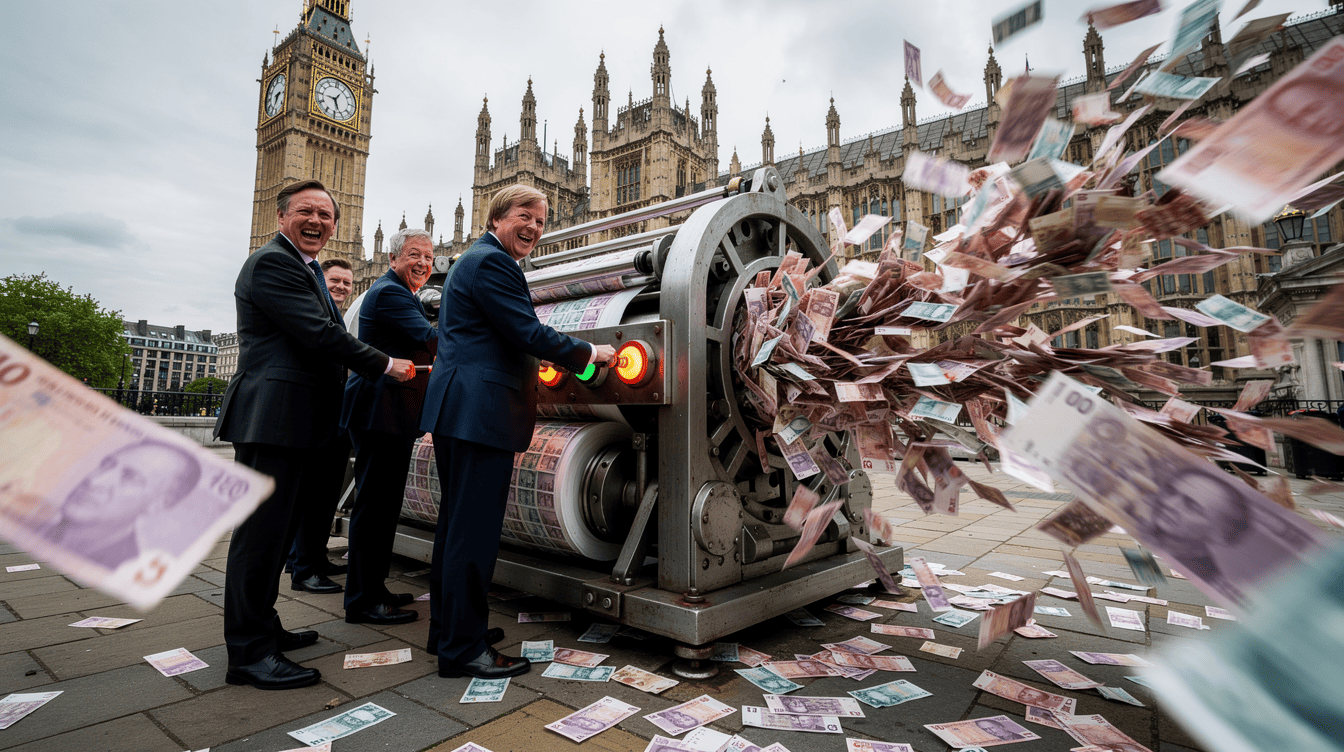
A government can fund itself in only three ways. It can tax its people: visible, unpopular, and constrained by revolt. It can borrow: a deferred extraction, tolerable only until the interest bill becomes its own crisis. Or it can create money.
The third is the one nobody votes for and everybody pays for, because it operates without consent, and often without notice. It carries no debate in the Commons. It appears on no ballot. It requires no manifesto commitment. And by the time it is visible, the transfer has already occurred.
Money creation is, in this sense, the only tool which allows a state to act immediately without consent. It is precisely why no state has ever permanently surrendered it.
The idea of severing this third channel entirely has enjoyed a long intellectual life. In the age of quantitative easing, it has acquired new urgency. If we could remove politicians from the printing press, the argument goes, we would remove the single most corrosive force in modern economic life: the capacity to spend without visible consequence.
It is a seductive proposition. It is also, as English history demonstrates with painful clarity, a proposition no modern state has survived attempting.
When Gold Was King
Before the Bank of England existed, money was metal. Gold and silver coins circulated according to weight, and the Crown's power over the money supply was limited by geology. You cannot mine what is not there.
This arrangement imposed a brutal discipline. The state could not fund wars by decree. It could not smooth recessions. It could not quietly transfer wealth from savers to spenders through the slow erosion of purchasing power. It had to tax, or it had to beg.
The constraint was real, but so was the temptation to cheat. Henry VIII infamously reduced the silver content of English coinage, a move so transparent it earned him the nickname "Old Coppernose" as the thin silver plating wore away to reveal the base metal beneath. Short-term gain, long-term destruction of trust.
Debasement is not a medieval curiosity. It is the prototype of modern monetary policy. Only cruder.
Isaac Newton, as Master of the Mint, attempted a more honest approach in the early eighteenth century, stabilising the gold-silver ratio and tightening standards. But even Newton could not resolve the fundamental tension: metallic money constrains the state, and constrained states are states in difficulty.
1694: The Ingenious Compromise
The founding of the Bank of England in 1694 was not a divorce from money. It was a marriage: one in which the state acquired the benefits of money creation without accepting its discipline.
William III needed to fund a war with France. The solution was elegant: a private institution would lend money to the Crown and, in return, gain the right to issue banknotes. Money creation was outsourced, not abolished. The state gained access to credit far beyond its metallic reserves. The Bank gained extraordinary commercial privilege.
This was the genius of the English approach. It did not choose between constraint and flexibility. It built a system in which both coexisted: uncomfortably, productively, and with just enough ambiguity to survive most shocks.
The gold standard, formally adopted in 1816, took this further. Every pound sterling was convertible into a fixed weight of gold. The Bank of England was bound by its reserves. And for nearly a century, the system delivered something remarkable: long-run price stability, global confidence in sterling, and the financing of the largest empire in human history.
But the gold standard did not fail quickly. It failed when it mattered.
Recessions could not be softened. Wages fell in real terms during downturns. Banking crises were savage because the lender of last resort was itself constrained. The system worked, but only so long as nothing went badly wrong.
1914: The Emergency Becomes Permanent
Something went badly wrong. When Britain entered the First World War, the gold standard was suspended within days. The state needed money — vast, immediate, unprecedented quantities of it — and gold convertibility was simply incompatible with survival.
This was not irrational. It was not a failure of discipline. It was the collision of monetary purity with existential threat. And the threat won, as it always does.
And this story is familiar to the Restorationist reader, who knows this year was pivotal in English history for a magnitude of reasons: when the state took over everything.
The critical change was not the suspension of gold. It was the discovery, by the political class, of something intoxicating: suspension worked. The emergency powers functioned. The state survived, expanded, and paid for a global war on a scale previously unimaginable.
Once a state discovers it can create money in extremis, the definition of "extremis" expands. What begins as wartime necessity becomes peacetime convenience. The emergency override becomes the normal operating procedure.
Churchill's Failure To Restore Gold
The 1925 return to the gold standard is perhaps the most instructive episode in English monetary history, and the most misused by both sides of the debate.
Winston Churchill, then Chancellor, restored gold convertibility at the pre-war parity of roughly $4.86 to the pound. The decision was urged upon him by the Bank of England and by orthodox financial opinion. Churchill was initially sceptical, but agreed to include the measure in his first budget.
The problem was simple and devastating: the pound was overvalued. Britain's price level had not returned to pre-war conditions. Wages were higher. Competitiveness was lower. Restoring the old parity meant forcing the entire economy to deflate itself to fit a monetary system designed for a world which no longer existed.
Keynes estimated the policy effectively required a reduction of about 10 per cent in the sterling receipts of export industries. The coal industry was crushed. Unemployment surged. The chain of events led directly to the General Strike of 1926.
The policy did not fail because gold was wrong. It failed because reality refused to comply.
Sound money advocates point to Churchill's error as proof he set the parity wrong — which is true. But the deeper lesson cuts against them. If the gold standard can only work at the "right" price, then someone must decide what the right price is. And whoever decides, decides with imperfect knowledge, institutional bias, and political pressure. Montagu Norman, Governor of the Bank of England, dismissed the concerns of industrialists, comparing their understanding of monetary policy to shipyard workers opining on battleship design.
Churchill himself later expressed doubt about the decision. He was right to. The gold standard lasted six years before reality forced Britain off it again in 1931. The "divorce" collapsed not because the idea was wrong, but because it could not survive contact with an economy in distress.
Nixon And The 1971 Debacle
If Churchill proved the danger of over-constraining money, Richard Nixon proved the danger of removing all constraint.
By 1971, the post-war Bretton Woods system, under which the dollar was convertible to gold at $35 per ounce, and all other currencies pegged to the dollar, was breaking apart. The United States did not have enough gold to cover the volume of dollars in worldwide circulation. Vietnam, the Great Society programmes, and persistent trade deficits had created more claims than America could honour. West Germany left the system in May 1971. Switzerland followed in August. Britain requested $3 billion in gold be transferred from Fort Knox.
On 15 August 1971, Nixon suspended gold convertibility. The measure was announced as temporary. It was permanent. The gold window never reopened. By 1973, floating exchange rates had replaced fixed parities worldwide.
The pattern is identical: the system holds until it binds, and when it binds, it is broken.
Since 1971, gold has risen from $35 to over $3,000 per ounce. The dollar has lost more than 98 per cent of its purchasing power against gold in half a century. Sterling, once the centrepiece of global finance, had already shed most of its strength by then. The trajectory is relentless and, for the ordinary saver, ruinous.
The Cantillon Problem
Advocates for divorcing the state from money often focus on inflation; the general rise in prices. This is real, but it understates the problem.
The deeper damage is distributional. The eighteenth-century economist Richard Cantillon identified a principle so simple it should be taught in schools:
When new money enters an economy, it does not arrive everywhere at once.
- The first recipients (banks, financial institutions, state contractors) benefit by spending before prices rise.
- The last recipients (workers, retirees, small savers) face higher prices without seeing their income rise first.
This is not a theory. It is a description of exactly what happened during quantitative easing. Central banks purchased government bonds, injecting money into financial markets. Asset prices rose. Property values climbed. Equity portfolios swelled.
Meanwhile, wages remained flat, savings earned nothing, and a generation of young people discovered they could not afford a house.
This is not corruption in the criminal sense. It is corruption in the structural sense: a system which rewards proximity to money creation (i.e. the City) and punishes distance from it.
The alternative — systemic collapse — would have been worse. But a side-effect is not the same as a neutral outcome, and the distributional consequences of QE will shape British politics for a generation.
What If We Did It?
Suppose Britain did divorce the state from money entirely. No central bank discretion. No QE. No Treasury override. Money governed by a fixed rule; say, a 2 per cent annual growth rate, set in statute and beyond political reach.
In calm weather, the system would be superb:
- Inflation would be structurally low.
- Government borrowing would carry a real cost.
- Fiscal discipline would be enforced not by goodwill but by architecture.
- The Cantillon distortion would shrink dramatically.
Now introduce a shock. A banking crisis. A pandemic. A war.
Under a rigid system, the state cannot:
- Inject liquidity
- Act as lender of last resort
- Absorb the initial blow and distribute the cost over time.
It must tax immediately, borrow at whatever insane rate the market demands, or watch the system seize.
ATMs stop working. Payrolls fail. Perfectly solvent businesses collapse for lack of liquidity. Not because they are unviable, but because the system cannot breathe.
This is not speculation; it is what happened in the 1930s and under the interwar gold standard. It is what happened when Churchill tried to force economic reality to obey a monetary symbol. Rigid systems do not bend; they shatter.
But here is the final problem: a democratic electorate will not tolerate a government which says "the rules prevent us from acting." Voters do not care about monetary architecture. They care about their jobs, their savings, and their children's prospects. A government which cannot respond to crisis will be replaced by one which promises to.
Full divorce is not merely impractical. It is politically unstable. The system would be broken by the first serious test. Not out of malice, but out of necessity.
Black Wednesday: The Market Bites Back
If the twentieth century taught Britain anything about monetary constraint, it should have been the lesson of 1992.
The European Exchange Rate Mechanism was, in principle, a partial discipline: not gold, but a fixed band tying sterling to the Deutschmark at a rate of roughly 2.95 DM to the pound. Britain joined in 1990, in part to import Germany's lower inflation rate. The trouble was the same as Churchill's: the rate was wrong. Sterling was overvalued. British inflation was running at roughly three times the German level. And the political commitment to maintaining the peg was, in the end, weaker than the market's willingness to test it.
Darth Sith Lord Soros and his Quantum Fund identified the contradiction and built a short position of approximately $10 billion against the pound. On 16 September 1992, the Bank of England attempted to defend sterling by raising interest rates twice in a single day; from 10 to 12 per cent, and then to 15. It spent an estimated 40 per cent of its foreign exchange reserves buying pounds on the open market. None of it worked. By evening, Norman Lamont announced Britain was suspending its ERM membership. The pound fell 15 per cent against the Deutschmark. Soros made over £1 billion in a day. The Treasury's total losses were later estimated at £3.3 billion.
The episode is often treated as a story about speculators. It is actually a story about credibility. Soros did not break the Bank of England. He identified — correctly — the point at which Britain's commitment to a fixed monetary rule became unsustainable. The system held until it bound, and when it bound, a single fund manager with sufficient conviction could shatter it.
Black Wednesday destroyed the Conservative Party's reputation for economic competence for over a decade. But it also, ironically, forced a better settlement: inflation targeting replaced exchange rate targeting, and the post-1997 framework (with all its limitations) emerged directly from the wreckage.
When The Bank Stitched Up Truss
If Black Wednesday proved the fragility of fixed exchange rate commitments, the gilt market crisis of September 2022 proved the fragility of something subtler: the institutional credibility on which the entire post-1997 settlement depends.
Kwasi Kwarteng's mini-budget announced roughly £45 billion per year in unfunded tax cuts — the largest fiscal loosening in decades — without an OBR assessment.
The gilt market's response was immediate and violent.
Thirty-year gilt yields spiked by 1.2 percentage points in three days, one of the largest moves ever recorded over such a period. Pension funds holding leveraged liability-driven investments faced cascading margin calls. The Bank of England, which days earlier had been preparing to sell £80 billion in gilts as part of quantitative tightening, was forced to reverse course and begin emergency purchases to prevent a systemic unravelling.
Within three weeks, the Chancellor was sacked. Within six weeks, the Prime Minister was gone. The Bank's "independence" lasted precisely until it was tested.
The episode is instructive for both sides of the debate.
- For the sound money camp: here was market discipline at work: swift, brutal, and effective.
- For the interventionists: here was the central bank stepping in to prevent a pension fund collapse whose consequences would have been felt by millions of ordinary retirees.
To the realist, it revealed something neither camp wants to admit: the entire system rests on a confidence trick. Not in the pejorative sense, but in the literal sense. Gilt markets function because investors believe the government and the Bank are, broadly, rowing in the same direction. When the government pulled hard against the Bank's monetary stance, the confidence evaporated in days.
Why A Bank Is A Quango
The Bank of England is operationally independent in the way a quango is supposedly operationally independent: it executes policy at arm's length, provides technocratic credibility, and absorbs political heat. The Governor is appointed by the government. The inflation target is set by the Chancellor. The mandate can be rewritten at any time.
In good times, this independence is real enough, ish. Rate decisions are made without ministerial interference. Technical implementation is genuinely expert-led. The MPC votes and the markets respond.
This independence is not fictitious. It is simply conditional.
During 2008, and again during COVID, monetary and fiscal policy converged so completely they became indistinguishable. The Bank purchased hundreds of billions in government bonds, directly lowering the cost of state borrowing. To call this independence is to redefine the word beyond usefulness.
The Bank is independent enough to impose discipline when discipline is easy, and obedient enough to support the state when support is required. It is independent in good times, and integrated in bad ones.
Are Any Of Them Qualified Or Competent?
This brings us to the question nobody in Westminster wants to answer: are our politicians, or our Treasury officials, actually qualified to hold the levers of monetary power?
For day-to-day management, the historical answer is clearly no.
Not because ministers are unintelligent (they are), but because they are political actors operating on electoral time horizons. A Chancellor facing an election in eighteen months has every incentive to prefer easier money, delayed pain, and policies whose costs fall on the next Parliament. The temptation is not moral failure. It is built into the job.
The entire post-1997 settlement is built around this recognition. And yet the settlement itself is more fragile than its architects would like to admit, because it depends on political actors voluntarily restraining themselves from interfering with an institution they have the legal power to overrule.
But politicians cannot be removed from the picture entirely. They control fiscal policy. They define national priorities. They bear democratic responsibility for economic outcomes. The dilemma is not whether they should be involved, but how much friction stands between them and the printing press.
The current answer, i.e. some friction, applied inconsistently, withdrawn under pressure, is not inspiring.
The Nationalisation Pendulum
Money is not the only domain in which Britain oscillates between state control and its absence. The broader economic landscape shows the same pattern: nationalise, privatise, re-nationalise. Each time with the certainty of a convert, each time producing the opposite pathology.
The railways were nationalised in 1948, privatised in 1993, and are now being brought back into public ownership operator by operator after a string of franchise failures.
Energy was nationalised after the war, privatised in the 1980s, and is now the subject of overwhelming public demand for renationalisation — 71 per cent in favour, according to polling. Water, privatised in 1989, faces the same pressure after years of sewage discharge, dividend extraction, and crumbling infrastructure.
The pattern is instructive because it mirrors the monetary question precisely.
- Nationalisation imposes control but breeds inefficiency.
- Privatisation introduces discipline but enables extraction.
Neither settles the question permanently, because neither resolves the underlying tension: who bears the risk, and who captures the reward?
This oscillation is itself a source of instability. Investors cannot commit capital to infrastructure on thirty-year horizons when the ownership model might reverse within a decade. Governments cannot plan coherently when every generation relitigates the same structural arguments. The result is a country trapped in a permanent argument about the proper boundary between state and market; in money, in industry, in everything.
The dismal state of the Treasury and its civil servants is not separate from this. It is the institutional expression of it. A department pulled in every direction (cutting taxes, increasing spending, constraining borrowing, stimulating growth) without a settled philosophy of what the state is for, will inevitably produce incoherent policy. And incoherent fiscal policy feeds directly back into monetary instability, because the Bank of England is ultimately left to compensate for whatever the Treasury fails to resolve.
The Permanent Contradiction
The history of money in England is not a search for the correct system. It is the repeated failure to resolve a contradiction: a state powerful enough to govern cannot be denied control over money, and a state with control over money cannot be trusted not to use it.
- Gold restrained the state, and the state thrived under constraint until it could not.
- Churchill tried to reimpose constraint, and the economy broke.
- The ERM imposed external discipline, and Soros proved it hollow.
- Nixon removed the last constraint, and discipline died.
- Truss ignored the implicit rules, and the bond market forced compliance within days.
Every subsequent attempt to rebuild institutional restraint (inflation targets, central bank independence, fiscal rules) has held only until the next crisis demanded otherwise.
A state with total control over money will, given sufficient time, abuse it. The Cantillon distortion guarantees this. New money flows first to those closest to power, and the political incentive to create it is permanent.
A state with no control over money will, given sufficient stress, break itself trying to obey the constraint. Churchill proved this. The interwar gold standard proved this. Every rigid monetary system in history has proved this.
Managing The Eternal Friction
The optimal arrangement is therefore neither purity nor surrender. It is friction. The practical question is not whether to remove the state from money, but how to make access to money creation slow, visible, and politically costly. The state must retain the capacity to act in genuine emergency, but the act of reaching for the printing press must carry a price so high it deters casual use.
Money must remain a tool of the state, but one it cannot reach for lightly.
There is no clean answer, no elegant system, no permanent settlement. There are only trade-offs, managed imperfectly, by fallible people, in institutions which drift. The English instinct has always been to choose the system which bends rather than the one which shatters.
The question for our generation is whether what we call "flexibility" is now simply a slower form of failure.