The End of the Electoral Roll: A New Voting Architecture for British Democracy
Britain invented modern representative democracy. It can invent the next one. A citizen-held franchise, verified by cryptographic proof rather than central registry, able to carry a daily signal from people to Parliament. Without digital ID, mass surveillance, or trusting any single office.

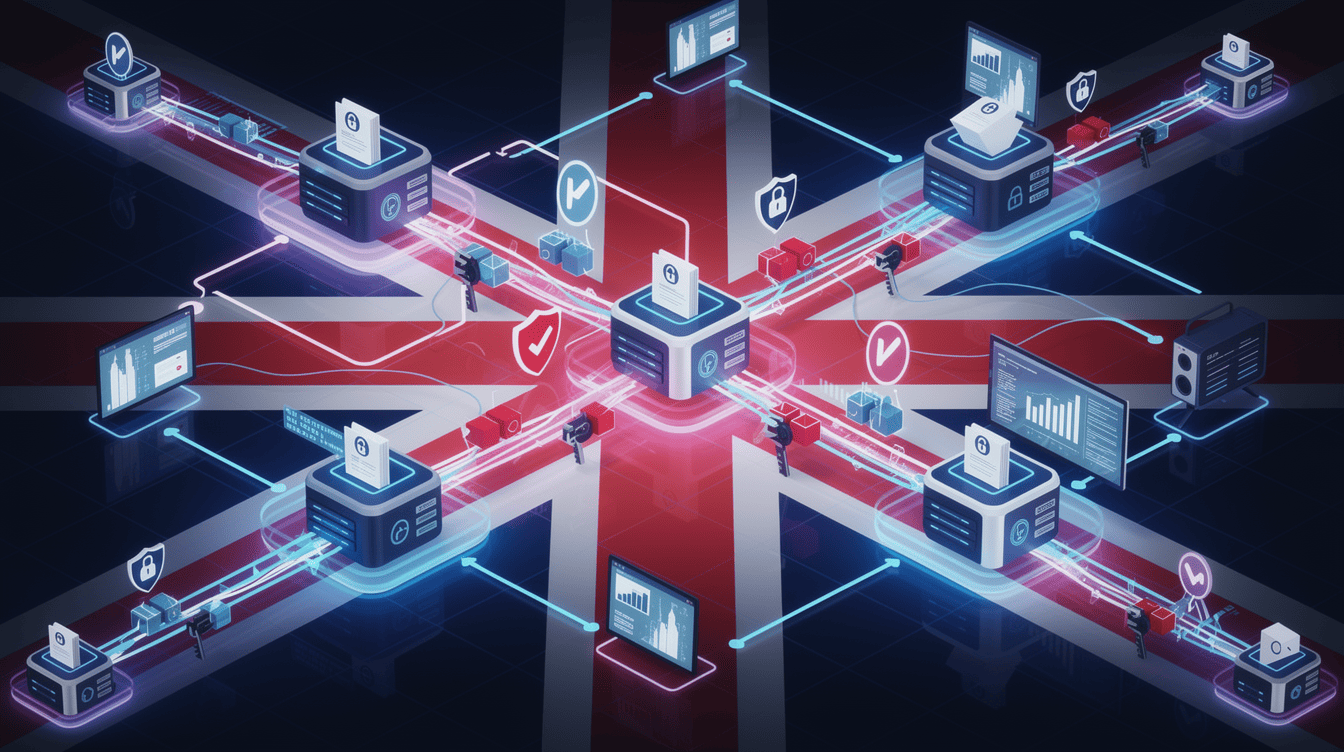
Britain runs one of the oldest continuously functioning democracies on earth. The machinery is venerable: paper ballots, pencils on strings, volunteers counting through the night, returning officers standing on stages at four in the morning. It is a beautiful system and it still largely works.
But it is slow, blunt, and rare. A general election compresses five years of accumulated sentiment into a single binary choice in a single afternoon. Policy errors, once made, persist for years before the next correction. Public anger accumulates silently and breaks out all at once. Governments discover they have lost the public at the ballot box, not before.
Elections are, in effect, periodic revolutions standing in opposition to French behaviour: large, discontinuous corrections separated by long silences. A modern country can do better. Not by voting more, but by sampling public sentiment more often, more precisely, and in a form government cannot ignore and cannot fake.
Liquid Direct Democracy With Factors
Treat the electorate less as an audience consulted occasionally and more as a body with a nervous system: continuously sensing, transmitting, and responding to its own condition.
Everything that follows is infrastructure. The architecture set out here has three operating principles:
Liquid direct democracy
Tgus Any citizen may vote directly on any open question, or delegate their vote revocably, by topic, at any time, to someone they trust. A busy surgeon might delegate economic policy to a trusted economist, keep health policy for herself, and hand education policy to a teacher she respects. A pensioner might delegate everything to their local MP. A political obsessive delegates nothing.
The Swiss have done referenda forever. Athens did it. It's not new.
MPs as factors, not relics
Representatives are not abolished. Their role is redefined as a factor. The definition was a man on the ground who represented the owner of a company or its board. We, the electorate, are the company and the Board.
Agents or representatives of European trading companies, such as the British East India Company, during the colonial period. Their duties included: overseeing the buying and selling of goods, ensuring profitable transactions, and maintaining relationships with local merchants and traders; setting up and managing trading posts or factories where goods could be stored, processed, and traded; securing trading rights, privileges, and concessions from local rulers or governments; coordinating the transport of goods to and from Europe, ensuring safe and efficient shipping operations; and keeping detailed records of transactions, inventories, and financial accounts for their trading company.
MPs stop being the sole channel for public opinion and start being something more useful: local sensors, interpreters of context, executors of decisions. The electorate provides the signal. Representatives provide the context. Government provides the action.
Elections without a central database
There is no live electoral register queried at the moment of voting. There is no government login. No national voter account. The state recognises you once, in person, and issues you a cryptographic franchise. From then on, the system verifies proofs, not people.
Taken together these are not three features; they are one constitutional machine.
Enhancement of Parliament, not replacement
This architecture replaces static, low-frequency representation with a continuous, high-resolution signal. It replaces centralised voter administration with citizen-held entitlement. It replaces trust in the counter with mathematics anyone can check.
It does not replace Parliament, courts, or the institutional weight of representation. War, national security, time-critical action, decisions requiring classified information; these remain with elected representatives, who may override the public signal when they must, but may never ignore it without consequence.
First-past-the-post still elects MPs. MPs still form governments. Governments still execute policy.
What changes is the informational environment in which they operate. They no longer govern in the dark between elections. They govern with a live, cryptographically verifiable reading of the public's will, and a public record of every time they chose to override it.
Why now? 3 reasons.
Zero-knowledge proofs (a branch of cryptography that lets you prove a statement true without revealing any of the underlying information) have matured from theoretical curiosities into deployable infrastructure. End-to-end verifiable election systems such as Microsoft's ElectionGuard and the French academic system Belenios already demonstrate the core property: a voter can confirm their ballot was included, and any third party can verify the announced result matches the encrypted ballots, without anyone seeing how anyone voted.
Anonymous credential systems, threshold cryptography, and proof aggregation have caught up to the point where a system of this ambition is no longer science fiction. It is just... engineering.
And the political case has grown impossible to ignore.
Brexit revealed what happens when a demand exists for decades and the political class refuses to ask the question. Whatever one's view on the outcome, the lesson is structural: any system in which those in power decide which questions the public may ask is not a democracy, it is a curated one.
Zero Day: Our Assumptions
The architecture begins from an uncompromising threat model. None of these are unrealistic. The Electoral Commission was hacked for over a year by Chinese state agents and nobody did a thing.
- Every device in the system may be compromised: the voter's phone could be running malware written by a bored teenager or a state intelligence service, and the system cannot trust the endpoint.
- Every voter may attempt fraud: double voting, identity spoofing, delegation manipulation, vote selling, coercion. Eligibility and uniqueness must therefore be enforced by mathematics, not by procedure.
- The network itself is presumed hostile (messages can be intercepted, delayed, replayed, or dropped) so nothing may rely on trusted transport.
- Parts of the infrastructure may be compromised too; nodes may censor submissions, reorder them, or attempt invalid state transitions, which means the system must be permissionless to verify even if not permissionless to write.
- And a coordinated, nation-scale attack is possible: state-level adversaries, botnets, insider threats. Failure must degrade gracefully, not catastrophically.
From these assumptions flows a single governing idea: the system does not define how power is exercised, it defines how power is verified.
What We Are Not Trying To Do
This is equally important. Overreach kills credibility.
- We are not eliminating coercion. Someone sitting next to grandma while she votes on the phone is a risk which exists today and will exist tomorrow. We are not eliminating household pressure, or persuasion, or social influence. Those are features of being human.
- We are not eliminating fraud in the absolute. We are reducing undetectable, large-scale manipulation to a vanishing fraction of current levels, and making whatever remains visible, measurable, and costly.
- The bar is not perfection. It is to be strictly better than the system we have today, across every major population group, under real-world conditions, on declared measures. A system which improves the national average while worsening integrity in Birmingham or the Western Isles has failed by definition.
Said plainly: this architecture makes manipulation visible, measurable, and costly. It does not make it impossible.
The MIT Paper
In 2020 the MIT Digital Currency Initiative published a paper titled Going from Bad to Worse: From Internet Voting to Blockchain Voting. It is the canonical technical critique, and any serious proposal must absorb it.
Their argument, stripped to essentials:
- Voter devices are insecure, and malware can alter votes before submission, undetectably, at scale.
- Blockchain-based voting can produce single-point catastrophic failures affecting millions at once.
- The blockchain itself does not solve the real problem: it secures storage, not the voting act, so garbage goes in and immutably stored garbage comes out.
- Remote voting enables coercion and vote-selling in ways the polling booth prevents. And even perceived vulnerability can collapse democratic legitimacy.
They are correct about all of it, given the class of system they are attacking: remote, unsupervised, client-trusting, electronic-only voting.
We are not proposing that system.
The architecture here treats the device as hostile from the first line of code. It requires multi-channel verification, permits re-voting so coerced votes can be overwritten privately, retains polling stations as hardened endpoints, and uses the public ledger only as an append-only audit rail: never as the thing that "makes it secure". Blockchain is present as a bulletin board, not a saviour.
MIT is correct to reject naive blockchain voting. Their conclusion (digital voting is therefore impossible) defines the constraints any serious system must meet. It does not close the question.
For Dave From Wetherspoons: How It Works
Before any of the machinery, here is what the ordinary person sees. Everything underneath must serve this.
Becoming a voter
On your eighteenth birthday, or on becoming a citizen, you go in person to an electoral enrollment centre. A clerk checks your documents. They verify in person you are who you say you are; you have not enrolled before; and you meet the legal requirements.
You walk out with one thing: your franchise. It may take the form of a paper code, an NFC card, a smartcard, a printed recovery phrase, or a chip. The form it takes is incidental. What matters is that it is yours, it was issued in person, and the state has no live database recording where it now is.
You take this franchise and you decide where it lives.
- You may keep it yourself in a safe.
- You may hand it to your bank for a small annual fee.
- You may split it three ways between your solicitor, your bank, and yourself, so that recovering it later requires any two of the three.
- You may leave it with a regulated security provider.
- You may do whatever combination gives you peace of mind.
The state does not know which option you chose. It does not need to.
Voting
At some later point, perhaps the same week, perhaps three decades later, Parliament or the public has triggered a referendum. You are notified by whatever means you prefer: a letter, a text, a notification, the news. It could be every day, every week, or every month.
You open a session. This might be on your phone, on a laptop, at a polling station terminal, at a post office counter, or by telephone call to your custodian if you are elderly or disabled. The interface does not matter. The system does not care which one you used.
You see a short, neutral description of the question, its deadline, and whether it is binding or advisory. If there are other open questions, you see those too. You answer what you care about. You skip what you don't. You confirm once.
The whole thing takes perhaps two minutes, and those minutes do not grow if there are three questions open instead of one.
Later, at your leisure, you can check that your vote was counted without revealing how you voted, to yourself or to anyone else.
If you were pressured at the moment you voted, you can quietly re-cast your vote before the deadline; only the last submission counts, and no one can tell you changed your mind.
What happens underneath
None of what follows is your problem. It is yours only if you want to know. The aim is for the complexity to be asymmetric: wildly difficult problems presented with extreme simplicity at the point of use.
If the grandmother in the Shetlands can receive her franchise, keep it safely with her bank, authorise a vote by telephone, and later confirm it was counted without understanding any of the machinery beneath, then the architecture is working as intended. If not, it is not ready.
The Franchise: Citizen As Keeper
The single biggest technical shift is the franchise is issued once and lasts for life, like citizenship itself. It is not reissued for each referendum.
A per-referendum reissuance model fits a five-year cycle. It does not fit a living democratic nervous system where voting may be frequent, delegation fluid, and participation continuous. Expecting citizens to re-authenticate every time Parliament asks a question is absurd.
So the model runs on three layers.
- The civil status layer holds the legal fact: age eighteen reached, citizenship obtained, qualifying residency established. This already exists today.
- The franchise credential layer is what is new: a standing, privacy-preserving proof of electorate membership, issued once and held by the citizen.
- And the event authorisation layer handles each referendum, deriving per-question proofs automatically from the franchise whenever the citizen opens a session.
The voter never touches the event layer consciously. It happens whenever they open a session.
What the state actually knows
At enrollment, the state verifies you and creates two artefacts.
- First is an internal civil record: this real person is part of the electorate. That record stays in the civil system. It does what civil records have always done. It may not be extended or inflated into something else.
- Second is your franchise credential. It encodes a cryptographic statement ("the holder of this is part of the electorate") wrapped into a form only you can unlock. Ditto.
Once issued, the state destroys any dependency on using it later. There is no account. There is no login. There is no live lookup at the moment you vote.
The distinction matters because it firewalls the franchise from everything else. The franchise proves you can vote. It does not prove who you are to banks, to police, to employers, to landlords. It is not a digital ID.
This is the discipline which stops constitutional infrastructure from becoming surveillance infrastructure. A voting credential which can be used for banking, welfare, travel, employment, or policing is no longer a voting credential. It is an identity card, which is a foul smell to the British.
Store it yourself or trust someone else
Most people cannot safely self-custody a cryptographic key for sixty years. The system must accept this without collapsing into a central chokepoint.
The model is assisted custody, not central custody.
- At one end is self-custody: a hardware token, smartcard, safe, or paper backup held by the voter themselves, offering maximum autonomy and maximum responsibility.
- In the middle sits custodian-mediated storage, where a bank, solicitor, regulated security provider, union, or civic body holds the franchise on your behalf for a small annual fee; you gain simplicity and a recovery path.
- At the more sophisticated end is split custody, where the franchise root is broken into shares (two of three, three of five) held by independent custodians. None holds the whole. Recovery requires cooperation, but no single party can lock you out.
Custodians may help you store, recover, and authorise. They may not vote on their own initiative, transfer the franchise, learn your ballot (unless you explicitly delegate a visible model), block recovery, or revoke the franchise. They are safety infrastructure, not political gatekeepers.
Preventing digital ID by the back door
Even if the state does not hold the franchise directly, it can achieve the same outcome by forcing custodians into a single shared registry for "resilience", "anti-fraud", "AML", "accessibility", or "operational efficiency". At that point digital ID has been recreated by stealth.
The anti-federation rule must be architectural, not merely political:
Custodians must not need to know about one another, query one another, or synchronise voter records in order for the system to function.
A bank should be able to hold a voter's franchise share without consulting the post office, another bank, or a government hub. Each custodian is an island. The only shared things in the whole ecosystem are the public cryptographic protocols: proof formats, revocation formats, transfer-envelope formats, recovery workflows.
Common protocol, no common registry. Or sharper: interoperability must stop at verification; it must not extend to political identity.
Revoking the ability to vote
Two cases matter. The first is renunciation of citizenship: once the legal act completes, the franchise status changes, a revocation event is added to a public revocation structure, and from that moment any proof derived from the revoked franchise fails validation. The person simply cannot cast future valid votes. No live lookup is needed; the revocation list is public.
The second is serious criminal conviction. If the law provides for suspension of voting rights upon certain convictions, a court-authorised revocation order follows final disposition, and the same mechanism applies. If the law does not provide for disenfranchisement, the cryptographic system must not invent it.
Revocation authority is tightly fenced. Not a minister. Not a returning officer. Not a custodian. Not the police database. A thresholded authority chain with court involvement where constitutionally required.
Past ballots are anonymous and cannot be surgically extracted. Revocation suspends future exercise of the franchise, not past expressions of it. That is the honest architecture.
Recovering a lost or stolen franchise
If you lose your franchise (phone stolen, dog eats the smartcard, your custodian goes bust) you return in person to an enrollment centre. The old franchise is suspended. A new one is issued. A public administrative record notes that a reissuance event occurred, without exposing you. It's what DVLA does every day.
Enrollment is rare. Participation is frequent.
The Cryptographic Science
For the non-technical reader, this section can be skimmed. The essentials are simple:
- Each vote is a small packet of mathematical evidence.
- The system checks the evidence, not the voter.
- No one, not even the state, can tell who voted for what. But they can tell it is a legitimate vote, from a legitimate voter.
- Everyone can check that the count is correct.
For the builder, here is the detail.
The proof bundle
When you cast a vote, what is actually submitted is a small bundle of cryptographic evidence. The ballot itself is encrypted on your device: for a binary referendum, yes, no, or abstain. Alongside the encrypted ballot travels a zero-knowledge proof of membership: mathematical evidence the submitter holds a valid franchise credential belonging to the currently recognised electorate, revealing no identity. Conceptually this is close to what the Semaphore protocol does for anonymous group membership.
- A second zero-knowledge proof attests the franchise has not been revoked, checked against a public revocation structure of the kind AnonCreds already supports.
- A third proof confirms the encrypted ballot is well-formed: it encodes a valid choice rather than a malformed payload.
The bundle also carries a referendum-scoped nullifier: a deterministic, anonymous marker unique to this voter for this referendum. Same voter, same referendum, same nullifier. Different referendum, entirely different nullifier. The nullifier is irreversible to identity. Finally, a transport integrity wrapper signs the envelope.
The verifier checks five things and nothing else.
- Is the membership proof valid against the public verification key?
- Is the non-revocation proof valid against the public revocation state?
- Is the ballot-validity proof valid? Has this nullifier been seen before?
- Do the referendum parameters match?
- If all pass: accepted. If any fail: rejected, with a public error class. No name. No lookup. No account. No registry query.
Democracy becomes a verification protocol, not a government application. The state does not need to build an app. It only needs to publish the rules: parameters, verification keys, revocation state, proof formats. Anyone can then build clients: banks, civic groups, accessibility organisations, hardware makers, post offices. The state defines the verification rules. Society provides the interfaces.
Why the nullifier matters
The nullifier is the mechanism which enforces one-person-one-effective-vote without knowing who the person is. It is derived deterministically from the franchise secret and the referendum identifier:
nullifier = f(franchise_secret, referendum_id)
The verifier keeps a set of seen nullifiers. If one appears twice on the same referendum, the second is rejected. Re-voting is handled the same way; a later submission from the same nullifier supersedes the earlier one within the voting window.
The property is strict: same voter, same question, same nullifier. Different question, different nullifier, no linkability. The only repeatable public marker is per-referendum. There is no stable cross-referendum handle which could be used to track voters over time.
This is the property which makes device independence workable: the system does not care whether the vote came from a phone, a laptop, a polling station, a bank's voting interface, an embassy kiosk, a military offline station, or a specialist accessibility tool. If the nullifier is fresh, the proofs verify, and the revocation state is clean, the vote is accepted.
Sessions: many questions, one action
At high referendum frequency, the system must not force one authentication per question. A voter facing three open questions should experience roughly the effort of answering one, not three.
A session is one authenticated civic interaction in which a voter may review and answer any number of currently open questions.
It opens with a single authentication, via self-custody, custodian, or supervised access (we don't care), which produces a session identifier, an expiry, the current referendum manifest, and a shared proof context. The voter then sees every open question at once, each with a neutral summary, deadline, and type. The manifest is frozen for the session. No new questions can appear partway through, which prevents manipulation and confusion.
For each question the voter may vote, abstain, or skip. The distinction between abstain and skip is constitutionally important: abstaining generates a nullifier and a formal abstention which counts toward turnout, while skipping leaves no record at all. Having marked their responses, the voter reviews the whole bundle once and confirms once.
At that moment the system generates one shared membership proof, one shared non-revocation proof, and then per-question ballot objects, ballot-validity proofs, and nullifiers — each cryptographically independent of the others. The bundle is submitted and sealed. A challenge to question B does not affect A or C.
Two invariants carry the architecture. One membership proof, many nullifiers: so proof cost is amortised across the session rather than paid per question. And per-question isolation so one challenge does not poison unrelated votes. If either fails, the session model is cosmetic rather than real.
Delegation, or where it gets hard
For direct voting the proof bundle is well understood. For delegated voting it becomes harder, and honestly, less mature.
The architecture must support it, but builders should not underestimate the difficulty. This one is a bastard.
A delegated vote roughly requires proof the delegate holds a valid, non-revoked franchise, proof of a valid delegation edge from origin to delegate, proof the delegation scope matches the referendum topic, and proof the origin voter has not themselves cast a direct vote on this question (which would override). Crucially, the nullifier must be keyed to the origin franchise, not the delegate, so one delegate with ten thousand delegations casts ten thousand individual effective votes, each unique.
When you delegate, you can see the delegate's voting record. You can revoke instantly. Delegates know their delegators are watching. This creates organic meritocracy; thoughtful delegates accumulate trust, careless ones lose it.
But delegation is dangerous.
Without constraints it becomes a market in political power. Realistic safeguards include:
- Caps on concentration so no individual holds more than a small percentage of delegated authority in any domain;
- Time decay so delegations expire after thirty to ninety days and must be renewed;
- Scope fragmentation using narrow dynamic scopes to prevent permanent blocs; and (most subtly):
- No on-chain enforceable proof of who delegated to whom, so delegation is observable in aggregate but not provable at the individual level.
That last property is what breaks vote-buying contracts: influence can emerge, but it cannot be sold with enforceable title.
The architecture must permit delegation, but must not depend on it. Ship version one without it. Add it carefully. Treat it as a constrained, lossy, temporary signal. Never as a transferable asset.
The Ballot Box, Reimagined
We do not want to build one giant national voting platform. We're building a layered sovereign system where each compute tier does only the minimum it must.
- At the edge sits the site layer: polling stations, embassies, military bases, post offices. These handle local ballot construction, local encryption, local journaling, and paper printing for reconciliation. They hold no master secret. They cannot alter national tallies. Their job is simply to turn a voter's action into a well-formed cryptographic submission plus a local evidence trail, and they must operate fully offline for an entire voting window and reconcile upstream later.
- One step inward is the regional layer, housed in regional sovereign data centres. This is where intake, deduplication, schema validation, reconciliation against local journals, and regional commitment publication happen. Think of it as the national equivalent of bank clearing — never the sole source of truth, always a checking station.
- The national cryptographic control plane is the smallest and most protected tier of the whole system. It handles parameter publication, threshold-guardian key material, referendum instantiation, scheduling, and revocation notices. No single minister, returning officer, or vendor holds decisive secret authority. All decisive actions require a quorum of independent threshold guardians drawn from different institutions. It should be boring, sparse, and heavily audited.
- Where the heavy compute lives is the tally and proving clusters: homomorphic tallying for simple referenda, verifiable mixnets where ballots are richer, zero-knowledge proof generation, and recursive proof aggregation so many regional proofs fold into one compact national proof. Modern zero-knowledge virtual machines such as RISC Zero and Succinct's SP1 are the relevant research material here.
- Widest of all is the public audit layer, mass-replicated, run by parties, universities, newspapers, civic groups, and ordinary citizens. Cheap proof checking. Bulletin-board mirrors. This is where blockchain, if used, belongs. As an append-only commitment rail, not as the thing that "makes it secure". MIT's point stands: blockchain does not save a compromised client. But as a public audit rail it is defensible.
- And underneath everything, the recovery layer: offline archives, paper-ballot imaging, court-supervised replay environments. This is constitutional infrastructure, not operations. The capacity to reproduce any tally from preserved artefacts, years later if need be.
The deepest infrastructure rule is simple to state.
- Compute which touches the voter should be local, constrained, and disposable.
- Compute which touches the result should be distributed, threshold-controlled, and publicly auditable.
- The expensive computation should be concentrated; the right to verify should be cheap and widespread.
A national voting system should not be architected like a website. It should be architected like sovereign payments infrastructure crossed with a public archive.
Paper votes are not yesterday's news
Paper ballots remain first-class citizens. Every supervised site produces a human-readable paper record alongside the digital one. Paper reconciliation is part of every site's close package. Paper ballots enter the same cryptographic pipeline as digital ones via scan-and-encrypt.
Offline continuity is not a fallback. It is a core mode. If the network fails (degraded by attack, politically contested, hit by a cable cut, a solar storm, a state actor) physical issuance continues. Paper voting continues. Local recording continues. Reconciliation happens when connectivity returns.
Any digital successor materially simpler than the current paper system is probably not solving the full problem. Elections are already complex because legitimacy is complex.
Who gets to ask the questions
The Brexit problem: if those in power control which questions the public may ask, there is no democracy, only a curated one. For thirty years the question of EU membership existed in British public life. It was asked only when the political class judged it could no longer be suppressed because of UKIP's popularity.
Or as Sir Humphrey would put it, one never holds a referendum or an inquiry unless one already knows the answer in advance.
The architecture must make this structurally impossible, not merely politically unlikely. The solution is three parallel, non-blockable trigger paths.
- The primary channel is citizen petition. A referendum is automatically instantiated when a threshold of valid signatures is reached. Not just a debate. Thresholds scale by tier: roughly 1–2% for advisory, 3–5% for policy, 8–10% for constitutional. Once threshold is met, the referendum is not approved, it is instantiated. No vote. No committee. No delay.
- Alongside this sits a parliamentary trigger. Parliament can still initiate referenda faster for urgent or structured proposals, but cannot monopolise access to the mechanism.
- And behind both, as a backstop, sit scheduled civic windows. At quarterly intervals, the highest-signature pending proposals automatically progress, preventing indefinite "just under threshold" suppression of inconvenient questions.
Abuse prevention matters too. Each citizen can support only a limited number of active petitions; there are rate limits on concurrent national referenda; similar petitions are merged. Access is open. Throughput is constrained.
No government gets to decide which questions the public is allowed to ask.
Not all questions are equal
To stop the system becoming a glorified polling engine, referenda come in tiers with different thresholds.
- Tier one covers constitutional and structural questions: sovereignty, electoral reform, fundamental rights; It demands a supermajority of 60–75%, a high turnout floor, long voting windows, and limited frequency.
- Tier two handles strategic policy: taxation direction, immigration frameworks, energy, major spending. Strong majority, moderate turnout floor.
- Tier three is advisory and sentiment-gathering: directional input, early-stage proposals; with lower thresholds, non-binding outcomes, trend-tracked over time.
Wording is neutrality-reviewed by any independent body. Cooling-off periods prevent iterative re-asking. Rate limits prevent flooding. The system measures conviction, not activity.
Universal access for any British person, anywhere
If the system fails anyone, it is politically dead.
- For blind and visually impaired voters, audio-guided interfaces, tactile ballots, and assisted polling with privacy safeguards.
- For the deaf and hard of hearing, text-first interfaces, sign-supported polling stations, clear visual confirmation flows.
- For those with motor impairment, assisted voting, accessible terminals, and proxy assistance with strict audit trails.
- For cognitive or psychiatric conditions, simplified interfaces, extended windows, optional assisted environments.
- For overseas citizens, embassy-based credential issuance, secure remote voting, postal fallback.
- For military personnel, on-base systems, offline-capable voting kits, delayed sync where needed.
No citizen loses their vote because of service, distance, or circumstance.
Dealing With Human Corruption
The governing rule: interrupt fraud at the smallest possible scope, with the least possible disclosure, as early as possible. Not "detect everything centrally". Not "trust an AI". Not "let the state decide".
- Pre-submission fraud interruption is the cleanest part because it is deterministic. Every verifier checks only valid proof, non-revocation, ballot validity, nullifier freshness, and parameter match. Any failure means immediate rejection, a logged public error class, and a signed evidence record. Simple, open-source, no judgement.
- Mid-stream fraud interruption is about visibility rather than decisions. A public anomaly ledger, published in near real time, shows duplicate nullifier attempt counts, verifier disagreement events, revocation race flags, regional intake gaps, custodian outage notices, and proof failure counts by class. No identities. No ballots. Just operational anomalies. Voters private; administration exposed.
- Post-submission fraud interruption uses scoped quarantine rather than national freeze. A suspicious event can be isolated to one credential, one custodian, one polling station, one region, or one referendum, only escalating to national if absolutely necessary. National suspension is itself an attack vector and must be guarded as such.
Not every submission should be accepted or rejected absolutely in the moment. Some, e.g. a revocation update racing with a submission, a partition conflict on the same nullifier, a verifier disagreement — should be provisionally accepted, flagged immutably, and resolved via published challenge rules. Silent acceptance and silent rejection are both bad.
Keep it simple, stupid
Every polling site or embassy emits a standard closing package: count of issued voting artefacts, count of received ballots, count of spoiled ballots, signed local journal hash, paper reconciliation count, uplink manifest hash.
The first audit question is then simple: does the site close package reconcile with regional intake and the national bulletin board?
If not, that site is immediately flagged.
Automatic audits
The system classifies failure automatically rather than through ad hoc investigation.
- Cryptographic invalidity (a proof that fails, a signature that fails, a commitment chain that breaks) triggers immediate suspension of the affected scope.
- Reconciliation anomaly, where counts do not match across site, regional, and national artefacts, triggers mandatory replay of the affected scope.
- Inclusion anomaly, where voters report missing commitments above a threshold, freezes certification for the affected scope until resolved.
- And statistical anomaly, where turnout or timing looks wildly abnormal, triggers escalated scrutiny but not automatic invalidation. Statistics are for triage, not for legitimacy.
The role of AI
AI belongs in the security and operations shell around the constitutional core. It must not enter the core itself.
The useful applications are genuine. AI can:
- Detect coordinated intrusion patterns
- Cluster anomalies
- Correlate custodian breach signals
- Triage fraud investigator workload
- Power accessibility interfaces: real-time speech for blind voters, sign translation, language translation for instructions.
- Flag synthetic-media disinformation campaigns during a voting window, and
- Help engineering teams review code and configuration for policy drift.
The prohibitions are absolute. AI may not decide any ballot is fraudulent, revoke credentials, certify a final result, override challenge outcomes, make eligibility decisions, or autonomously halt national tallying. AI may raise the alarm. It may not ring the constitutional bell. Use AI to watch the guardians, not to become one.
Disputing dirty elections
Trust decays fast. A result must be challengeable in minutes, reviewable in hours, replayable in days.
- Within five minutes of close, the system publishes total submissions, regional manifests, all proof artefacts, and site close-package hashes.
- Within thirty minutes, the independent verifier network has checked proof validity, count reconciliation, regional completeness, and public mirror consistency.
- Within two hours, an automatic anomaly board publishes proof failures, reconciliation mismatches, abnormal issuance or turnout flags, and inclusion challenge counts.
- Within twenty-four hours, if needed, there is a scoped replay of the affected region, a court-supervised review path opens, and provisional certification pauses for the affected scope.
Measuring for assumed failure
The system is not judged by aspirations. It is judged by declared measurements, baselines, thresholds, and failure conditions stated in advance. Not in terms of econometrics for political technocracy purposes; for simple technical reasons and failure signal feedback.
- Concrete targets matter: session completion should run above 95%, with anything below 88% counting as failure.
- Proof generation on representative hardware should stay under three seconds median, with ten seconds the outer threshold.
- Duplicate nullifier acceptance must be zero: any confirmed duplicate counted is a constitutional-level failure.
- Provisional acceptance should run under 0.5%, with automatic scope suspension triggered above 2% and automatic rerun above 5%.
- Recovery after reported loss should succeed 98% of the time.
- A single custodian incident affecting more than 0.1% of the active electorate triggers review; anything above 1% without rapid containment is outright failure.
- And question independence must be perfect — if a successful challenge to one question invalidates another in the same session, the session model has collapsed.
All of these metrics must be stratified by geography, age band, access mode, disability-support pathway, connectivity. A system which improves the national average while degrading specific communities has failed by definition.
Reporting runs at three cadences:
- Per-referendum on the operational measures
- Monthly on custodian incidents and recovery
- Quarterly on baseline comparison and threshold breaches.
All published. Moving the goalposts is itself a failure mode.
This system does not promise a perfect democracy. It promises a more honest one where failure modes are measured rather than assumed; where manipulation at scale becomes costly and visible; and where improvements are judged against defined baselines rather than asserted.
Constitutional constraints against system drift
A serious system can rot over decades as political actors learn to work it. The following must be hard-coded constitutional limits, not soft norms.
- Provisional vote volume must be capped, with automatic suspension when the cap is breached.
- All quarantine rules must be machine-executable and non-discretionary.
- Rerun authority must be strictly capped and require supermajority approval.
- Challenge board decisions must sunset, so precedent does not accumulate silently over decades.
- Aggregated custody supervision must be constitutionally prohibited.
- No identity-based turnout detection may exist: this is an accepted trade-off.
- And any rule not expressible as deterministic code cannot govern the system.
Without these, the architecture will be hollowed out within ten to fifteen years. With them, it holds.
Transforming British Democracy
Under the current system, a policy error persists for years. Public anger accumulates silently. Correction arrives at the next election, abrupt and often destructive.
Under this architecture, policy error is detected early. Sentiment is visible continuously; correction is gradual; governments no longer discover public anger at the ballot box; they observe it forming in real time.
Policy becomes iterative: propose, measure, refine, re-measure. Not: guess, commit, defend for five years.
Example: a government introduces a new housing policy. At week one, support runs 62%. At week four, 54%. At week twelve, 41%. That trend matters more than any single vote. The government can adjust, consult, rephrase, test variations — before the collapse of support becomes a collapse of the government itself.
The new role of MPs
MPs retain authority where the public cannot have it: war, intelligence, national security, time-critical action, decisions requiring classified information. They can override the signal: but only visibly, on the record, politically accountably.
Representatives retain the right to override the signal, but not to ignore it without consequence.
Parties become coordinators and interpreters, not gatekeepers. FPTP still elects MPs. Governments still form. What changes is that governance occurs in a high-signal environment rather than a low-signal one.
The electorate becomes a continuously sampled signal, not a periodically consulted audience.
Not mob rule. Signal is structured — formal questions, defined thresholds, time windows. Delegation stabilises participation so expertise concentrates dynamically without creating a permanent political class. Representatives remain as the execution layer. Advisory and binding votes are clearly separated.
Not a polling engine. Thresholds, stratification, neutral question review, cooling-off periods, rate limits — all prevent weaponisation.
Not an abolition of Parliament. An upgrade to its informational environment.
For English Tinkerers: The Blueprint
Suppose you are an aspiring computer science graduate with a soldering iron and a laptop, and having read this far you are beginning to suspect you could prototype the thing. You would be right. The mathematics is real. The libraries exist. What follows is a general technical overview of how to approach the problem — not a recipe, but enough to orient an inventive tinkerer who wants to get started.
The central discipline is adversarial: you are not building a product, you are building a falsification rig. The aim is not to prove the architecture works but to find out, quickly and cheaply, where it breaks. Each experiment should answer a binary question, and each failure should redesign the next experiment. A nation-scale prototype is a fantasy. A toy constitution (one voter, three questions, one session, all the invariants preserved) is where to prototype before attempting the "big" problem of national vote.
A handful of questions carry most of the weight.
- Can a vote be verified as valid without any central database lookup?
- Can nullifiers genuinely prevent double voting under concurrent submission at scale, including replay and reordering attacks?
- Can a revoked credential be made unusable without any identity query?
- Can one session carry several questions while keeping each one cryptographically independent, so a challenge to one does not poison the others?
- Can a voter change their mind on question B a week later, without disturbing their earlier answers on A and C?
- And, hardest of all , can a second, independent implementation, written from the specification alone by someone who has never seen your code, reproduce your results from the public artefacts?
If these hold, there is something real to build. If any of them fails, redesign before writing another line.
The technology choices should be boring.
- Rust gives the crypto-adjacent discipline the domain deserves;
- Go offers faster systems iteration if prototyping speed matters more than formal rigour at the start. Either works. What matters is picking one for the core and staying with it.
- Storage should be unglamorous: append-only logs, SQLite or PostgreSQL, filesystem receipts for prototypes. Distributed databases are a distraction on day one.
- The API surface should be tiny: open a session, fetch the manifest, submit a bundle, verify a receipt, publish public state.
- The front end can be ugly. Manifest screen, choose answers, review bundle, submit, receipt view. Nobody is judging your CSS.
Above all, do not invent cryptography. The primitives you need already exist in mature libraries. Ed25519 or BLS for signatures. Merkle trees or similar structures for membership commitments. Poseidon or similar for nullifier derivation. And for the zero-knowledge parts, use existing tooling before attempting anything bespoke.
The single fastest way to waste two years is to attempt a full bespoke ZK voting chain from scratch. There are enough hard unsolved problems at the protocol layer without also trying to reinvent the algebra underneath.
Several existing systems are worth studying closely.
- For anonymous group membership and external-nullifier patterns, the Semaphore protocol is the canonical reference.
- For non-revocation proofs against public revocation state, AnonCreds is the mature example.
- For privacy-preserving token issuance, the IETF's Privacy Pass standard provides the right conceptual family.
- For end-to-end verifiable voting, Microsoft's ElectionGuard and the French academic system Belenios both demonstrate what voter-verifies-inclusion and third-party-verifies-result actually look like in running code.
- For proof aggregation and recursive proving, the zero-knowledge virtual machines from RISC Zero and Succinct (SP1) are where national-scale audit compression becomes plausible.
- For threshold cryptography (the distributing-trust primitives needed for the control plane) NIST's ongoing threshold project, particularly IR 8214C, is the authoritative reference.
- For tallying, homomorphic schemes handle simple binary referenda cleanly; verifiable mixnets come in where ballots are richer. Fully homomorphic encryption is worth watching but not worth anchoring on for a first build.
Blockchain, if you use it at all, should appear only as a public, append-only audit rail for commitments, proofs, schedules, and issuance events. Not as the thing that secures the vote. MIT is right about that, and no amount of clever protocol design makes them wrong.
The order of prototyping matters.
- Start with the direct session bundle: one voter, three open questions, one session, three nullifiers, three independent results, and confirm challenging one question leaves the other two untouched. This is the first must-pass.
- Then build stateless verification: a verifier that accepts valid bundles, rejects revoked credentials, rejects duplicate nullifiers, and runs with the network disabled.
- Then re-vote by question, proving that a later session can change B while leaving A and C intact.
- Then throughput: scale from ten questions to thirty to ninety, and confirm that a voter answering a few of them experiences session time rising slowly, not linearly.
- Then, finally, the independent verifier written from your published specification by someone who has never seen your code and see whether they reproduce your result from the artefacts alone.
Several things should stay explicitly out of the first version.
- Liquid delegation is genuinely hard and politically explosive; design the extension points for it but do not ship it.
- Threshold custody across many providers belongs in version two.
- Ranked ballots can come in version 1.5.
- AI anomaly detection belongs in the operational shell, not the constitutional core.
- Nation-scale distribution and blockchain settlement rails are problems for a much later stage.
The temptation to ship a full constitutional machine on day one is the single most common failure in projects of this kind.
What will separate your work from the dozens of half-formed proposals which have preceded it is the write-up. Document the assumptions you are making, the invariants you are preserving, the packet formats you have chosen, the failure cases you have considered, the challenge rules, and, above all, what you are explicitly not trying to solve yet. Name the conditions that would falsify the design. That last point is what makes serious people take you seriously.
Any genuinely useful research project here answers at least one of four questions:
- Can session-level proof reuse work without breaking per-question isolation?
- Can stateless verification survive realistic revocation and re-voting behaviour?
- Can user effort stay nearly flat as question count rises?
- Can the whole system remain intelligible enough to be independently re-implemented from specification?
Answer any of those well and you have done something which did not exist before.
The spirit of the exercise matters more than the stack. This is not a startup. It is a very English shed-built constitutional instrument. Small. Clear. Testable. Unfashionable. Hard to fool. Hard to hype. Hard to kill. The people who built the first telephone exchanges, the first radar stations, the first national grid were not launching products. They were building things that had to work for a century. That is the right idea.
Putting The Electorate In Possession
Get rid of the cryptography, the compute tiers, the threshold guardians, the audit classes, the petition thresholds, and what is left is a single conceptual inversion.
The system we have today runs on a simple premise: the state owns the register, and the citizen requests permission to participate. You appear on a list held somewhere in Whitehall or your local council. On polling day you present yourself, your name is checked, and you are granted the exercise of a right the state has catalogued. The electoral register is the master document. You are an entry in it.
What is proposed here turns that relationship inside out. The citizen holds the franchise. The state must prove the integrity of the count.
Not blockchain. Not zero-knowledge proofs. Not liquid democracy as a fashionable idea. Those are implementation details. The revolution is a change in who owns what.
The franchise is yours. It lives where you choose to put it. It cannot be checked against a list because there is no list. And every time a result is announced, the state must publish the mathematical evidence that the count is true — evidence any citizen, any newspaper, any university can verify for themselves, without asking permission.
Britain invented modern representative democracy across three centuries of argument, revolt, and reform. The Great Reform Act, the secret ballot, the extensions of suffrage — each step was resisted, and each now looks inevitable.
The next step is not more frequent elections. It is the moment the electoral register itself stops belonging to the state.
The mathematics exists; the infrastructure exists. The political case is overdue. What remains is the generation of builders who will treat this not as a product to ship but as a thing that has to work for a century and who understand the purpose of the technology is not to replace Britain's institutions but to give them, at last, a nervous system worthy of the country they serve.