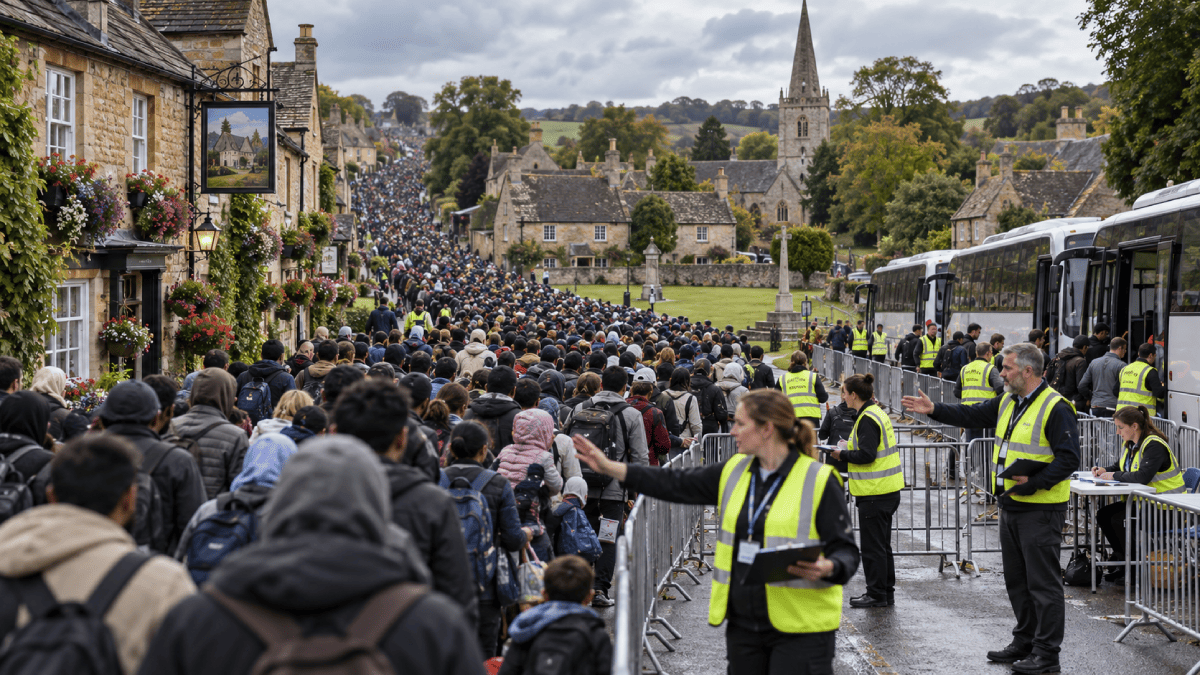
Dumb And Dumberer: Burnham's Grand Plan To Save The World
Nobody elected him, his party couldn't find anyone to run against him, and his big idea is the one Jim Callaghan buried fifty years ago. Britain's seventh Prime Minister in a decade took to the stage in Liverpool with a care plan he first announced in 2010 and a grudge against Mrs Thatcher.

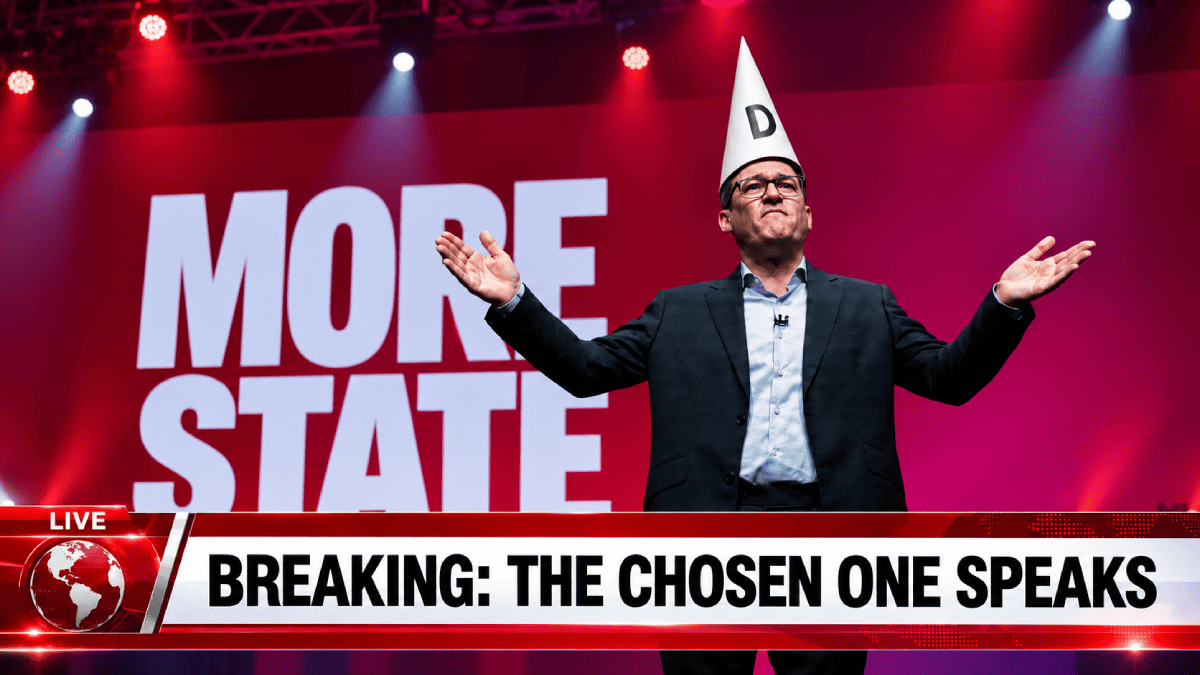
Britain's inability to find a leader of any moral or political character stopped being funny a long time ago. The female staff at the Times and the senior female members of the Labour party, for their part, wanted to cast a British reality TV version of Justin Trudeau who could make the worst disasters of Euro housewife socialism seem cool again. The trouble with such an idea is one's Manchurian candidate inevitably ends up speaking in public and the plan goes a bit wrong.
In September 1976, James Callaghan stood up at the Labour conference in Blackpool and told a room full of true believers the thing they least wanted to hear. The idea of spending your way out of trouble, he said, no longer existed, and in so far as it ever had, it had only worked by pumping inflation into the economy and unemployment in after it.
The same day, his Chancellor, Denis Healey, turned his car round at Heathrow as sterling fell through the floor. Within weeks, a Labour government was on its knees before the International Monetary Fund asking for a loan.
Fifty years and one day later, another Labour Prime Minister stood up in Liverpool and gave the speech Callaghan's hecklers had been waiting half a century to hear. The Chancellor is once again called Healey. The gilt market is once again jittery. The IMF has once again written to the Prime Minister begging him not to do anything silly with the public purse.
Andy Burnham read the letter, thought about it carefully, and then announced a new state-owned grid company; a promise to nationalise water; a council housebuilding drive; a free universal care service; a bus fare cap; and VAT off the electricity bill by Thursday.
Some men learn from history. Others try to restage it with better lighting.
Andy Burnham found a time machine, set It to 1976, and brought back nothing useful.
171% Vote Share In A Banana Republic Election
Andy Burnham has never won a general election as leader of anything larger than Greater Manchester. He came back to the Commons through an engineered by-election in Makerfield in June. In July the Labour Party held a leadership contest, and like every communist dictatorship, he was the only candidate. Even the Vatican holds a proper vote and sends up smoke.
By his own reckoning he is the seventh Prime Minister in ten years.
A country which once gave its leaders a decade to prove themselves now gives them roughly the shelf life of a Tesco sandwich, and still somehow ends up with a queue of the same faces from the Gordon Brown era.
"Conference, I am 10 weeks into this job," Burnham told the hall. "And not all of my recent predecessors have been able to say that." The line got a laugh. It deserved a stiff drink.
When the bar for a British Prime Minister has fallen to outlasting a lettuce, the joke is on the country, and the country has stopped finding it funny.
An hour-long televised address to the nation, drafted by a team of speechwriters, checked by special advisers, and backed by the entire apparatus of the British state, is much better evidence.
Dear lord. We are in trouble.
Sentimental Crap For Women Of A Certain Age
Burnham announced early on he would give "a real speech" instead of the "usual tub-thumping". What followed was forty minutes of family photographs for the women in the audience who still need to "hope again" their student dreams of a magical Denmark utopia of sharing and caring are real.
- His grandad drove a lorry along the Liverpool docks for Tate & Lyle.
- His gran Kitty walked three miles out of the bombed city to put a deposit on a house.
- His mum and dad built a home "filled with life, love and laughter".
- He thanked his wife on stage.
- He thanked Keir Starmer, the man whose job he now occupies without the inconvenience of an election.
- He compared himself to David Moyes succeeding Alex Ferguson, the first accurate self-assessment of the afternoon, before quickly reversing it.
Sentiment is fine in a eulogy. In a Prime Minister's plan for a country nearly £3 trillion in debt, it is a way of avoiding arithmetic. Every time a number threatened to appear, a grandparent turned up instead.
Then came the economics. "As someone said to me recently," Burnham told the nation, "there's a reason why you can't build all over the Water Works and the Electric Company on the Monopoly board."
The Prime Minister of the sixth-largest economy on earth, facing the highest borrowing costs since the financial crisis, cited a board game as evidence for public ownership of utilities.
A board game whose entire object is to bankrupt everyone else at the table. A board game descended, as it happens, from one invented to warn against landlords, which may explain its appeal.
"I have a theory of growth," he added later. No Prime Minister with a working theory of growth has ever needed to announce the fact.
People with functioning cars do not stand in the street telling everyone they have a theory of engines.
Thatcher Has Been Dead For A While Now
Burnham's entire account of modern Britain fits into one line of his speech: "Deindustrialisation. Deregulation. Privatisation. Austerity. Brexit." Five words, one villain, and a promise to "make a break with the direction of the past 40 years".
History, in the Burnham telling, has two chapters.
- In the first, it is 1945, everybody has a council house, a secure job, and a smile, and the trains run on optimism.
- In the second, a grocer's daughter from Grantham arrives in 1979 and sells everything off for a fiver. Nothing of note happens after this except the suffering.
Margaret Thatcher left Downing Street on 28th November 1990. She has been dead since 2013. Labour has run the country for some 15 of the 40 years Burnham condemns, including thirteen straight years from 1997 with some of the largest majorities in British history.
In all those years Labour did not renationalise water. It did not restart mass council housebuilding. It did not abolish Right to Buy. It privatised a slice of air traffic control, extended the private finance initiative into every hospital and school it could find, and gave the Bank of England its independence.
Burnham was not watching from the stalls. He sat in those Cabinets as Chief Secretary to the Treasury, Culture Secretary, and Health Secretary.
At some point a politician owns the state he helped build. For Andy Burnham, the moment is always forty years ago and somebody else's fault.
- The Office for Budget Responsibility expects the tax burden to reach 38.5 per cent of GDP by 2030/31, the highest since the Second World War.
- Welfare spending was forecast at £332.9bn for 2025/26 and £406.9bn by the end of the decade.
- Public sector net debt stood at 93.8 per cent of GDP at the end of August, a level last seen when the Beatles were still playing the Cavern Club a mile from where Burnham gave his speech.
If this is the rampant free market of Labour legend, the market has hidden itself remarkably well.
Britain has a state which taxes more than at any point in peacetime, spends more on welfare than on anything else, borrows more than it forecasts, and still cannot fill a pothole or build a reservoir. Burnham looked at this leviathan and concluded it was suffering from a lack of attention.
The Bad Idea Machine Is 16 Years Old
The big announcement, the one the hall was told to regard as "as significant as the creation of the NHS itself", was a National Care Service. Free at the point of use. Homes and savings protected. No care charges from the basic state pension. Delivered "in the next Parliament", after Baroness Louise Casey has finished her review.
 Sam Thorpe
We've made our position clear on this in some detail. It is one of the dumbest and most insanely stupid ideas in recent memory. And that is saying something as it has incredible competition.
These ideas feel like stepping back in time to a century ago. We are now in the computer age of AI with a century of data why they do not work.
At a care home in July, Burnham had told the audience not to feel a sense of déjà vu. There is a good reason he raised it. On 30th March 2010, the Health Secretary laid a White Paper before Parliament called Building the National Care Service. It promised care "free when they need it", protection for homes and savings, a commission to work out the funding at the start of the following Parliament, and full delivery some time after 2015.
The Royal College of Nursing reported it as the biggest change to the welfare state since 1948.
The Health Secretary was Andy Burnham.
Sixteen years later the same man has brought back the same policy, with the same slogan, the same comparison to the NHS, the same deferral of the funding question to a review, and the same delivery date pushed beyond the next election.
The only thing missing is the price.
The 2010 White Paper at least put a figure on it: an extra £4.4bn a year. This time Burnham gave no figure at all. Sixteen years of reflection have made the plan vaguer.
It takes a special kind of politician to be caught out by his own White Paper.
"It will be fully funded, and not through borrowing," Burnham declared. With what, precisely?
The only funding measure he named was a change to the absurd pension triple lock from April 2030, replacing it with a guaranteed rise of at least inflation or 2.5 per cent and a woolly pledge to keep up with earnings "over time".
The triple lock is projected to cost £15.5bn a year by 2029-30. A new formula starting in 2030 claws back little in its first year and a bit more each year after. Reported estimates for a national care system run to £18bn and upwards. The service arrives years before the savings could possibly cover it.
Meanwhile he has ruled out raising income tax, National Insurance, or VAT, the three taxes big enough to fund anything of this size. The new bad ideas reportedly on the table instead include yet more burden, more tax, and more state pressure: a new 1.8 per cent levy on earnings and a 10 per cent charge on estates.
The Conservatives killed his 2010 plan by calling it a "death tax". Burnham has spent sixteen years thinking about how to answer the charge and appears to have settled on... a death tax.
A pledge with no cost, no revenue source, and no start date belongs on a raffle ticket.
The Institute for Government has pointed out Casey will not report until 60 per cent of this Parliament has gone. Legislation follows the review, and the service in the Parliament after. In practice, voters are being asked to re-elect Labour for the privilege of finding out how much the care service costs.
Then there was the line the hall loved most: "Care that is about people not profit."
This stupid, childish false dilemma was trotted out, yet again.
Care workers are paid wages, and quite right too. Care homes need buildings, boilers, beds, hoists, and kitchens, every one supplied by a company expecting to make money. The NHS, which Burnham holds up as the model, buys its drugs from Pfizer, AstraZeneca, and GSK, none of whom are registered charities.
Someone has to pay for all of this. Care is not free. And for that matter, deriving a profit from serving others is not immoral.
Whether an elderly woman is washed, fed, and treated with dignity has nothing to do with whether her care home pays a dividend. It depends on inspection, on contracts with teeth, and on the power to shut down the bad operators. Burnham said nothing about any of it.
Free at the point of use does not abolish rationing either. It moves it from the price to the waiting list. Anyone who has spent eighteen months waiting for a hip operation understands the mechanism perfectly.
Around 409,000 people are already waiting for a social care assessment, before Burnham has created a single new entitlement to add to the pile. The exploding ADHD benefits bill testifies for itself.
More work for the civil service! Months of fruitful work!
The Imaginary Ownership Ban
The moment the hall rose to its feet was the promise to repeal "Margaret Thatcher's ideological ban on public ownership of water companies." Thatcher's government was the root of many evils so it always gets the lunatics stamping the floorboards.
Unfortunately there is no such ban. There never was.
The Water Act 1989 allowed ministers to set a limit on how many shares the government could hold in the newly privatised companies. The Water (Target Investment Limit) Order 1990 did so, at around 3 per cent or less for each company. It was signed by David Hunt and Chris Patten, two men who could not have been mistaken for ideological fanatics.
When a Liberal Democrat MP asked in May whether existing law prevents nationalisation, Defra answered plainly: nationalisation would need new primary legislation and compensation for the owners.
Parliament can pass such an Act on any Tuesday it likes. It did exactly this for coal, the railways, steel, and the Bank of England.
Repealing a share cap lets the government buy more shares on the stock exchange. It lifts no ban, because there is no ban to lift. Burnham has declared war on a law which does not exist and will, no doubt, declare victory over it next spring.
Either the Prime Minister does not know this, or he does and said it anyway. Neither possibility flatters him.
Defra estimated nationalising the sector at around £100bn in 2025. A Frontier Economics study in July put the figure at £144bn by 2030. The House of Commons Library published a full briefing on water ownership less than three weeks before the speech, setting all of this out in plain English.
The Library is inside the same building where Burnham now works. It is free to use. Nobody in Downing Street appears to have popped over.
Water, Burnham continued, is "a service where the shareholders never lose." The pension funds which wrote their Thames Water stakes down to nothing would like a word.
He's not wrong, however. We've written about this. There is a real argument about keeping water under state control. They simply can't make it.
Evan Griffiths
Nobody disputes the scandal of English water. Companies loaded themselves with debt, paid out dividends, pumped sewage into rivers, and faced regulators under the Water Industry Act 1991 who spent decades looking at their shoes.
Every one of those failures was a failure of regulation and enforcement, which Labour and Conservative governments alike could have tightened at any point.
Labour had thirteen years to do it and did not bother. Burnham now says the answer is to let the same state which failed to police the companies own them instead.
More work for the civil service! Months of fruitful work!
The referee who never blew the whistle is now proposing to buy the team.
State Monopolies To Fix State Monopoly
Next came Great British Grid, a "publicly owned company which will challenge the private sector operators" and "increase competition, drive down costs and speed up connections".
If your eyes are rolling at this point, join the club. Great British Energy, Great British Nuclear, and now Great British Grid.
The quango which actually runs Britain's electricity system and manages the queue of projects waiting to connect is the National Energy System Operator.
It has been publicly owned since October 2024.
Burnham proposes to create a state company to compete with a state company in order to fix a queue which the state has, in large part, already fixed.
The connection queue ballooned past 700GW because speculative developers with no land, no planning permission, and no intention of building anything could reserve a place in line for years.
We wrote about this extensively. The problem is structural.
Geoffrey Mitchell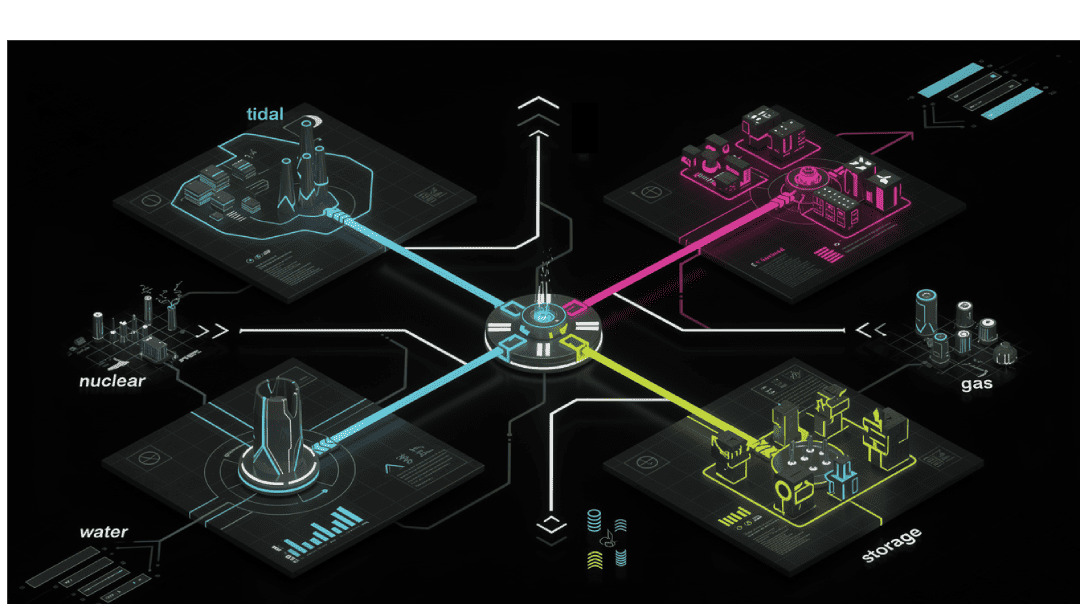
NESO rewrote the rules to put ready projects first and cut the pipeline to 283GW of generation and storage, plus 99GW of demand.
The problem was a badly designed queue. The cheapest answer, even if it wasn't the best one, was a better designed queue.
Nobody needed a new nationalised company with a Union Jack on the letterhead.
For forty minutes Burnham argued utilities should never have been treated as markets with winners and losers. Then he justified Great British Grid on the grounds it would create more competition. Either the grid is a natural monopoly best run by the state, or it benefits from competition.
A Prime Minister cannot sell both ideas to the same audience in the same hour and expect to be taken seriously, though on the evidence of the applause, he can expect to be cheered.
"For the first time," Burnham announced, "we will have a national energy plan."
- The Blair government published Our Energy Future, a national energy White Paper, in February 2003, while Burnham was a backbench MP.
- The Johnson government published the British Energy Security Strategy in 2022.
- Burnham's own party published the Clean Power 2030 Action Plan in December 2024, and the grid queue has been rebuilt around it ever since.
He inherited a national energy plan from his own colleagues and announced its invention, rather like a man who finds a tenner in his coat pocket and calls a press conference about his investment strategy.
For immediate relief, VAT comes off household electricity from Thursday. In July the IMF told the incoming Prime Minister, in writing, to avoid cuts to energy taxes because they are "costly, difficult to unwind, and weaken price signals".
Burnham waited ten weeks, cut one, and thanked the hall for the standing ovation. "I didn't expect a standing ovation for that," he said. The bond market didn't give him one either.
But much more work for the civil service! Years of fruitful administrative work!
Right To Buy Scrapped Yet Again
The whole emotional architecture of the speech rested on one house. Gran Kitty scraped together a deposit, bought a home, and "it changed the fortunes of my family." Burnham talked about working-class aspiration. He talked about never pulling up the ladder. He talked about young people who deserve "the hope you can have a home of your own."
All nice red meat for the red party of the working class. Gran Kitty was a hell o' a gal.
Half an hour later he pulled up the ladder.
Every new council home built under his programme will be exempt from Right to Buy, so councils can "restore stronger democratic control over our housing stock."
Since the Housing Act 1980, more than two million council tenants have bought the homes they live in. Every one of those sales moved an asset off a council's books and into a working family's hands. Families who had never owned anything suddenly owned bricks, and their children inherited them. It was the largest transfer of property to ordinary people in modern British history, and Burnham speaks about it as though it were a burglary.
It was the one policy Labour should have come up with, but didn't.
His idea of "common wealth" is wealth owned by the state on your behalf. Wealth owned by you is apparently a leak in the system. Gran Kitty's house was a triumph of aspiration.
A council tenant in Knowsley buying the house she has lived in for twenty years is a threat to "our housing stock".
Whose stock? She pays the rent on it.
A fair critic concedes the real failure of the 1980s: councils were not allowed to replace the homes they sold, and successive governments of both colours left the rule in place for decades.
The answer to a failure to build replacements is to build replacements. Forbidding tenants from owning their homes answers a different question entirely, namely how to keep people renting from the council for ever.
Burnham backed his case with a statistic. "Over a million people are in that position on housing waiting lists," he said, "almost exactly the same number as the homes we lost through Right-to-Buy in the 1980s."
The official figure is 1,340,435 households, not people, drawn from the government's own live tables. The Ministry itself warns the lists likely overstate the number of households still in need, because councils rarely clear them out.
People and households are very different. The first is singular, and the second is plural.
Waiting lists peaked at 1.9 million in 2012, then fell sharply after the Localism Act 2011 let councils decide who could join. Setting two numbers of a similar size next to each other proves nothing about cause. By the same method, Everton's league titles since 1987 exactly match the number of water companies in public ownership, and one explains the other just as well.
If Burnham truly wants to know who stopped Britain building homes, he could look up the Town and Country Planning Act 1947. It disgracefully nationalised the right to develop land, handed every future house in the country to the discretion of a planning committee, and gave Britain one of the most restrictive planning regimes in the developed world. It was passed by the Labour Attlee government.
Alex Coppen
The golden age of Burnham's speech wrote the law which has stopped his children's generation owning anything.
On neglected rented homes, Burnham offered an analogy: "We don't let people sell food which damages health. So why allow it with homes?" Councils already have licensing powers, repair notices, and Empty Dwelling Management Orders, brought in by a Labour Act in 2004 while Burnham sat on the Labour benches.
His new proposal goes further: make it "much easier" for councils to acquire privately owned homes, and "legislate if necessary".
On what threshold? At what valuation? With what right of appeal? With what compensation? The speech did not say, because the speech did not know.
But there will be much more work for the civil service! Years of fruitful quango work!.
17 Million Democratic Votes Are Outdated
"Immigration control weakened by Brexit," Burnham told the hall. A few minutes later he boasted net migration was "down more than 80% since the peak of the Boris Johnson era." Both statements were delivered with a straight face.
The Office for National Statistics puts net migration at 944,000 in the year to March 2023 and 171,000 in the year to December 2025. The fall came overwhelmingly from fewer people from outside the EU arriving for work, after rules on visas, salaries, and dependants were tightened in London.
Net migration of EU citizens has been negative since the middle of 2022.
Whitehall set the rules which caused the surge. Whitehall changed the rules which reversed it. Both were exercises of powers Britain acquired by leaving free movement.
Burnham is the only man in the country who can use Brexit powers to cut migration by four fifths and then complain Brexit took the powers away.
There is a narrow and reasonable argument about returns deals and Channel cooperation, which depend on French and European goodwill. Burnham did not make it. He blurred the two because "Brexit took away control" suits a speech whose final act was a promise to set out "different options" for Britain's relationship with the EU.
Voters who remember being promised the referendum result would be respected can fill in the rest.
Your vote does not matter. It's irrelevant.
Burnham treats the largest referendum mandate in British history as evidence of national error to be corrected by the political class, rather than starting from the presumption the settlement chosen by voters should be made to work.
The same speech also launched a national commission on electoral reform, on the grounds a government elected on "less than 30% of the vote" would lack legitimacy. In June 2016, 17,410,742 people voted to leave the European Union, 51.9 per cent on a 72.2 per cent turnout.
In Burnham's arithmetic 29 per cent is a constitutional emergency and 51.9 per cent is a regrettable error. He wants "public control" over everything except the decisions the public has actually taken.
And all this from a Prime Minister nobody voted for, lecturing the country on legitimacy.
Productivity, Debt, Defence? Huh?
The word "productivity" does not appear once. Britain's output per worker has flatlined for the best part of two decades. The OBR expects growth of 1.1 per cent in 2026 and productivity growth of around 1 per cent a year in the medium term. The entire question of how Britain becomes richer, as opposed to how it divides up what it already has, went unasked. Burnham spent an hour redistributing slices of a cake nobody is baking
The US is growing at 2.2%, Indonesia is growing at 3.7%, and China is growing at 5%.
- Borrowing in the first five months of the financial year reached £77.3bn, some £8.1bn above forecast.
- Ten-year gilt yields in September climbed above 5.3 per cent, the highest since 2007.
These statistics alone are fatal. They illustrate a financial abyss.
Every point on those yields is billions more in debt interest, money which buys no nurses, no soldiers, and no care workers. Burnham's response was to promise to "stick to our fiscal rules" in a single sentence and move on to buses.
In a year of open war in the Middle East and from a Prime Minister pledging to stand by Ukraine, received a subordinate clause about "NATO obligations", tucked into a paragraph about welfare.
The ageing population, which drives the pension bill, the health bill, and the care bill Burnham wants to enlarge, appeared only as a constituency to be thanked. Chancellor John Healey delivers his first Budget on 28th October into a bond market already charging Britain more than at any time since the financial crisis.
The speech gave him nothing to work with except a longer shopping list.
The dates can be be described as back-of-the-napkin.
- The disastrous care service supposedly arrives in the next Parliament.
- The catastrophic pension change starts in 2030.
- Suicidal electoral reform goes into the next manifesto.
- The insane water "journey" is "10 years".
- The batshit "plan for Britain" will be published "later this year".
Every expensive promise has been posted to a date after the next election, when the bills fall due and the author may well have moved on.
The only things arriving this Thursday are a tax cut and a round of applause.
Magic Golden Hammer World: The Same Repetitive Answer To Every Problem
Line the announcements up and one method runs through them all. It's an old theory, and it's known by the maxim, "he who has a hammer thinks everything is a nail." We've heard this before from every catastrophically insane socialist ideologue who comes near power in some way. The divine state will fix it.
- Housing is failing, so councils take control of the stock.
- Water is failing, so the state prepares to own it.
- Grid connections are slow, so the state creates a company.
- Care is broken, so the state promises a national service.
- Young people are drifting, so the state organises a 45-day work placement, an apprenticeship at 18, and their mental health support.
- Growth is weak, so a new "Number 10 North" will oversee "the rewiring of the British state" from the centre while also, somehow, "driving power out of Whitehall and into every postcode".
The diagnosis changes every five minutes. The prescription never changes at all.
A doctor who prescribed antibiotics for a broken leg, a sore throat, and a bad divorce would be struck off. In politics he gets a standing ovation and the keys to Downing Street.
Why would the British state, which already runs NHS waiting lists, the benefits system, the planning committees, the Border Force, the prisons, and the Post Office's legal department, suddenly become good at running water companies, power grids, care homes, and housing estates as well?
Public ownership does not produce competence by itself, any more than private ownership produces greed by itself. What makes an institution work is who pays when it fails, who gets sacked, who can walk away, and who can be sued. Burnham's speech contained not a single sentence on any of it.
His answer to a state which cannot manage what it already has is to hand it more to manage. The civil service must be thrilled.
He wrapped up with a boast:
What I am outlining is a more serious and thought-through prospectus for the future of Britain than people have been offered in a generation.
Yes. And that's not good, because it won't work.
A serious prospectus usually contains numbers. This one contained a gran, a Monopoly board, a nonexistent law, an energy plan he forgot his own party had written, and a care service he first promised before the iPad went on sale.
Thank You Times Staff, This One Is Even Worse
Callaghan's audience in Blackpool heard a Labour Prime Minister tell them the world had changed and the old promises could no longer be paid for. They hated it. Within weeks the IMF arrived and proved him right.
Burnham's audience in Liverpool heard a Labour Prime Minister tell them the world had not changed at all, the old promises could be paid for after the next election, and the only thing standing between Britain and paradise was a woman who died thirteen years ago.
They loved it. They cheered the VAT cut. They cheered the bus fares. They cheered the repeal of a ban which does not exist.
He finished with "We can do it."
Do what, Prime Minister?
Nationalise water with money the Treasury does not have, build a care service whose cost you refuse to name, compete with your own grid company, and cut migration using the powers you say Brexit stole? The gilt market, the IMF, and anyone with a calculator would like to know how.