From The Moral High Ground To The Valley Floor
Byline Times can produce extraordinary journalism. Three years pursuing the Wootton story. Vital PPE reporting. Real risk to its own people. But a growing habit of reshaping official data to serve political conclusions is slowly poisoning the well its strongest investigations filled.

Fleet Street is partisan. It always has been. The country is better for it. The Daily Telegraph ("Torygraph") is the house journal of the Conservative professional classes and has been since the Edwardian age. The Guardian ("Grauniad") speaks for the progressive university-educated left and makes no apology for it. The Times ("Thunderer") is now the voice of the female civil servant of a Certain Age.
The Daily Mail ("Daily Wail") and Daily Express ("Daily Sexpress") are the voice of middle-England anxiety, sometimes shrill, frequently effective, and always readable in the way a car crash is watchable. The Sun ("The Scum") is popular conservatism with its shirt off. The Financial Times ("The Salmon") follows the money. The New Statesman ("The Staggers") is essentially the Fabian society's unofficial publication from 1913. The Spectator has been indulging the libertarian right over a good lunch since 1828.
PM Jim Hacker:
Don't tell me about the press—I know exactly who reads the papers. The Daily Mirror is read by people who think they run the country. The Guardian is read by people who think they ought to run the country. The Times is read by people who actually do run the country. The Daily Mail is read by the wives of the people who run the country. The Financial Times is read by people who own the country. The Morning Star is read by people who think the country ought to be run by another country, and The Daily Telegraph is read by people who think it is.
Sir Humphrey: Prime Minister, what about the people who read The Sun?
Bernard Woolley: Sun readers don't care who runs the country, as long as she's got big tits.
Everybody knows where these publications stand. Their readers know. Their enemies know. The sympathies are visible on every front page, and the reader can apply the appropriate discount. This is not a weakness of the British model, but a primary strength. A press in which every outlet pretends to objectivity is a press in which nobody can identify the bias. Better to have the flags flying openly.
This small magazine sits on the Burkean/Diceyan libertarian right and says so at every opportunity. The Morning Star sits on the Marxist left and says so with equal frankness. Neither is lying to anyone about the view from the editorial chair.
A Strong Left Means A Strong Right
The left, at their best, are extraordinarily good diagnosticians. They are extremely sensitive to problems and diagnose them well. Where they go spectacularly wrong is trying to prescribe the answers. Their solutions are invariably badly thought out (if at all), ineffective, and destructive. One needs to know where to draw the line.
Listen to them about problems. Do not listen any further when they suggest fixes.
It was left-wing investigation and left-wing campaigning journalism which dragged the phone-hacking scandal into public view. It was the Guardian and the Observer, working with sources the tabloids tried to suppress, which forced the Leveson Inquiry into existence. It was Carole Cadwalladr, whatever one thinks of her conclusions, who forced the question of data-driven political campaigning and dark money into the national conversation. It was Peter Jukes, through the Untold podcast and his book with Alastair Morgan, who kept the Daniel Morgan murder and its tangled web of police corruption, private investigation, and tabloid complicity in front of a public the Metropolitan Police would rather had looked away.
The answer to bad journalism is not less journalism. It is more journalism, from more perspectives, with more willingness to follow evidence into uncomfortable places. A healthy democracy needs left-wing investigators with sharp elbows and long memories. The left sees structural failures the right often prefers not to notice. It asks questions about power and money the comfortable would rather leave unasked.
Like Hope Not Hate, Britain is better off with Byline Times in existence than without it. The country is always best when the two adversaries have a balanced and vitriolic parliament of the Fourth Estate.
Which is precisely why the pattern now visible in its pages is so disappointing.
What The Papers Don't Say
Byline Times launched in 2019 with a founding mythology built on moral authority. Its strapline is "What the Papers Don't Say." Its co-founder, Jukes, came out of the Daniel Morgan and phone-hacking world, where the enemy was a press corps so rotten it hacked the voicemail of a murdered teenager. He is a superb English writer from a grammar school with prophetic views on dramatic theory and literary excellence. Artists are lefties. Good.
Its Editor-in-Chief, Hardeep Matharu, is a different creature altogether. As a rabid Cambridge middle class leftie, she has rather alarmingly described journalism as possessing:
the same power to craft the ideas we think with, not just the ideas we think about.
Not so much. That has an entirely different name.
The publication set out, explicitly, to be the corrective to a dishonest media.
This was not an empty promise. Byline's work on pandemic-era PPE procurement was well-sourced and genuinely important: real contracts, real political connections, real public money flowing to suppliers with no credible track record. Its coverage of the VIP lane scandal raised questions the mainstream press was slow to ask.
When Byline operates at this level, it is precisely the publication British journalism needs: tenacious, evidence-led, willing to take on powerful media figures under legal threat.
The difficulty is what happens when a publication capable of this standard starts applying the same sloppy techniques it was created to oppose.
Exhibits A - E Of Many More
The recurring Byline method, visible across several years of output, works like this:
- Find a genuine document from a serious institution.
- Cite a real number from the document, then
- Quietly change what the number means, so the finding points at the political target of the week.
The target doesn't really change: Tories, Reform, Farage, Orban, Trump, "far-right Nazis," billionaires, and so on.
The self-righteous narration of politics is standard Bernie Sanders yadder and UK Green Party stock: right-wing populists are hidden Hitlers; the planet is dying; dystopic billionaires are buying everything; the world is under constant hijacking from a right-wing fascist conspiracy ordinary people are being duped by. The usual. All a bit silly, obviously.
The source is authentic. The figure is accurate. The category has been switched. The reader absorbs a false impression built on real evidence.
The £6.6 billion
On 22 May 2026, Byline published: "£6 Billion Was Wasted on Failed and Abandoned Conservative Government Schemes." The source was the House of Commons Public Accounts Committee report NAO financial audit insights 2024–25. The PAC found the 17 main departmental groups reported £6.6 billion in losses during 2024–25, across more than 2.7 million loss events.
The individual figures hold up under scrutiny. The Home Office lost £290 million on cancelling the Rwanda migration scheme. The Department for Transport incurred £472 million from scrapping eight road projects, including the A303 Stonehenge tunnel. The Ministry of Defence reported £1.6 billion from cancelled projects and retired assets. DWP overpayments from fraud and error, excluding the state pension, reached £9.3 billion at a 6.2 per cent rate; the department's accounts have been qualified for 36 consecutive years.
Every number checks out.
The headline does not.
The PAC report described losses comprising cancelled or retired assets, write-offs, debts no longer pursued, and fraud. Some were inherited Conservative programmes, subsequently cancelled by Labour. Others were routine accounting events in the permanent machinery of government. The 2024–25 financial year straddles the July 2024 change of government. The Treasury line quoted in Byline's own piece says the current government ended the Rwanda scheme and cancelled unaffordable road projects "to protect the public finances."
Labour is inside the story. The headline pretends otherwise.
An audit category became a party-political category. The number was real. The meaning was not.
The £49 billion
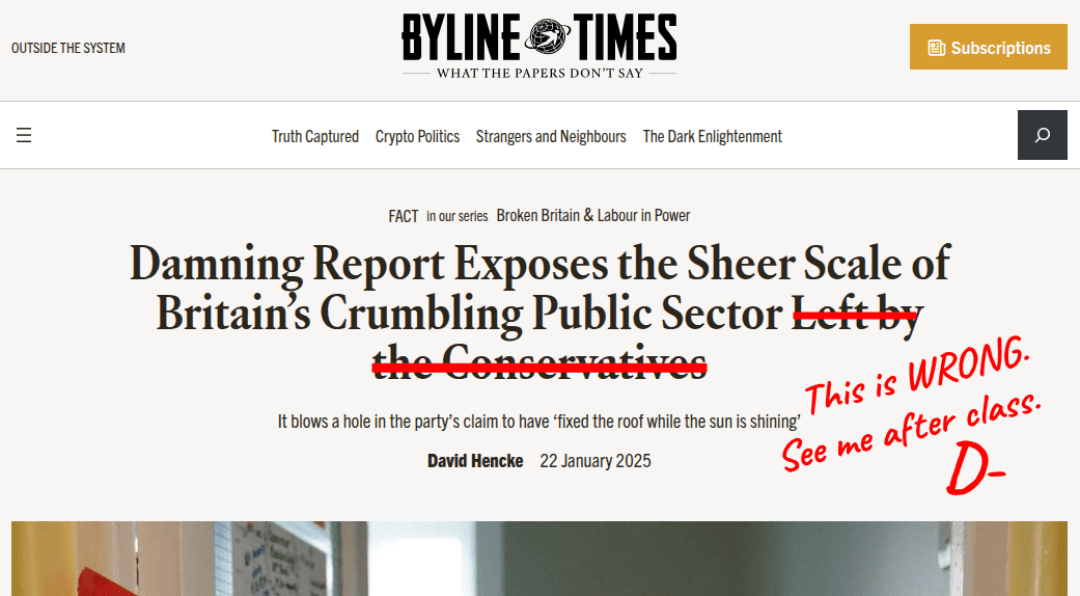
In January 2025, Byline ran: "Damning Report Exposes the Sheer Scale of Britain's Crumbling Public Sector Left by the Conservatives." The underlying NAO report on public service facilities found the government maintenance backlog stood at a minimum of £49 billion, concentrated in MOD, school and NHS properties, with incomplete and inconsistent data across departments and a decade-long decline in estate condition.
The finding was institutional and structural: a state unable to maintain its own buildings over a sustained period, regardless of which party was nominally in charge. Byline converted it into a morality play with a single villain.
The NAO uncovered a broken estate-management system. Byline found a campaign leaflet.
The pandemic denominator
In August 2020, under the headline "Fact-Free Farage: UK Sees Fall in Asylum Applications," Byline reported a drop in asylum applications in the first half of 2020 compared with the second half of 2019, using this to debunk Nigel Farage's rhetoric about a Channel crossing "invasion."
The figure was accurate.
It was also the wrong figure.
2020 saw a global pandemic and an international travel shutdown. The pressure Farage was describing, whatever one thinks of his language, concerned visible irregular arrivals by small boat across the English Channel, not the total administrative count of asylum applications during a period when movement across borders had largely ceased. Subsequent House of Commons Library data confirmed small boat crossings became the dominant unauthorised arrival route from 2020 onward, rising steeply once travel restrictions eased.
Byline answered a question about one phenomenon with a statistic measuring a different phenomenon.
The flood map
In November 2025, Byline published: "Drowning in Denial: One in Five Homes in Reform UK Heartlands Could Be Under Water Within 25 Years," reporting more than 700,000 homes across Reform-led councils faced medium or higher flood risk by mid-century, based on Aviva modelling.
The flood data may be entirely sound. The question is whether "Reform heartlands" is an explanatory category or a political label draped over geography.
Flood risk is a function of coastlines, estuaries, floodplains and low-lying terrain. Reform councils are concentrated in exactly those areas. Without a comparison against non-Reform councils in similar geographical positions, the headline implies a political relationship where the data shows only a geographical one.
This is, of course, social science thinking, trying to do "science." The ability to prove a hypothesis false – the non-Reform councils – is known as falsifiability.
Dan Wootton
A three-year inquiry, conducted by former News of the World journalists Tom Latchem and Dan Evans, assembled a dossier of evidence alleging the GB News presenter ran a decade-long catfishing campaign using fake online identities to solicit sexual images from men. Byline handed the dossier to the Metropolitan Police.
Both the Met and Police Scotland opened investigations. Wootton was suspended from GB News and lost his MailOnline column. A civil claim in the High Court, brought by an anonymous complainant, remains live.
Byline's journalists paid a price for the work: one had what appeared to be blood smeared on a car windscreen, the team received threats by email and telephone, and reporters were targeted with cyber attacks. The evidence included password-breach data linking Wootton's known email accounts to the fake identities, which Wootton has never denied controlling. Whatever the eventual legal outcome, the investigation was forensic, courageous, and consequential.
Wootton didn't deny much and admitted "errors of judgment" publicly on television. Reading between the lines, it appeared like a classic News of the World sting operation.
It's not a stretch to believe Wootton was up to no good, and he was a prime target being openly gay and right-wing. However, this was a spectacular backfire and serious mistake of editorial judgment. They thought they had him bang to rights. Neither English or Scottish police agreed.
Officers assessed all information available to establish whether any criminal offence has taken place. An investigation was commenced into these allegations. All parties involved have now been advised that no further action will be taken. There were no arrests during the investigation.
Degenerate behaviour is one thing. Attempting to switch the category again on a fishing expedition with the police hoping it turned criminal is another. At that point, it looks malicious.
Five stories. Five real documents. Five accurate sets of data. Five switched categories.
Irony And Heavy Lifting
The Sun, the Daily Mail, the Express: everybody knows the game. The headlines shout. The framing is heavy-handed. The political sympathies are as subtle as a foghorn. Readers of those publications either share the sympathies or apply a correction. The bias is priced in.
Byline Times was supposed to be different. The entire founding proposition was accountability, accuracy, and the moral courage to tell the public what the rest of the press would not. It positioned itself as the antidote to a media culture in which powerful interests shaped coverage to suit political ends.
And yet the pattern above is precisely the disease Byline diagnosed in others: the use of real events, real documents, and real numbers to construct a political impression the underlying evidence does not support.
The tabloids do it for the right. Byline does it for the left. The mechanics are identical. A genuine finding is picked up, stripped of context, reframed to fit a political conclusion, and served to readers as though the conclusion were the finding itself.
Peter Oborne's recently article illustrates this too perfectly. Peter is surprised to learn journalists make up fake quotes, even if readers aren't.
With the rise of social media with its fruity language and constant controversy, political journalists are under ever increasing pressure from their bosses to make their reports more lively and colourful.
They are urged to litter their reports with comments such as ‘one Cabinet Minister told me’ to give the impression, accurately or not, that they have inside information.
This is presented as new information; a "scoop" of magnitude. This scandalous practice is shocking if true.
Unfortunately it's also on the same page misrepresenting figures to attack partisan enemies, defending Green Party figures, and doing opinion-forming on Farage's "failing campaign."
Byline did not set out to become the Mirror image of everything it opposed. But a publication which routinely converts audit categories into party-political indictments, uses pandemic-distorted statistics to dismiss inconvenient trends, and drapes geographical data in political branding has forfeited the moral distinction on which it was built.
We can't have a proper English intellectual fight about the issues like this. Not with misrepresented data, silly conflations, and cheap partisan hackery. We, academic adversaries of the lunatic left, deserve better. In true Daily Heil style, by jove, this rot must stop.
The people Byline criticises most sharply, the activist politicians who treat facts as raw material for pre-written conclusions and the press outlets which bend evidence to fit editorial prejudice, would recognise the technique immediately. They use it every day. The difference is they never promised to be better.
A Fair Fight Which Lifts The Debate
This is not a cause for celebration on the right. A Byline Times doing serious, rigorous, evidence-led investigative journalism from the left would make British public life better. It would catch things the right-leaning press ignores. It would ask questions about power, procurement and institutional failure nobody else is asking. It would force the comfortable to answer for themselves.
The left's role as diagnostician depends entirely on the quality of the diagnosis. When the numbers are bent, the diagnosis is worthless, and the patient — the public — stops trusting the doctor. Every category switch, every denominator trick, every headline converting a structural finding into a partisan one makes it fractionally easier for the next genuinely guilty party to dismiss the investigation. "Consider the source" is a lazy defence, but lazy defences work when the source has earned the suspicion.
Byline Times does not lack talent. It does not lack sources. It does not lack institutional knowledge or editorial ambition. It lacks is the willingness to let the evidence arrive somewhere unexpected. The forecast never changes. Only the weather is new.
A newspaper follows the facts, including into friendly territory. A prosecution decides the verdict before examining the evidence. Byline Times began as the former. It is drifting, article by article, toward the latter. The readers who depend on it, the adversaries like ourselves who need to be challenged by it, and the democracy which needs what it was supposed to be, deserve better than this.