SAS Death Squads And The "Latest Massacre" Cover Up
They arrive as advisers. They leave as a problem nobody wants to investigate. From the Malayan jungle to a locked safe in Poole, one regiment has done Britain's unspeakable work and answered to no one. Now a judge is being asked what separates the nation's finest soldiers from a death squad.
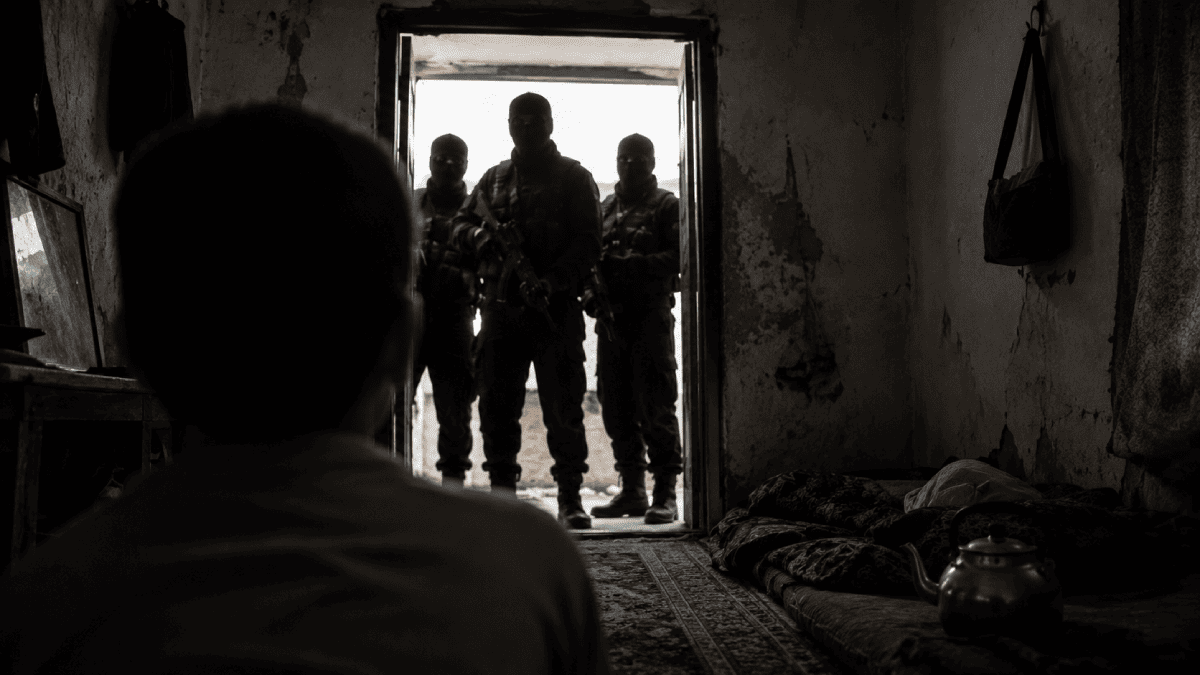
In December 2025 the Afghanistan Analysts Network published a report on the conduct of Britain's most admired military unit. The title was a play on the regimental motto. Instead of Who Dares Wins, it read Who Dares, Kills? The subject was a body of evidence, assembled from whistleblowers inside the Special Air Service itself, describing the killing of detainees: sleeping men and children across a stretch of Helmand between 2010 and 2013.
Lawyers put the number of suspicious deaths at more than eighty.
One former SAS member described his own colleagues to BBC Panorama in three words: "These are murderers."
There is no unit in the British armed forces held in higher regard. The SAS is the national talisman; the source of a bestselling memoir industry; a television format and a cinematic myth of the lone professional who does the necessary thing while lesser men flinch. Its members are drawn from across the army by a selection process built to break all but the most capable.
They take professionalism as a point of religious seriousness.
And they have, on the available evidence, functioned at times as a death squad wearing the King's uniform. Protected afterwards by a wall of official secrecy thicker than the one around MI5.
The comfortable explanation is a good unit was corrupted by a bad war. A few operators in one squadron lost their bearings in Afghanistan and disgraced an otherwise clean tradition. The evidence does not support it.
The uncomfortable truth runs the length of the regiment's history and its cousin units in Australia.
The SAS was created to kill selected people outside the rules of conventional battle. Britain kept it after the war for which it was invented, and reached for it again and again whenever it wanted violence done without the political cost of declaring a war, making an arrest, or admitting an intervention.
What happened in Helmand was not a departure from the regiment's purpose. It was that purpose, arriving at last in a form too large and too well documented to bury.
Your duty, sirs, is to be the glory of England. Nothing else will do.
Built For Deniable Killing
The SAS (unofficial motto "Speed, Aggression, Surprise") was raised in the North African desert in 1941 by David Stirling, Jock Lewes, and Paddy Mayne for a specific job: to get behind German and Italian lines, destroy aircraft on the ground, blow up fuel dumps, cut communications, and kill enemy personnel before vanishing back into the dark. This was legitimate warfare against Axis forces.
From the first day it was a particular kind of warfare. One built around small autonomous teams, surprise instead of engagement, deception and disguise, deep penetration, weak supervision, and success which depended on the enemy never knowing who had done it.
The wartime regiment sat inside a wider British machinery of irregular violence, and it is worth being precise about that machinery, because one strand of it answers a question which recurs later in this story: when did Britain's foreign intelligence service acquire the right to a private army?
The answer is it never gave it up.
Before the war, MI6 had run a paramilitary and sabotage arm called Section D. In 1940 Section D was folded, with other units, into the newly created Special Operations Executive to fulfill Churchill's order to set occupied Europe ablaze through sabotage and subversion. When the war ended and the SOE was wound up, its residue did not evaporate. MI6 absorbed the remaining elements as a war-planning capability aimed at the coming Soviet threat, and it kept, quietly, the doctrine and the personnel for deniable violence abroad.
The SAS supplied the most directly lethal military expression of the same tradition. The inheritance the war left was not simply elite soldiering. It was the British state's settled acceptance of small secret formations (some military and some tucked inside the intelligence service) licensed to destroy and kill beyond the ordinary front line.
The regiment was formally disbanded in 1945.
It did not stay disbanded.
By 1947 it had been reconstituted, and it was turned toward the problems Britain actually faced: not a conventional enemy army, but colonies which wished to stop being colonies.
Enforcers For The Colonies
The reconstituted regiment entered the emergency through the Malayan Scouts and became part of a counter-insurgency system: deep-jungle pursuit, intelligence-led patrols, ambush, the coercion of natives, food denial and forced resettlement. The enemy could no longer be told apart from the civilians among whom he moved.
The method which emerged would recur everywhere the regiment went afterwards: intelligence identifies the human target; special forces locate or provoke it; lethal force removes it; and the surrounding state files the result under military necessity.
Malaya also set the pattern for what happened afterwards, when the killing went wrong. In December 1948, at Batang Kali, Scots Guards shot twenty-four unarmed rubber tappers, then told the world the dead had been fleeing insurgents caught with a cache of ammunition.
That account held for seventy-seven years (defended through successive governments and a refusal to hold an independent inquiry) until a British minister finally acknowledged in 2025 that the official story had been false.
The Guardsmen were not special forces, but the sequence they demonstrated is the one the SAS would repeat: a killing; a tidy cover story of armed men and self-defence; and then decades of institutional resistance to any investigation capable of testing it.
The jungle taught the method. It also taught the state how long a false account could be made to last.
During the Jebel Akhdar campaign of 1958 and 1959, SAS squadrons broke the forces opposing Sultan Said bin Taimur and preserved a monarchy friendly to British interests in the Gulf. This was not assistance to an ally so much as a compact, deniable method of deciding who would rule a country.
The regiment returned for the Dhofar rebellion in the 1970s, this time raising firqats from surrendered rebels, running civic-action programmes, and propping up Sultan Qaboos who was installed in a palace coup in 1970. It was nine men against four hundred. The lesson of Oman was the SAS could maintain a whole regional settlement in Whitehall's favour without Britain ever admitting to a war.
In North Yemen through the 1960s, Britain covertly backed royalist forces against an Egyptian-supported republic using former SAS men, mercenaries, and intelligence links to wage a war it flatly denied fighting. In Aden the regiment ran covert operations against Arab nationalists.
Borneo produced Operation Claret: authorised, secret, offensive cross-border raids into Indonesian territory while Britain publicly maintained a defensive posture designed to let ministers cross a frontier militarily and deny they had done so.
Two habits formed in these years and never left.
- The first was the layering of a policy so ministers and diplomats could deny an intervention while intelligence coordinated it. The SAS supplied the expertise and local forces or mercenaries supplied the visible manpower.
- The second was a matter of vocabulary. The regiment learned to deploy under the description of a "training team" or "advisory" mission. An adviser is not a combatant. An adviser generates no headline about British boots on foreign soil. The tradition of arriving as trainers, who do considerably more than train, was established in the deserts and jungles of the retreating empire.
Today, the SAS are deployed in Ukraine as "advisers" so the British state can fight a covert deniable war against Russia.
Executive Branch Of The FCO's Executive Branch
The Yemen operations pointed to something more permanent than a single deniable war. When Britain wanted royalist forces armed and directed without admitting it, the men who did the arming and directing were former SAS soldiers moving through intelligence channels.
This was not improvisation. It was the visible surface of a standing arrangement which had never been dismantled.
What it did not always hold in-house was the manpower to use it, and here the SAS supplied the answer. Within the regiment sat the Revolutionary Warfare Wing: a handful of senior sergeants trained for the most sensitive wet work.
Operators drawn from that wing and the equivalent element of the Special Boat Service, formed the unit long known within MI6 only as "the Increment": a pool of vetted soldiers the intelligence service could call on for assassination, sabotage, and other tasks it could not send an ordinary case officer to perform.
The foreign intelligence service never decided at some identifiable moment it was entitled to a private army capable of killing. It simply never surrendered the one it inherited from the war, and topped it up with the best soldiers the army could produce.
The arrangement was formalised in 2007 as E Squadron. Its existence was confirmed only by a Ministry of Defence email which surfaced in 2021.
An ordinary SAS operation runs through a military chain: prime minister and defence secretary, then the Chief of Defence Staff, then Director Special Forces, then the unit.
The Increment and its successor permit a different line entirely.
A foreign-policy authority through the chief of MI6 to a covert operation staffed by military operators in plain clothes and false identities. It gives the spy service armed men for covert entry, reconnaissance, agent extraction, sabotage and, where authorised, lethal action.
The record is too thin to call it a standing assassination unit. It is, unmistakably, the place where intelligence policy and deniable military violence were designed to meet. It had been sitting there, under changing names, since before the empire finished retreating.
When six SAS soldiers and two MI6 officers were captured entering rebel-held Libya by helicopter in 2011 carrying weapons and multiple passports, the working configuration was briefly visible in daylight: the spy and the soldier, inserted together into a collapsing state. William Hague's explanation to Parliament was comic:
Last week I authorised the dispatch of a small diplomatic team to Eastern Libya in uncertain circumstances which we judged required their protection to build on these initial contacts [with the Libyan opposition] and to assess the scope for closer diplomatic dialogue.
Merchants Of Death Engage On UK Soil
Northern Ireland is often written as the moment Britain turned its dirty methods on its own citizens. It is more accurate to say the colonial machine was shipped home and reassembled in Belfast and Armagh.
The counter-gang doctrine Brigadier Frank Kitson had refined in Kenya and Malaya arrived with him in 1971. First as a plain-clothes "Bomb Squad", then as the Military Reaction Force, a unit linked by a later BBC investigation to the shooting of unarmed civilians and eventually disbanded after the Provisional IRA compromised one of its cover operations.
The army needed a professional covert surveillance capability for Ulster. Half of B Squadron (who pulled off the counter-insurgency in Oman) were sent to close the gap, The other half was tasked with selecting and training what became 14 Intelligence Company ("the Det").
Cabinet was so anxious about the political meaning of an SAS deployment operators were "debadged" (returned on paper to their parent units) so ministers could deny special forces were in the province. Any man killed would not appear on the regimental roll of honour. Deniability was engineered into the paperwork before a single operator crossed the water.
The Det's own cover name completes the pattern.
Formed in 1973, the unit was first called the Special Reconnaissance Squadron, then hurriedly renamed when officials worried the initials sat too close to SAS. In theatre it operated as the "Northern Ireland Training and Advisory Teams", borrowing the identity of a real unit whose job was to prepare troops for their tour.
A covert surveillance and interception outfit hid inside the language of training and advice, exactly as the regiment had learned to do abroad. It cycled through a run of further cover names over the years, and its lineage did not end with the Troubles.
In 2005 the Det was reorganised into the Special Reconnaissance Regiment (SRS), absorbed formally into United Kingdom Special Forces, and its surveillance expertise carried onward to Afghanistan, Iraq, Libya, Yemen, and Somalia. The unit built to watch the IRA became the template for a global one. It is the equivalent of America’s Intelligence Support Activity (ISA).
After the IRA's Kingsmill massacre in 1976, the government abandoned its squeamishness about deploying the SAS openly. The regiment took its place at the sharp end of an intelligence chain which could identify an IRA unit, anticipate its movement, prepare a killing ground, and put heavily armed soldiers rather than an arrest team at the end of it.
What followed was not one controversial shooting but a series running across the border counties of Tyrone, Armagh, and Fermanagh through the 1980s and into the 1990s.
It began at Strabane in February 1985, where the SAS fired more than a hundred rounds at a three-man IRA unit moving weapons, killing all three; one, David Devine, was sixteen, the youngest IRA member killed in the conflict.
In April 1986 the regiment shot dead the IRA's Fermanagh commander, Séamus McElwaine, as he prepared an ambush near Rosslea.
Then came Loughgall in May 1987, the model in its purest form. The state knew the East Tyrone IRA intended to attack the police station.
Around two dozen SAS soldiers were positioned in and around it. The unit was allowed to arrive with its bomb-laden digger, and all eight members were killed along with a civilian (Anthony Hughes) who drove into the ambush and was mistaken for an attacker. Roughly 600 rounds were fired.
Two of the dead were later found to have been unarmed, and three were shot at close range as they lay dead or wounded on the ground. The European Court of Human Rights did not rule the killings themselves unlawful, but it held Britain responsible for failing to investigate the nine deaths effectively and independently.
Loughgall has not been proved in law to be an execution. It was a pre-planned, intelligence-controlled ambush designed around overwhelming lethal force, after which no investigation was ever allowed to establish whether the state had intended anyone to survive.
The template repeated.
At Drumnakilly in August 1988, ten days after an IRA bomb killed eight soldiers at Ballygawley, the SAS shot three IRA men en route to kill an off-duty Ulster Defence Regiment member.
At Coagh in June 1991, three more were shot dead in an ambush so carefully staged an SAS soldier dyed his hair and padded his body to impersonate the intended target and draw the unit in. A surveillance operator filmed the whole thing from an unmarked van, and the recording was afterwards destroyed on the grounds that it showed the soldiers' faces.
14 Intelligence Company did the watching in most of these operations; the SAS did the shooting; and the surrounding structure of Special Branch, agent-runners, and the Force Research Unit fed the intelligence and managed the aftermath.
Cold-Blooded Death On The Rock
One killing in the sequence belongs apart because it happened not in the border counties, but on a Mediterranean rock with a demonstration the mechanism at its purest. Operation Flavius on Gibraltar, in March 1988, was the moment the method crossed from a colonial emergency into peacetime Europe, and it remains the cleanest illustration of the state constructing a lethal encounter.
Three IRA members, Mairéad Farrell, Daniel McCann, and Seán Savage, were identified, followed across international borders, allowed to enter Gibraltar, kept under surveillance and then shot dead by the SAS in the street.
They were unarmed.
No detonator was found on them. The car they had parked contained no bomb.
The soldiers said they had believed the three were reaching for weapons or could set off a device by remote control.
The mechanism of a state killing does not require the man who pulls the trigger to intend murder. It requires only untested intelligence assumptions; a decision to deploy soldiers rather than make an arrest; a failure to intervene earlier; and a briefing that a suspect may be about to detonate a bomb. The lethal outcome is then built into the plan, while every individual participant can be protected by presenting the final seconds as an honest mistake.
Gibraltar showed the machine could produce a corpse and an exoneration from the same set of facts.
For decades the official account of these operations held that they were gun battles. In February 2025 the account failed in court.
An inquest into the 1992 Clonoe ambush (the aforementioned incident where the SAS shot four IRA men dead in a chapel car park minutes after they attacked a police station) found the use of lethal force unjustified.
The coroner, Mr Justice Humphreys, held the soldiers did not have an honest belief that lethal force was necessary; no attempt had been made to arrest the men even as they lay wounded, and the claim the IRA had opened fire in the car park was, in his words, "demonstrably untrue".
He found state agencies had perpetuated a false account and noted a Ministry of Defence document describing the operation as "an excellent security forces success".
The government announced it would challenge the finding.
The significance is not in the single case but in what it establishes: one of the classic SAS accounts of a Troubles ambush was not merely doubtful but false. Confirmed as false by a court, three decades on. The pattern which ran from Strabane to Clonoe had finally been named for what it was by a judge.
24 SAS: Military Criminality For Private Hire
Running alongside the uniformed history is a shadow one in which the same men, the same methods and the same Whitehall relationships were moved off the government payroll and sold.
A serving SAS officer retires, forms or joins a private security company, takes a contract with a foreign government corresponding to British interests, then operates under British diplomatic protection or deliberate official silence.
The personnel came from British special forces. The methods came from British counter-insurgency. Responsibility could be displaced onto a nominally private firm.
David Stirling himself built the first model.
His Watchguard International, set up in the 1960s, sold security advice, training, and protection to foreign rulers in Africa and the Middle East,Its literature offered “Military Security and Surveys, Head of State Security, and Special Forces”, including the training of foreign personnel to combat insurgency and guerrilla warfare.
The company was registered in Guernsey, concealing its directors, and operated from Sloane Street through an organisation staffed by former senior SAS officers. Stirling’s director of operations was Colonel John Woodhouse, a former commanding officer of 22 SAS who designed the selection process.
Watchguard’s bodyguard business provided cover for more ambitious operations. In 1970 Stirling offered Saudi Arabia a task force to invade Yemen, undermine its government and conduct destruction “on a massive scale” using sophisticated sabotage techniques. He boasted in the proposal he had access to the Special Air Service Regiment of the British Army.
He later planned the Hilton Assignment: an operation financed by Libyan exiles to overthrow Muammar Gaddafi. Former SAS officers were recruited to raid a prison in Tripoli, release political prisoners and trigger an uprising against the new regime. The plan was abandoned under British and American pressure because Stirling and his associates were too closely identified with the British establishment for an attack to be plausibly presented as private.
Watchguard proved a British state capability could leave the payroll without leaving the British strategic orbit.
Keenie Meenie Services, KMS, was the next development of the model. Its London operation began at 11 Courtfield Mews near Gloucester Road in 1975. The company was incorporated in Jersey as Executives International Ltd in June 1977 and renamed KMS two months later.
Its principal figures included former SAS commanding officers Brigadier Mike Wingate Gray and Colonel Jim Johnson, together with Major David Walker and Major Andrew Nightingale. It was known inside special forces as “24 SAS”, an unofficial regiment supplying former operators to foreign rulers, companies and private armies.
The name was regimental slang for covert work, variously translated as “under the counter” and associated with SAS operations in southern Arabia. The concern among serving personnel was the SAS was becoming a publicly funded training school for private military contractors.
The company was designed for concealment. Its Jersey registration avoided public disclosure of its true ownership. Its nominal shareholders worked for Morgan Grenfell’s Jersey operation. Its London premises, telephone line, and vehicles were registered to Johnson’s insurance company, Thomas Nelson, which supplied commercial cover when landlords or public authorities asked questions.
Johnson had used the same methods since the Yemen war. In 1963 he and Stirling recruited former SAS officers to fight for the Yemeni royalists against the Egyptian-backed republican government. Colonel David Smiley became field commander while Johnson operated the London recruiting and financial network.
Serving personnel were recruited directly from the regiment. Mercenaries initially travelled through the British base at Aden. A serving RAF officer appears to have been seconded by the Secret Intelligence Service, either to assist the operation or to provide Whitehall with an official observer.
The force was financed by Saudi Arabia, at times through gold bullion delivered to Johnson in London. Israeli aircraft secretly flew supplies across Saudi territory to the royalists, helping pin Egyptian troops and armour down in Yemen before the Six Day War.
The Ministry of Defence denied recruitment was official even after an adjutant of 21 SAS disclosed that his office at the Duke of York’s Barracks had been used as a clearing house for mercenaries. Names and military records were passed to a secret address, after which volunteers were contacted about operations in Yemen, Africa and the Middle East. The officer was ordered to write a report and the matter disappeared.
KMS inherited this recruiting machinery. Former commanders, recently retired officers and serving personnel continued to meet at Courtfield Mews. Groups of former SAS troopers arrived for apparent briefing and debriefing sessions before and after overseas contracts.
Andrew Nightingale had served in SAS Group Intelligence at the Duke of York’s Barracks and appears to have been in contact with KMS before formally leaving the Army. The barracks held personnel records on former SAS members, providing a ready directory of men trained in surveillance, interrogation, sabotage, infiltration. and killing.
Correspondence obtained in 1978 showed serving SAS personnel remained in contact with the company. A sergeant in the regiment’s Operations Research Section wrote to Wingate Gray about a commercially available transmitter hidden inside a watch. He distinguished information he could pass on from the SAS’s sensitive interest in the device, then referred approvingly to the effectiveness of Wingate Gray’s teams.
KMS maintained more than a roster of retired soldiers. It operated offices, vehicles, communications, procurement routes, and overseas supply chains. Documents referred to rifle-cleaning equipment shipped to Oman, radios brought into Muscat without difficulty and military supplies concealed behind coded descriptions such as “coloured card”.
Its teams protected Sultan Qaboos of Oman and Saudi oil minister Sheikh Ahmed Zaki Yamani. Its personnel assisted the Sultan’s Special Forces during the suppression of the Dhofar rebellion and recruited for work across Oman, Kuwait, Bahrain, Saudi Arabia, Qatar, and South America.
David Walker had previously worked through Control Risks and an organisation described by mercenary recruiter John Banks as HRS, which Banks claimed was semi-official, protected Saudi client,s and held a permanent Argentinian contract through which government money was passed. The Foreign Office confirmed Walker had undertaken temporary duties at British embassies in Chile, Argentina, Brazil, and Colombia.
Shortly before KMS was exposed, a sanitised account appeared presenting it principally as a company providing security assistance to British embassies. The Foreign Office denied employing private armed bodyguards but admitted a specialist British company sent teams to selected embassies to train locally employed security staff.
That legitimate work supplied access, official relationships and a ready explanation for overseas movements. It also made the company useful to the state. When Harold Wilson’s government tried to rein in mercenary activity in 1976, KMS was sufficiently well connected to survive. One Foreign Office official later explained legislating it out of existence would deprive the diplomatic service of specialist protection for which no adequate substitute existed.
From 1984 KMS trained the Sri Lanka Special Task Force, a police counter-insurgency unit deployed against Tamil separatists in Sri Lanka, and supplied British pilots who flew helicopter gunship missions for the Sri Lankan state. The STF went on to commit torture, disappearances, and summary executions.
Britain’s former defence attaché (Lt Col Richard Holworthy) who liaised with the company, later recalled how helicopter crews dropped grenades concealed inside wine glasses onto Tamil villages. The glass held the safety lever down until it shattered on impact.
The Foreign Office did not want to send overt military assistance to Sri Lanka for fear of damaging relations with India. KMS allowed it to assist at one step removed, with a veneer of plausible deniability. British special forces personnel helped build and operate a unit inside a brutal war while Whitehall retained enough distance to deny that it was British military assistance.
The same personnel appeared wherever Britain wanted a policy conducted without owning it.
KMS trained Afghan fighters against the Soviet occupation, operating in Oman and Saudi Arabia inside the wider Western, Pakistani, and Saudi programme supporting the mujahideen. It became involved in the American supply effort for the Nicaraguan Contras while congressional restrictions constrained direct US assistance. Its founders reportedly enjoyed direct access to Downing Street.
It also existed inside a wider network linking respectable former officers, intelligence personnel, arms dealers and openly criminal mercenary recruiters. John Banks claimed close relationships with David Walker, Andrew Nightingale, and Special Branch officer Ray Tucker. Banks alleged Tucker had helped Angola-bound mercenaries pass through Heathrow without passports, including men wanted by the courts.
Banks was an unreliable witness, but significant parts of his account were independently corroborated. He correctly identified the same former SAS officers, recruiting centres and official contacts found inside the KMS network.
The distinction was not between official soldiers and private mercenaries. It was between respectable and disreputable parts of the same market. KMS operated from Kensington mews and City insurance offices. Banks recruited above a laundrette. Both drew from the same military pool.
When notoriety accumulated, the network flowed onward.
As KMS prepared to leave Courtfield Mews, David Walker acknowledged the same men had established Saladin Security from the same address. Saladin took over overseas protection contracts and continued employing former SAS personnel from offices in west London.
Personnel, clients, and Whitehall contacts survived. Legal liability did not travel with them.
In 2020 the Metropolitan Police war crimes team opened a scoping investigation into KMS’s conduct in Sri Lanka, prompted by research and a submission to the United Nations.
The Foreign Office, which had already destroyed hundreds of files relating to Sri Lanka, continued to withhold important KMS documents. Some were scheduled to remain secret until 2046, around sixty years after they were written rather than the standard twenty.
No one has been convicted of a mercenary offence in a British court for more than a century.
The state which once called these men private has spent decades protecting the files, relationships and personnel that would show how private they really were.
Beyond KMS lies the later industry built from the market these firms opened: Saladin, Control Risks, ArmorGroup, Aegis, and the larger corporate contractors later absorbed into multinationals such as G4S and GardaWorld.
Not all of these companies were mercenary organisations. What matters is the structural gift the model gave the state.
A government can benefit from an operation without issuing a traceable order. A commercial contract does not trigger the scrutiny which deploying troops would. A handful of former operators can train hundreds of local personnel, keeping the British footprint small and the multiplier enormous.
The state can provide training, intelligence, diplomatic access, contracts, and protection while denying responsibility for what the resulting force does.
When exposed, officials can say that the company was private, then invoke national security to bury the evidence that it was not.
The SAS motto was “Who Dares, Wins”.
The Yemen mercenaries coined a more accurate version.
“Who Pays, Wins.”
Helmand: Toddlers Murdered In Their Beds
By the time the regiment reached Afghanistan, everything it had ever been was in place: the deniable deployment, the intelligence-led killing, the language of partnership and advice, the culture of exceptional secrecy. What changed was scale, documentation, and the presence of whistleblowers who would not stay silent.
After 2001 the SAS was folded into a vast American-led system of target lists, night raids, and kill-or-capture missions. The objective was frequently not to defeat a formed enemy but to find a named or categorised individual at a compound and remove him.
In those conditions, arrest and assassination became interchangeable. Intelligence designated a man an insurgent, troops arrived in the night, the adult males were separated, and a subsequent death was written up as the result of a concealed weapon or a sudden hostile move.
For example, in November 2010 a former district governor who had worked for years alongside British forces, Mohammed Ibrahim, was killed, according to his family, while wearing plasticuffs, shot in the corner of the eye and then the chest.
On 16 February 2011, a raid at Gawahargin killed four men of one family: an elderly farmer and teacher, Abdul Khaliq, and three younger men described by their relatives as students. The unit's account was each detainee, one after another, had been escorted back inside a building and had produced a weapon from behind a curtain or a table (a grenade in one case, an AK-47 in another).
Senior officers did not believe it.
One email sent hours later called the incident "the latest massacre".
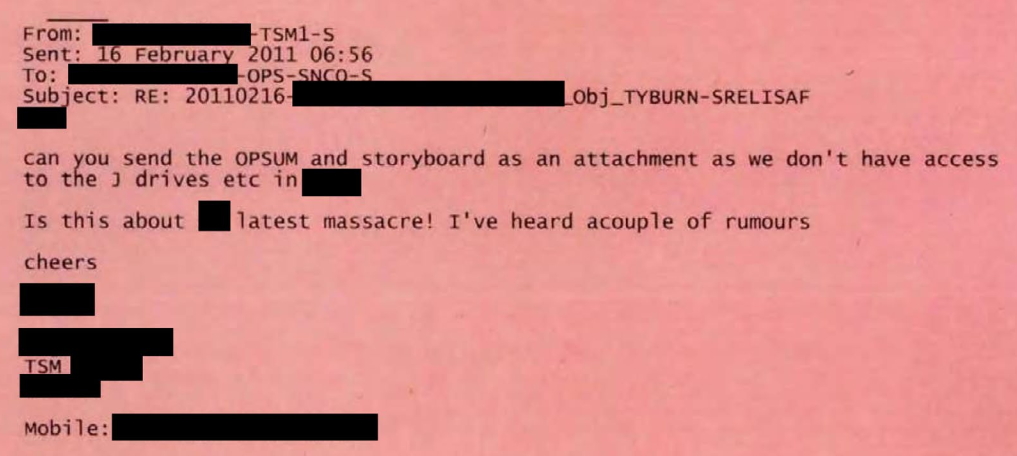
Another, working through the sequence of men sent back into rooms to open curtains and re-emerging with rifles, ended: "You couldn't MAKE IT UP."
For what must be the 10th time in the last two weeks, they sent an [Afghan man] back into the [room] to open the curtains (??) he re-appered [sic] with an AK. Then when they walked back in to a different [room] with another [Afghan man] to open the curtains he grabbed a grenade from behind a curtain and threw it. ... Fortunately, it didn’t go off ... this is the 8th time this has happened.
And finally they shot a guy who was hiding in a bush who had a grenade in his hands. You couldn’t MAKE IT UP!
This is how it was reported by the SAS officer in his operational summary marked SECRET REL ISAF:
0211 As the call sign approaches the compound they hear the 'B' [male] moving under a bush. When he comes into view, his hands are hidden under his body and as the call sign approaches, removes them revealing a grenade. He poses an immediate threat to life and is engaged with aimed shots resulting in one EKIA [enemy killed in action].
A staff officer noted dryly murder and the British forces in Afghanistan had "oft been regular bed-fellows", but this was beginning to look, in his word, "bone".
I find it quite incredible the amount of [Afghans] that [the SAS sub-unit] send back into a building who then decide to get weapons/grenades and engage the [SAS] knowing that it will achieve nothing. Why come out – why not wait for the [SAS] to come into the room and engage them in a confined space where there is a greater chance of causing cas [casualties]?
Whilst murder and the UKAF [UK forces in Afghanistan] have oft been regular bed-fellows, this is beginning to look bone [stupid/pointless].
On 18 October 2012, four teenage boys (12, 14, 16, 18) were shot at close range in a guesthouse in Nad Ali while drinking tea. Their mother said the cups were full of blood. The bullet holes in the walls were all below one metre; ballistic experts consulted by the BBC found the evidence consistent with killings from above at close range, not with a firefight.
The incident report described the dead as "military-aged males", though two of them were children. It blamed the deaths on the unit's Afghan partners; a claim later admitted to be false.
In August 2012 at Shesh Aba a family was shot where they slept in a courtyard on a warm night. The parents were killed. Their sons, eighteen months and three years old, survived with serious injuries.
As horrified peers put it, their colleagues shot toddlers:
The senior officer, identified only by his cipher N1466, described how he was “deeply troubled” by what he suspected was the “unlawful killing of innocent people including children but also the absence of what I considered at the time should have been the response of all officers, including very senior officers in the chain of command, and I struggled to come to terms with what had happened”.
He added: “When you look back on it, on those people who died unnecessarily…there were two toddlers shot in their bed next to their parents, you know, all that would not necessarily have come to pass if that had been stopped”.
The full extent of this may never be known. According to the main whistleblower:
Citing one raid, he told the military police that special forces shot at a mosquito net until there was no movement. He said: “When the net was uncovered it was women and children. The incident was covered up and the individual who did the shooting was given some form of award to make it look legitimate.”
The methods of concealment were as consistent as the killings.
- Weapons were carried onto operations to be dropped beside the bodies of unarmed men and photographed in situ. Folding-stock rifles were favoured because they packed into a day sack; the man who planted them was nicknamed "Mr Wolf" after the fixer in Pulp Fiction.
- Handcuffs were cut off the dead before the photographs were taken.
- Drone cameras which should have filmed detention operations were told to "spin the ball": swinging away so by the time they swung back there were only bodies.
- First-impression reports were written as fiction dressed to fit the rules of engagement, with staff officers at headquarters phoning to help "clarify" the language so a shooting would not trigger a referral to the military police.
- Troopers dropped detainees from forklifts "for fun".
Some in the squadrons kept a personal count of their kills.
The 2022 inquiry, chaired by Lord Justice Haddon-Cave, is ongoing, and reaches only a threshold of credible evidence rather than the criminal standard of proof. Nothing has yet been established in a criminal court, and the allegations remain allegations.
But they are no longer allegations made only by grieving Afghan families or by journalists. They come, in large part, from former British special forces personnel testifying about their own regiment, and the documentary trail runs upward.
The material forced out of the Ministry of Defence shows knowledge of "more bodies than weapons" reaching the most senior levels of special forces command, and the family's counsel told the inquiry suspicion of extra-judicial killing ("EJK") was known, in his account, at the highest levels of government, "even in 10 Downing Street".
"A Cancer Infected The Squadron"
The SAS have an infamously dark sense of humour, to say the least. These are not merely tough and dangerous men; they are resilient men who, left to their own devices, start climbing unknown mountains for fun. They are recruited for their character, not in spite of it. They are renowned across the world for the professionalism and humour.
But this squadron was something else.
The exact squadron (A, B, D, E, G) is not identified other than "UKSF1". Which is half the problem.
N1466, the senior whistleblower, called it a "cancer" which had "infected" the squadron. He believed the "root problem" was "the intent [to kill].”
Former ambassador Sherard Cowper-Coles noted:
They treated the Afghans as Untermensch [a German word meaning subhuman, famously used by the Nazis to refer to Jews, Slavs, the disabled and non-heterosexuals]. There was a racist undertone. For them it was like fox hunting in Herefordshire.
The earlier-mentioned trooper said, in full, to the BBC:
It can be an addictive thing to do, to kill someone. These blokes were intoxicated by that feeling of killing people. Some of the guys we killed genuinely were bad people, but they were taking pleasure in the brutality and the killing. Lots of psychotic murderers.
Another, in the same interview:
It seemed like he was trying to get a kill on every operation. Every night, someone got killed. He was notorious in the squadron. He genuinely seemed like a psychopath.
One trooper gleefully described his tour in glowing terms and said it was similar to Northern Ireland. He estimated two divisions (the previous, and his own – unclear whether it was A/B/D/G squadrons or boat/mobility etc) had killed at least 800.
[REDACTED] were before us mate and their rate on the old bad guys was [REDACTED] I think it was about 400 to 500 KIA.
My squadron … we hit 300-odd [killings], and that was KIA, never mind the ones what we arrested. Myself, personally I don’t keep counts, mate … I was like a fucking kid in a sweet shop, to be honest … it was just so busy. Never experienced anything like that in my life, ever.
Mate, we broke them, we broke [REDACTED] squadrons, look at the squadrons, you got sabre squadrons coming in back to back, six month tours, whacking them every day, every day, nonstop, and the whole of Helmand was clear, we cleared it, and now look at the state of it.
It was like Northern Ireland, mate. If they’re not armed there and then, it’s a little bit of a grey area, but we managed. Obviously we get smart. We know how to deal with these people and that’s what we did.
The veteran said Afghan partner troops had protested about the killings. According to him, they were subsequently pushed towards the front of a firefight:
They lost a bloke that night. That calmed them down … and they let us do our job then. It sounds quite gruesome, but it’s the way we dealt with them.
30 former personnel were interviewed for the BBC’s 2025 Panorama investigation. What a former colleague described an SAS operator associated with an unusually high personal kill count:
He genuinely seemed like a psychopath.
The same operator allegedly prevented someone else from shooting a wounded Afghan because he wanted to slit his throat personally.
He wanted to go and finish the wounded guy off with his knife. He wanted to, you know, blood his knife.
An SBS veteran characterised the overall conduct as "barbaric" and described the behavioural transformation he said he witnessed:
...I saw the quietest guys switch, show serious psychopathic traits. They were lawless. They felt untouchable.
He described a wounded person who was still alive and receiving medical attention:
Then one of our blokes came up to him. There was a bang. He’d been shot in the head at point-blank range.
Another described a “mob mentality” which descended into child-killing:
They handcuffed a young boy and shot him. He was clearly a child, not even close to fighting age.
How did they get away with it for so long? First, they staged scenes with fake "drop weapons" prepped in advance for use in photos.
There was a fake grenade they’d take with them onto target. It couldn’t detonate.
Afterwards, they knew how to write up the reports cleverly.
Squadron was acting under Card Alpha, acting in self-defence to justify a shooting. That’s why a lot of the reports are written like they are. It’s a fiction. But they’re written up to appear within the rules of engagement.
We understood how to write up serious incident reviews so that they wouldn’t trigger a referral to the Royal Military Police.
Very cleverly.
If it looked like a shooting could represent a breach of the rules of conflict, you’d get a phone call from the legal adviser or one of the staff officers in HQ. Do you remember someone making a sudden move?’ ‘Oh yeah, I do now.’ That sort of thing. It was built into the way we operated.
Did colleagues know? Yes. Many of them refused to work with this squadron. Others were calling them unprofessional.
N1466, senior the whistleblower, rightly said the killings were a “stain” on the reputation of the special forces and sacrifice of others.
We didn’t join UKSF for this sort of behaviour – toddlers to get shot in their beds or random killing. It’s not special, it’s not elite, it’s not what we stand for and most of us, I don’t believe, would either wish to condone it or to cover it up.
Which begs two simple questions for our bravest and best.
Why wasn't the nature of these men spotted during selection, which lasts a year and tests every man down to the bones?
And which squadron was it? A, B, D, or G? Which troop?
Northmoor: Failure Designed To Fail
The Royal Military Police is a corps of the army, not independent of it. Its investigation, Operation Northmoor, did not begin until years after most of the killings in 2014 when the forensic trail was long cold.
When it did begin, it was obstructed at every level.
- Surveillance footage was "overwritten";
- Backups had been "lost",
- Weapons had been "recycled or sold for parts".
- When investigators were finally offered technical help to view drone footage, they were ordered by senior leadership to decline it, so the film of alleged war crimes was never watched.
- Data on a special forces server was deleted shortly before investigators arrived, in defiance of an order to preserve it.
Northmoor was wound up without a single prosecution.
Two names recur at the top of the command structure.
- General Sir Mark Carleton-Smith, head of special forces from 2012, signed off a serious-incident review which recorded the wounded children and dead civilians of the Shesh Aba raid. He did not pass the evidence to the military police. He was later made head of the army and knighted.
- In 2011, Gwyn Jenkins, then commanding the Special Boat Service, was handed a written account from a colleague describing a de facto policy of executing "fighting-age males" on target, including a man killed with a pistol after a pillow was placed over his head. Rather than refer it to the police, Jenkins locked the document in a safe: a "security compartment" the military police were not told existed for another four years. He informed his superior; he did not inform the police. He was promoted in 2025 to First Sea Lord, head of the Royal Navy, the third most senior officer in the British military.
The head of the British Army and the First Sea Lord of the Royal Navy.
The state promoted them for it.
Take a breath.
When the Afghan republic fell, more than two thousand members of the Afghan units which had partnered UK special forces (the "Triples") applied for resettlement in Britain. These were the men who had been present on the very raids now under investigation; i.e. potential witnesses to what happened.
The then veterans minister, Johnny Mercer, who had himself been warned by SAS sources the killing allegations were credible and had been told drone footage he asked to see did not exist, called the arrangement an obvious conflict of interest.
Some of the rejected Afghans have since been killed.
The state which trained these men, fought beside them, and then declined to save them appears to have found their survival inconvenient.
On What Basis Can The State Refuse to Answer?
Special forces answer to no parliamentary committee. The Defence Select Committee cannot examine them. MI5, MI6, and GCHQ are supposedly overseen by Parliament's Intelligence and Security Committee which has been refused the power to question the SAS.
UKSF is accountable only to the prime minister and the defence secretary.
So determined was the government to protect the regiment it initially insisted the SAS not even be named in the Afghanistan inquiry; an agreement under which the chairman and government lawyers would say only "special forces" while the media and the families' lawyers were left free to say "SAS".
Only in June 2025 was the regiment finally nameable in its own war crimes inquiry.
Tthe Ministry of Defence has built a layered system which operates before, during, and after any operation.
- It refuses to confirm or deny special forces activity even where it is universally known; a blanket policy which conceals not only tactics but also:
- whether ministers authorised a deployment;
- what legal basis was used;
- which country consented;
- whether Parliament was bypassed and ;
- whether civilians died.
- Freedom of information requests are refused on the argument many individually harmless disclosures could, cumulatively, reveal something damaging – which renders almost everything exempt.
- Former members sign lifelong confidentiality agreements, and the department can reach for the Official Secrets Act, contractual action, injunctions and threats to pensions.
- Witnesses appear behind ciphers, so the public cannot know whether an officer implicated in one episode supervised another.
- And the investigation is run by the army's own police.
The secrecy is self-validating:
- The state refuses to acknowledge a unit or operation.
- Because it has never acknowledged it, confirmation becomes sensitive.
- Because confirmation is sensitive, anyone who confirms it can be restrained.
When the Afghanistan inquiry was being considered, the then permanent secretary at Defence (Stephen Lovegrove, civil service) advised the defence secretary Ben Wallace against holding a public inquiry at all, partly on grounds of cost and the reputational damage to the armed forces.
That candour is the tell. And Lovegrove himself needs to be prosecuted for misconduct in public office. Wallace explained to the inquiry the advice he was given by Lovegrove was:
I believe that we should also continue to resist commissioning a public inquiry which would be expensive, unproductive and extremely bad for the reputation of defence and for Armed Forces morale, particularly if as seems likely a succession of witnesses were unable to recall their part in events on the ground. (p. 168)
There is a special place in hell for civil servants generally, but more broadly all people like this regardless of where they pop up.
The institutional worry was not confined to whether Afghans had been murdered. It extended to the price and the embarrassment.
This is not a conventional cover-up requiring one central conspiracy. It is a self-protecting information system which can refuse confirmation, attack the reporting, demand journalists surrender their evidence, classify the files, insist only military investigators may assess them, close the investigation without charges, and then cite the absence of charges as proof the allegations were baseless.
How Do You Domesticate Trained Killers?
The SAS is very good at what it does, which includes things the country has never been willing to look at directly. Britain built a unit to kill selected people outside the frame of ordinary battle, kept it long after its founding war, and used it for eighty years as the tool it reached for whenever violence needed doing without a war being declared.
It sent the regiment abroad as "advisers"; lent its blades to the intelligence service as a standing trigger it has never given up; brought its methods home to Belfast to lay a killing ground from Strabane to Clonoe; sold the same expertise through private firms it could disown; and finally turned it loose in Helmand inside a larger industrial killing machine.
At each stage the same features reappear: threat inflation; executive authorisation; intelligence-led targeting; soldiers in a policing role; compartmented knowledge; no written order stating the full object; investigations delayed or strangled; evidence withheld or destroyed; the operators exonerated because responsibility dissolves upward and the commanders protected because operational detail dissolves downward.
Our national pride in the regiment is not misplaced. These are, by any measure, the most capable soldiers in the world and most of them will never fire an unlawful shot.
That is precisely what makes the problem so hard.
The country trained an elite in secrecy with the conviction ordinary rules do not reach them, and in the certainty they will not be held to account. Then it expresses surprise when a portion of them behave exactly as an organisation with those attributes.
Much, much worse is yet to come. The inquiry has recovered the deleted data.
As one senior special forces officer told the inquiry: the regiment had come to seem beyond reproach; holding a golden pass which let it get away with murder.
We have seen this over and over again.
This week, MI5 have been censured – again – for lying to the courts about an agent involved in serious criminality.
Last year in March 2025, five SAS soldiers were arrested on suspicion of war crimes (i.e. murder) during an operation in Syria.
This is not a regiment Jock, Paddy, Coop, Jim, Sadler, Reg, Woodhouse, Lofty, Bronco, or even Mad Mike Kealy would recognise. It has become a state-run private violence tool with zero accountability which is used to achieve the government's political outcomes. Who wouldn't want the world's best soldiers and most dangerous men at their service?
This began, as The Restorationist documented at the beginning of this series, with the Special Night Squads in Palestine during 1938.
The whole apparatus, from the Malayan jungle to First Sea Lord's safe, was designed to make one question impossible to answer.
When an organisation is a) secret, b) exempt from ordinary disclosure, c) shielded by neither-confirm-nor-deny, d) investigated only by its own side, and e) deployed under rules hidden from the public, then...
What is genuinely left to distinguish a lawful special operation from a death squad?
On the evidence now sitting before a British judge, the honest answer is: not enough.
The British Murder Machine series is a stark reminder the cover-up of atrocities like Pakistani rape gangs is a long-established pattern. The obsession with secrecy has bred endemic corruption for a century. If we truly want to begin again, our country needs an era of public repentance and reconciliation, with external superinvestigators, to wash out the ugly truth of Establishment criminality.
 Alex Coppen