The OBR Lays Out The Cost Of Not Reforming The State
The OBR modelled the next 50 years. An ageing population getting sicker, weak-to-nonexistent productivity, and colossal national debt mean there is no scenario where we don't go bust. Mass immigration of workers to fix the pensions ratio won't fix it. The IMF have already warned the new PM.

The weird cultish world of women-of-a-certain age fangirling over Burnham in controlled spontaneity is in for a rough few months. His honeymoon will be short-lived. Even The Times, his backer, is concerned. Nationalising industries is ruinous and expensive. He cannot borrow, because the bond markets have made their position clear. He cannot tax, because the public are broke and the wealthy are out the door. He cannot spend, because the IMF have already warned him about it.
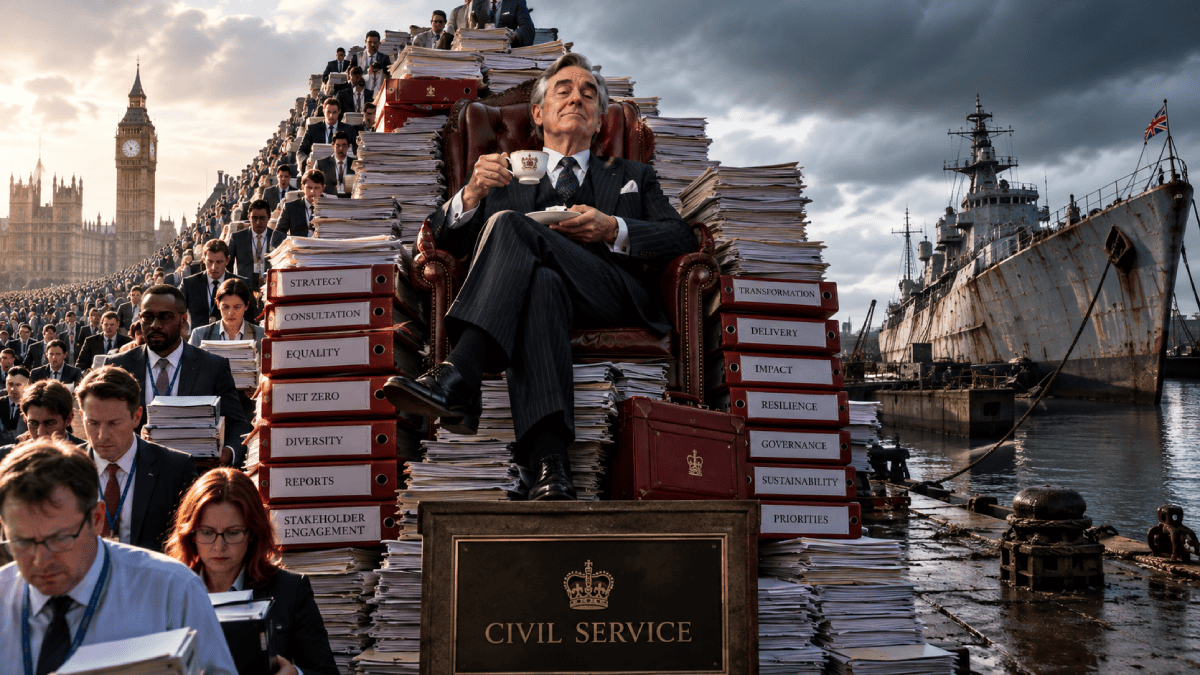
Most importantly, he is going to be ridden like a horse by a civil service absolutely salivating at the prospect of doubling their expenditure over two trillion.
His devolution plans will fail because the civil service maintains centralisation as doctrine. The takeover of Thames Water will collapse because its arithmetic simply doesn't add up. Any North Sea plans will be frustrated by a lunatic zealot and the religious left. He can't build more houses because it is the planning system itself which is the problem on top of mass immigration. He can't do more social care as it has already bankrupted half the councils in England. If he goes back on immigration, he loses what is left of the Red Wall.
And he can't cook the books because a certain quango is a touch too forthright. This man simply does not have the aptitude, experience, or killer instinct to meet the moment.
The Office for Budget Responsibility has published fifty pages of arithmetic which the newspapers have compressed into a single threat. The new Prime Minister who is unelected and economically clueless must, yet again, raise taxes on an exhausted public by £120 billion to avoid a crisis. The number is real. The framing is a swindle.
What the OBR actually calculated is more interesting and far more damning than any headline about taxation. Its 2026 Fiscal risks and sustainability report takes the British state as it presently exists, carries every one of its promises forward to 2075, and asks a single question: can this be paid for?
The answer, delivered across almost every scenario the watchdog can construct, is no.
Debt climbs onto what the report calls an "unsustainable and ever-rising path". The state cannot fund itself out of fifty more years without either seizing an ever-larger portion of the economy or spiralling into insolvency.
Lets put it in a simpler format.
The government's own watchdog highlights an ageing population and weak productivity will pile significant pressure on UK public finances over the next 50 years, causing long-term debt scenarios to become ultimately unsustainable.
We're going bust if this continues.
That is the finding. The £120 billion is merely one way of dressing it up, and the least illuminating way available.
Burnham wants to nationalise, spend, and pretend we are a Nordic social democracy. The markets are going to see the catastrophe from a mile off. His days are numbered.
What The £120 Billion Actually Measures
The OBR does not say Britain needs £120 billion in tax rises. It says the primary balance (which is government spending excluding debt interest set against receipts), must improve permanently by 3.8 per cent of GDP from 2031-32 onwards to hold public debt at roughly 95 per cent of GDP through to 2075.
Convert 3.8 per cent of GDP into cash at today's scale and you land near £120 billion. One percentage point of GDP is around £31 to £32 billion.
Note what has been smuggled in.
The adjustment could come from higher taxes, lower spending, structural reform, or any mixture of the three. The report itself compares the figure to total onshore corporation tax receipts or the entire education budget. Translating a spending-or-taxing choice into a pure tax demand is a political act performed by the press, not a conclusion reached by the watchdog.
Note also the target.
Ninety-five per cent of GDP is not fiscal health.
It is the level at which debt merely stops getting worse. The £120 billion buys nothing except the continued operation of the existing settlement while debt sits at a historically extreme altitude.
To bring debt back to its pre-financial-crisis level of around 40 per cent of GDP, the OBR says the required adjustment rises to 4.9 per cent.
The OBR modelled the next 50 years. An ageing population, weak productivity, and insane debt mean there is no scenario where we don't go bust. And mass immigration to fix the pensions ratio won't fix it.Higher productivity would shrink the number; a return to the miserable productivity of the last fifteen years would push the necessary tightening above 8 per cent. The £120 billion is not a fact sitting in a drawer. It is one output of a fifty-year model, and the model rests on assumptions worth examining one by one.
The Assumption Machine
The report is admirably candid about its own method. Where the government has legislated a long-term commitment, such as the absurd religious notions of net zero or the pensions triple lock, the OBR includes it. Everywhere else it assumes the tax and spending structure of 2030-31 continues unchanged, with each category broadly holding its share of GDP before demographic pressure is layered on top.
In the report's own words, this is equivalent to assuming "the public provision of goods and services broadly rises in line with the wider economy".
That is a reasonable accounting convention. It is not a neutral one. It bakes in the permanence of everything the modern British state happens to do. It assumes future Britain provides substantially the same welfare, the same tax-funded health monopoly, the same earnings-linked pension, the same sprawl of departments and services, and a public sector whose claims grow automatically with national income.
The OBR is testing whether that state is affordable. It never asks whether that state is necessary.
Watch what the machine produces once you feed it those assumptions.
| Spending area | 2030-31 | 2075-76 | Change |
|---|---|---|---|
| Health | 8.4% | 13.5% | +5.1% |
| State pension | 5.0% | 8.6% | +3.6% |
| Adult social care | 1.2% | 1.8% | +0.6% |
| Education | 4.3% | 3.4% | −0.9% |
| Other welfare | 6.2% | 6.4% | +0.2% |
| Defence | 2.7% | 3.5% | +0.8% |
| Public service pensions | 1.2% | 0.9% | −0.3% |
| Other current and capital | 10.6% | 10.6% | flat |
| Total primary spending | 39.8% | 48.6% | +8.8% |
Health and the state pension between them explain nearly the entire deterioration. The crisis is not that the courts, the police, the armed forces or the border are becoming unaffordable.
It is socialism.
Again. It is always socialism.
Britain has built an enormous broken machine for transferring wealth to old age and ill health, and the machine's promises expand on their own.
The NHS: The Largest Guess in the Building
Health spending rising from 8 to 13 per cent of GDP is the single heaviest assumption in the document. Only part of the rise is ageing. The OBR breaks the 2.5 per cent annual real growth in health spending into three parts:
- emographic change contributes 0.4 percentage points;
- Income effects contribute 1.2, and
- "Other cost pressures" contribute a full 1.0 percentage point a year.
That last component deserves scrutiny, because it does an enormous amount of work. The OBR attributes it largely to the Baumol effect: the assumption healthcare productivity grows more slowly than the rest of the economy, so the sector devours an ever-larger slice of national wealth as the country grows richer.
In plain terms, the projection assumes the health service remains structurally resistant to productivity improvement for half a century.
The watchdog is honest enough to model the alternative.
Strip out those extra cost pressures, whether through technology, through artificial intelligence raising clinical productivity, or through governments simply constraining costs, and health spending rises only modestly to around 9 per cent of GDP by 2075. That single change removes roughly four percentage points of GDP, an amount close to the entire £120 billion adjustment under discussion.
This does not prove the optimistic path will arrive by magic. It proves the warning depends on treating medical cost inflation almost as a law of nature rather than as an institutional failure open to reform.
And it exposes the narrowness of the questions ordinarily asked. Instead of merely asking which taxes must rise to fund future NHS demand, a serious review would ask:
- Why the state must remain the near-monopoly purchaser what a universal guarantee should actually cover
- Which care is insurable rather than tax-funded, and
- Why routine provision could not be mutual, private, occupational, or charitable, while the state guarantees only catastrophic and indigent care.
The OBR models demand under the present architecture. It cannot model the replacement of that architecture, because that is not its job. It is, however, ours.
There is a further wrinkle the report is unusually frank about.
Healthy life expectancy in Britain has been flat since 2012 and is now falling, driven mainly by worsening self-reported health among the working-age population.
A country whose workers are getting sicker before they are getting older is a country whose health projections carry a fat downside tail. The OBR's worse-health scenario adds around 45 per cent of GDP to debt on its own.
The State Pension: 3 Promises in a Trench Coat
Pension spending climbs from 5 to 8.6 per cent of GDP, and the triple lock accounts for roughly a third of that rise. Even uprating by earnings rather than the triple lock leaves the bill near 7 per cent. The report frames this as the cost of keeping a promise. The more useful observation is the promise conflates three entirely different things:
- Smoothing income across a lifetime,
- Insuring against the risk of outliving one's savings, and
- Relieving poverty in old age.
A state confined to its core functions might retain an old-age poverty floor, protection against catastrophic longevity, transitional recognition of what people have already accrued, and a last-resort guarantee.
It would not necessarily run a vast pay-as-you-go scheme designed to preserve the relative income of every retiree by taxing the next generation of workers.
The OBR projects the cost of preserving that conflation to the penny. It has no remit to question whether the conflation should exist.
The Quiet Confession About Growth
Buried in the productivity scenarios sits the report's most revealing admission. Faster growth helps the public finances substantially only if the government does not spend the proceeds.
In the higher-productivity scenario, debt ends up around 120 per cent of GDP lower than the baseline, but the OBR is explicit this depends on future governments declining to convert higher GDP into proportionately larger public services.
Hold primary spending constant as a share of GDP instead, "consistent with broad trends seen over the past 50 years", and almost the entire benefit of faster growth evaporates.
There is the ideological core of the modern state laid bare.
If GDP per person nearly triples by 2075, as the baseline expects, then holding a department at a fixed share of GDP means tripling its real resources. It does not mean maintaining services.
It means the state automatically claims the same slice of a far larger pie, in perpetuity, regardless of whether the function requires it.
A richer country does not need three times as much bureaucracy per head, yet the baseline assumes it shall have precisely that. Growth cannot rescue a state which treats every increase in national prosperity as its own entitlement.
Population Is Not The Escape Hatch
For decades the Treasury's reflexive answer to ageing has been more people: import workers, widen the tax base, dilute the pensioner-to-worker ratio. The OBR quietly dismantles this.
Its higher-population scenario (which raises births and lowers deaths to leave the population around 9 million larger by 2075) produces not fiscal relief but a larger required adjustment: 4.8 per cent of GDP rather than 3.8, because more people eventually means more pensioners, more health demand, and lower GDP per person.
The report states the conclusion without flinching: maintaining a larger population "does not relieve pressure on the public finances".
The higher-population scenario varies natural change, not migration, so it is not itself a direct test of a higher immigration target. But the underlying reasoning survives whichever mechanism you choose. The baseline already assumes net migration contributes nearly 12 million people across the fifty years (!!!!!!!), and the population still ages relentlessly – with the old-age dependency ratio climbing past 40 per cent.
Migration slows ageing. It does not abolish it.
Migrants, inconveniently for the broken model, also grow old.
The proposition more workers today fund the pensions of today, only to become the pensioners who must be funded by yet more imported workers tomorrow, is not sustainable arithmetic. It is a chain letter with a flag on it.
Sever the link between immigration and the dependency ratio and the entire justification changes. Migration stops being a macroeconomic volume lever pulled to prop up unfunded promises, and becomes a selective policy judged on the things that actually matter: genuine labour shortage, lifetime fiscal contribution, infrastructure cost, capability, and whether admission raises or lowers output per person.
The OBR has, perhaps inadvertently, supplied the evidence for abolishing mass immigration indefinitely.
What The OBR Gets Right
None of this is a reason to dismiss the report. On its own terms it is rigorous, and several of its findings deserve to be nailed to the door of every department in Whitehall.
Delay is ruinous. An immediate adjustment of 3.8 per cent of GDP becomes roughly 8 per cent if a government dithers until the early 2050s, and the burden falls squarely on a later generation.
The tax base is already near its practical ceiling: uprating personal thresholds by inflation for fifty years would drag a full-time worker on the artificial National Living Wage into the higher rate by the late 2060s and pull two-thirds of all taxpayers into the 40 per cent band, with labour-supply consequences the static figures ignore.
The tax-to-GDP ratio is forecast to reach 43 per cent by 2030-31, up from 37 in 2019-20, which would lift Britain from below the advanced-economy average to slightly above it.
Debt interest already runs at £110 billion, the third-largest line in the entire budget after health and welfare. These are not projections. They are the present.
The OBR has, in effect, documented the death of the post-war fiscal settlement. What it cannot do, constrained by its remit to model unchanged policy, is imagine a different settlement.
A Different Model Of The State Changes It All
Set the watchdog's assumptions aside and model a different state. Not one which trims budgets while leaving the architecture intact (e.g. the austerity of the 2010s) and which merely spreads dysfunction thinly across an unchanged machine. A genuinely different conception, in which the two great age-related systems are closed to new unfunded liability and replaced over time by funded provision.
The mechanics are straightforward to state, if not to execute.
- Close the state pension to new ordinary accrual.
- Place existing entitlements in a declining legacy account.
- Move younger cohorts into funded provision, leaving the state responsible only for a poverty floor and systemic guarantees.
- Close the tax-funded universal health system progressively to new lifetime liability, retaining:
- catastrophic cover,
- emergency access,
- public health and support for those who cannot provide,
- while routine care migrates outside the Exchequer.
Crucially, national spending on health and retirement need not fall at all. It simply ceases to be government spending. Britain might still devote 12 or 14 per cent of its economy to healthcare; the point is the liability no longer sits on the public books.
The transition carries a real and unavoidable cost.
For perhaps two or three decades the working population funds both the legacy systems and its own new funded provision at once, which may make the early years feel heavier, not lighter. The dividend arrives only as the old liabilities run off and the funded institutions mature. A serious model shows three phases rather than an instant saving.
| Public spending | 2030 | 2050 | 2075 |
|---|---|---|---|
| OBR baseline (continuation) | ~40% | ~44% | ~49% |
| Replacement state | ~40% | ~37-40% | ~27-30% |
The trajectory is the whole argument. The OBR's line climbs without end.
The replacement line rises slightly through the double-funding years, crosses over as the legacy burden fades, then falls sharply. A rough mature settlement might place permanent public health spending near 4 per cent of GDP rather than 13, public pensions near 2 rather than 8.6, social care near 1 rather than 1.8, and a narrowed welfare state near 4 rather than 6, while defence and the sovereign functions are deliberately increased, not cut.
Total primary spending settles somewhere around 27 to 30 per cent of GDP against the OBR's 49. Even a markedly less successful version, landing at 32 to 34 per cent, would sit fifteen points below the baseline and transform the debt dynamics entirely.
That reduction of roughly nineteen to twenty-two points of GDP is not £600 billion of pure saving vanishing from national life. Most of it becomes private, mutual or funded provision.
The transformation is in where the liability rests, not in whether Britain looks after its sick and its old. It continues to do both. It simply stops financing both by taxing one generation to pay for another in a chain which the OBR has now shown, in its own numbers, cannot hold.
The Cost Of Refusing To Fix This Country
Beneath the headline the report states what the Treasury has spent thirty years refusing to hear. Britain does not face a £120 billion revenue shortage. It faces a state whose inherited promises exceed what its future productive population can bear, and no amount of taxation, imported labour, or hoped-for growth resolves the contradiction while the promises themselves remain untouched.
The OBR has priced fifty years of leaving the post-war state exactly as it is, and the price is roughly half the economy.
That is not an argument for despair, but for for building the state which the OBR is forbidden to imagine: one whose ordinary cost sits comfortably below its ordinary revenue, whose core is sovereign and strong, and whose largest liabilities have been funded in advance rather than borrowed from the young.
The alternative to £120 billion in permanent tightening is not fiscal recklessness.
It is a different country, costing closer to thirty per cent of its economy rather than half, and the arithmetic for reaching it is now, thanks to the OBR, unusually clear.