One Household, One Vote
The French idea of universal suffrage has been a mistake. Our direction of travel over a century towards atomised liberalism has been the wrong one, and nobody dare say it. The only people who should have a say in a civilisation are those who contribute to it and act to continue it.

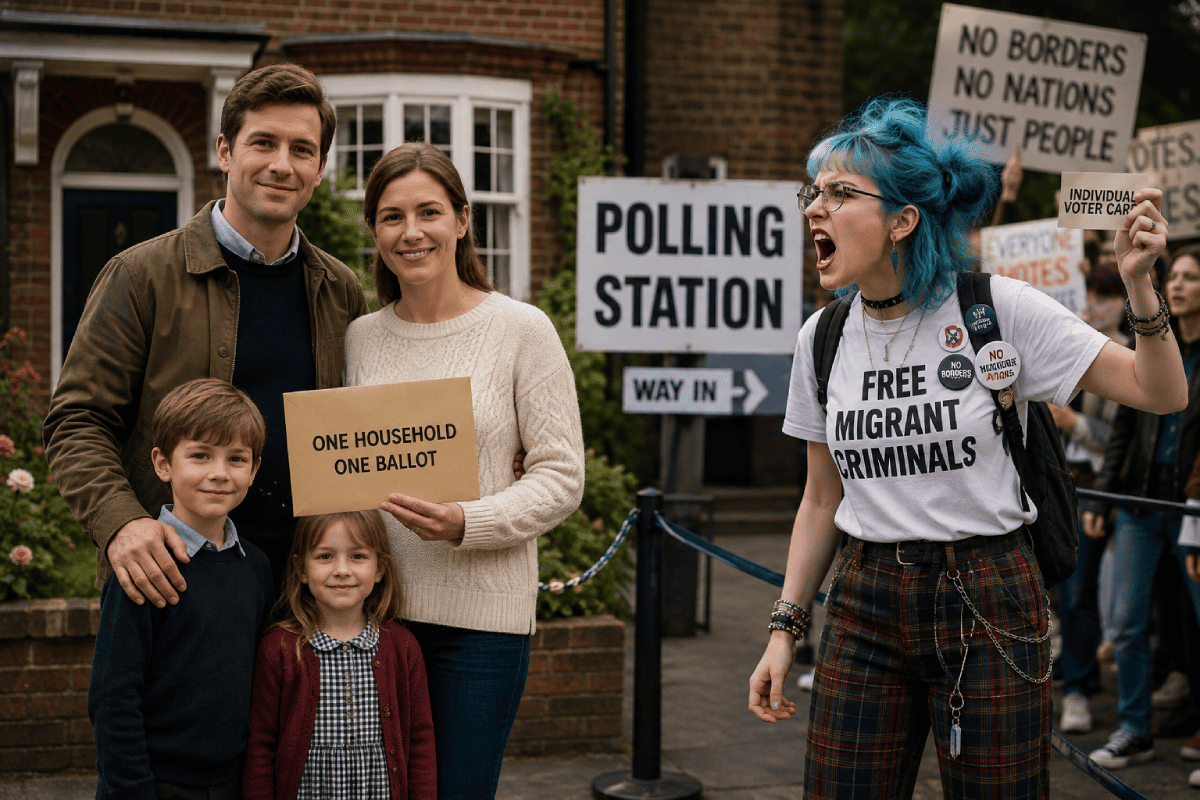
A vote is not a prize. It is a share in making other people do things. Whoever holds one helps decide how much money the state takes out of a stranger's wages, where it goes, who is allowed into the country, who goes to prison, how much debt the country runs up, and whether young men are sent abroad to be shot at. He also helps decide which bills are left behind for people who have not been born yet.
The usual defence of the current arrangement is everybody gets a vote at eighteen. Why? Because they have... had a birthday.
Everyone matters equally on a moral level, and everyone in this country is owed the same protection from it: fair courts, honest policing, and the state off their back unless they have done something.
None of which means everyone is fit to run things. Being owed protection and being entitled to govern are separate things, and the second does not follow from the first. Not all votes are equal, even if the voter is.
Britain's electorate is everybody alive and over eighteen on polling day. The men who cleared the land, wrote the law, built the docks, and paid for all of it are dead and do not count.
The children who will spend forty years paying off the debts run up this year are too young or not yet born, and do not count either.
A system which boasts about giving everyone a voice has handed the country to whoever happens to be standing on it this afternoon.
This is a French idea from their disastrous revolution, expressed from the addled, deranged brain of their chief philosophical clown.
Somebody Always Decides Who Gets to Vote
Counting the votes is one thing. Deciding whose votes get counted is another, and it happens first, before anybody puts a cross on anything.
Britain already excludes plenty of people, and rightly.
- Children cannot vote.
- Convicted prisoners serving a sentence cannot vote, under section 3 of the Representation of the People Act 1983, a rule Strasbourg spent two decades attacking without shifting.
- Peers cannot vote for the Commons.
None of those exclusions was decided by a vote. They were decided in advance, by law, and they build the electorate which then does the voting.
What Britain does not exclude is foreigners.
Under the rules as they stand, any qualifying Commonwealth citizen can vote in a general election. That is a citizen of fifty-six other countries, needing only leave to enter or remain here. The Electoral Commission sets it out. Irish citizens vote too. Maltese and Cypriots vote in everything.
A Nigerian arriving on a skilled worker visa can help pick the government of the United Kingdom within months of landing, and can stand for Parliament while he is at it.
An American who has lived in Manchester for thirty years, married a Yorkshirewoman, raised three British children, and paid higher-rate tax the whole time cannot vote at all.
Nothing separating those two men has anything to do with belonging here, paying for the place, or living in it. One of them comes from a country which used to be coloured pink on the map. Nobody has ever repealed the rule because repealing it would look bad.
Nationality is not the test for voting in Britain. Nostalgia is.
Anyone who wants to defend the current system as a matter of principle should start there. And once it is admitted the electorate is something we built rather than something we found, the whole question turns round.
The usual complaint is: give me a reason to take this adult's vote away.
The smart one is: tell me what this person has done to earn a say in ordering everybody else about.
One Person One Vote Is Younger Than the NHS
Universal suffrage did not grow naturally out of a darker age. It was legislated, recently, by Parliaments elected under completely different rules.
Before 1918 the vote came through a tangle of separate qualifications: owning property, renting property, paying rates, occupying a house, occupying rooms as a lodger, holding a job which came with accommodation, going to certain universities, running a business. Parliament's own account of the period records the 1908 franchise reaching around sixty per cent of adult men, with some men voting more than once.
The Lords debate on the Representation of the People Bill in December 1917 works through seven different franchises before the new residence rule swept them away.
England never ran a tidy one house, one vote system, and there is no lost golden age to restore. Lodgers qualified on their own. A man might vote in three constituencies while his brother, living in their parents' house with no rooms of his own, voted nowhere.
Even so, for centuries the vote in England went with something: property, a trade, a house, a business, membership of a body. It did not go with simply being an adult who was still breathing.
Whole institutions voted as institutions. Towns returned members. Universities returned members.
The City of London still runs a business vote, where qualifying firms appoint voters according to how many people they employ, and the republic has not arrived yet.
| Year | What changed |
|---|---|
| 1832, 1867, 1884 | The vote widened, still tied to property, work, and householding |
| 1918 | Almost all men over 21; women over 30 with a property qualification |
| 1928 | Men and women equal at 21 |
| 1948 | The last extra votes for business premises and universities abolished |
| 1969 | Voting age cut from 21 to 18 |
| 2026 | Bill before Parliament to cut it to 16, with registration from 14 |
Equal votes for men and women date from 1928.
One person, one vote is younger still, because the extra votes for businessmen and graduates survived until the Representation of the People Act 1948, another disastrous gift from the Attlee government to go alongside the rest of them.
The system now treated as the bedrock of legitimate government is younger than the National Health Service. It was imposed by a Parliament nobody calls illegitimate, despite having been elected under the old rules.
The Family Is The Basic Building Block
Edmund Burke described a country as an agreement between the living, the dead, and those still to come. The trouble has always been practical. The dead cannot hold anyone to it and the unborn cannot be asked.
Roger Scruton pointed at the answer in his 1989 paper on corporate persons. Promises across the centuries only mean anything when something outlives the people who made them. A regiment can carry an obligation for two hundred years because the regiment is still there when every man who joined it is dead.
Scruton put the family in the same category. John Finnis, replying in the same volume, disagreed with him about it.
Accept the idea and an obvious question immediately follows. Why the family in particular? A college lasts. A regiment lasts, usually with more spirit. A parish lasts. A firm can last three hundred years. All of them own things, remember things, owe things, and carry on after their members die.
If lasting a long time earns a vote, they should all get one, which is roughly what the old estates and guild chambers of Europe tried, with results running from harmless to shameful.
The difference is straightforward.
- A college gets new fellows by electing them.
- A regiment gets soldiers by recruiting them.
- A parish gets a new vicar by appointing one.
- A firm advertises.
Every one of them takes its next generation of members from human beings who already exist, already have names, and were already raised somewhere else.
Only one institution makes them in the first place.
A regiment has never produced a soldier. It has only ever collected other people's sons.
Aristotle saw this and drew a careful line. His Politics says the city comes first in importance (as a finished thing comes before its parts), while the household comes first in order of creation. Nothing here needs the family to outrank the country. It only needs the family to come first, and Aristotle grants that much.
There is a fashionable half-answer to all this farted out of the universities, which is to give children votes for their parents to cast until they grow up.
It admits the problem, then fixes it by inventing more individual voters, with everyone now sovereign from the moment of birth. A patient with too much of something is prescribed more of it.
What Is A Household?
A qualifying voter would be a married household with children of its own and a record of having handed part of its earnings to the state. Four requirements, doing four separate jobs.
| What it does | The test | The question it answers |
|---|---|---|
| Creates the voter | Marriage | What is the thing casting the vote? |
| Qualifies it | Children of its own | Why should a body like this vote at all? |
| Switches it on | A record of paying in | Why does this particular household vote? |
| Takes it away | Treason, serious crime | How is it lost? |
Marriage does not make children. An unmarried mother is raising the next generation exactly as a married one is. What marriage does is make a household visible.
Two people stand up in public and declare themselves one household with obligations to each other, and the state has something it can put on a list. Without it there is... an address with some adults in it.
Children are what qualify the household. A household producing nobody ends when its members do. It is asking for a say in the running of a country it will hand on to no one.
Paying in switches the vote on, and it counts as a record rather than a snapshot. Thirty years of income tax does not stop counting the day someone retires. A theory built on handing the country safely to the next generation, which then strips the vote from a couple at sixty-seven for the crime of having finished, would be a joke.
The same rule cuts the other way.
A household living entirely off money taken from other households (i.e. leeching benefits) has never paid in and does not qualify, however many children it has. Producing people is not the same as keeping a country running.
A household is a going concern: once it exists and qualifies, it carries on through changes in who is in it, the way a regiment carries on when a generation of soldiers retires. The children grow up and move out; the household is still there. One spouse dies; the household carries on in the one left. The widow needs no special sympathy clause, because nobody is making an exception for her.
None of it passes down.
A daughter of a voting household inherits nothing.
When she marries and has children she starts a new household, and it qualifies on its own or it does not. A vote handed down the bloodline would be self-defeating from the start.
Who Votes? Husband Or Wife?
Nobody cares. They are married. They sort it out. It is their own business. The question assumes the answer it is looking for. Neither of them owns half a vote, because neither owns any part of one. A cabinet argues and issues one decision. A jury argues and returns one verdict.
Demanding every private opinion get its own separate public expression only makes sense if individuals are the point, which they are not. The unified household is.
Either spouse can cast the household's vote, and once it is cast it is gone for that election.
What the state does not do is ask questions about the inside of the marriage. Not who talked whom round; not whether they agreed; not whether one of them has got through thirty years of marriage without learning the name of the Chancellor.
Whether husbands or wives end up deciding seven times out of ten is not the state's business. Nobody is promising a marriage divides its influence down the middle. The claim is the state does not owe anybody such a promise.
This is not coverture coming back. Under coverture the law swallowed a wife's legal existence into her husband's and drew consequences from it about property, debts, and contracts.
Letting either spouse cast the household's vote is the opposite arrangement, and the difference is cosmetic or fine. The state surrenders any interest in private household life.
A Deliberately Smaller Electorate
The ONS counted 13.0 million married-couple families in 2025, forty per cent of them with children still at home. Households whose children have grown up would still qualify, so the electorate would be well above five million and nowhere near the forty-eight million people on the roll today.
Most adults would have no vote of their own.
That is the point of it, not an accident, and the people left out would be most of the country rather than a handful of unlucky cases.
Nobody should promise the result would be wiser government.
Parents can be idiots. Taxpayers can be greedy. A married couple with four children is perfectly capable of voting to bankrupt the country. The case for giving households the vote rests on what they do, not on any prediction about how they would use it.
Nor did universal suffrage create the welfare state itself.
The Old Age Pensions Act 1908 and the National Insurance Act 1911 were both passed by a Parliament elected on a narrow, property-based franchise. Anyone drawing a straight line from mass democracy to the national overdraft is missing the point entirely.
Nobody Taken Off the Roll Gets To Approve It
Under parliamentary sovereignty no Parliament can tie its successors' hands, so any rule about who votes could be rewritten by the very people it puts in power. Worth noting, though, every electorate everywhere has this problem.
No angel came down and certified the 1928 settlement either, and the Parliament which passed it had been elected by somebody else entirely.
When the vote is widened, the new voters can approve of it afterwards. When it is narrowed, the people removed never get asked.
Narrowing it would need an electorate to vote for its own abolition, or some upheaval of a kind Britain has not had since the seventeenth century.
Neither is available to a government with a majority and a good drafting team.
England Has Never Liked Universal Suffrage
A sovereign Parliament could pass all of this tomorrow. It would run straight into promises Britain has never withdrawn, and the story of those promises is better than anyone lets on.
The United Kingdom is, sadly, still signed up to the European Convention on Human Rights. The Convention opens by pointing at the Universal Declaration of Human Rights, then announces it wants those rights recognised everywhere and enforced together, claiming they depend on real political democracy.
A machine built to turn a manifesto into law.
What is interesting about the ECHR is how the sausage was made.
In August 1949 the French delegation wanted the words universal suffrage written into the promise about elections. The British delegate objected, and not on grand philosophical grounds. He pointed out the plain fact Britain's own franchise was very wide and was not universal, since it left out prisoners, some mentally ill people, and peers.
The French dropped the phrase. Evidence to Parliament's committee on the draft prisoner voting bill sets out the exchange, drawn from research into the negotiating record by Dominic Raab.
Lord Lester read the same record differently, and the argument has never been settled.
Mr Raab: If a person commits a serious enough crime to be sent to prison, they forfeit the right to vote, along with their liberty, for the limited period of their incarceration. We have come a long way since the year 888, but our tradition of liberty sustains the basic idea that with freedom comes responsibility. When the European convention on human rights was negotiated in 1949, that remained a guiding principle, so when the French proposed including a right to vote it was rejected because the draft contained the words "universal suffrage". The British delegate, Sir Oscar Dowson, a former Home Office legal adviser, stated:
"In no State is the right to vote enjoyed even by citizens without qualifications. The qualifications required differ from State to State...And it is our view that the variety of circumstances to be considered may justify the imposition of a variety of qualifications, as a condition of the exercise of suffrage".
Robert Halfon: I thank my hon. Friend for giving way and for his important point. Does he agree that the founders of the European convention on human rights, who did what they did because of what had happened in world war two, would never have wanted to give Rudolf Hess and Albert Speer the vote?
Mr Raab: My hon. Friend makes an important point, and of course he is absolutely right.
What the treaty ended up saying is there must be free elections at sensible intervals, by secret ballot, in conditions letting the people express their opinion when choosing a legislature.
Universal suffrage does not appear anywhere in it. The words were left out deliberately, and it was us who left them out.
Strasbourg put them back in by another route.
- The Commission read universal suffrage into the article in a German case in 1967.
- The Court approved a reading in Mathieu-Mohin and Clerfayt in 1987.
- By Hirst in 2005 the Grand Chamber was saying:
- voting is no sort of privilege
- a modern democracy must lean towards letting people in
- universal suffrage has become the basic principle, and
- departing from it puts at risk the legitimacy of the parliament elected and everything it passes.
The Court's own guidance now calls universal suffrage the benchmark and cites that chain of cases.
To illustrate the point, the judges reached for British history, and described the old franchise as one limited to favoured individuals and groups approved of by whoever held power at the time.
A hundred and fifty years of British constitutional argument, read back to Britain as a cautionary tale by a court applying words British negotiators had taken out.
Anything involving paying in fares no better.
Evidence before the same committee recorded a minimum income requirement could not be squared with the purpose of the article, because it would not give every citizen an equal say.
Giving the vote to households instead of individuals would not detain the Court for twenty minutes. Under the Human Rights Act no British judge could strike the Act down. There would be a declaration of incompatibility, followed by years of argument in Europe.
Every constitution believes in something. A monarchy is not neutral about monarchy. What deserves attacking is the pretence this particular belief is not a belief at all.
Universal suffrage arrived in the last century as one possible answer to the question of who should vote. It now works as the test other answers are marked against, before anyone has heard them.
Meanwhile, Labour's insane Representation of the People Bill would drop the voting age to sixteen and start registering people at fourteen. Sixteen-year-olds work and pay taxes, and people who pay in should get a say in how the money is spent.
More realistically though, is how they vote.
They vote Green and Labour. Young immature minds skew disproportionately left-wing, until they have something to conserve and move right.
A Universal Nowhere Person Who Never Existed
The Universal Declaration was adopted in December 1948, announcing rights belonging to human beings simply for being human. The generation which grew up under it did not invent the idea.
The Stoics got there first. Christianity has always had a universal account of the soul, and the Enlightenment needed no help from anyone born in 1946.
What the post-war years did was put one version of it in charge of everything, and raise a couple of generations who took it for the natural state of mankind.
- The man at the centre of it has no ancestors and no descendants.
- He owes nothing he did not agree to.
- He has no country with a special claim on him and no culture he did not select.
- He has rights before he has parents and equality before he has joined anything at all.
Michael Sandel described something close to him as a self who exists before his own attachments rather than being partly made out of them.
Alasdair MacIntyre complained about a morality worked out by nobody in particular, from nowhere in particular, about duties belonging to no actual person.
There has never been such a man.
It's garbage. Nonsense.
None of these ideas exist in reality and we owe them no loyalty.
Real people are born to particular parents, in a particular town, at a particular point in a story already well underway. They speak a language they did not invent, live under laws written by the dead, are protected by soldiers they never met, owe debts they never agreed to, and enjoy things they never paid for.
The stripping away comes later, in the seminar room, until nothing is left but a chooser, and then a constitution gets built for the leftovers.
Chosen identity, chosen community, chosen belief, chosen family, chosen country. Anything handed down becomes faintly suspect for the sole reason of not having been picked off a menu.
Yet almost everything of any weight in a life arrives unchosen. Parents. Birth. Death. Language. Home. The debt owed to people who looked after us before we could do anything for them. The debt owed to people who will be here after we are gone.
A man whose moral world starts at the moment he consents to something has nothing useful to say about any of it.
The family wrecks the theory completely, which may be why so little political philosophy wants to talk about it. Nobody picks his parents. A baby agrees to nothing. Children take on a language, a nationality, a religion, a set of relatives, and either money or the lack of it, none of it negotiated.
The one institution responsible for producing human beings runs almost entirely on obligations nobody signed up for.
The self-governing individual is not the foundation society is built on. Society finishes building him before he is old enough to choose anything.
Political theory starts with adults, fully grown, appearing out of nowhere, and gets straight on to the rules for sharing a country. Where the adults came from is treated as somebody's private business. Somebody conceived them. Somebody carried them. Somebody fed them for twenty years, taught them to speak, and handed them the habits which make their independent choices possible.
Nobody ever asks who keeps producing the people the whole system depends on, because asking would spoil it.
A country is not kept going by individuals.
It is kept going by institutions, and one of them comes before all the rest, because it produces not only its own replacements but the people every other institution runs on.
Giving that institution the vote is not a prize for respectability or a bribe for the married. It is a decision about what a country actually is.
Universal suffrage answers the same question differently: it claims a country belongs to whoever is standing on its magic soil, aged eighteen, on the day of the poll. Everybody who built it has no say. Everybody who will live in the wreckage has none either.
That's insane. It's French. And it's wrong.
It deserves to disappear.
The burden now sits where it has not sat for a hundred years. It sits with the people who think a birthday hands a man power over strangers, and who have never once been made to explain why.