Parliament Votes £1.15 Trillion A Year And Barely Reads Any Of It
Ministers no longer argue for money before receiving it. Two days a session, six chosen debates, a bundled motion for the rest, and a bill nobody may amend. Then comes the better trick: order somebody else to pay, and no annual price is ever put before the Commons.
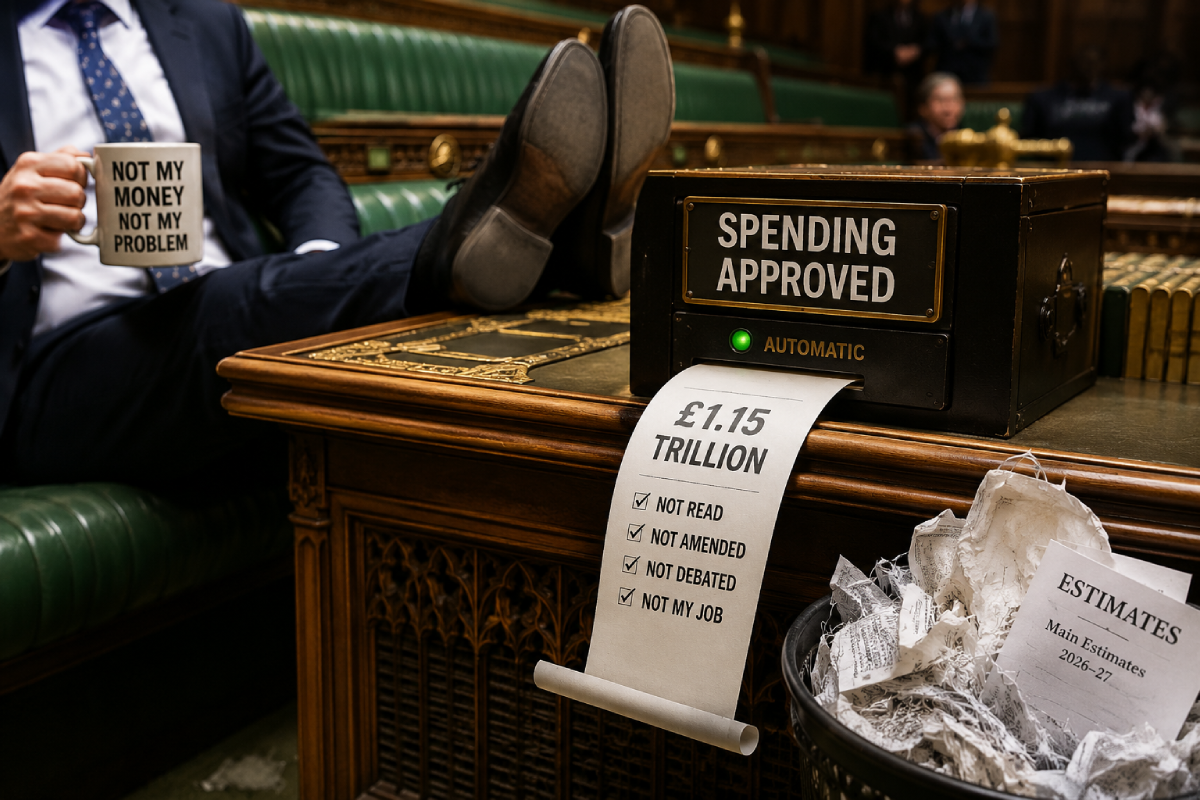
Britain has a device for stopping ministers wasting your money. Nobody has repealed it. Brussels never took it. Successive governments have not dared abolish it, because abolishing it would require a vote and a headline. It sits in the Standing Orders of the House of Commons, in working order, operated every year, and almost never used for the purpose it exists to serve.
The principle behind it can be explained in three sentences.
- Government wants money.
- Parliament controls the money.
- Parliament makes government explain itself before handing any over.
For several centuries this was one of the central workings of the constitution. The Crown came to the Commons asking for supply. The Commons raised complaints about the Crown's conduct. Ministers wanted the complaints to stop, because ministers wanted the cash. Out of this came the old rule of grievance before supply, which was never a debating courtesy. It was leverage, and everyone in the Chamber understood it as leverage.
If the Army wanted another million pounds, the million pounds had to be voted. If the House considered the money wasted, the department incompetent, or the policy absurd, there was an object standing in front of MPs, ready to be attacked, delayed, or cut.
The budget.
Every functioning household, business, charity, regiment, and village cricket club understands the mechanism instinctively. Requiring an employee to obtain approval before spending £50,000 gives you authority over him. Requiring him to deliver a presentation on Tuesday and then transferring the £50,000 automatically on Friday gives you a presentation.
Westminster built the second system, slowly, over roughly a hundred and thirty years, and then wrote it into the rulebook.
What's Actually Left Of Supply
Departments still produce Estimates. The Commons still passes formal resolutions granting supply. Parliament still enacts Supply and Appropriation Acts authorising both the use of resources and the issue of cash from the Consolidated Fund. On 18th March 2026 one such Act authorised the use of resources up to £520,458,767,000 for the year ending 31st March 2027, and permitted the Treasury to issue up to £422,048,736,000 in cash, before a single Main Estimate for the year had been examined by anybody.
The curious element is what happens between the paperwork and the money.
Almost nothing.
Three days are set aside in a session for consideration of Estimates. Not three weeks, not three days per department. Three days.
The subjects debated on those days are chosen in advance, and are frequently only loosely connected to the Estimates being approved. Members may propose a reduction to an Estimate selected for debate. They may not propose an increase, because expenditure remains the initiative of the Crown under a rule of the House dating from 1713.
Every Estimate not selected, which means the overwhelming majority of them, is disposed of together in a single bundled motion, without debate and without the possibility of amendment.
The Supply and Appropriation Bill founded on those resolutions is then introduced. Under Standing Order No. 56 the questions on second and third reading are put forthwith, meaning no debate occurs. The Speaker certifies the bill as a money bill. The Lords pass it unamended, because the Lords have no role in supply at all. Royal Assent follows.
Winston Churchill, giving evidence to a procedure committee in 1931, dismissed debates on Supplementary Estimates as the most worthless he had encountered in his career. He was complaining about a system considerably more rigorous than the current one.
The Procedure Committee returned to the subject in 2017 and heard evidence from Dr Joachim Wehner of the London School of Economics, who observed anyone setting out deliberately to design a parliamentary budget process hostile to scrutiny would struggle to improve on the British arrangements.
The Committee's own verdict is the more damning of the two, because it is Parliament describing its own machinery.
The principle of annual authorisation remains vital, the Committee said, but the process as it has evolved is not a means of controlling spending decisions, and should not be presented as one.
The Committee then proposed modest changes. The Government indicated the matter was one for the House. The House has three Estimates days.
Separate Of Debate And Cheque
The reforms associated with Balfour between 1896 and 1902 permitted policy debates to proceed while the Estimates themselves were disposed of separately. A later parliamentary review concluded the link between debating an Estimate and voting it had been broken at that point.
Once ministers knew the vote would arrive regardless, the content of the day's debate became a matter of decoration.
By the early 1980s the pretence had become embarrassing.
Twenty-nine days a session were formally designated Supply Days, and were being used for general political argument rather than examination of expenditure.
A select committee proposed replacing the fiction with Opposition Days while establishing eight genuine Estimates Days for scrutiny of spending. Eight was described in the House as an irreducible minimum.
- 1981: a committee of the House concludes it needs eight days.
- 1982: the Government provides three.
- 2026: the House has three.
Forty-four years of experience, and no further correspondence.
This Year's Appropriations Farce
| Stage | Date | What was authorised |
|---|---|---|
| Vote on Account presented to the Commons | 10th February 2026 | Resources up to £520.5bn and cash up to £422.0bn for a financial year not yet begun |
| Commons approves Supplementary Estimates, Vote on Account, and Excess Votes | March 2026 | Above, plus £56.9bn of additional resource for 2025-26 and £2.6bn of excesses for 2024-25 |
| Supply and Appropriation (Anticipation and Adjustments) Act 2026 | Royal Assent 18 March 2026 | Second and third readings put without debate |
| Main Estimates 2026-27 presented | April 2026 | £1,154.9bn of resource and capital expenditure sought |
| Estimates days | 29th and 30th June 2026 | Six Estimates debated and resolved individually; the remainder disposed of together under Standing Order No. 55 |
| Supply and Appropriation (Main Estimates) Act 2026 | July 2026 | A further £634.5bn of resource authorisation, put forthwith |
The fifth row is the one worth pausing over. Across two days the Commons debated and separately resolved six Estimates: the Cabinet Office, the Northern Ireland Office, the Home Office and Ministry of Justice together, the Department for Culture, Media and Sport, the Department of Health and Social Care, and the Department for Work and Pensions. Six subjects, chosen in advance, argued over properly, and voted on individually. Nobody can complain about those.
The Deputy Speaker then put the questions on the outstanding Estimates.
Everything else the British state proposed to do in 2026-27 was authorised in a single motion: a further £275.3 billion of resource for current purposes, £94.5 billion for capital purposes, and £251.9 billion of cash from the Consolidated Fund. Defence. Education. Transport. Energy. The Foreign Office. Business. Environment. The Treasury itself.
Every department not among the chosen six, disposed of in one question, put and decided without debate, without amendment, and without any Member being able to reduce a single line of it.
The Supply and Appropriation Bill was brought in that evening on the resulting resolutions. It was read the first time and set down for second reading the following day, when the questions would be put forthwith.
Nobody was misled and nothing improper occurred. The procedure worked exactly as the House has designed it. Six departments received scrutiny. The rest received a signature.
That £422 billion of cash was authorised in advance in March, before the detailed proposals for the year appeared in April, and long before the Commons expressed any view on them in June.
Roughly forty-five per cent of a year's expenditure is approved on the basis of continuing existing services, a category defined by what Parliament approved last time. The Commons Library briefing explaining all of this to Members runs to dozens of pages, which tells you something about how many of them find it self-evident.
By the time the House reaches the Main Estimates in high summer, the spending review has concluded, departmental settlements are fixed, programmes are staffed, contracts are signed, announcements are made, and expectations have hardened into political facts. Parliament arrives at the end of the process to supply the signature.
This is the first accomplishment of the modern British state: parliamentary permission converted into parliamentary confirmation.
The second is considerably more elegant.
Money Which Never Gets Voted On
Some government expenditure never enters the annual cycle at all. Standing services are charged directly on the Consolidated Fund by permanent statute, and require no yearly authorisation.
Judicial salaries are charged this way. Debt interest too. The arrangement exists to protect certain payments from political interference, which is a respectable reason.
It is also an extremely useful precedent, and in 1972 it was put to spectacular use.
The European Communities Bill provided for Community obligations to be met as a direct charge on the Consolidated Fund.
Introducing the Bill on 15 February 1972, Geoffrey Rippon told the House the relevant subsection distinguished payments required to meet Community obligations by making them a direct charge on the Fund, recognising the special nature of the commitment.
The special nature of the commitment was precisely the problem. Britain would owe the money whether or not the Commons felt like voting it, and the Commons was accordingly relieved of the exercise.
Enoch Powell had opened the same sitting with a point of order arguing the Bill imposed charges on the subject and therefore required Ways and Means Resolutions before second reading, calling the arrangement a surrender of the taxing power of this House.
The Speaker ruled taxation was not the main purpose of the Bill and the resolutions were not required. Michael Foot, from the opposite end of British politics, supported the submission, on the ground the matter went to the root of the Commons' control over how money is raised and voted.
Powell and Foot agreed. Both lost.
The EEC did not destroy parliamentary control of supply. The Commons had done the bulk of that work itself, decades earlier, without foreign assistance.
What membership demonstrated, at scale and on the record, was a constitutional logic: an obligation created before Parliament is asked for the money renders the asking ceremonial, and once the asking is ceremonial the annual vote can be dispensed with as tidily as any other redundant formality.
Whether or not Whitehall consciously drew the lesson, the logic was by then unmistakable, and it applies to a great deal more than membership fees.
A Vote On The Statute Is Not A Vote On The Bill
Nobody is suggesting energy levies, employer duties, or council obligations are imposed lawlessly. Parliament passed the statutes. Ministers made the regulations under powers Parliament granted. Where the affirmative procedure applies, the Commons voted. Anyone who claims these costs are unauthorised will be corrected within a paragraph by somebody with a copy of the relevant Act.
The distinction is between authorising a machine and pricing its output.
Parliament votes once on the statute. The statute creates a duty, a levy, or an entitlement. The machine then runs for twenty years, extracting resources from households and businesses at a rate determined by regulation, formula, contract, or market price. At no point in those twenty years is any Member of Parliament asked the question which supply exists to force:
This scheme will take £4.7 billion out of the country this year. Shall we renew it?
The Estimates process asks such a question about departmental spending, badly, in a bundle, three months late. It does not ask it at all about the rest.
Legislative authority is not annual financial accountability. Britain has plenty of the first and almost none of the second.
Making Somebody Else Pay For It
Suppose a government wishes to spend £5 billion subsidising a particular kind of electricity generation. The traditional route runs from taxpayer to Treasury to department to subsidy. It produces a conspicuous £5 billion line in a departmental Estimate, a figure journalists can quote, and a minister who must defend the sum against every competing use of the same money.
The alternative route runs from consumer to energy company to mandated scheme to subsidy. It produces a regulation, a compliance obligation, and a slightly larger electricity bill. The Government can then explain, accurately, it is not spending £5 billion. Energy companies are complying with the law.
The consumer loses the money either way. The political visibility differs completely.
Parliament has caught the Government doing this, described it precisely, and then watched it continue.
The Energy and Climate Change Committee set out the mechanism in its 2014 report on the Levy Control Framework, noting the obligation to finance several energy and climate policies had been placed on energy companies rather than funded through general taxation, with companies recovering the cost from consumers through bills.
The Office for National Statistics reached the obvious conclusion.
It classified the Renewables Obligation, the largest element of the framework, as notional taxation and public expenditure, on the ground the levies and the spending share the essential features of taxing and spending, despite the money never passing through government hands.
What happened next deserves preservation in amber.
The ONS decision obliged the Government, from 2011-12, to include the spending and the revenues in departmental Annually Managed Expenditure and in the department's Main Estimates (which is to say inside the parliamentary approval mechanism).
The National Audit Office then pointed out including the items in the year-end accounts would be inconsistent with international accounting standards. The department accordingly obtained a derogation from the Treasury and removed the spending and the revenues from its Supplementary Estimates every year thereafter. In November 2013 the Chief Secretary wrote proposing the expenditure should stay out of Estimates and accounts permanently, and be reported to Parliament by some other means instead.
Money classified by the national statistician as taxation and public spending was therefore admitted into the constitutional mechanism for approving taxation and public spending, found to be incompatible with the accounting rules governing that mechanism, and quietly removed again every year for the convenience of the audit.
The Committee's response is the most important sentence any select committee has written on British public finance in fifty years. Effective taxation and spending of this kind, it said, ought to be subject to some form of parliamentary authority before it arises, notwithstanding the absence of any money entering or leaving the Consolidated Fund.
Parliament should be able to express a view on the sums involved and the purposes for which they are intended.
The reply was a reporting arrangement.
The energy levy is the best-documented instance rather than the only one. Each of the following mechanisms consumes real economic resources. They differ enormously in their legal basis, their accounting treatment, and who ultimately bears the burden, and anybody claiming otherwise is overreaching. What they share is the absence of an annual moment at which a minister must ask the Commons for the sum in cash.
| Mechanism | Where the cost surfaces |
|---|---|
| Direct departmental spending | Government budget |
| Standing statutory charge | Consolidated Fund |
| Regulatory levy | Customer bill |
| Employer mandate | Payroll and business costs |
| Local-government duty | Council finances |
| Guarantee or long-term contract | Future or contingent public liability |
| Mandated cross-subsidy | Other customers |
Only the first arrives before MPs as a clean annual request for a specific sum, and even that arrives in a bundle.
Consequences Never Reach The MP
A tailspin becomes unrecoverable at the moment feedback from a decision stops returning to whoever made it. The old system connected policy to cost, cost to supply, supply to the Commons, and the Commons to a named minister standing at the despatch box explaining himself.
Every link in that chain has been quietly unbolted.
Modern government produces policy, converts it into a regulation, levy, duty, obligation, or guarantee, and lodges the cost in somebody else's accounts.
- The energy company raised your bill.
- The council raised your council tax.
- The landlord raised your rent.
- The water company borrowed too much.
- The employer stopped hiring.
- The nursery closed.
- The university cut places.
- The broadcaster wants a different funding mechanism.
Each statement may be perfectly true on its own terms. Some of these outcomes have nothing to do with government at all.
Others are substantially downstream of decisions made in Whitehall by people who will never be required to defend the figure, because no figure was ever put in front of them. Sorting one category from the other is precisely the work which annual pricing used to do and no longer does.
The consequence is intervention which justifies itself in perpetuity:
- Expensive electricity is cited as evidence for a state energy company.
- Housing scarcity is cited as evidence for buyer support.
- Childcare closures are cited as evidence for larger entitlements.
- Water insolvency is cited as evidence for a further regulatory settlement.
Each rotation deposits another duty, another levy, another contract, another body, and another constituency of dependants whose livelihood now rests on the arrangement continuing.
None of it requires anybody to walk into the Chamber and ask for a specific sum for a specific purpose while colleagues who want the money for something else watch.
Putting The Price Back On Government
One rule governs everything which follows: where government compels the expenditure of money, public or private, Parliament should be shown the annual price and required to vote on it.
Not the policy. Not the statute.
The price, in cash, this year, by scheme.
Call it a National Obligations Estimate, laid before the House each year alongside the departmental Estimates, listing every scheme by which the state compels expenditure it does not itself make.
In each entry: the legal authority, the total expected cost in the coming year, who pays, the cost per household or per business, the previous year's outturn, and a five-year forecast.
Then the Commons votes on it, with the same power of reduction it has over an Estimate.
The Energy and Climate Change Committee asked for a fragment of this in 2014, confined to one department, and received a reporting arrangement. The principle deserves better than one department.
Everything else is housekeeping, and several items have already been recommended by committees of the House and ignored.
Estimates should be published and approved before the financial year they fund begins, as happens in most comparable legislatures, rather than three months into it. The OECD has said so. The Procedure Committee has said so. The Treasury has found the existing timetable convenient.
Three Estimates days should become eight, as originally proposed in 1981, and the subject of each debate should be the Estimate itself rather than a select committee report tenuously connected to it.
The bundled motion should end. No department should receive £251.9 billion of cash authority by being swept along in a question nobody was permitted to divide.
Reduction motions should be reachable by backbench Members as of right on any Estimate, not merely on the handful chosen for debate. The Crown's monopoly on initiating expenditure need not survive as a monopoly on discussing it.
The Commons still has control of supply.
It has simply stopped using the thing, renamed the occasion, and never asked for the power back.
Restoring it would make the working lives of ministers and officials tedious, repetitive, and fraught with the risk of public humiliation over sums of money they would prefer nobody itemised.
Which is the entire point of a parliament.