Weaponising The NHS To Exploit Global Medical Tourism
Britain spends over £200bn a year on socialism and earns pocket money from it. Meanwhile Irish patients queue, Canadians flee, Gulf ministries pay cash, and Nigeria's elite fly to London. Every one of them is a customer the NHS is too proud, or too disorganised, to bill.

Britain spends an absolute fortune on health and earns almost nothing from it. The Department of Health and Social Care's day-to-day budget was planned at £202 billion for 2025/26, with £193 billion flowing to the NHS in England quango.
Under the 2025 Spending Review the NHS resource budget climbs to £226 billion by 2028/29. In return the country holds a waiting list of 7.37 million treatments, which rose again in August and sits essentially where it stood a year ago.
If we're going to pay for this bloated socialist dinosaur and its accompanying fanatical religion, it might as well start making us some money.
No private business could spend at this rate without asking what its assets might fetch.
The NHS owns some of the most famous medical names on earth. It runs the Royal Marsden, Moorfields, and the teaching hospitals of Oxford, Cambridge, and London.
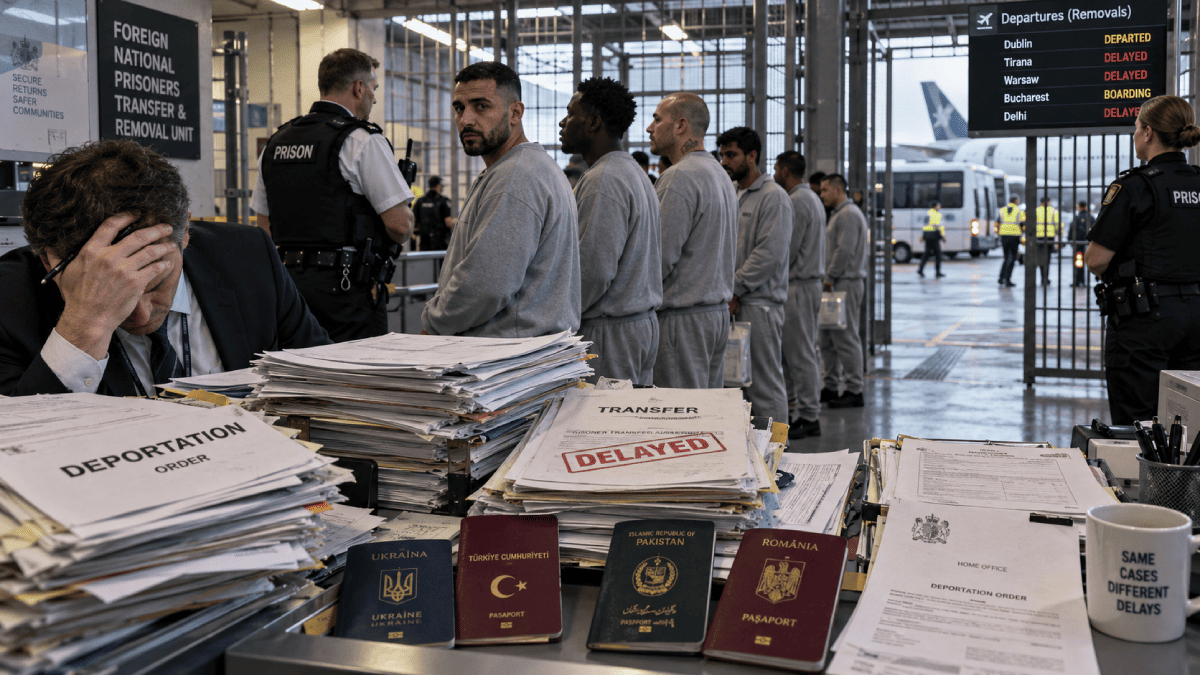
Foreign presidents fly to London when they fall ill. Yet the health service's most visible commercial activity, judged by the political noise it generates, is chasing tourists for unpaid invoices.
The answer is to commercialise it.
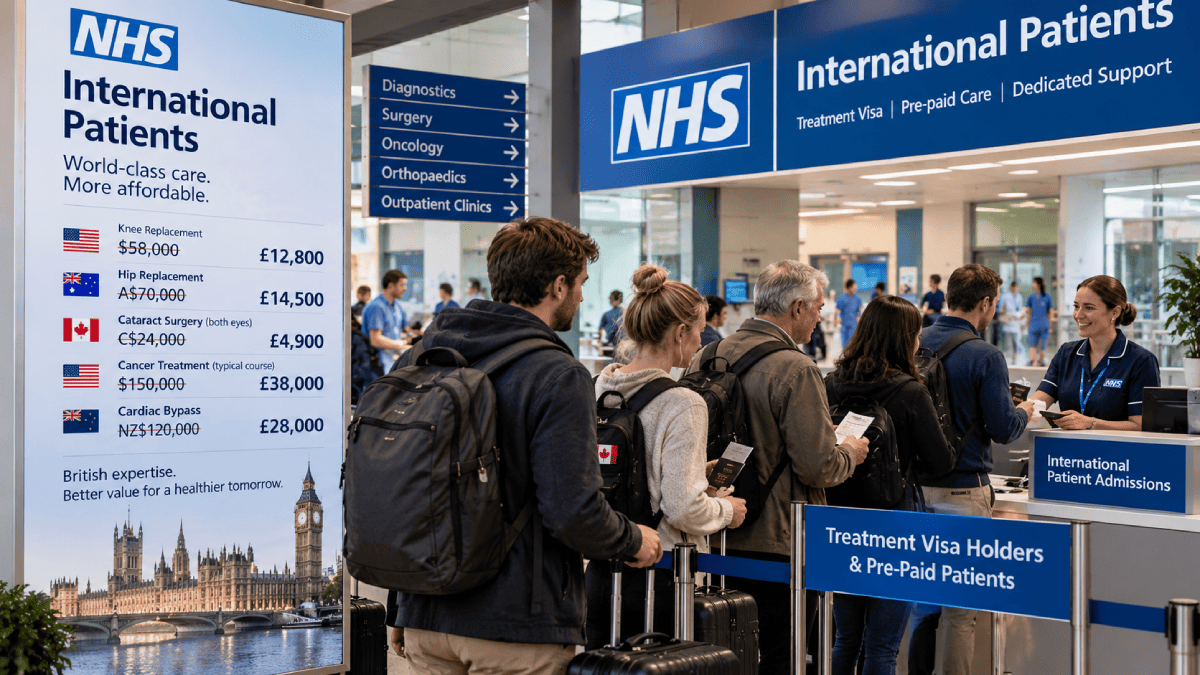
Point the NHS outward, sell its surgery, its consultants, its brand, and its training to every country with a queue, a cash surplus, or a broken hospital system, and make the customers pay before they board the plane.
Trade unions will hate it. Good.
Labour will hate it. A bonus.
Communists will hate it. Exceptionally good.
The people who describe the NHS as a national religion will hate it more. Both reactions are a sign of a good idea.
 Alex Coppen

£384m Invoiced, £131m Received
Under the National Health Service (Charges to Overseas Visitors) Regulations 2015, chargeable visitors from outside Europe are billed at 150% of the NHS tariff. On paper this looks like a premium. In practice the money rarely arrives.
A Policy Exchange report found NHS trusts in England invoiced overseas patients £384 million between 2021 and 2024.
They collected £131.8 million.
A further £167.9 million remained outstanding and £84.5 million had been written off for good.
Sajid Javid, health secretary from 2021 to 2022, put it plainly in the foreword: "The NHS is not a charity."
Britain has built an elaborate apparatus for treating foreigners who cannot or will not pay, and almost nothing for selling treatment to foreigners who would gladly pay up front.
Private Patients Already Pay Handsomely
The Health and Social Care Act 2012 allowed foundation trusts to earn up to 49% of their income from outside the NHS, provided the majority still came from the health service. The Centre for Health and the Public Interest counted 1,142 NHS beds set aside for paying patients as far back as 2015/16.
Analysis by Regent's Park Healthcare puts combined NHS private patient unit revenue at about £850 million in 2024/25, with at least £1.2 billion forecast by 2030/31.
A 2023 University of York study found the Royal Marsden drawing 53% of its income from commercial work, while Guy's and St Thomas' made £441 million commercially in 2021/22.
Foreigners count for far more than their numbers suggest.
Research by the London School of Hygiene & Tropical Medicine and the University of York found international patients made up just 7% of private patients at the foundation trusts studied, yet supplied almost a quarter of private income.
NHS Trusts Don't Know Their Own Costs
When the Centre for Health and the Public Interest examined private patient work, 73 of the 114 trusts reporting private income could not state what treating those patients had cost, mostly because they never measured or recorded it.
Four of the nine hospitals examined in detail made significant losses, one of them losing £18 million over six years.
A hospital selling knee replacements without knowing the cost of a knee replacement is a charity shop built from a surgical theatre.
A hospital forced to quote a fixed price to a Saudi ministry or an Irish health authority must know its costs to the pound.
British taxpayers have spent seventy-eight years failing to impose this discipline on the health service.
Foreign customers would impose it within a financial quarter.
The Moorfields NHS Hospital in Dubai
Moorfields Eye Hospital opened its first overseas branch in Dubai in 2007, owned and managed by the NHS foundation trust. The Dubai hospital has since treated more than 180,000 patients from over 90 countries, added a centre in Abu Dhabi, and sends its surplus back to London to support NHS services. It holds care agreements with Dubai Police and Emirates.
Governments noticed, made speeches, and drifted off.
Andy Burnham, as Labour health secretary, consulted in 2010 on an "NHS Global" body to make money abroad.
The coalition government launched Healthcare UK at the Arab Health Congress in Dubai in January 2013. Healthcare UK now claims over £1.3 billion in NHS-backed contracts since 2016.
The entire sum would not keep the NHS running for a long weekend.
Academia noticed too, mainly to fret. A 2025 paper in Globalization and Health examined the NHS reimagined as an export industry and traced the commodification of NHS access to relations of coloniality.
Selling a cataract operation to a Dubai police officer apparently now requires a theory of empire.
Every System On Earth Is Failing Somebody
The market for British medicine is no single country. Each health system breaks in its own way, and each breakage produces a different customer.
Gulf governments have the money but not enough specialists, so their health ministries pay cash to send complex cases abroad, and Kuwait has sent thousands of cancer, heart, and paediatric patients to foreign hospitals.
Ireland has the opposite problem. Its public system has more than a million people waiting, and its Health Service Executive already pays for hips and eye operations across the border in Northern Ireland.
Canada rations by queue, and over 100,000 patients a year who refuse to wait go abroad instead.
Sweden's regions promise treatment within 90 days, miss the deadline, and look to other countries for surgery to cover the gap.
Nigeria has lost its doctors and its rulers' confidence, and its citizens spend more than $1 billion a year abroad on care they cannot get at home.
Chinese families send cancer patients overseas in search of better survival odds.
America offers the most expensive medicines in the developed world and the most frightening bills, with medical problems behind two thirds of personal bankruptcies, leaving self-pay patients, employers, and insurers hunting for surgery at half the price.
Britain can sell something to every one of them: complex surgery to the Gulf, day surgery to Dublin, rapid elective operations to Canadians and Swedes, hospitals run on the Moorfields model and second opinions to Lagos and Beijing, and a fixed price to Americans.
None of these customers wants charity. Each wants a quote.
Around 1.5 million people travelled to Turkey for health care in 2024, spending more than $3 billion, and Ankara has set a target of $20 billion a year by 2028. The average Turkish medical tourist spends roughly $2,000, on teeth, hair, eyes, and weight-loss surgery at prices no British hospital could approach.
Britain's market sits at the complex end: cancer, cardiac surgery, neurosurgery, children's specialist care, and rare disease, where a ministry or a family chooses on reputation first and price second.
There is one exception: nedicine prices make a poor export.
Eli Lilly's chief executive David Ricks had already called Britain "probably the worst country in Europe" for drug prices, and Lilly had raised the UK private list price of Mounjaro from £122 to £330 a month for the highest dose.
Manufacturers will close any gap in pill prices the moment foreigners start queueing at a British pharmacy.
The durable British advantage lies in everything a drug company cannot reprice: the operation, the nursing, the bed, the scan, and the consultant's hour.
Gulf Ministries Pay Cash For London Prices
Gulf governments send their most complex patients abroad at public expense, companions and all. In 2017 Saudi Arabia funded 2,401 citizens for treatment overseas at a cost of about SR3 billion, or $800 million. The United States took 1,307 of those patients at roughly SR1.54 million each.
Britain took 236, at around SR361,000 each.
Britain treated Saudi patients for roughly a quarter of the American price and still won under a tenth of the business. A country capable of losing on those terms has not tried.
Kuwait shows the opposite risk.
A British export service would take sovereign deposits up front, settle monthly, and stop admitting a ministry's patients the day its account fell into arrears.
Selling to governments works beautifully when the invoice comes first.
Ireland Already Buys Surgery in Belfast
The Republic of Ireland's National Treatment Purchase Fund reported 1,040,698 people on a hospital waiting list at the end of September 2026. Some 64,718 had waited eighteen months or longer.
Dublin already pays to send patients north.
Under the Northern Ireland Planned Healthcare Scheme, launched in 2021, more than 2,600 Irish residents travelled to Northern Ireland for private treatment in its first eighteen months, mostly orthopaedics and eye care, at a cost of over €9 million to the Health Service Executive.
The money went to private clinics.
Public hospitals in Belfast, Newry, and Derry, sitting a short drive from the same patients, took none of it.
A commercial NHS would sign a standing contract with Dublin, build dedicated day-surgery units along the border, and bill the Health Service Executive by the hip.
Canada Exports Its Queue
Canada's single-payer system is a cherished national symbol, and like most national symbols it moves slowly. The Fraser Institute found Canadians waited a median of 28.6 weeks from GP referral to treatment in 2025, with around 1.4 million procedures outstanding across ten provinces. Neurosurgery patients waited 49.9 weeks; orthopaedic patients waited 48.6.
An estimated 105,529 Canadians left the country for treatment in 2025, a figure the Fraser Institute itself regards as an underestimate. Most of them head south to American prices.
There are two choices: pay American prices for a same-day appointment, or book into a Mexican clinic with a questionable safety record.
Britain shares Canada's language, its head of state, and its legal traditions, and could undercut Boston and Cleveland comfortably.
Ottawa's other contribution to health tourism has been to make assisted death more accessible. We will not be providing that, as thankfully the National Suicide Service was defeated.
Sweden Outsources Its Health System
The supposed utopia of Sweden promises treatment within 90 days under its care guarantee, and its regions routinely send patients elsewhere when they cannot meet it.
In 2021 the northern region of Norrbotten sought to buy operations in orthopaedics, gynaecology, ear, nose, and throat, and general surgery from providers in other Nordic and European countries.
Scandinavian regions buy surgery in bulk, pay on time, and publish their tenders.
An NHS trust with spare theatre capacity, built for the purpose, could bid for every one of them.
Exporting Nigerian Doctors Back To Nigeria
Nigeria's own minister of state for health said in 2017 the country lost more than $1 billion a year to medical tourism through a loss of confidence in its health care. President Muhammadu Buhari spent 171 days in Britain on medical trips during his first years in office, which tells Nigerians everything about where their rulers place their trust.
Nigeria has the third largest contingent of foreign doctors working in Britain, with 9,976 Nigeria-trained doctors reported in 2022.
Britain imported the doctors. It may as well sell their services back.
Wealthy Nigerians, oil companies, and the Nigerian state already pay for London treatment.
A Moorfields-style NHS hospital in Lagos or Abuja, owned by a British trust and staffed partly by returning diaspora consultants, would bring the care to the customer and the profits home to Britain.
Its critics will call this "neo-colonial". Its patients will call it a hospital.
China's Cancer Treatment Problem
China's National Health Commission reported in 2018 over 600,000 Chinese patients sought treatment overseas in a single year, around 80% of them with cancer.
Chinese officials cited the gap between five-year cancer survival rates at home and in developed countries, and the country's lag behind the West in drug development.
Britain's oncology centres, led by the Royal Marsden and The Christie, are exactly what such families seek.
Many will never travel.
They can still buy second opinions, remote treatment planning, and clinical training, sold by NHS consultants over a video link and billed in yuan.
America Bankrupts The Rest
The United States remains the largest prize, if no longer the only one.
| Hip replacement, self-pay | Typical price |
|---|---|
| United States | $30,000 to $45,000 |
| United Kingdom, private | £11,000 to £17,000 |
| Turkey, international patient | €9,100 to €16,900 |
Ranges from a 2026 comparison by Acibadem. The Horder Centre puts the average UK private price at £13,698.
A RAND study for the US Department of Health and Human Services found American prescription drug prices in 2022 ran at 278% of those in 33 comparison countries.
A study led by David Himmelstein found medical problems contributed to 66.5% of American personal bankruptcies, around 530,000 families a year.
The Congressional Budget Office expects the One Big Beautiful Bill Act, signed on 4th July 2025, to add 10.9 million people to the uninsured by 2034.
The British offer to Americans: a fixed price agreed before departure, a named consultant, a fortnight's recovery in Cambridge, a gentle punt along the Backs once the stitches allow, and a cup of tea served by someone who has never heard of a co-payment.
A Pre-Paid NHS Treatment Visa
Britain already lets foreigners in for private treatment. The Standard Visitor route permits stays of up to 11 months for private medical care. It treats a Saudi child's cancer surgery much like a weekend shopping trip, and it gives hospitals no structure for selling at volume.
A British Medical Treatment Visa would turn permission into a product. You pay for your treatment before you land, and any extra before you leave. And the City can set up its own lending schemes.
| Feature | Rule |
|---|---|
| Admission | An accredited hospital issues a priced treatment contract before travel |
| Payment | Full estimated cost lodged in escrow, or guaranteed by an approved insurer, employer, or foreign government |
| Complications | Compulsory cover for complications, readmission, and repatriation |
| Companions | One carer or close relative admitted on the same terms |
| Entitlements | No free NHS care, no right to work, no recourse to public funds |
| Duration | Tied to treatment and recovery, extendable only on clinical evidence |
| Overstaying | Forfeits a cash bond and bars future applications |
We know exactly what botched foreign surgery costs, because we pay the bill when our own citizens come home from cut-price clinics abroad. A review led from Cardiff University put the cost to the NHS of treating such complications at between £1,058 and £19,549 per patient. A British export scheme should never hand another country the same headache.
The real money lies in bulk contracts: Gulf ministries, the Irish Health Service Executive, Nordic regions, oil companies, and American employers who fund their own staff health plans.
A guaranteed annual order for 2,000 cardiac procedures lets a trust borrow, build, and hire against a known income, which no grant from Whitehall has ever reliably allowed.
Foreign Money Must Build New Theatres
With 7.37 million treatments waiting, critics will ask why a British surgeon should spend a single afternoon on a Kuwaiti. Foreigners did not build the queue. It grew under an arrangement in which overseas patients barely feature, and it will not shrink because the NHS refuses their money.
The test is whether foreign revenue adds operating theatres, beds, and staff, or merely rents out the ones British patients already queue for.
Six rules would enforce the test:
- Export work runs through separate subsidiaries or wings with their own accounts, theatres, and beds.
- Every surgeon, anaesthetist, and nurse hired for export work counts as an additional head, published by post, with poaching from neighbouring NHS hospitals tracked and penalised.
- Each trust publishes an annual ledger of revenue, full costs including buildings and borrowing, surplus, and money transferred to NHS care.
- The surplus goes directly into cutting domestic waits at the parent trust.
- Export work is suspended automatically if independent figures show local NHS waits worsening because of it.
- Paying foreign patients never receive priority for emergency care, intensive care beds, or donor organs.
None of these conditions is exotic. Most are simply the accounts any company already keeps.
£5-6 Billion A Year In Revenue
Let's assume an average bill of £20,000 for complex care and a surplus of 20% after full costs. It could be cash up-front or from City lending programs, as required. But each is paid in advance of arrival.
| Patients/year | Revenue | Surplus at 20% |
|---|---|---|
| 50,000 | £1.0 billion | £200 million |
| 150,000 | £3.0 billion | £600 million |
| 300,000 | £6.0 billion | £1.2 billion |
Illustrative scenarios, not forecasts.
Even the largest scenario produces a surplus worth about 0.6% of the £202 billion health department budget.
Medical exports will not pay for the NHS. Nothing will, except taxpayers or a cheaper NHS.
An export wing selling hips to Dublin and heart surgery to Riyadh would need a published price list, audited costs, and staff paid commercial rates for commercial output.
Once such a price list exists, the rest of the health service faces an awkward question every time the same operation costs more down the corridor.
Competition would arrive inside the NHS through a side door, carrying a foreign passport.
In Lieu Of A Real Alternative
The NHS was founded in 1948 as a "national gift." Seventy-eight years later it functions as a national monument: enormous, revered, and permanently short of money. It is terminally flawed, bleeds money, kills thousands, and its defenders are religious zealots who do loyalty dances and collective performances for socialism.
Monuments earn nothing. Shop windows do.
Britain has the surgeons, the hospitals, the universities, the language, and a brand foreign governments still trust.
Ireland has a million people waiting. Canada exports a hundred thousand patients a year. Riyadh pays four times the British price to send its patients to America. Nigeria's rulers already fly to London. Turkey has shown how fast a determined country can build the trade.
Sell them British medicine.
Charge properly, collect in advance, publish every penny, and spend the proceeds on British patients.
If the NHS cannot learn what its own operations cost from the taxpayers who fund it, it can learn from customers who refuse to pay a bill they cannot read.