How States Break: Overthrowing The Establishment In A Week
Whitehall waves 146,000 police officers and 70,000 soldiers about like proof of strength. Only a sliver of either can be sent anywhere in a hurry. Leviathan governs on borrowed obedience, and nobody in charge has asked how many of its hidden props could fail at once.

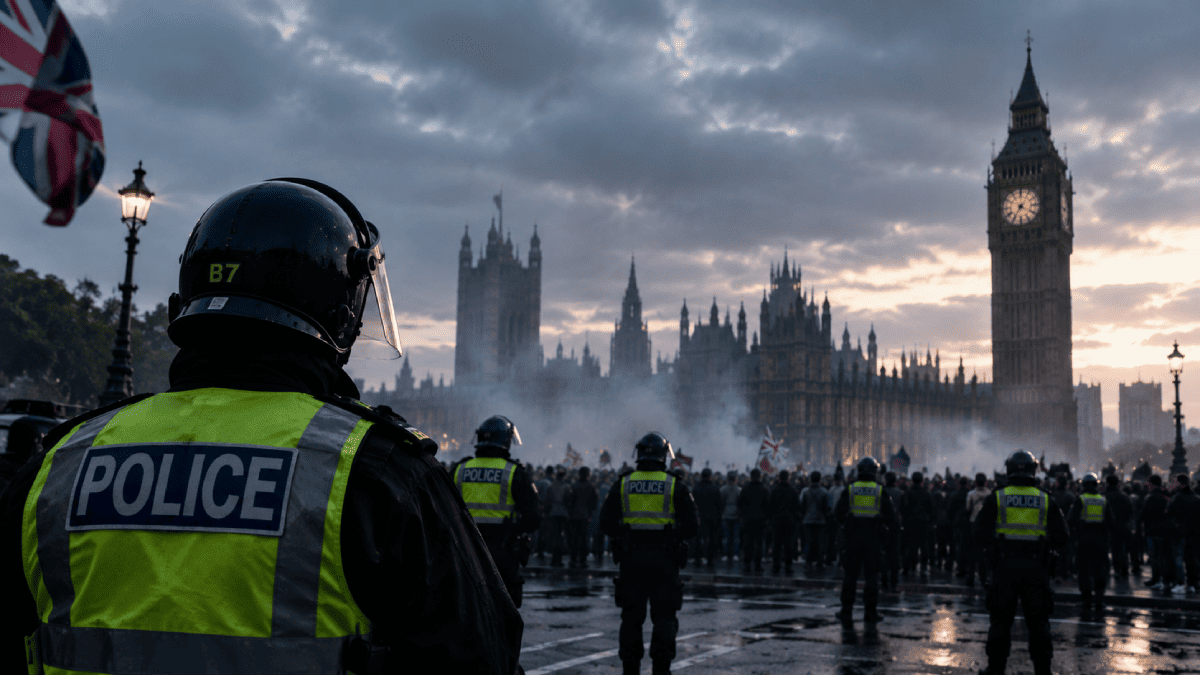
Guy Fawkes went about breaking the British state with thirty-six barrels of gunpowder and a cellar under the House of Lords. His theory was simple: kill the King, the Lords and the Commons in one blast, and the realm would have no head.
Four centuries later the state he targeted no longer lives in one building. A modern plotter would need rather more than gunpowder. He would need to stop HMRC collecting tax, the DWP paying pensions, forty-three police forces answering 999 calls, and several thousand councils sending out the bin lorries on Tuesday.
Ministers find this comforting. They should not.
On paper the British state is a colossus. It commands police forces, an army, intelligence agencies, prisons, courts, local government, emergency services, taxation and a communications network reaching every household. Governments of both parties sell these numbers to voters as a measure of strength.
Almost none of them describes power the state can turn into coordinated action at a few days' notice. It is an illusion, at best.
Between what Britain nominally possesses and what it can concentrate, deliver, and sustain lies a gap. States break inside gaps of this kind, and the British one is wider than anyone in Westminster cares to admit.
How strong is Leviathan really? It turns out this bloated and overgrown beast is perilously fragile.
230,000 Officers Vs 55.7 Million Adults
Count every body in the United Kingdom carrying a warrant card, a customs commission or an arrest power, and the total looks reassuring. The 43 territorial forces of England and Wales are only the start.
| Enforcement body | Approximate strength |
|---|---|
| Territorial police, England and Wales | 145,886 officers |
| Police Scotland | 16,402 officers |
| Border Force | about 10,000 staff |
| Police Service of Northern Ireland | about 6,300 officers |
| National Crime Agency | about 6,000 staff |
| Special constables, England and Wales | 5,196 |
| British Transport Police | about 3,200 officers |
| Ministry of Defence Police | about 2,500 officers |
| Royal Military Police | about 2,500 personnel |
| Civil Nuclear Constabulary | more than 1,800 officers and staff |
Add the roughly 22,000 operational prison officers and the total edges past 220,000. Behind them sit HM Coastguard's 400-odd staff and 3,000 volunteer rescue officers, along with a small army of council enforcement officers, DVSA examiners, HMRC investigators and immigration enforcement teams.
Ministers could, in a crisis, reach for all of them. This is known as Military Aid to the Civil Authorities (Maca).
The trouble with this reserve is simple. None of it is spare.
Every one of those bodies already has a full-time job, and most of the jobs matter more in an emergency, not less.
- Border Force guards ports and airports, which are precisely the places a disordered country most needs watched. Its officers hold customs and immigration powers. They are not constables, and pulling them inland empties the border.
- The Ministry of Defence Police and the Civil Nuclear Constabulary are armed guards for military bases, warheads and power stations. They have reinforced civil forces before: the Ministry of Defence Police sent every available public-order officer to London in 2011, and the Civil Nuclear Constabulary now supplies more than 60 per cent of the country's armed policing surge capacity. Each time, somebody has to decide which nuclear site or munitions depot can manage with fewer guards for the duration.
- The British Transport Police already struggle to cover the railway.
- The National Crime Agency is a few thousand investigators chasing organised crime, not a riot reserve.
- The Royal Military Police exists to police the armed forces.
- The coastguard pulls people out of the sea and has no arrest powers at all.
A drafted border officer or nuclear constable is a body moved from one gap to another.
In a single crisis the swap may be worth making. In a crisis touching ports, railways, power stations and city centres at once, the reserve turns out to be the same people counted twice.
The 2017 Manchester Arena bombing showed how thin the arrangement is. Under Operation Temperer (the plan to deploy troops to support and free up police officers in key locations following major public disorder) the government deployed 984 soldiers to guard Parliament, stations, embassies and Sellafield, out of 3,800 earmarked, simply to free armed police for patrol.
One attack, and the state reached straight past its entire civilian enforcement apparatus for the Army.
Even the biggest block, the territorial police of England and Wales, shrinks fast under inspection. A payroll composed with a significant level of "female officers" is not a fighting strength, and every politician who quotes the first number as though it were the second is selling something.
| Force | FTE |
|---|---|
| Police officers | 145,886 |
| of whom classed as frontline | 115,764 |
| of whom in local policing | 55,561 |
| of whom in investigations | 23,676 |
| of whom in public protection | 15,298 |
| Officers on long-term absence | 6,670 |
| of whom on long-term sick leave | 3,358 |
| Police staff and designated officers | 81,296 |
| PCSOs | 7,259 |
| Total paid workforce | 234,441 |
| Special constables (headcount) | 5,196 |
Of the 145,886 officers, 115,764 count as frontline. Only 55,561 work in local policing.
Another 23,676 sit in investigations and 15,298 in public protection, chasing burglars and murderers and shielding children and vulnerable adults.
A further 6,670 were on long-term absence, 3,358 of them on long-term sick leave. Policing runs around the clock, so each officer works a fraction of the week's 168 hours.
At any moment large numbers are off shift, on rest days, on leave, in training, giving evidence in court or at home with a bad back. Of those on duty, only some can walk away from normal work without the 999 queue backing up. Of those, a smaller number hold public-order training. Of those, fewer still can be gathered in one place. Of those, fewer again can be kept there for a week.
Four quantities matter, and official rhetoric blurs all of them.
- Nominal capacity is everything on the books.
- Deployable capacity is what can be released from normal duties.
- Coordinated capacity is what can be moved, commanded and supplied as one force at one place.
- Sustainable capacity is what can be kept there, day after day, while losses are replaced.
A country can hold enormous resources while possessing a modest ability to concentrate them where and when they are needed. Ministers announce the first number. Riots test the last.
Police Limits: Three Riots At Once
His Majesty's Inspectorate of Constabulary found the number of officers holding Level 2 public-order training fell from 20,234 in July 2022 to 18,351 in July 2024. Level 3 trained officers fell from 43,507 to 38,315 over the same period.
Nobody decided it. Nobody noticed it. It simply happened.
The national mobilisation requirement never expected all 18,351 in the field together. The Strategic Policing Requirement sets the formal target:
- 297 Level 2 Police Support Units across England and Wales;
- 75 additional PSUs for London;
- 234 Level 3 Basic Deployment Units;
- 18 Attenuating Energy Projectile (rubber bullet) teams, trained to fire baton rounds.
A Police Support Unit consists of an inspector, three sergeants and eighteen constables, plus three drivers and their vehicles. At 25 personnel per unit, 372 PSUs amount to roughly 9,300 public-order personnel, available over a 24-hour mobilisation period.
The entire national response to serious disorder rests on those 9,300 people, for a population of more than sixty million.
HMICFRS reported the PSU calculation had historically rested on the expectation of three simultaneous seats of significant disorder lasting seven days.
Three.
For a week.
After the summer of 2024 the inspectorate concluded this method was no longer suitable, which is a polite way of saying events had already blown through it. It also found some specialist capabilities were neither clearly defined nor counted, so nobody could say with confidence how much mutual aid really existed.
Here is the British state's strength and weakness in one planning assumption.
It is very good at pouring resources onto a small number of identifiable problems.
Its danger grows with every additional problem drawing on the same reserve, and its planners built the reserve for three.
Southport Needed 6000 Officers
Between 1st and 18th August, under Operation Navette, policing generated 44,438 public-order officer shifts. Daily specialist deployments climbed steeply.
| Date (August 2024) | Officers deployed |
|---|---|
| 1st August | 750 |
| 3rd August | 3,750 |
| 5th August | 4,825 |
| 8th August | 5,150 |
| 10th August (peak) | 6,675 |
A national strategic reserve was scraped together and units were shuttled between regions. The peak of 6,675 officers represented about 72 per cent of the formal 9,300 Level 2 requirement. Getting there meant cancelled rest days, rewritten shift patterns and ordinary policing left threadbare elsewhere.
The bill came in bodies.
The Home Affairs Committee recorded 302 police officers injured, of whom between 54 and 69 needed hospital treatment, depending on the stage and definition used.
The state won.
It also burned through nearly three-quarters of its formal specialist mobilisation target at the peak, against disorder which never came close to threatening the existence of the state.
Anyone calling that a comfortable margin has not done the sums.
Force Is Only As Large As Replacements
Strength at the start of a confrontation is the least interesting number in British policing, and the one politicians quote most. What decides outcomes is the regeneration rate: the speed at which the state can replace what an emergency consumes.
That means injured, exhausted and sick officers.
It also means damaged vehicles, worn-out kit, full custody suites, commanders who need sleep, investigators drowning in footage, and the back-office staff who keep rotas, overtime and logistics moving.
Below are the numbers on a single deployment of 500 public-order officers losing 30 people a day to injury, exhaustion or other unavailability. Each day it loses 6 per cent of its starting strength. Ish.
| Day | Remaining | Cumulative losses |
|---|---|---|
| 1 | 500 | 0 |
| 2 | 470 | 30 |
| 3 | 440 | 60 |
| 4 | 410 | 90 |
| 5 | 380 | 120 |
| 6 | 350 | 150 |
| 7 | 320 | 180 |
After six days of losses, 36 per cent of the original force has gone.
Every replacement comes from somewhere, and the real denominator stops being the original 500. It becomes the finite national pool of trained officers as Southport demonstrated.
At thirty losses a day, one sustained confrontation devours 210 trained people in a week, 420 in a fortnight and around 900 in a month.
One troubled town could, over time, eat a serious slice of the country's specialist public-order strength while the Home Office's headline workforce figure looked as healthy as ever.
Public-order policing runs on helmets, shields, flame-retardant clothing, radios, protected carriers, command vehicles, medics, fuel, food, water, evidence-gathering kit and the mechanics who keep the fleet moving.
None of it is a static stockpile.
Vehicles need servicing and repair. Radios fail. Carriers get bricked and burned. PPE has to be replaced.
After the 2024 disorder it set out to expand its Level 2 trained population to about 4,500 officers, with a plan to sustain 96 PSUs every 24 hours for ten days or more. At 25 per unit, roughly 2,400 public-order deployments a day, drawn from a pool of around 4,500. The Met also had about 220 protected public-order carriers and approved the purchase of 96 more, at a capital cost of around £10.8 million, alongside additional protective equipment.
Britain's largest force needs nearly two trained officers on the books for every one it hopes to keep on the street each day.
The rest of the country is in no better position.
London Had To Be Rescued In 2011
The riots of August 2011 remain the cleanest modern demonstration of concentration deciding an outcome. The Home Affairs Committee set out the London figures.
- About 3,000 uniformed officers were on duty on the evenings of 6th and 7th August.
- About 6,000 were deployed on Monday 8th August, and the Met reported those resources were stretched by simultaneous incidents across the capital.
- On Tuesday 9th August deployment rose to 16,000 uniformed officers, including about 3,750 public-order officers.
- Around 1,705 of those public-order officers arrived through mutual aid from other forces.
The committee concluded the surge in numbers was crucial to restoring control. The lazy conclusion is "more police works".
Wrong.
London was rescued because large parts of Britain were quiet that week and could spare their officers.
Had Manchester, Birmingham, Leeds, and Bristol burned on the same nights to the same degree, there would have been nobody left to send.
Surveillance Isn't Enforcement
Britain's coercive apparatus extends far beyond policemen and soldiers. Its surveillance infrastructure encompasses approximately 120 identifiable monitoring and information systems, covering communications, financial transactions, vehicle movements, biometrics, facial recognition, online activity, and government records.
You can study them all here:
 Editor
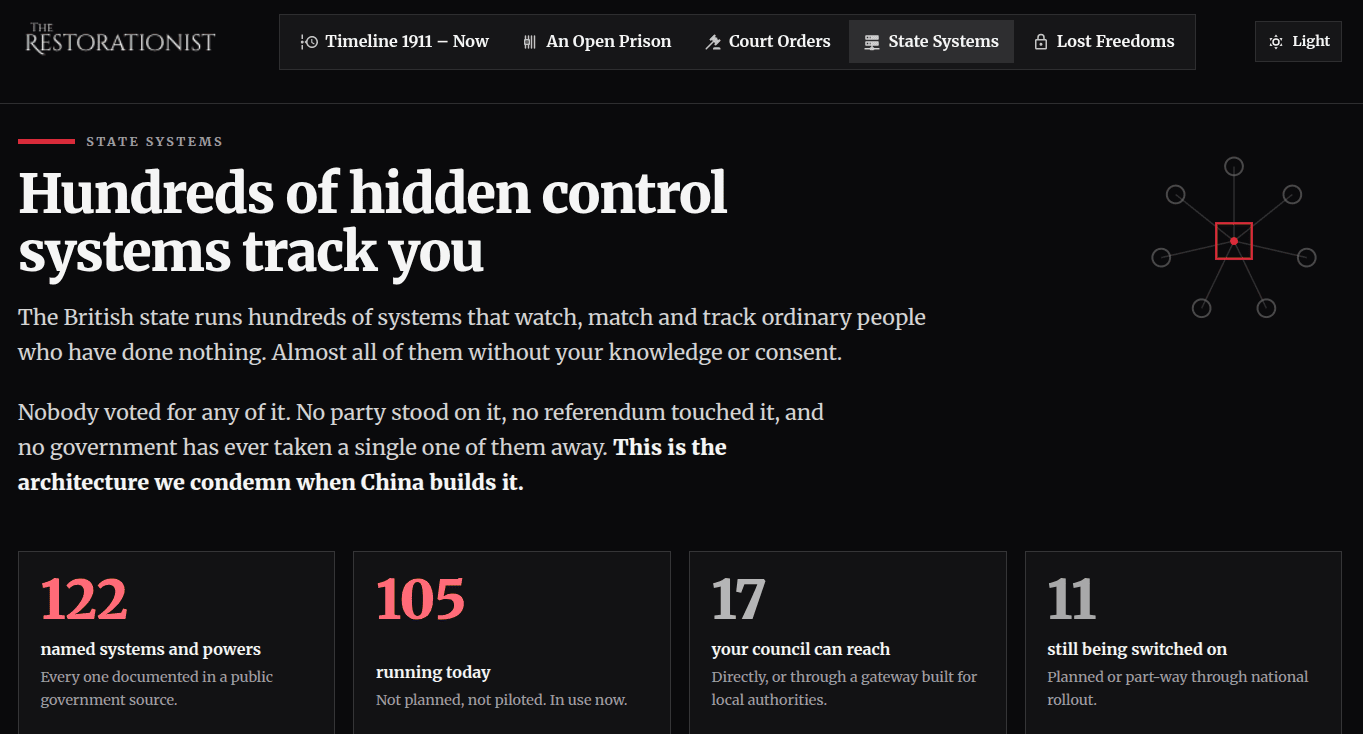
The National Automatic Number Plate Recognition Service receives more than 100 million vehicle observations daily from 12,076 fixed camera sets and 1,878 mobile cameras. Records are ordinarily retained for one year. That amounts to more than 36 billion observations annually, although many concern the same vehicles.
The Home Office reports retrospective facial recognition identified 127 suspects following the August 2024 disorder. The Metropolitan Police conducted 180 live facial recognition deployments in 2024, compared with 32 in 2023. Police also maintain national fingerprint and DNA databases, while communications providers can be required to supply specified records under the Investigatory Powers Act.
The Investigatory Powers Commissioner oversees the exercise of investigatory powers by approximately 600 public authorities. Its 2024 report recorded 363,656 warrants and authorisations across the powers reported, including different forms of surveillance and communications-data acquisition. These are distinct legal instruments, not all judicial warrants.
The result is a state capable of reconstructing journeys, identifying faces, tracing communications and assembling evidence long after an event. Britain has accumulated an extensive machinery for monitoring its population, much of it operating continuously and without requiring an officer's physical presence.
Leviathan has acquired an extraordinary number of eyes. It has not acquired a corresponding number of hands.
20 Riots Are Harder Than 1 Large Protest
Concurrency is the state's soft underbelly. One major crisis has somewhere to draw reserves from. Twenty simultaneous crises start raiding each other's.
A crowd of 50,000 people in a single city is geographically legible. Command can be concentrated. Reinforcements have one destination. Custody, intelligence and logistics can all be organised around a known area.
Twenty towns each holding 2,500 determined participants present twenty command problems, twenty custody problems, twenty supply chains, twenty intelligence pictures and twenty competing bids for the same reserve units.
Meanwhile every one of those twenty towns still expects its domestic abuse calls answered and its road accidents attended.
Size has three dimensions, and official planning has mostly worried about one:
- mass scale, meaning how many people are involved;
- geographical scale, meaning how many places are affected at once;
- institutional scale, meaning how many parts of the state are being loaded at the same time.
The third may matter most, because every serious incident creates demand well behind the police line. It needs control-room operators, custody officers, investigators, intelligence analysts, prisoner transport, evidence handling, Crown Prosecution Service lawyers, court time, medical support, vehicle maintenance and command staff.
Ten simultaneous incidents of 1,000 people can strain the state far more than one incident of 10,000, because they multiply every one of those secondary demands by ten.
The Miners' Strikes And Game Ground
In April 1984 the Home Office told Parliament on some occasions around 7,000 officers from outside forces had been deployed simultaneously into the coalfields, on top of large numbers of local officers. Metropolitan Police mutual-aid deployments alone totalled 7,695 in September 1984, with tours lasting between one and eight days.
It was a formidable display of power, sustained for a year.
It was also fought on the state's preferred ground. The dispute was concentrated in identifiable coalfields, the opponent was a single organised movement, and the rest of the country was broadly calm.
National reserves could be assembled and rotated against a known target for as long as the government chose.
Distributed disorder across dozens of unconnected places would have offered no such gift.
Fragile Illusion Vs Stubborn Intransigence
Dominic Cummings has spent several years insisting the gap between apparent and actual state power is wider than Westminster admits, including in his talks for the Pharos Foundation in Oxford.
He describes a state in which formal authority and practical executive ability have drifted apart.
- Bureaucracies run themselves with nobody in effective control.
- Ministers carry responsibility for systems they cannot command.
- Decision-making seizes up whenever events fall outside established procedure.
- Institutions advertise abilities they may struggle to exercise in a genuine emergency.
His favourite exhibit is Covid procurement, where rules written for ordinary government produced plainly unacceptable results in a crisis unless ministers explicitly overrode them.
He argues similar obstructions run throughout Whitehall, and attacks what he calls "fake responsibility", "fake meritocracy" and "fake Cabinet Government": formal structures concealing where real decisions are made, and by whom.
His historical parallel is 1848. Decades of apparent stability conceal slow institutional rot. Elites fail to notice conditions worsening. A sudden shock arrives, and political change previously unthinkable happens within weeks.
Britain has deep sources of resilience, and they come from the very permanence and redundancy Cummings finds so infuriating.
Governments fall while HMRC keeps collecting tax, the DWP keeps paying pensions and benefits, the NHS keeps treating patients, councils keep emptying bins, courts keep sitting, the Bank of England keeps operating, the lights stay on and police forces keep answering calls.
A Whitehall incapable of reforming itself can still be very hard to knock over. Inertia is a defence as well as a disease.
Interdependent Systems Means Fragility
Four things must be kept separate: the government, the regime, the state and the nation. The fall of a ministry is not the fall of the state. The loss of a city centre is not the loss of the country.
It's often said control of institutions would be required. Seizing or isolating Parliament, Broadcasting House or an airport would deliver control of very little beyond the building itself. A temporary victory while Leviathan re-settles.
The British state consists of networks, databases, payroll systems, courts, police forces, councils, utilities, banks, telecoms, logistics chains and millions of routine administrative acts carried out every day by people who never give the constitution a moment's thought.
Distributed administration and the internet make the modern state far harder to decapitate than its Victorian or Edwardian predecessors. There is no throne room to storm.
The same complexity breeds a different weakness: interdependence.
A Victorian state needed little technology simply to keep existing. Modern Britain depends continuously on electricity, data networks, card payments, telecommunications, fuel distribution, digital records, refrigeration, transport software, satellite navigation and just-in-time supply chains.
Modern government can do vastly more than its nineteenth-century ancestor. It also rests on many more systems which cannot simply stop for a week while the trouble blows over, and almost nobody in government could tell you which of them would fail first.
70,000 Troops Not Trained Or Available
Behind the police stands the Army as the coercive reserve. On 1st July 2026 the British Army had a Full-Time Trained Strength of about 75,200, of whom around 70,950 were trade-trained, according to the Ministry of Defence's quarterly personnel statistics.
Britain does not possess 70,950 interchangeable domestic security troops, and anyone who talks as though it does has never looked at an order of battle.
A modern army consists of engineers, signallers, gunners, air defenders, logisticians, intelligence staff, medics, mechanics, headquarters personnel, trainers and people committed overseas, alongside its infantry and armoured units.
Headquarters Standing Joint Command coordinates the armed forces' contribution to UK resilience through Military Aid to the Civil Authorities.
Government policy has long stated there are no standing military forces held for these tasks. Support is not guaranteed, and the civil authorities normally get the invoice.
The figure worth knowing is the number of suitably trained personnel who could be diverted into sustained domestic operations without wrecking the Army's other commitments.
The Ministry of Defence publishes no such number.
It would be far smaller than the headline strength, particularly over weeks rather than days, and the silence is telling.
Northern Ireland Is The Template
At the height of Operation Banner in the early 1970s, more than 20,000 regular troops were deployed in the province, supported by locally recruited forces. Contemporary accounts put the total military presence in 1972 at around 27,000 personnel spread across more than a hundred bases.
In July 1972 about 21,500 regular troops were present. (Forces News; RTÉ)
The regular Army of the period numbered roughly 180,000, so the Northern Ireland commitment at its peak swallowed about 12 per cent of it, before counting the training, logistics and rotation machinery behind it in Great Britain.
With a provincial population of about 1.5 million, the peak ratio was in the order of one military person for every 55 residents.
Even at that density, the state did not achieve ubiquitous physical control. Barricaded no-go areas in Derry and Belfast survived until Operation Motorman on 31st July 1972.
Operation Banner lasted 38 years.
More than 300,000 service personnel passed through it, and 1,441 died during it, 722 of them in paramilitary attacks.
Military substitution for police is possible. It is also manpower-hungry, ruinously expensive and dependent on endless rotation. And it was carried out by an army more than twice the size of today's.
Obedience Is The Force Multiplier
No democratic state has enough police or soldiers to compel its population. There is no constable for every citizen who might refuse an instruction, and there never has been. The system works because almost everybody complies almost all of the time.
Taxes are paid. Court orders are obeyed. Drivers pull over when the blue lights appear. Businesses follow regulations. Civil servants process ministerial decisions. Crowds generally disperse when told. Employers administer government rules on the state's behalf, unpaid. Banks freeze accounts when the court says so.
The coercive apparatus exists to mop up the exceptions. Its power is multiplied many times over by expected compliance.
The monopoly of force is, in large part, a confidence trick in the literal sense: a system running on confidence.
The police do not need to overpower the population.
The population needs to believe resistance will eventually fail. This belief can remain entirely rational even while the number of people able to enforce every rule at once stays remarkably small.
One person refusing an instruction is trivial. A hundred is manageable. Ten thousand refusing the same instruction independently hands the state ten thousand separate enforcement problems.
Spread those ten thousand across twenty towns, and the state must divide its forces instead of massing them.
The arithmetic does not degrade gently. It flips.
Mass Peaceful Refusal And The Pipeline
Violence, perversely, can make the state's job easier. Public-order law, protective equipment and specialist tactics are built for violent disorder, and violence hands police a clear legal and tactical objective.
Mass peaceful refusal is a far uglier problem for the state.
Each person who declines to move, cooperate or obey may have to be dealt with individually.
Crowd management turns into a long grind of physical contacts, arrests, vehicle journeys, custody bookings, interviews, evidence packages, court hearings and remand decisions.
The measure which matters is the contact fraction: the share of a crowd requiring direct physical intervention by the state.
- A crowd of 20,000 in which 100 people need handling is a policing operation.
- A crowd of 20,000 in which thousands independently need handling is a logistics crisis.
The headline crowd size matters far less than the number of individual enforcement acts the state must perform, and every one of those acts feeds a pipeline already close to full.
Zero Capacity To Try Or Imprison
England and Wales recorded about 754,046 arrests in the year to March 2025, an average of around 2,066 a day. Police custody systems recorded about 938,050 detention episodes across reporting forces, roughly 2,570 custody admissions a day averaged across the year.
These figures describe enormous throughput, and throughput is easily mistaken for capacity.
The system copes only because people keep moving through it: arrest, custody, interview, then release, bail or charge, and the cell becomes free again.
A machine capable of processing nearly a million detentions a year cannot hold a million people at once, or anything remotely like it.
The coercive machinery is a pipeline:
police encounter → arrest → police vehicle → custody suite → custody staff → solicitor → CPS → magistrates → court cells → prisoner transport → remand → prison.
Its capacity is set by whichever stage chokes first. In Britain, several are already choking.
The far end of the pipeline is close to full.
| Prison measure | Figure |
|---|---|
| Prison population, 30th June 2026 | ~85,858 |
| Usable operational capacity | ~89,120 |
| Headroom | 3,262 places (about 3.7%) |
| Prisoners on remand | ~15,386 |
| Prisoners held in crowded accommodation, 2025-26 | ~23.9% |
| Band 3-5 operational prison officers, 2026 | ~22,000 |
| First receptions, January to March 2026 | 17,945 |
Britain can push tens of thousands of people through its prisons in a few months and still cannot absorb a few thousand extra at the same time.
Flow capacity is not stock capacity.
A state which cannot hold more than about 3,000 additional prisoners is in no position to threaten mass arrests, whatever its Home Secretary says on the radio.
Successive governments have already shown how pressure travels backwards through the system. Under Operation Safeguard, triggered in November 2022 for the first time since 2007, police cells were used to hold prisoners who would normally have gone into the prison estate. Between February and July 2023 an average of 274 police cells a day were taken up this way, at a cost of £30.2 million.
Under Operation Early Dawn, defendants were summoned to magistrates' courts only once a prison cell had been confirmed for them if remanded; until then they sat in police stations. The government reactivated it in August 2024, in the middle of the disorder.
Police planning papers describe Early Dawn as the national response when available prison places fall below 450, with a further stage, Operation Brinker, imposing a one-in, one-out regime if Early Dawn proved insufficient.
- A one-in, one-out regime for the prisons of a G7 country.
- Prisons fill.
- Courts cannot remand.
- Defendants stay in police cells.
- Police lose custody space.
- The ability to make further arrests contracts.
The state cannot arrest its way through a mass emergency, because it has officers enough to make thousands of arrests and nowhere to put the people arrested.
The courts sit in the middle of the same pipeline, and they are already drowning. As of June 2026, according to the Ministry of Justice's criminal court statistics:
- the magistrates' courts had about 380,230 open cases;
- the Crown Court had about 80,829 open cases;
- around 23,706 Crown Court cases had been open for more than a year.
A political crisis generating thousands of extra prosecutions would land on a justice system already carrying roughly 461,000 open criminal cases.
The state's formal authority to prosecute is unlimited.
Its ability to prosecute at any useful speed is already exhausted.
1 Million Firearms Do Not Make A Trained Army
Private firearms come up in every pub argument about state power, usually with more heat than arithmetic. England and Wales contain a substantial stock of legally held rifles and shotguns, recorded in the Home Office's certificate statistics, and the weapons covered number well over a million.
Sporting guns scattered across farmhouses and gun cabinets are not organised military power. Guns do not a revolution make.
The Provisional IRA's firearms came from the US in the 70s, but its primary supplier through the 80s was Libya. It's funding and training came from the Soviet Union, which built on an agreement made during the 1920s.
What turns weapons into force is everything around them: command, communications, training, ammunition supply, transport, medical support, discipline, leadership, intelligence and cohesion.
History is brutally consistent here.
The loyalty of organised security forces has mattered far more than whether civilians own one million guns or two.
When Soldiers Stop Obeying
The most consequential resource any state owns is its own institutional cohesion. Neither automatic obedience nor automatic defection by police and soldiers can be assumed, and governments which assume the first tend to discover the second too late.
Many of the revolutions people remember did not happen because civilians suddenly gathered enough weapons to defeat an intact modern state.
They happened when soldiers, police, officials, local elites or bureaucracies became neutral, divided or unwilling to keep carrying out orders.
Four cases show different routes by which formal authority stopped turning into effective authority. Their institutions, levels of violence, political movements and outcomes differed enormously.
Paris in 1848
In Paris in February, the National Guard, the citizen militia the July Monarchy relied on, would not defend Louis-Philippe against the crowds, and the King abdicated within days. Revolt spread to Vienna, Berlin and across the Italian and German states within weeks.
London supplied the contrast.
When the Chartists gathered on Kennington Common on 10th April 1848, the government had sworn in tens of thousands of special constables, mostly ordinary middle-class volunteers, and the day passed off without upheaval.
The British state of 1848 survived because large numbers of its citizens turned out to defend it. Whether today's would is a question no minister has thought to ask.
Russia, February 1917
The Tsar ordered the Petrograd garrison to suppress strikes and bread riots. On 27th February the Volynsky Regiment mutinied instead, and other units followed through the day until, by the evening, tens of thousands of soldiers in the capital had gone over Nicholas II abdicated within days.
The Russian Empire still nominally commanded millions of men under arms. None of them were in the right place and willing at the right moment.
France, May 1968
Student protest grew into a general strike involving around ten million workers, the largest in French history. On 29th May de Gaulle vanished from Paris, flew to Baden-Baden to see General Massu (commander of French forces in Germany) and returned the next day to dissolve the National Assembly and call elections.
Gaullists won a large majority in June.
Authority can look fragile with terrifying speed, and legitimacy can return just as fast when the institutions hold and the army stays loyal.
Romania, 1989
Protests began in Timișoara on 16th December. Security forces fired on crowds, but by 20th December the army in the city had refused further orders and returned to barracks.
After Ceaușescu's televised balcony speech collapsed into jeering on 21st December, the army switched sides almost wholesale; the dictator fled Bucharest by helicopter the next day and was shot on Christmas Day.
A regime with one of the most feared security apparatuses in Europe fell in nine days.
The same features recur: elite division, hesitation or defection by the security forces, administrative paralysis, economic interruption, a collapse of confidence, and the sudden disappearance of assumptions which had looked permanent only days before.
Losing A Street Is Not Losing The Country
Street control and state control are separate things. Losing several streets, a few neighbourhoods or even a city centre for a night or two does not mean losing Britain, however breathless the rolling news coverage.
- The British state can communicate from elsewhere and administer from elsewhere.
- It can identify participants afterwards from cameras, phones and forensic evidence, and arrest them days or weeks later; the courts in 2011 and 2024 did exactly this, and handed down sentences with remarkable speed.
- It can move national resources once the scale of a problem sinks in.
Equally, seizing Parliament, Broadcasting House, Heathrow or any other symbolic building would not deliver control of the country.
The modern state lives in networks.
Its distributed design makes it hard to decapitate physically. It also leaves the state hostage to a very large number of systems continuing to work at once.
Compounding Crises Since 1969
Every major British crisis of the past half-century probed a different weakness, and the state's record is far patchier than its defenders like to pretend.
Operation Banner in Northern Ireland, 1969 to 2007, tested soldiers as a substitute for police. It proved the thing can be done, at the price of enormous manpower for nearly four decades.
The 1981 riots tested local police strength in Brixton, Toxteth, Moss Side and elsewhere. Forces lost the streets repeatedly and won them back only with reinforcement. Merseyside resorted to CS gas, the first time police had fired it on the British mainland.
The miners' strike of 1984-85 tested national mutual aid against a concentrated, organised opponent. The state sustained vast concentrations for a year because its enemy obligingly stayed in one place.
The Poll Tax riot of 31st March 1990 tested public-order command in central London. Of 2,198 officers on duty, 374 were injured. Order was restored the same night. Margaret Thatcher was gone within eight months and the Community Charge within three years.
The fuel protests of September 2000 tested the supply chain. Small groups at a handful of refineries and depots blocked six of the eight major refineries within days, emptied pumps across the country, and pushed the government into emergency powers and a hurried redesign of its fuel-crisis planning.
Oldham, Burnley and Bradford in 2001 tested the response to communal disorder spread across several towns. More than 400 officers were injured. In Bradford alone deployment rose to almost 1,000 officers, and more than 300 were hurt.
The England riots of August 2011 tested what happens when incidents erupt simultaneously across a capital and several cities. Local forces were overwhelmed until national concentration arrived.
The 2024 Southport riots tested the modern national mobilisation system at high intensity. Thousands of trained officers were shuttled around the country, propped up by cancelled rest days and emergency prison measures.
11 Kinds Of State Failure
"Failure" covers very different events, and most loose talk about state collapse, from doom-mongers and complacent officials alike, comes from running them together.
- Tactical failure means police temporarily losing control of streets, as in Brixton in 1981 or Tottenham in 2011.
- Capacity failure means resources exist nationally but cannot be concentrated fast enough. London between 6th and 8th August 2011 is the textbook case.
- Concurrency failure means too many simultaneous incidents carving up the reserve. England in 2011 came close, and HMICFRS found the national plan built for no more than three.
- Attritional failure means people, vehicles and kit consumed faster than they can be replaced. Britain has not yet been pushed to this point, and the trained-pool arithmetic shows how quickly it would arrive.
- Processing failure means arrests outrunning custody, court or prison throughput. Operations Safeguard and Early Dawn were the early warnings.
- Systems failure means a breakdown in one network spreading into others, as the fuel protests of 2000 demonstrated.
- Administrative failure means legal authority existing while the machine cannot act on decisions, which is the heart of Cummings's account of Covid procurement.
- Political failure means order restored while the policy or the government cannot survive. The Poll Tax is the British example.
- Legitimacy failure means enough citizens refusing to recognise authority for ordinary instructions to become unenforceable. The nationalist no-go areas of Derry and Belfast between 1969 and 1972 lived it.
- Institutional failure means police, army, bureaucracy or courts ceasing to act as one system. At the Curragh in 1914, cavalry officers made clear they would resign rather than coerce Ulster, and the government backed down.
- Regime failure means the bodies able to coerce and administer no longer recognising one political authority. In 1688 John Churchill and much of the officer corps went over to William of Orange, and James II fled.
These categories must not be collapsed into one another.
- A government can lose a riot without losing the state.
- It can restore order and still lose politically.
- It can hold legislation granting sweeping emergency powers while lacking the vans, cells and court time to use them.
- It can keep an army while losing that army's willingness to perform one particular domestic task.
The government itself can disappear while most of the administrative state carries on paying pensions.
Confidence == Compliance
The British state is a confidence and compliance system. It does not need enough force to dominate seventy million people physically. It needs enough effective force, administrative competence and institutional legitimacy to sustain the general expectation of its instructions being carried out in the end.
This makes Leviathan simultaneously stronger and more fragile than its headline numbers suggest, and its custodians understand neither half.
It is stronger because Britain has distributed institutions, mature mutual-aid arrangements, professional police and armed forces, deep administrative continuity, large financial resources, national communications, a formidable ability to investigate and prosecute after the event, and a proven capacity to concentrate force once it understands a crisis.
It is more fragile because all of this rests on assumptions invisible to almost everyone, including most of the people running it:
- most people comply;
- trouble comes in sequence, not everywhere at once;
- quiet areas can reinforce troubled ones;
- police losses stay replaceable;
- vehicles and equipment are repaired faster than they are lost;
- the Army remains available as a reserve;
- prisons keep accepting manageable flows;
- courts keep processing cases;
- infrastructure keeps working;
- civil servants carry out decisions;
- security forces recognise the political centre;
- goods keep moving;
- information keeps moving;
- the public keeps believing the state will prevail.
Every one of those assumptions is under strain today. Several are already failing quietly, and nobody in authority is counting them together.
Nobody serious expects a crowd to defeat the British Army. It could. But it wouldn't, because we love and respect the men of our army.
The stress test worth running asks how many of the assumptions multiplying the state's power can fail at the same time before its enormous nominal resources stop turning into actual authority.
Whitehall has never published an answer, and there is little sign it has ever asked.
Removing The Stage Props One by One
Tomorrow we remove the assumption of normal circulation, examining a general strike and severe nationwide disruption to transport and freight.
Next we remove reliable infrastructure and ask when failures in electricity, communications, payments, water, health and logistics begin cascading into disorder.
On the 5th November, we remove sufficient police capacity at the same moment as political non-cooperation builds around Westminster, the Army is weighed as a substitute reserve, and sectarian migrant or communal ethnic disorder elsewhere makes competing claims on the same forces.
At the end of the week, we ask the final question: if the existing political state genuinely collapses, what do you replace it with, without destroying the nation it administered?
Britain's state is nowhere near as weak as a crude comparison between police numbers and population might suggest. Nor is it remotely as omnipotent as its ministers and their headline figures pretend.
Its real power lies in the enormous multiplier created by routine cooperation.
When almost everybody obeys, a small coercive apparatus can govern tens of millions. When compliance, infrastructure, logistics, institutional cohesion and reinforcement start failing together, the arithmetic turns very quickly, and the people in charge will be the last to notice.
That is how states break.