The Army Can't Stop A Joint General Strike And Road Blockade
Ministers treat the Army as the answer to a general strike. Its record says otherwise: a week to reach a forecourt, drivers barred from jumping red lights, and a Defence Chief refusing to play spare labour. Britain runs on moving goods, and no statute can order them to move.

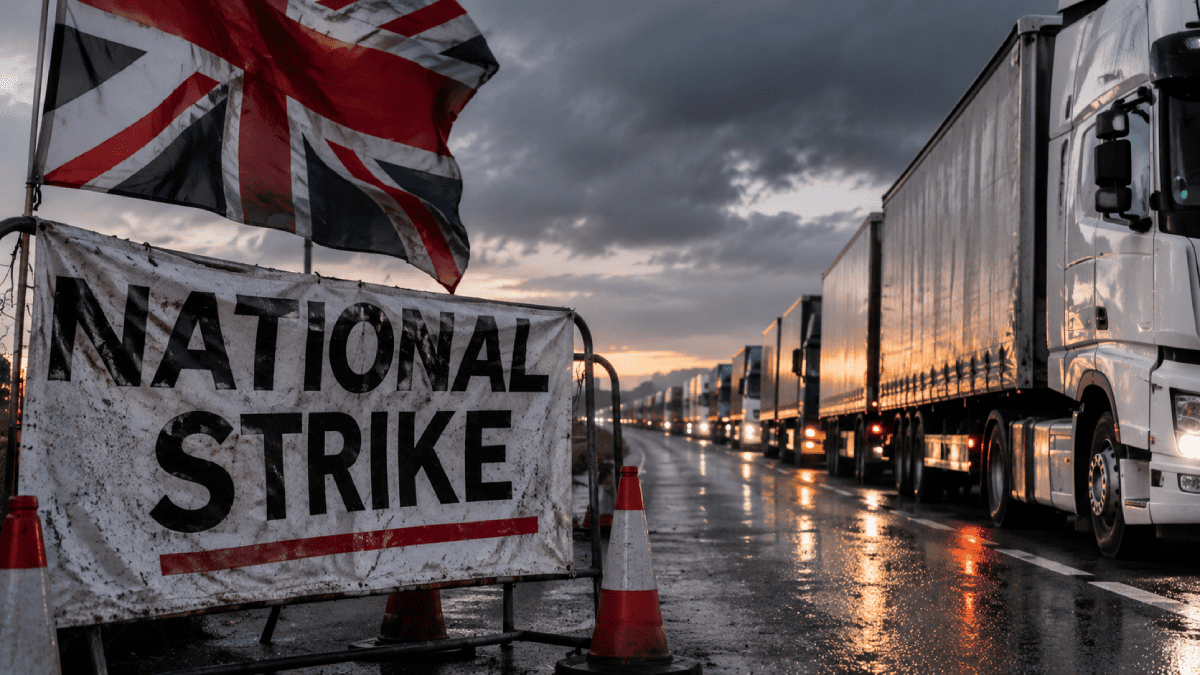
In September 2000 a few farmers and lorry drivers parked outside Britain's oil refineries and humiliated the government. Nobody bombed anything. The crude sat safely in its tanks and the refineries stood intact.
Small groups turned up at the gates, the tankers stopped rolling, and by 15th September an estimated 90 per cent of filling stations were empty.
Tony Blair had a landslide majority, the British Army, and every police force in the land. The men at the gates had tractors.
Within days the Conservatives led Labour in the polls for the first time in eight years.
Seventy-four years earlier the unions had tried the other method.
Between 1.5 and 1.75 million workers walked out in May 1926, on top of about 1.075 million in the coal stoppage. The bare threat of it had already forced Stanley Baldwin into a humiliating climbdown on Red Friday the previous summer.
When it came, transport seized up and the Cabinet found itself recording, with a straight face, the end of racing and the survival of cricket.
England has given its rulers two nightmares worse than any riot. Everybody stops working, or a few people stop the fuel.
Neither needs a thrown brick. Both go straight for the throat of modern government, which is the assumption tomorrow's lorry will turn up.
Whitehall's answer to both nightmares has four letters: MACA: Military Aid to the Civil Authorities. When the pumps run dry, send for the Army. Ministers say it the way a child says the grown-ups are coming.
The grown-ups are not coming.
There are too few of them, they arrive late, and they have told ministers to their faces they are not spare.
A general strike and a arterial blockade is a combination no British government has had to face, and is unlikely to ever overcome.
Take a national crisis over immigration and proposed expulsions, bitter enough to have gone far beyond marches. A general strike follows, with heavy disruption to haulage, ports, fuel distribution, rail, and warehousing at the same time. Which side is striking makes no difference. A diesel tank has no opinion on the Immigration Rules.
What happens if Britain stops moving for a week with a general strike and lorry blockade?
Four Million Tonnes A Day Doesn't Wait
Politicians talk about the economy as though it lived in a Treasury spreadsheet. It lives on a lorry. The Department for Transport's figures for 2025 show what the country's comfort actually rests on:
| 2025, simple averages | Year | Per day | Per week |
|---|---|---|---|
| Goods lifted by GB-registered HGVs | 1.53bn tonnes | 4.2m tonnes | 29.3m tonnes |
| Distance driven by those HGVs | 19.0bn km | 52m km | 364m km |
| Freight through all UK ports | 428.3m tonnes | 1.2m tonnes | 8.2m tonnes |
Freight does not arrive in tidy daily portions, and a pallet can be lifted twice on its way to a shelf. The scale survives the caveat.
Those lorries drive the equivalent of 1,300 laps of the equator every day, and moved 162 billion tonne-kilometres of freight last year.
Food, fuel, medicines, industrial inputs, building materials, retail goods, parcels, waste, and farm produce all ride on the same national conveyor belt.
Food alone was 219 million tonnes lifted in 2023. Rail, the alternative beloved of conference speeches, is a distant third behind road and water.
Stop the belt and demand does not stop with it.
A nation still eats, bleeds, and fills its bins on a strike day. Monday's undelivered freight joins Tuesday's queue.
A strike runs up a debt, and every morning the debt is bigger.
51 Major Ports Serving People's Food
Spread a map on a Whitehall table and Britain looks impossible to stop: 51 major ports, a long tail of minor ones, thousands of miles of road, depots in every county. In 2025 the major ports took 419.5 million of the 428.3 million tonnes crossing British quays, and the minor ports scraped 8.8 million. International traffic came to 336.1 million tonnes: 237.5 million in and 98.6 million out, the ledger of a country living on what it buys.
The ten largest ports handled 73 per cent of major-port traffic. London took 13 per cent, Grimsby and Immingham 11, and Milford Haven 9.
Dover alone handled 18.5 million tonnes of roll-on, roll-off freight, or 19 per cent of the national total. France accounted for 21 per cent of this traffic and the Netherlands 19.
Defra's own figures show how dependent the breakfast table has become on the shortest crossings: 42 per cent of imported dairy and eggs, 39 per cent of meat, and 29 per cent of fruit and vegetables.
Ministers will insist freight can simply divert. Ask them how they know. They will be vouching for a capacity their own department cannot measure.
Defra admits an evidence gap, at port level and national level alike, on how easily food traffic can be switched between ports.
Britain had eight major refineries in 2000 and has four now. The priority list of 2000 implied about 12,800 filling stations.
A network can look vast and still hang from a small number of busy channels, and a generation of efficiency has sold off the spare ones.
A Larder On The Motorway
Through Covid, the new EU border, and Russia's invasion of Ukraine the population never faced a sustained shortage of food items. The trade rerouted, reformulated, and coped. Credit where it is due. Britain feeds itself by constant replenishment, and Defra concedes the just-in-time model leaves "very low stockpiles (if any)" anywhere in the chain.
Single points of failure are compounded by a low-stock approach across many businesses.
Even the British loaf is exposed: the Bread and Flour Regulations 1998 demand calcium carbonate in non-wholemeal flour, the supply now rests on a single French quarry, and some larger mills take one or two tanker loads a week.
Those past shocks mostly hit prices or foreign supply.
The domestic machine for moving what was already here kept running. Nobody should take comfort from surviving a test which never touched the drivers, the depots, or the docks.
Every Power But No Plan
Ministers announced the 2000 blockade was not the British way and rummaged through the cupboard. An Order in Council under the Energy Act 1976 produced reserve powers. The Civil Contingencies Committee convened.
Some 3,200 petrol stations, about one in four, and 2,500 fuel depots became priority suppliers, with another 300 outlets for essential users such as the emergency services and parts of the food industry.
Then Lord Brabazon of Tara asked whether some of the priority sites had ceased to exist. Lord Macdonald, the Transport Minister, conceded inaccuracies, misdated the first ministerial meeting, and had to borrow a colleague's diary to correct himself.
The legal powers everyone had been so solemn about were never used. Local councils and police improvised the whole thing on a non-statutory basis, and ministers gave chief officers no instructions on ending the protests.
The state held every legal authority it could want and had almost nothing ready for the crisis in front of it.
The Institute of Directors put the damage at around £1 billion.
Ministers were reduced to thanking the TUC and the CBI for helping to end it, while Lord Tebbit asked on what exact date Labour had discovered it was wrong to use industrial power against a government.
Jack Straw, normally a scumbag, at least told the truth. Just-in-time chains brought efficiency, the Home Secretary admitted, and left "the life of the nation" exposed. His task force built early warnings, contingency plans, and joint crisis management with industry, police, and unions.
On 8th November Gordon Brown froze fuel duty and scrapped excise duty on farm vehicles. It was far less than the protesters wanted.
The morning papers needed two words all the same: "PROTEST PAYS".
Military Aid Comes With No Guarantee
The real inheritance of 2000 was a promise of Ministry of Defence drivers for tankers as a last resort. Today the scheme is Operation ESCALIN, and on 20th January 2026 Michael Shanks confirmed its survival by raising the hourly charge to hauliers from £28.51 to £34.44.
A national fuel emergency, priced like a plumber.
ESCALIN is one branch of MACA, and the public imagines MACA as a reserve army of helpers waiting in barracks.
Read the Ministry of Defence's published policy and the picture falls apart.
There must be a definite need and a clear task. Other options, including commercial ones, must be discounted. The request goes through the department's operations directorate and needs a minister's signature, unless life is at immediate risk.
The customer gets the bill, which ran at about £4,000 a week per soldier in the strikes of 2022 and 2023. And the sentence every Home Secretary should have tattooed on one arm:
As there are no standing military forces for these tasks, military support is not guaranteed.
It comes, says the policy, from spare capacity.
On 18th December 2022, with 1,200 troops drafted to cover striking ambulance and Border Force staff, Admiral Sir Tony Radakin gave ministers his view of spare capacity. The armed forces, said the Chief of the Defence Staff, are "not a spare capacity", and leaning on them to cover strikes was "slightly perilous".
The Telegraph reported Army fury at soldiers giving up Christmas, and defence officials complained about covering for strikers on a smaller pay rise and with no right to strike of their own.
A statute from the Second World War, kept alive by the Emergency Powers Act 1964, lets servicemen be put to "urgent work of national importance".
It does not make them paramedics. Soldiers driving ambulances cannot run a red light, because a uniform confers no professional powers. A House of Lords committee has already said the armed forces cannot serve as a civil protection force.
Parliament, the Chief of the Defence Staff, and the department's own policy have all warned ministers.
Ministers keep the fantasy anyway, because the alternative is admitting they have no plan.
The Army Maths Gets Worse Every Time
Armies cost a lot of money. Which the government doesn't have, and can only get from issuing IOUs to markets who won't lend to a country about to remove its government. They certainly won't get it from tax.
| Year | Crisis | Service personnel |
|---|---|---|
| 1984 | Dock strike plan, never used | 2,800 |
| 1984 | Coal haulage plan, never used | 4,500 drivers |
| 2002 | Firefighters' strike | 19,000 |
| 2021 | Forecourt panic | 222 drivers |
| 2022 | Ambulance and Border Force strikes | 1,200 |
Margaret Thatcher's secret dock plan needed 2,800 troops to unload 1,000 tonnes a day, and a state of emergency simply to let them touch the cranes. Her coal plan needed 4,500 service drivers and 1,650 tipper lorries to shift 100,000 tonnes a day.
Those were the plans of a government with a far larger Army, facing one dispute in one industry.
Today, at 22 tonnes a day per driver, the 4.2 million tonnes British lorries lift each day would take about 189,000 soldiers.
The Army's trained regular strength stood at 70,870 on 1st July 2026.
Every cook, clerk, signaller, and infantryman in it would cover about a third of the job, in lorries nobody has supplied. Run the dock ratio across the whole Army and it unloads about 2 per cent of a normal day at the ports.
The sums are crude, and modern kit would beat them in places.
Nobody could close the gap with kit. Replacing Britain's 283,000 HGV drivers at the 2022 charge-out rate would cost about £1.1 billion a week, if the country owned 283,000 spare soldiers.
James Callaghan's government reached the same conclusion in January 1979, as lorry and tanker drivers strangled the country.
The Cabinet Office drew up Operation Drumstick to put soldiers in tanker cabs. It needed a state of emergency to requisition the oil companies' assets, and it died on 18th January after Bill Rodgers argued the troops could cover only a fraction of the drivers.
In 2002 and 2003 about 19,000 service personnel stood in for 55,000 firefighters, on nuclear-era Green Goddess engines, while Washington was asking for British forces for Iraq. Admiral Sir Michael Boyce said the quiet part aloud:
We can't perform at the full extent of our operational capability while 19-thousand people are tied up.
One profession, on strike, tied up the equivalent of more than a quarter of today's trained Army.
Then let's look at speed.
In September 2021, with no strike at all, panic buying began on 24th September. The Defence Secretary approved the request on the 28th.
Drivers needed up to three days of extra training.
The first deliveries began on 4th October, ten days in, and 222 drivers eventually reached civilian hauliers, with a Reserve Tanker Fleet of 80 vehicles in the background.
A week of national paralysis would be over before the first convoy left the depot.
When bin workers went on all-out strike in Birmingham in 2025 and the council declared a major incident, the great military rescue consisted of a small number of office-based planners.
A trained tanker driver keeping a hospital's fuel depot alive does more for the state than a rifle company on a street corner, and substituting for missing civilians is plainly its best use in a strike. It can protect the handful of functions which must survive.
It cannot run a country.
Those same people are pencilled in for Operation Temperer, disorder, floods, and the war in Europe everyone keeps warning about, and a soldier in a tanker cab is in only one place.
Diesel passed £2 a litre on 2nd October, the UK imports nearly 55 per cent of its supply, and reserves were reported at 42 days.
Keir Mather, a transport minister, calls this robust.
Forty-two days of diesel feeds nobody from inside a storage tank.
And all of this assumes the Army wants to support the government, when it is only sworn loyal to the Crown.
National Strikes Are Bloodless Coercion
A riot asks whether the state can restore order, and the state has shields, cells, and courts for the purpose. A strike asks something nastier: can the state run the economy without the people who run it?
- Police cannot drive every lorry.
- Soldiers cannot staff every warehouse.
- Government cannot command every checkout, depot, signal box, and maintenance shed in the land.
The wider the stoppage, the more brutally ministers must decide what lives and what is left to die.
The 162 million working days lost in 1926, the worst year on record, came largely from the miners' stoppage and the General Strike, and the state still won.
It won because it had prepared for years.
It revived its Supply and Transport Committee in 1923 and used the nine months bought on Red Friday to prepare. The Organisation for the Maintenance of Supplies appeared in September 1925, and a full plan followed by December.
When the day came, Hyde Park became a food depot and warships landed supplies at Liverpool. The TUC surrendered unconditionally after nine days, and Baldwin's government then banned sympathetic strikes.
Nothing in Britain today is comparable to the old unions. Density stands at 22.4 per cent, and 33.2 per cent in transport and storage, and road freight is scattered across 46,310 enterprises.
No Triple Alliance survives to pull the lever.
The volunteers of 1926 drove vans and ran power stations. Nobody is handing a load of hazardous fuel to a keen young man from a Cambridge college; tanker drivers need specialist licences.
And in 1926 a General Council could walk into Downing Street and end the whole business in a morning.
A stoppage spread across thousands of small firms and self-employed drivers has nobody to surrender on its behalf.
The men who beat Tony Blair in 2000 had no general secretary at all.
CCA 2004 Cannot Ban Strikes
The state's defence runs in layers: commercial rerouting, industry fuel plans, coordination under the Civil Contingencies Act 2004, police protection for essential activity, MACA, and at the very top, emergency regulations under Part 2 of the Act.
Part 2 reads like a dictator's Christmas list.
- Section 19 covers disruption to money, food, water, energy, fuel, communications, transport, and health services.
- Section 22 lets ministers protect or restore those supplies, requisition property, ban assemblies and movement, and deploy the armed forces.
Here at last is the key to Thatcher's cranes and Callaghan's oil tankers.
Then read section 23.
Emergency regulations may not prohibit participation in a strike. They may not conscript a single person.
Any offence they create tops out at three months in prison (in which there is no capacity to hold them), and they lapse within seven days without Parliament's approval.
An amendment to exempt strikes endangering life failed in committee. Grant Shapps proposed scrapping the ban and it survives him.
Government guidance calls these powers a last resort and tells local planners not to assume they will exist.
Nor would they matter much.
A regulation can requisition a lorry. It cannot manufacture a driver, a fitter, or a forklift operator.
A stoppage over expulsions falls outside the statutory definition of a trade dispute, so unions lose their immunity and face damages and injunctions. Workers can be summarily sacked.
Anyone physically obstructing a road, port, or oil depot risks up to twelve months in prison, and the trade dispute defence would be useless to him.
Sabotage (e.g. concrete blocks on railway lines) is a crime of a different order altogether, and it would hand ministers the moral clarity a mass walkout denies them.
Yet the man who simply stays at home has broken a contract and nothing more. Nobody can arrest him.
A democratic state facing millions of absent workers has not acquired millions of prisoners; a custody suite is no use against somebody sitting in his kitchen.
His employer can sack him, of course, in an industry where 26 per cent of firms were already reporting driver vacancies, and then find out who will drive the fleet.
7 Days Of Spiraling Catastrophe
Anyone selling an hour-by-hour timetable for British collapse is a charlatan. Different systems fail at different speeds. The order of events can still be predicted and rehearsed.
The first 24 hours
Queues come before shortages. The stock is there, and so is the public's memory of 2021. People fill up on anticipation alone, and local supply drains faster than any strike could manage. Public bodies open the continuity plans the 2004 Act requires.
Ministers go on television and tell everybody to buy normally, which worked so well last time.
Days 2 -3
Averages stop meaning anything. One town has fuel and bread; the next has neither. Fresh food goes first, since it has the shortest life and the fastest routes.
Fuel becomes the master problem, because almost every other supply chain burns it. The fuel plan lets ministers prioritise the emergency services and ration everybody else, and the fight over who counts as essential begins.
It will be vicious.
In 2000 Lord Macdonald counted 30 categories of essential users and declared theatre cleaners as important as surgeons, while recoiling at the idea of people at refinery gates deciding who might live.
Somebody will be deciding now, and the list grows as the fleet does not.
The government of 1926 refused a TUC offer to cooperate on essential services. A government in 2026 might beg for one, and find no one at the other end of the telephone.
Days 4 - 7
Food, medical supplies, waste, public transport, and industrial inputs all fight over the same drivers and the same diesel. The MACA request forms reach the Ministry of Defence faster than it can answer them, and each one is a demand for soldiers it has already promised somewhere else.
Factories short of parts send workers home, swelling the numbers idle whether they back the strike or not. Bins fill. Managers of ambulance trusts ring Whitehall, and each call exposes another dependency nobody wrote down.
A supermarket can lose a product while the food system functions. A petrol station can close while ambulances stay fuelled. A port can stall while freight diverts. T
he crisis arrives when local shortages become common and connected enough for substitution to stop working, and no official alive can say when.
The UK Can Absorb 1 Failure - Not 5
The state does have real strength. It has many ports, many fuel terminals, big logistics firms, regional depots, rail freight, military transport, and a private sector which reroutes around trouble faster than any ministry.
Recovery can be quick: Lord Macdonald could claim normality restored within a reasonable period, and by late October 2021 forecourt stocks had hit their highest level since May.
The government's published risk assessment rates industrial action as "limited" in impact, with a likelihood of 1 to 5 per cent.
The assessment scenario treats industrial action sector by sector, and every strength listed above is a form of substitution.
- A rail strike pushes freight onto roads.
- A disrupted port sends ships elsewhere, and the cargo still needs dockers, drivers, and a warehouse at the far end.
- Soldiers can ease a driver shortage, provided the depot gates open and somebody is there to load the lorry.
A general strike takes haulage, ports, fuel distribution, rail, warehousing, and local transport in the same week.
- One blocked road has diversions.
- One stricken port has alternatives.
- One strike can be worked around.
Take enough transport modes and labour pools at once and the network runs out of spare routes, and every reassuring sentence in the contingency plan turns out to have assumed another part of the country was still working.
Police reinforcements in 2011 and 2024 came from quiet counties.
Logistics obeys the same rule, and so does MACA.
Britain does not have to run out of food, fuel, or goods for the state to enter crisis.
The systems which move them only have to fall far enough behind demand for substitution and replenishment to stop compensating.
Governments Fold Long Before Larders Empty
Nobody has to starve. Ministers will feel the knife long before material collapse, as businesses close, commuters give up, patchy shelves lead the evening news, and hospital managers go public.
In September 2000 ministers swore no government could let demonstrators dictate policy. By November the Pre-Budget Report had paid up.
Logistics runs on faith.
Shoppers buy a day's food because they trust tomorrow's delivery. Drivers run a quarter-tank because they trust the next forecourt.
Withdraw the trust and demand climbs at the moment capacity falls.
Mass panic is neither inevitable nor necessary. A sensible household which has seen pumps run dry will fill up early, and millions of sensible decisions can do the work of a blockade.
A government confident of its majority might try to sit it out.
Lord Brabazon put support for the fuel protesters at some 90 per cent; a strike over expulsions would split the country far more sharply.
Baldwin sat it out, and the unions ran short of money first. He had spent three years preparing.
Today's state has a tanker roster, a fuel plan, a risk assessment built around individual sectors, a statute forbidding it to ban the thing it fears, and a Chief of the Defence Staff on record refusing to be its spare labour.
It has not faced the real thing in a century. Nobody in office remembers how.
A strike of this kind still touches nothing but the steering wheel. The lights stay on. Card readers work. Depots receive their orders over a live network, data keeps flowing, and water comes out of the tap.
The government's own assessment warns a national power failure would drag down telecoms, water, sewage, fuel, and gas behind it.
Stopping the lorries takes away Britain's ability to move. Whether it can still function standing still is a worse question.