Settlement Year: 3 Referenda With 10 Dangerous Questions
For fifty years MPs have told Britain its views on hanging, borders, speech, and Strasbourg were too complicated to act upon. Hand the country ten brutal questions, three bank holidays, and a pencil. Then watch the most expensively educated people in the land try to wriggle out.
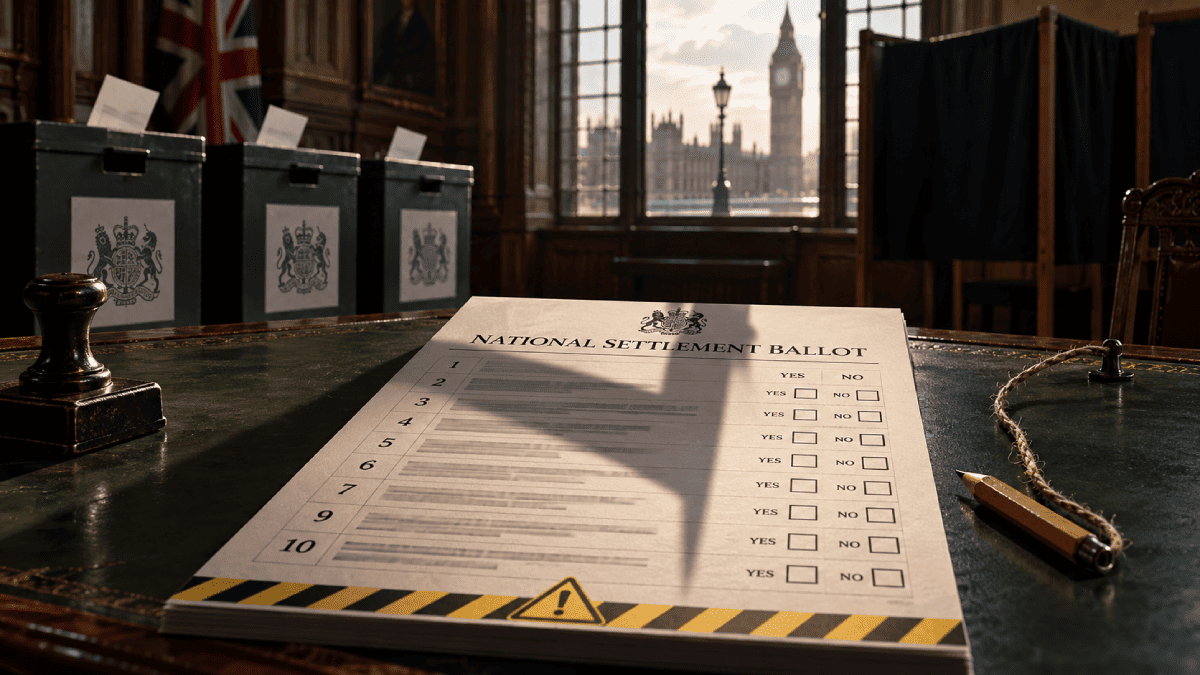
Every British general election asks the voter one question disguised as hundreds: which of these people, if any, would you like to trust for five years? The answer arrives as a single cross in a single constituency. It is stapled to a manifesto bundling waiting lists with defence procurement, tax thresholds with foreign policy, and the party's settled view on human rights with a promise about potholes.
Nobody asks the voter what they think about any of it. They are invited to choose who does the thinking, and then to go away quietly until the next one.
For ordinary government the arrangement works well enough. Nobody wants a plebiscite on frigate procurement or the drainage schedule for the A303. Representatives exist to take thousands of dull decisions citizens have neither the time nor the appetite to take themselves, and most of them manage it adequately. Ish. Kind of.
Then there is the other list.
These are questions of first principle on which the political class reached its own answer decades ago, and has treated public disagreement ever since as a customer complaint about a product the firm has no intention of changing.
Capital punishment. Mass immigration. The European Convention on Human Rights. Whether a Briton may be rude on the internet without a knock at the door from the constabulary.
On these, Westminster's technique is polished, cross-party, and older than most of the people using it. The subject is dissolved into procedural fog: "safeguards", "pathways", "community cohesion", "online harms", "a conversation we need to have as a country".
The conversation never happens. A review is commissioned instead. The review is published on the Thursday before a bank holiday, everyone falls asleep, and the settlement survives another Parliament.
Picture instead one year in which the fog is banned.
Parliament passes a single Act naming ten questions, each phrased as bluntly as English permits. The whole country votes YES or NO on all ten, three times, on three existing bank holidays. Whichever answer wins two of the three ballots becomes law on 1st January and stays protected for 25 years.
No candidates. No parties. No campaigns. No focus-grouped slogans about taking back anything. Just a folded sheet of paper, a stubby pencil on a string, and half a century of accumulated British irritation.
Call it a Settlement Year. It would be the most entertaining constitutional carnage since 1649, with considerably less beheading, depending on how Question 2 goes.
10 Questions Too Dangerous for Any Manifesto
If a mainstream party could print the question in its manifesto without its candidates fleeing the hustings, it is too tame. Tax rates, the licence fee, Lords reform, and voting systems all fail; politicians will happily bore the country senseless about those.
What remains is the list they have spent entire careers edging around, like a man who has spotted his ex-wife in Waitrose.
NATIONAL SETTLEMENT BALLOT
| No. | Question | YES | NO |
|---|---|---|---|
| 1 | Should immigrants living in Britain be required to leave? | ☐ | ☐ |
| 2 | Should the death penalty be restored? | ☐ | ☐ |
| 3 | Should the practice of Islam be prohibited? | ☐ | ☐ |
| 4 | Should Britain leave the European Convention on Human Rights? | ☐ | ☐ |
| 5 | Should the killing of unborn children or terminally ill adults be permitted? | ☐ | ☐ |
| 6 | Should Britain abandon its commitment to Net Zero? | ☐ | ☐ |
| 7 | Should Scotland, Wales, and Northern Ireland continue to have devolved governments? | ☐ | ☐ |
| 8 | Should government have the power to restrict speech solely because it is offensive? | ☐ | ☐ |
| 9 | Should every law-abiding adult have the right to own and carry a firearm? | ☐ | ☐ |
| 10 | Should landowners need government permission to build on their own land? | ☐ | ☐ |
Every question fits on one line. Any schoolchild can understand them. There is no ambiguity whatsoever.
None carries a qualifier, because the qualifier is where Parliament hides its answer. Swap "immigrants" for "illegal immigrants", or "Islam" for "Islamist extremism", and the matter has been decided in a committee room by people who will never have to defend the decision.
The qualifier is the career politician's natural habitat. Remove it and he becomes a hermit crab without a shell: pink, soft, and scuttling for the nearest rock.
- On six questions YES means change.
- On Questions 7, 8, and 10 YES keeps the present law.
- Question 5 manages both at once, since abortion is currently lawful and assisted dying is not.
Anyone planning to tick straight down one column without reading will end up endorsing a programme so incoherent it could only be passed off as a coalition agreement.
Best Of 3 Settles It For 25 Years
A single referendum hands the losing side every excuse in the repertoire, and Westminster can recite them in its sleep. The same nonsense and equivocation is trotted out every time to try to nullify a result which defied the fascist ideological orthodoxy of Lib Dem luvvies in Brighton and Bristol.
- Turnout was odd.
- It rained in the Home Counties.
- The campaign lied.
- Voters were really protesting about something else.
- They did not understand the consequences.
- They were too old.
- They were too young.
- They were misled by a bus advert.
- It's a Russian disinformation conspiracy voters think left-wing ideas are insanely stupid.
Britain heard the full liturgy after 23rd June 2016, and then watched the Commons spend three years rejecting every available version of the result, including every option MPs invented for themselves in the indicative votes of 2019.
Repetition kills most of those excuses stone dead. The rules for each question are independent:
- A simple majority of valid votes decides each ballot.
- Whichever answer wins two of the three ballots becomes the settlement.
- No turnout threshold applies, so nobody who stays at home hands either side a free vote.
- No supermajority applies either. Persistence does the work a 60 per cent hurdle would otherwise do, without making one citizen's ballot worth more than another's.
- All ten questions stay on all three ballots, even after one side has already won twice.
A proposition winning with 54, then 52, then 57 per cent has settled more than the law; it has confiscated every excuse in the building.
- After the first win, the commentariat says the public was angry.
- After the second, it detects support softening.
- After the third, at a higher figure, there is nothing left to say, and the silence on the Commons terrace would be delicious.
A proposition winning 54 and 51 per cent before sliding to 43 per cent is still settled under the two-from-three rule, but the record shows opinion turning, and whoever reopens the matter a quarter of a century later will know it.
Each settled answer commences on 1st January after the Settlement Year and cannot be reversed by ordinary legislation for 25 years. A first-time voter at 18 would be 43 before the matter returned without another three-ballot year, by which point most of the MPs who opposed the result would be in the House of Lords, complaining about it there instead.
Parliament describes its own sovereignty as the power to make or unmake any law, and no Parliament can bind its successors. A 25-year lock therefore relies on political cost; no court would enforce it against a later Act.
The lock still bites, because Parliament has already made its own competence conditional on a popular vote.
Since 2016, section 63A of the Scotland Act 1998 has declared the Scottish Parliament and Government permanent, removable only on the decision of the people of Scotland in a referendum.
A Settlement Act would borrow the same device: any Bill reversing a settlement would first need approval in a fresh Settlement Year.
A future government could repeal the lock, but some minister would have to stand at the despatch box and explain why the public had been asked three times and was now being ignored. Volunteers for the job would be scarce.
Brexit Without the Loose Ends
The European Union Referendum Act 2015 specified the question, the franchise, and the date. It said nothing whatever about what would happen if Leave won, apparently on the assumption it would not. When the Supreme Court decided Miller in January 2017, it held the result could not by itself begin withdrawal, and further primary legislation was required.
Three years of stupid argument about what voters had "really" meant followed, conducted largely by people who had spent the campaign telling voters what they ought to mean.
A Settlement Act writes both outcomes before anyone votes.
For every question, one schedule contains the law commencing on YES and another the law commencing on NO, or a plain statement of the law which continues unchanged.
Voters know exactly what their cross does.
Nobody negotiates afterwards, and no minister gets to "interpret" anything. Interpretation is how Westminster turns a clear instruction into a consultation paper.
- The death penalty schedule must name the offences, the method, the appeal process, and the treaty consequences.
- The planning schedule must list what survives the abolition of planning permission: building regulations, nuisance law, listed buildings, and pollution control.
- The immigration schedule must decide whether "immigrants" includes naturalised British citizens.
Every evasion the Commons normally parks in a future statutory instrument must be settled before the first poll card hits the doormat. For a parliamentary draftsman, it is the equivalent of being made to show his working for the first time since his A levels.
Good Friday + Spring/August Bank Holidays
Voting which happens on bank holidays is already in the calendar. Taking 2027 as an illustrative year, the three ballots fall on Good Friday, 26th March; the Spring Bank Holiday, 31st May; and the Summer Bank Holiday, 30th August. Scotland, for some unknown reason, takes its summer bank holiday at the start of August, so the Act moves the Scottish holiday for one year rather than inventing a new one.
Nobody gains a day off. Everybody gains a reason to use one, which is more than can be said for the average sitting Friday in the Commons.
Polling stations open from 7am until 10pm, the same hours as a general election. Two of the three ballots fall on a Monday, which has a pleasing rhythm. The country votes on its day off, the counts run through the night, and Britain returns to work on Tuesday knowing the answer.
The remaining rules are dull by design:
- One ballot paper. Ten questions on a single folded sheet, each counted separately. A voter who spoils Question 6 has spoiled Question 6 alone.
- One electorate. Everyone entitled to vote at a general election on the date of the first ballot, with the electoral roll frozen for the year apart from deaths and corrections. The same people decide all three rounds.
- Postal and proxy votes carry over automatically from the first ballot to the other two.
- One national count. Local counting officers count and report; the Chief Counting Officer declares the UK result for each question, as the chair of the Electoral Commission did in 2016. Constituencies are irrelevant. A vote in Truro weighs exactly the same as a vote in Tower Hamlets, and no safe seat can bury anyone.
- Challenges go to a panel of three senior judges within 21 days of each declaration, and only on procedure: fraud, miscounts, or administrative failure. No court may decide a question was too wicked to take effect.
The 2016 referendum cost an absurd £129.1 million to deliver in the era of instant social media everyone uses every day, including more than 40,000 polling stations.
Ten questions on one paper count as one poll for administrative purposes, so three ballots would come to roughly £390 million in 2016 money, before inflation and longer counts.
The Rwanda scheme cost £700 million and relocated four volunteers, a unit cost of £175 million per person which would make even the Ministry of Defence blush.
For just over half the money, a Settlement Year would relocate the entire constitutional argument.
No Buses, No Billboards, No Campaigns
In 2016, 123 registered campaigners reported spending more than £32.6 million. Leave.EU and Vote Leave were both fined afterwards for breaking spending rules. A Settlement Year abolishes the whole circus.
- No official campaigns are designated.
- No grants are paid.
- Nobody paints a number on a bus.
- Paid advertising in any medium is banned, as are campaign donations and spending by parties, companies, trade unions, charities, or foreign interests to procure a result.
- No government leaflets appear, no departmental websites take sides, and no civil servants draft arguments.
- The Government holds no official position on any question.
- Ministers may say how they intend to vote, as private citizens with unusually good seats. Whether any of them would dare is another matter entirely.
What survives is speech: a ban on arguing would sit rather awkwardly beside Question 8.
Newspapers may editorialise, vicars may preach, columnists may foam, MPs may answer questions on the radio, and families may ruin Sunday lunch for five consecutive months. Nobody may pay to push a persuasive message in front of millions of voters.
The only document the state sends is one booklet per household, with a double-page spread for each question. It sets out:
- The question
- What YES does
- What NO does
- The current law, and
- The commencement date.
Arguments for either side appear nowhere in it.
New Zealand used a comparable principle for its 2020 referendums, when the Ministry of Justice kept its public information factual and impartial and followed the wording of the legislation as closely as possible.
The state explains what a vote does. It never explains why anyone should cast it, which would come as a novel experience for Whitehall's communications directorates.
One Chance for Parliament to Flinch
The sponsors choose the ten, and the ten appear in Schedule 1 of the Bill. No citizens' assembly, no expert panel, and no commission certifying whether a subject is respectable enough to be asked. Parliament has its say during the passage of the Bill, as with every other Bill.
MPs may delete a question, substitute another, or kill the whole thing at second reading, and put their names to the division list while they do it.
Committee stage would be the finest television since the Coronation:
- An amendment to replace "Islam" with "Islamist extremism".
- Another inserting "illegal" before "immigrants".
- A third restricting the death penalty to "multiple murders of exceptional gravity, subject to review".
Each would be moved in the grave tones of a man who has just discovered responsibility, and each would perform the same trick: answering the question in Westminster before the public could answer it at the ballot box.
The sponsors' reply would be short. An amendment changing the question is an attempt to vote on behalf of tens of millions of people who have not yet been asked.
The unnecessary Electoral Commission quango has a statutory duty under the Political Parties, Elections and Referendums Act 2000 to comment on the intelligibility of a referendum question, and its guidelines require wording which avoids any implied judgement.
It has used the power to real effect, persuading Parliament to change the proposed Scottish independence question and the 2016 EU question. Under a Settlement Act the Commission (sadly) keeps its role. It may tell Parliament a word is ambiguous or a question contains two propositions. Parliament then decides.
The Commission may not advise on whether a question ought to be asked at all, a restriction some of its alumni would find physically painful.
Question 5 would receive the full treatment. "Killing" and "unborn children" fail every neutrality test the Commission has ever applied, and the question plainly combines two policies. It is a de facto question of whether the Britannic peoples remain a moral Christian polity even if their political class exist on a continuum from secular to satanic.
The sponsors would answer with a single principle: whether the law should permit the deliberate ending of a human life at either end of it. "Killing", they would add, is simply what the dictionary calls the act.
The House of Commons would then be forced, for once, to vote on a word instead of hiding behind one. Once Royal Assent is given, the wording is frozen for the year.
No minister may alter a comma between ballots, and the Act contains no regulation-making power for anyone to try.
Five Months of Ministerial Cringe
The Government has no position, so every minister sent onto the morning radio faces the same question for five months: how will you vote on Question 2? Westminster has trained for decades to avoid exactly this moment, and the results would be spectacular.
The first defence is democratic modesty.
It's really important the British people have their say." Yes, minister, and you are one of them. How will you vote
The second is privacy.
The ballot is secret, and rightly so.
Nobody has ever asked a Cabinet minister to keep a view on anything secret before, and they would take to it with alarming enthusiasm.
The third is the process defence.
I'm still weighing the evidence.
By late May, after the first ballot, the minister would still be weighing it. By August, after the second, the scales would need replacing.
- The whips' offices would have nothing to whip.
- Leaders' conference speeches would arrive with ten conspicuous holes in them, like a Swiss cheese drafted by a special adviser.
- The Conservatives, having pledged in October 2025 to leave the ECHR, would at least have one answer ready, and would then be asked about the other nine.
- Reform would face the novel experience of the public answering the questions it usually asks on the public's behalf, followed by awkward enquiries about Questions 3 and 9.
- Labour frontbenchers would discover a profound interest in the independence of the electorate. Somebody, somewhere, would demand a fourth ballot to confirm the first three.
Meanwhile the backbenches would provide the best entertainment of all.
Dozens of MPs have held firm private views on hanging, immigration, or Strasbourg for their whole careers and kept them for the tea room.
Freed from the whip and with no manifesto to hide behind, some would finally say what they think in public.
Others, having spent twenty years telling constituents they "understood the strength of feeling", would be asked on camera which way they had voted, and would discover a sudden, urgent need to be in the Western Isles.
Thirty Years Of Voting Against Hanging
Capital punishment supplies the cleanest historical case for the whole exercise. The Murder (Abolition of Death Penalty) Act 1965 suspended hanging for murder for five years, and MPs made abolition permanent in December 1969.
The entire issue was gamed by a Romanian immigrant who gamed Parliament's procedures. For three decades, MPs laughed as they openly voted against the British stated public people's wishes.
Because this is a British democracy, Bernard.
The Commons voted on restoration roughly once a Parliament and rejected it every time, including on 13th July 1983 and again in 1994 by 403 votes to 159.
Against what the British people wanted.
For most of the period, the public wanted the opposite.
| Source | Year | Finding |
|---|---|---|
| MORI | 1995 | 76% said the death penalty is sometimes justified |
| MORI | 2002 report | 82% backed it for the killing of a child |
| British Social Attitudes | 1986 | 75% agreed it is the most appropriate sentence for some crimes |
| British Social Attitudes | 2019 | 43% agreed |
| Ipsos for UK in a Changing Europe | 2020 | 0% of Labour MPs in favour; 31% of Labour voters |
| Ipsos for UK in a Changing Europe | 2020 | 21% of Conservative MPs in favour; two-thirds of Conservative voters |
Not one Labour MP out of the sample, against nearly a third of the people who elected them. Even Ipsos, reviewing its own figures, noted MPs had consistently voted against reintroduction for 30 years.
The doorstep formula throughout was "I understand the strength of feeling", which is Westminster for "I have heard you, and I have no intention of doing anything about it."
The classical defence belongs to Edmund Burke, who told the electors of Bristol in 1774 his judgement was theirs to benefit from but his conscience was not theirs to instruct. On Burke's view, an MP who votes against the gallows despite a gallows-minded constituency is doing the job exactly as intended.
The British Social Attitudes series shows support falling from three quarters to under half over 33 years: Parliament held its line and the country moved a long way towards it. Polling on abstractions is also flaky. When Ipsos offered British respondents life without parole as an alternative, support for execution fell to 33 per cent.
The argument cuts both ways, however. If polls are too crude to justify restoring the gallows, they are too crude to justify ignoring the demand for it.
The honest response to a gap of this size was to ask properly, with the statute on the table. For thirty years nobody in the Commons wanted to find out, for the excellent reason finding out carries a risk of being told.
Assisted Dying, Abortion, Net Zero
When Parliament does decide the big moral questions, it tends to do so quietly, narrowly, and then in reverse. And it tends to decide the opposite of what the Britannic people wants, because it serves its graven idol Leviathan.
Kim Leadbeater's assisted dying (mercy killing) Bill passed the Commons by 314 votes to 291 on 20th June 2025. In the Lords, a small number of peers tabled more than 1,200 amendments, committee stage ran out of road, and the Bill fell when the session ended on 29th April 2026.
Lauren Edwards reintroduced it, and on 11th September 2026 the Commons rejected it at second reading by 286 votes to 270.
In fifteen months the elected house said yes, the unelected house said nothing at extraordinary length, and the elected house then changed its mind. Anyone trying to identify the settled will of Parliament on the matter would need a coin.
New Zealand's Parliament took the grown-up route: it passed the End of Life Choice Act 2019 and asked the public whether it should come into force. 65.1 per cent said yes, and the law has operated since November 2021.
Does that make it morally right? No. But if an entire people wish to dishonour themselves and kill their elderly, they should be allowed to perish from the earth for it.
On 17th June 2025, female MPs blackmailed the House into voting 379 to 137 to repeal the Infant Life (Preservation) Act 1929 via a backbench amendment to the Crime and Policing Bill tabled by Tonia Antoniazzi. Our moral shame has never been worse. A whole building of bad actors filling the division lobby for the cause of killing their own offspring. One wonders why we are defenceless and unable to raise a navy.
The most significant change to foeticide law in England and Wales in decades arrived as a new clause bolted onto a crime Bill, like a conservatory added to a police station.
Net Zero took even less effort.
On 24th June 2019, the Commons debated an Order replacing "80%" with "100%" in section 1 of the absurd Climate Change Act 2008. One MP marvelled during the debate at how a change of this magnitude could be achieved by substituting a single figure in one subsection. Marvelled.
The Order was approved without a recorded Commons vote.
A legally binding transformation of the entire economy, running for three decades, went through with less scrutiny than a planning application for a loft conversion in Islington.
None of these was put to the country.
All three were treated as the private business of whichever few hundred people happened to be in the building on the day.
Switzerland, Ireland, Australia, New Zealand
Other democracies ask their voters difficult questions as a matter of routine, and the results regularly humiliate the people who framed them.
| Country | Year | Proposition | Establishment position | Result |
|---|---|---|---|---|
| Switzerland | 2009 | Ban the construction of minarets | Federal Council and all major parties bar the SVP opposed | Passed, 57.5% |
| Ireland | 2024 | Redefine the family in the Constitution | Government and every major Dáil party backed YES | Rejected, 67.7% NO |
| Ireland | 2024 | Replace the "woman in the home" clause | Government and every major Dáil party backed YES | Rejected, 73.9% NO |
| Australia | 2023 | Indigenous Voice to Parliament | Federal government backed YES | Rejected, 60.1% NO, in all six states |
| New Zealand | 1992 and 1993 | Replace first-past-the-post with MMP | Indicative vote, then binding run-off | 84.7% for change; then 53.9% for MMP |
| New Zealand | 2020 | Legalise recreational cannabis | Referendum on a draft Bill | Rejected, 50.7% NO |
Ireland's entire political establishment lined up behind two constitutional amendments, and the glorious Irish voters produced the highest No vote in the history of Irish referendums. The Care amendment lost in every one of 39 constituencies. Leo Varadkar admitted the Government had received "two wallops", accepted responsibility for failing to persuade, and the Irish state carried on without collapsing into the sea.
The Swiss Federal Council, having campaigned against the minaret ban, announced it respected the result the same evening. Grown-up political classes lose referendums and survive. Only a very nervous one refuses to hold them.
Pollsters and politicians misread voters constantly: Swiss polling ten days before the minaret vote showed only 37 per cent support.
Repetition also tests enthusiasm: New Zealand's appetite for change fell from 84.7 per cent in the first round to 53.9 per cent in the binding second, still enough to win. After the first, the Labour leader Mike Moore observed the people didn't speak on Saturday, they screamed.
The minaret ban targeted the buildings of one religious minority, and the UN Human Rights Committee objected to both the campaign and the result.
Direct democracy is perfectly capable of singling out a minority, and a British Settlement Year would face the same accusation from its first day.
Our answer is simple: your religious fetish for "protecting minorities" like a Noble Savage zookeeper is a premise we reject outright. Rule of the majority is the basis for all democratic systems. If you don't like it, create your own autocracy somewhere else.
Where Each Question Hits The Statute Book
| No. | What YES would require | Principal legal collision |
|---|---|---|
| 1 | Removal of residents defined as immigrants | Nationality law; Article 8 ECHR; roughly ten million people |
| 2 | Restoration of capital sentences for defined offences | Protocol 13, incorporated by the Human Rights Act 1998 |
| 3 | Prohibition of Islamic worship and practice as defined | Article 9 freedom of religion |
| 4 | Notice of withdrawal; repeal of the Human Rights Act | ECHR commitments in the Belfast Agreement |
| 5 | YES keeps abortion lawful and legalises assisted dying; NO ends abortion and keeps assisted dying illegal | Abortion Act 1967; Suicide Act 1961 |
| 6 | Repeal of the 2050 target | Climate Change Act 2008 and its carbon budgets |
| 7 | NO abolishes Holyrood, the Senedd, and Stormont | Scotland Act 1998, s.63A; Government of Wales Act 2006, s.A1; the Belfast Agreement |
| 8 | NO repeals offences based on offensiveness | Communications Act 2003, s.127; Malicious Communications Act 1988, s.1; Online Safety Act 2023 |
| 9 | A constitutional right to own and carry | Firearms (Amendment) Act 1997 |
| 10 | NO abolishes the general requirement for permission | Town and Country Planning Act 1990, s.57 |
A YES on Question 2 alone would run straight into Protocol 13, and ministers would reach for "our international obligations", a phrase British politicians deploy the way toddlers deploy "Mummy said".
A simultaneous YES on Question 4 takes Mummy out of the room.
The electorate would have settled the domestic question and its external obstacle on the same afternoon, which is why ten questions asked together carry more force than ten asked separately.
Question 7 is the one place where a UK-wide majority looks genuinely unfair.
If England voted to abolish devolution and Scotland voted to keep it, the Settlement Act would have to override the promise Parliament made to Scotland in 2016, and a similar promise to Wales. The Belfast Agreement adds a treaty with Ireland on top.
The strongest version of the Act would therefore require a separate majority in each nation for Question 7 alone, borrowing the double majority Switzerland and Australia already use for constitutional change. Holyrood's reaction to being put on the ballot at all would be worth the price of admission.
Question 8 has a live statistical basis. Police made 12,183 arrests in 2023 under the two main communications offences, roughly 33 a day, against 1,119 sentencings. A country arresting eleven people for every one it sentences has either an astonishing number of innocent citizens or an astonishing appetite for knocking on doors. The House of Lords Library has catalogued the resulting free speech concerns.
No party has ever put the underlying principle to the country in four hundred years, possibly because every party in office has found the powers rather handy.
Question 9 has a surprisingly ancient pedigree. The Bill of Rights 1689 allowed Protestant subjects arms for their defence "as allowed by Law", and Parliament has leaned on those last four words for three centuries. After Dunblane in March 1996, the Firearms (Amendment) Acts of 1997 banned almost all handguns for little discernable reason other than Blair's polling numbers. Nobody has asked the country since.
Question 10 looks mundane and detonates the post-war settlement. The disgraceful Town and Country Planning Act 1947 nationalised the right to develop land a year before the NHS opened, and today section 57 of the 1990 Act requires permission for almost any development.
Nearly eighty years of housing policy rest on an answer nobody was ever asked to give, which may go some way to explaining the housing problem.
Ten Million People And 41,000 Removals a Year
Question 1 deserves arithmetic, since those demanding it and those deploring it both tend to avoid any. The 2021 Census found ten million residents of England and Wales born outside the UK, 16.8 per cent of the population.
The Home Office recorded around 41,000 returns, enforced and voluntary combined, in the year ending June 2026.
At the present pace, removing everyone born abroad would take roughly 240 years, finishing some time around 2270, assuming nobody else arrived, no court objected, and the Home Office did not lose the files. Net migration, for reference, fell to 171,000 in 2025, its lowest level since 2021, so the queue would still be lengthening.
"Immigrants" could mean foreign nationals only. It could equally mean everyone who was not British at birth, which would include naturalised citizens and require stripping citizenship from people who swore an oath to the Crown.
The second version is repatriation in its plainest form.
The sponsors must pick one, Parliament may amend it, and the booklet must state the answer in words a child could follow. The politician's favourite escape hatch, "of course we only ever meant illegal immigration", is bolted shut. The other side's favourite, "nobody is seriously proposing this", goes the same way.
Somebody would be, on the ballot paper, in print. You have a mandate, or you don't.
Islam, Article 9, And The Limits Of A Majority
Question 3 is where the exercise stops being fun for anyone. The 2021 Census recorded 3.9 million Muslims in England and Wales, 6.5 per cent of the population. Article 9 protects the freedom to manifest a religion in worship, teaching, practice, and observance.
A YES schedule would have to define "practice" in cold statutory language: mosque worship, private prayer, religious instruction, dress, halal slaughter, and Islamic charities. Every line would be printed in the booklet for every household to read.
Nothing comparable has been put to voters in any Western democracy. The Swiss minaret ban concerned a structure; the Swiss government assured Muslims they remained free to practise.
Question 3 concerns the religion itself.
Liberal constitutionalism holds certain rights exist specifically to protect minorities from majorities, and putting a religion's lawful existence to a national vote treats a right as a preference. Anyone defending representative government would make their stand on Questions 1 and 3, and they would be right to.
Somebody already decides which rights sit above majorities, and at present the somebody is a combination of Parliament, British judges, and a court in Strasbourg.
A Settlement Year asks whether the electorate accepts the arrangement.
It also works in both directions. A NO on Question 3, repeated three times in a single year, would be the most powerful democratic endorsement of religious freedom Britain has ever produced, and would silence a certain type of politician for a quarter of a century. The same applies to Question 1.
Three consecutive refusals to endorse repatriation would bury the subject more thoroughly than any number of Commons motions.
It would also end a long-running act of political ventriloquism. Plenty of MPs have spent a decade hinting at Question 3 to one audience and deploring it to another. A Settlement Year would require them to pick an audience.
A Lame Post-War Boomer Truth Victory
The following results are invented for illustration and predict nothing. But they are somewhat predictable in a liberal democracy with Boomers still running the show to the soundtrack of John Lennon's "Imagine."
| Question | Ballot I | Ballot II | Ballot III | Settlement |
|---|---|---|---|---|
| 1. Immigrants required to leave | NO | YES | NO | NO |
| 2. Death penalty restored | YES | NO | YES | YES |
| 3. Practice of Islam prohibited | NO | NO | NO | NO |
| 4. Leave the ECHR | YES | YES | YES | YES |
| 5. Killing of unborn or terminally ill permitted | YES | YES | NO | YES |
| 6. Abandon Net Zero | YES | YES | YES | YES |
| 7. Devolved governments continue | NO | YES | NO | NO |
| 8. Government may restrict offensive speech | NO | NO | NO | NO |
| 9. Right to own and carry a firearm | NO | YES | NO | NO |
| 10. Planning permission required | NO | NO | YES | NO |
In this imaginary year the country sides with the prevailing Westminster view on repatriation, Islam, firearms, and the life and death question. It overturns the governing consensus on hanging, the ECHR, Net Zero, devolution, speech, and planning.
And herein lies the risk. If you're bound for 25 years, there's no mass expulsions or prohibition of Islam. Which is what makes the entire exercise exciting as hell.
Six defeats, each delivered at least twice, on questions where MPs spent decades assuring everyone the public mood was more nuanced than it looked.
It turns out the public mood was exactly as nuanced as it looked.
And we all know how the Britannic peoples outside the M25, Brighton, Bristol, Cardiff, and Dublin, are going to vote.
Tuesday Morning 650 MPs Rediscover Humility
The last declaration arrives in the small hours of Tuesday 31st August 2027. Parliament being in its summer recess, a large share of the Commons would receive the news by a swimming pool in Tuscany. No hung Parliament. No coalition talks. No recount capable of changing anything.
The screens simply read SETTLED, ten times over.
They return in September to a building full of people who spent their careers describing several of these answers as beyond respectable consideration. The public has now considered them three times. The vocabulary would arrive on cue, and deserves a translation.
| What the MP says | What the MP means |
|---|---|
| "I respect the result, but" | I do not respect the result |
| "We must listen to the concerns behind the vote" | Voters are confused, and I will explain their concerns to them |
| "This is a complex area" | I have a view, and I will not say it in public |
| "Our international obligations" | Somebody in Strasbourg will say no on my behalf |
| "Voters were misinformed" | Voters disagreed with me |
| "Rights cannot be put to a vote" | Rights I approve of cannot be put to a vote |
| "Now is not the time" | Never |
| "We need a proper national conversation" | A review, reporting after the next election |
Minority protection, treaty law, and the Union are real problems, if over-stated and over-emphasised. Every one of those arguments was also available to the public for five months, chewed over at every dinner table in the country, and weighed three separate times. The voters heard them. They were unmoved, or moved, and either way they answered.
An opinion poll measures a preference; a referendum exercises authority. An MP can disregard a poll with a clear conscience, and often should.
Disregarding a single referendum is harder, as the last decade demonstrated at tedious length. Disregarding two wins from three, on the exact wording, with the legal consequences printed in advance, is a different act altogether, and a considerably more embarrassing one.
A governing party normally claims a mandate for everything in its programme because voters chose the bundle.
Nobody voted YES on Question 4 to secure a hospital or a tax cut. Nobody held their nose for a local candidate they rather liked.
The only thing on the paper was the question.
Four Ways Out And None of Them Dignified
Parliament would have four options to escape this entertaining nightmare of listening to the people they supposedly govern and write laws for. We all know it would act in bad faith, cynically. As it showed it would during 2017 - 2020.
Unfortunately this design makes it nearly impossible.
- Implement. Accept the ten matters were the electorate's to decide and commence the schedules on 1st January as the Act provides.
- Dissolve. A government whose programme has been dismantled question by question can ask whether it remains the right body to run the country the voters have just described. A general election follows.
- Ask again. Reopen a settlement through a fresh Settlement Year, with fresh wording and three fresh ballots, and hope the country has changed its mind by the fourth, fifth, and sixth attempts.
- Override. Repeal the Settlement Act by ordinary statute, which parliamentary sovereignty permits. Translated into plain English, the override says: we asked you three times because we judged you competent to answer, you answered wrongly, and your answers no longer count. The standard EU protocol.
The fourth option is legally available and politically suicidal, which is exactly the point of asking three times.
It would also expose, more starkly than Brexit ever did, the gap between the legal sovereignty of Parliament and the political sovereignty of the people.
Any MP voting for the override would be putting a signature to the proposition: the public may choose who governs, provided it never gets any say in what they do.
Suppose the answers matched no existing party's programme.
Labour, the Conservatives, the Liberal Democrats, and Reform would each discover which of their positions had been rejected by the country in isolation, stripped of personality, packaging, and the leader's family photograph.
Some would adapt.
Others would face deselections, splits, and entirely new coalitions.
The question on every doorstep would become which party could credibly govern the country the ballots had revealed, and the honest answer for several of them would be "none of ours".
The Most Exciting Politics In 100 Years
Suppose a governing class shares one set of assumptions about borders, punishment, speech, energy, and rights, and the country it governs holds substantially different ones. For five years, the constitution gives the governing class every legal advantage.
Acts of Parliament bind the courts. Whips bind the backbenches. Nothing obliges a government to ask the country anything between general elections, and a general election supplies a verdict on a bundle, frequently producing a new government sharing most of the old one's assumptions under a different colour of rosette.
Burke's own career offers a footnote. Bristol elected him in 1774 and received his lecture on the independence of the representative. By 1780 he had withdrawn from the Bristol contest facing likely defeat.
The electors had the last word, six years late.
Burke at least delivered his lecture in person and took his punishment. His modern heirs prefer to deliver the lecture and then change the subject.
A Settlement Year leaves parliamentary sovereignty legally intact. What it changes is the price of using sovereignty against the people who handed it over.
The standard objection, heard every time a referendum is proposed, says these questions are too important to be settled by a public vote. If so, they are also too important to be settled by 286 MPs on a sitting Friday, by 1,200 amendments in the House of Lords, or by a statutory instrument approved without a vote on a Monday evening in June. The very objection is repulsive. If anyone dare make it, they deserve what is coming to them.
Ask the country three times.
If the answer comes back the same, every MP in the land would face the question lurking beneath all ten: whether the people they represent are sovereign, or merely consulted.
Each of them would have to answer it out loud, on the record, without a qualifier. For a good many of them, it would be the first time.