The National Disgrace Act: A Decade In The Civic Stocks
Britain strips knights in secret and lets its most shameless citizens bank the outrage. A new law will put twelve jurors in charge, publish a Dishonours List beside the Honours List, and leave the country's worst exhibitionists with a basic bank account and no passport.

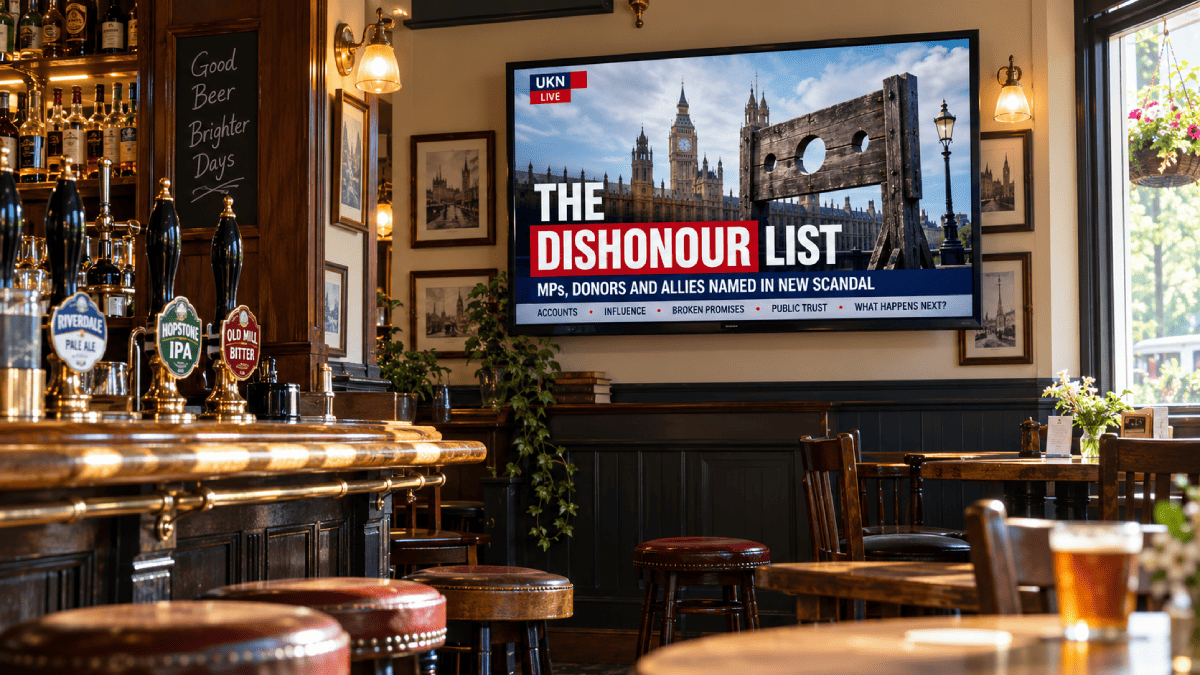
On 11th June 1872, Mark Tuck, a Newbury rag-and-bone man of long-established intemperate habits, was sentenced to four hours in the stocks for drunkenness. On release he went straight to the pub. He was the last man in England to be locked in them, and English shame has been on remand ever since.
Parliament abolished the pillory in 1837, with Lord John Russell assuring MPs it was "a punishment which is never inflicted". In 1967 it (sadly) abolished the offence of being a common scold, along with eavesdropping and challenging to fight.
Nobody got round to abolishing the stocks. The law still has room for them. Only the nerve has gone.
They worked because they were cheap, quick, and public. Nobody in Newbury pretended four hours would dry Tuck out. The town watched, the town judged, and every drunk in Berkshire took note.
A community stated its minimum standard out loud and pinned a name to the breach.
Modern Britain has kept the outrage and thrown away the verdict. It seethes online, signs petitions by the million, and then watches the object of its fury bank the proceeds.
Public shame never went away. It was privatised, monetised, and sold back to the people feeling it.
A National Disgrace Act will nationalise it again.
Twelve jurors, a published Roll, and up to ten years of civic exile for anyone who makes a living out of embarrassing the country. No minister will admit to wanting it. One will introduce it anyway, because every scandal of the past five years has been assembling it piece by clumsy piece.
Even OnlyFans Banned Bonnie Blue
In January 2025, Tia Billinger (trading as "Bonnie Blue"), claimed to have had sex with 1,057 men in twelve hours. Lily Phillips, another undesirable degenerate, had already managed 101 in a London Airbnb, filmed by the YouTuber Josh Pieters for a documentary which ended with its star in tears and its view count in the millions.
Phillips responded to the tears by announcing a target of 1,000.
Blue raised the stakes.
In June 2025 she advertised a "petting zoo" in central London, at which she would be tied up, naked and gagged, in a glass box while 2,000 men did as they pleased. OnlyFans, a company whose entire business model is paid nudity and prostitution, banned her permanently.
A pornography subscription service drew a line. The Crown drew nothing.
Channel 4 (a broadcaster owned by the British public) then gave her a feature-length documentary, 1000 Men and Me.
- Visa and Smirnoff asked for their adverts to be pulled.
- The Children's Commissioner warned it risked setting back efforts to protect children from degrading pornography.
- Ofcom took the complaints and declined to investigate.
The taxpayer had, in effect, commissioned the promotional film.
In September she took a "freshers' tour" to Dundee, provoked objections from MPs, and simply moved it to Glasgow. In December, Balinese police raided a rented studio and detained her with seventeen men. Indonesia deported her and barred her for a decade, and a Denpasar court fined her roughly £9 over a pick-up truck painted with the words "Bang Bus". She flew home and issued a statement:
I'm rich and have good lawyers. Did you really think I'd face jail time?
She then filmed herself outside the Indonesian embassy in London, dragging Indonesia's flag along the pavement from the back of her dress, surrounded by masked men. Jakarta lodged a formal complaint with the Foreign Office.
In February 2026 she claimed to have had unprotected sex with around 400 men in a day and announced a pregnancy. By August, in the final weeks of it, she was selling footage of a group stunt billed as preparation for labour.
Australia has barred her. Indonesia has deported her. OnlyFans has thrown her off. Britain, which issued her passport, has not managed so much as a stiff letter.
English law cannot touch her, and the reason is almost comic. The common law offence of outraging public decency requires a lewd act in a place where at least two members of the public could see it.
Rent a villa, admit only volunteers, film everything, and sell it behind a paywall, and the offence evaporates. The flasher on the top deck of the number 38 goes to court. The industrialised version goes to Channel 4.
The Obscene Publications Act 1959, with its test of whether material will "deprave and corrupt", has been a museum piece since a jury acquitted Penguin Books over Lady Chatterley's Lover in 1960.
The damage this prostitute does has nothing to do with corrupting her subscribers, who arrived pre-corrupted. It lies in turning "British" into a punchline across half the planet, on purpose, for cash. No offence on the statute book recognises it.
Whitehall Already Hands Out Disgrace
Anyone who calls a National Disgrace Act un-British has not been paying attention. The British state already brands people as disgraced. It simply does it without a jury.
The Honours Forfeiture Committee, a panel of senior quangocrats, strips honours from anyone judged to have brought the system into disrepute. By its own account it is not an investigative body and cannot determine guilt.
In 2012 it cancelled and annulled Fred Goodwin's knighthood after RBS swallowed £45.5 billion of public money. Goodwin had been convicted of nothing.
Paula Vennells lost her CBE in 2024 after 1.2 million people signed a petition. Both decisions were popular. Neither went near a courtroom.
Then came Andrew.
In December 2010 the Queen's second son stayed at Jeffrey Epstein's Manhattan home, two years after Epstein's conviction for procuring a minor for prostitution.
- In November 2019 he went on Newsnight to explain himself and offered the nation a Pizza Express in Woking and a medical inability to sweat.
- In 2022 he settled Virginia Giuffre's civil claim without admitting liability.
- On 30th October 2025 the King began removing his brother's styles, titles, and honours, and letters patent dated 3rd November finished the job.
The Palace called the measures "censures" and imposed them while acknowledging he continued to deny the allegations.
On 19th February 2026, his sixty-sixth birthday, Thames Valley Police arrested him on suspicion of misconduct in public office over claims he forwarded confidential reports from his trade envoy days to Epstein. He was released under investigation and denies wrongdoing.
On 23rd February, Peter Mandelson, sacked as ambassador to Washington the previous September, was arrested on suspicion of the same offence over claims he passed sensitive government material to the same man, and released on bail. A former prince and a former ambassador, arrested four days apart over one dead financier: the Epstein files have done more to enforce standards in British public life than any regulator in living memory.
Ministers have since weighed legislation to remove Andrew from the line of succession, with Canada, Australia, and New Zealand signalling support.
Ipsos found 73% of Britons in favour and 7% against. YouGov later put support at 82%.
A Bill removing one named man from the succession is a National Disgrace Act with a single defendant and no jury. Westminster is openly weighing the bespoke version. It has not yet noticed it could write the general one.
Honours lapse on death, so Jimmy Savile died a knight.
The child abuse inquiry noted drily how recipients go on being called "Sir" in obituaries. The Committee's best effort was a statement confirming it would have acted had he been convicted while alive.
| Existing mechanism | Who decides | Jury | Formal appeal | Reaches Bonnie Blue |
|---|---|---|---|---|
| Honours forfeiture | Senior civil servants, then the Sovereign | No | No | No, she has no honours |
| Royal letters patent | The King | No | No | No |
| Succession legislation | Parliament and fourteen other realms | No | No | No |
| Recall petition | 10% of a constituency's voters | No | No | No, MPs only |
| Platform ban | A compliance department | No | No | Briefly, until she moved platforms |
| Foreign deportation | Indonesian immigration officials | No | No | Yes, in Bali |
| Outraging public decency | A jury | Yes | Yes | Only if she performs outdoors |
| National Disgrace Act | A unanimous jury | Yes | Yes | Yes |
Every mechanism above the last line condemns without a jury. Our Act will be the first to insist on one. Anyone who calls it authoritarian will need to explain why they sat quietly while a man was stripped of his titles by his own brother without a hearing.
A Jury Decides What Disgust Means
The offence will be committed where a person intentionally engages in conduct which:
- Takes place in public, or is deliberately published to the public;
- Falls within a domain listed in the Act: gross public indecency, desecration of a protected site, betrayal of a public office or public trust, dishonourable conduct while representing the United Kingdom, or the commercial exploitation of extreme public degradation; and
- Goes far beyond vulgarity, controversy, bad taste, or private vice.
Once the Crown has proved the acts, the jury will answer two questions:
- Would an ordinary reasonable member of the British public regard the proven conduct with profound revulsion?
- Would the same person regard it as so disgraceful as to justify withdrawing the defendant's civic privileges for a fixed term?
Both answers must be unanimous.
The Juries Act 1974 allows ten-to-two majorities in ordinary trials. The Act will forbid them. If twelve citizens drawn from the electoral roll cannot all agree, the defendant walks.
If they do agree, no pundit, publicist, or professor of media studies gets a veto.
None of this is new.
Lord Reed has described the man on the Clapham omnibus as one of the hypothetical figures English courts rely upon to apply objective standards. Since Ivey v Genting Casinos in 2017, juries have judged dishonesty by the standards of ordinary decent people.
A jury trusted to recognise dishonesty can be trusted to recognise disgrace. The two are rarely strangers.
- First, only proven acts count. Rumour, allegation, and whatever "everybody knows" will be inadmissible as grounds for a verdict.
- Second, the defendant's own label for the conduct will carry no weight. When Rick Gibson exhibited earrings made from freeze-dried human foetuses in a London gallery in 1987, his supporters called it serious art. A jury convicted him regardless, and the Court of Appeal upheld it. Call it art, activism, or content. The jury will call it what it is.
In January 2022 a Bristol jury acquitted the four people charged over the toppling of Edward Colston's statue, to the fury of half the country. A disgrace law worth having will live with such verdicts. The standard will belong to twelve citizens, not to whichever faction shouts loudest online.
When the House of Lords upheld Frederick Shaw's conviction for publishing a directory of London prostitutes in 1961, Viscount Simonds claimed a residual power for judges to protect "the moral welfare of the State". Lord Reid dissented and said new crimes were Parliament's business.
The Act will take Reid's side.
No judge will invent National Disgrace. Parliament will define it, publish it, and give every exhibitionist in the country fair warning. Prosecutions will need the Attorney General's consent, the same filter used for confiscating criminals' memoir profits, and every clause will be drafted on the assumption a Home Secretary its authors despise will one day hold office, because one always does.
Obscenity Is Not Speech
The Act will protect speech more generously than current law and punish deeds far more harshly. Argument, satire, scholarship, journalism, sermons, and fiction will sit entirely outside it. Wave a placard outside Buckingham Palace demanding a republic. Draw the late Queen as a lizard.
Section 29J of the Public Order Act 1986 already shields ridicule and abuse of religions from the offence of stirring up religious hatred, and the Act will extend the same courtesy to the Crown, Parliament, and the nation.
Deeds are another matter.
- In June 2020 a man urinated beside the memorial to PC Keith Palmer, the officer murdered defending Parliament in 2017, and received fourteen days.
- In 2010 Charlie Gilmour, son of a Pink Floyd guitarist, swung from the Union flag on the Cenotaph during a student protest and was later jailed for sixteen months for violent disorder.
- Oh, and we can talk about Anne Widdecombe here, can't we?
Under the Act both would face a second question from the same jury, and few juries would need to send out for sandwiches.
Which brings the prosecution to Jeremy Corbyn. On 12th October 1984 the IRA bombed the Grand Hotel in Brighton, killing five people in an attempt to murder the Prime Minister and her Cabinet.
A fortnight later Corbyn, a backbench MP elected the previous year, invited two convicted IRA members into the House of Commons. He has always said he was promoting dialogue.
His opinions on Irish unity will be untouchable under the Act, however much they curdle one's stomach. Using the privileges of a parliamentary seat to entertain convicted members of the organisation which had just tried to blow up the government is conduct, done through a public office. His explanation will go before the twelve as evidence. It will not bind them. Article 7 of the European Convention bars retrospective punishment, so 1984 is safe. His successors on the back benches will not be.
The Act will also refuse to let a jury's sympathies pick the victims. Parliament, not the jury, will list the protected sites: places of worship of every faith, war memorials, graves, national monuments, Parliament, and the courts. Pig's blood over a mosque, excrement on a church altar, swastikas across a synagogue, and a drunk relieving himself on the Cenotaph will face exactly the same test.
The jury will not be asked whether it likes Muslims, Catholics, Jews, or the monarchy. It will be asked what the defendant did. Religiously aggravated criminal damage will still be punished as it is now, with a civic verdict stacked on top. Burning your own Quran, Bible, or Union flag in a lawful place remains expression. Invading someone else's sacred ground to defile it does not.
In 2016 Asad Shah, an Ahmadi shopkeeper in Glasgow, was stabbed to death by a man who considered his religious claims blasphemous.
In 2013 Fusilier Lee Rigby was run down and butchered in Woolwich for being a British soldier.
All three killers are serving life, and the Act will add only a name on the Roll. The name matters. Britons may reject any belief this country holds. Nobody may murder on behalf of one it has declined to enforce.
Ten Years Of Civic Death
The Ancient Greeks had ostracism. On conviction the court will impose a National Disgrace Order of between six months and ten years. The disgraced remain British. They may work, marry, worship, rent a flat, and see a doctor.
What they lose is everything which makes notoriety pay.
| Consequence | Scope | Existing model |
|---|---|---|
| The Dishonour List | Names, conduct, and terms published in the London Gazette in the same editions as the New Year and Birthday Honours | The stocks; the public record of disqualified directors |
| Honours and titles | Forfeited automatically, with no committee and no palace intrigue | Honours forfeiture; the Titles Deprivation Act 1917 |
| Public office | No candidacy, ministry, peerage, quango seat, magistracy, or charity trusteeship | House of Lords (Expulsion and Suspension) Act 2015 |
| Companies | May not form, direct, or control one | Company Directors Disqualification Act 1986 |
| Banking | Basic account only: wages in, rent out, no credit, no investments, no business accounts | Payment Accounts Regulations 2015 |
| Payments | No platform, broadcaster, publisher, or promoter may pay a person on the List | Financial sanctions under the Sanctions and Anti-Money Laundering Act 2018 |
| Passport | Surrendered for the life of the order; a judge may return it for compassionate or genuine work travel | Royal prerogative passport powers |
| Public money | No grants, subsidies, contracts, or honours; NHS care, benefits, and legal aid untouched | Debarment under the Procurement Act 2023 |
| Notoriety earnings | Every pound traceable to the disgrace confiscated | Coroners and Justice Act 2009, Part 7 |
The Dishonour List will be the Act's signature. Twice a year the Gazette will announce who has been knighted for services to industry, and on the facing page who has been placed on the Roll for services to embarrassment.
The stocks worked because the whole town could see who was in them. The Gazette will do the same job for the whole country, and considerably more people will read the second list than the first.
The payment ban will do the real damage. however.
Platforms serving British users will check the List exactly as banks already check the sanctions list for Russian oligarchs. A person on the Roll may post whatever she likes, wherever she likes. Nobody may send her a penny for it.
Any platform which does will face the penalties reserved for anyone caught funding a sanctioned warlord, and its compliance department will learn to read the Gazette with real devotion.
Nobody will be gagged.
Newspapers may condemn, broadcasters may interview, and Piers Morgan may give a disgraced influencer an hour every night of the week. He simply may not pay her any form of compensation - monetary or otherwise. Notoriety without income is plain embarrassment.
Every pound derived from the disgrace, whether subscriptions, sponsorship, appearance fees, or the inevitable memoir, will go to the Exchequer, using the exploitation proceeds regime Parliament built in 2009 for criminals who sell their stories. Earnings from honest work will be left entirely alone. For some names on the List it will be their first experience of it.
Since 2013 the Home Office's stated position has been blunt: no Briton is entitled to a passport at all, and the Home Secretary may withdraw one by prerogative without a court in sight. The Act will hand the decision to a jury and a judge, with a fixed end date.
Citizenship itself stays off the table. Section 40 of the British Nationality Act 1981 already lets the Home Secretary strip nationality where it is "conducive to the public good", a power reserved for terrorists, spies, war criminals, and organised criminals.
A National Disgrace Order expires. Deprivation of citizenship does not.
The Act will be harsher than a caution and gentler than exile, which is roughly where the stocks always sat.
First Entries On The Dishonour List
None of the following could be tried for conduct predating the Act. As a dry run for the jury room, they are irresistible.
| Name | Conduct | Verdict | Jury room |
|---|---|---|---|
| Kim Philby | Soviet agent inside MI6; fled to Moscow in 1963 | Disgrace | Unanimous before the kettle boils |
| John Profumo | Lied to the Commons about Christine Keeler, 1963 | Disgrace | The affair was his business; the lie was the country's |
| Jonathan Aitken | Jailed in 1999 for perjury after promising to fight with "the simple sword of truth" | Disgrace | Impaled on his own sword |
| Jeffrey Archer | Jailed in 2001 for perjury and perverting the course of justice | Disgrace, narrowly | The novels will be heard in mitigation |
| Charlie Gilmour | Swung from the flag on the Cenotaph, 2010 | Disgrace | A war memorial is no climbing frame |
| Jeremy Corbyn | Hosted convicted IRA members in the Commons weeks after Brighton, 1984 | For the jury | Twelve citizens will enjoy the deliberations |
| Andrew Mountbatten Windsor | Arrested in 2026 on suspicion of misconduct in public office; denies wrongdoing | Only on conviction | Pizza Express is no offence; proved misuse of the envoy's office would be |
| Peter Mandelson | Arrested in 2026 on suspicion of misconduct in public office | Only on conviction | Same test as the former prince, same jury |
| Fred Goodwin | Led RBS into a £45.5 billion rescue | Acquittal | Ruinous but lawful; the honours system can keep him |
| Jimmy Carr | Used the K2 tax scheme, lawful at the time, 2012 | Acquittal | Lawful, apologised for, and funnier than the prosecution |
| Colston Four | Toppled a slave trader's statue into Bristol harbour, 2020 | Already decided | A jury acquitted them; the Act will respect it |
| Jimmy Savile | Hundreds of abuse allegations surfaced after his death | Beyond reach | The Act tries the living; try them while they are |
| Lily Phillips | Sex with 101 men in a private flat, filmed for a public documentary | Contested | Private and consenting, but the Crown will say the documentary was the product |
| Bonnie Blue | Glass-box "petting zoo", a flag dragged past a foreign embassy, and pregnancy stunts sold worldwide | First in the dock | Public, deliberate, monetised, with a diplomatic complaint to prove the national damage |
The Act bites on deliberate, public, and profitable degradation of the country's name. It spares the incompetent, the merely greedy, and the privately debauched.
Goodwin keeps his pension. Carr keeps his jokes. Phillips gets a fair fight.
Bonnie Blue keeps her freedom, her citizenship, and her basic bank account, and precious little else.
Consequences For Those Who Bring Shame
A committee of mandarins strips honours. A King strips his brother. Ministers draft a Bill to remove one man from the throne's line of succession. Parliament's Public Office (Accountability) Bill is busy writing misconduct in public office into statute. A million people sign a petition and a CBE vanishes. Constituents recall an MP. OnlyFans bans a creator, Indonesia deports her, and Australia bars her.
Every component of a National Disgrace Act already exists in precedent, in draft, or in public demand. It lacks only a short title and a minister reckless enough to move the second reading.
The first version will be clumsy. It will probably carry the name of a villain, and the House of Lords will spend a winter tearing strips off it.
Human rights barristers will call it medieval, and they will be right. So is trial by jury, and so is the idea a community may tell one of its own, in public and on the record, to be ashamed.
Shame is powerful. Shame works. It is a corrective mechanism.
Mark Tuck took his four hours and went to the pub. Newbury knew exactly what it thought of him, and so did he.
Today the Tucks of the world go to the bank instead, and the town can only watch. Nobody ever abolished the stocks. Parliament simply needs to find somewhere new to put them.