Strategic Economic Dominance Over The European Union
If our idiot political class are having trouble “making the most of post-Brexit opportunities,” we can help. Instead of slithering and oozing like social democrat weasels, how about no fishing rights, no union, no alignment, no tariffs, no taxes, and total war until we win or they beg us to stop?

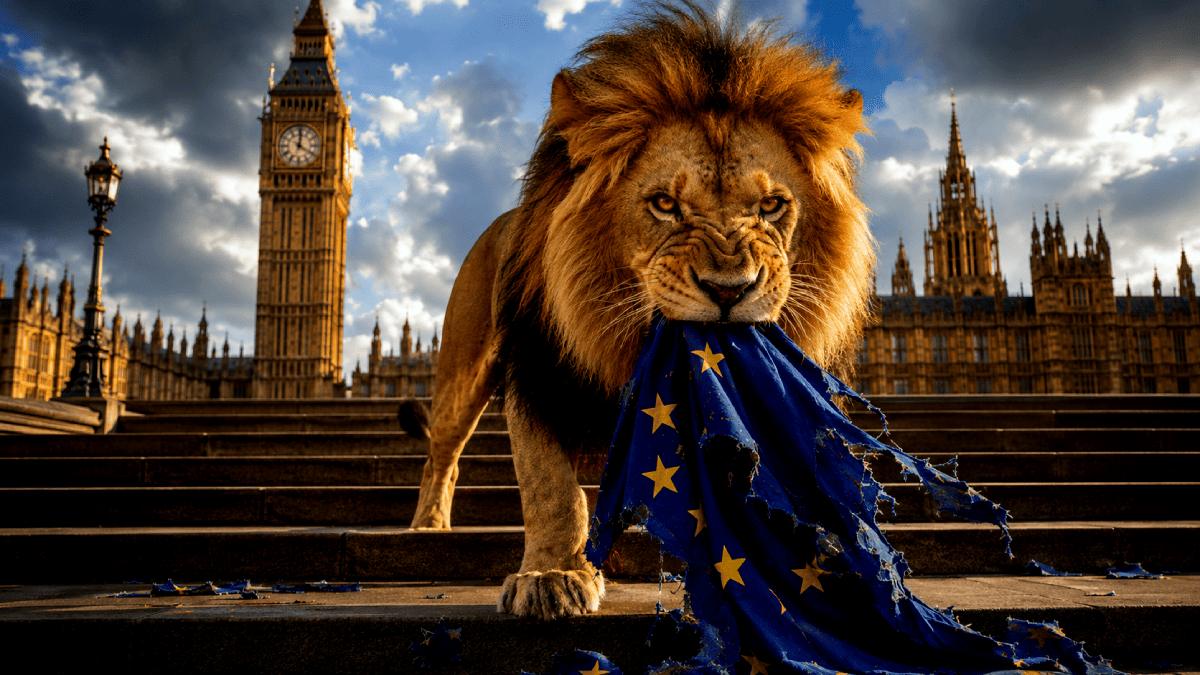
In May 2025 Britain held a lever Brussels genuinely wanted. European fleets take a large share of their catch from British waters (the Dutch and Belgian fleets in particular depend on them), while British boats take comparatively little from European seas. That asymmetry was a sovereign asset, renewable annually, physically British, impossible for a landlocked member to replicate. The government signed it away until 2038 in exchange for a summit and a warm communiqué.
That is what the accommodationist state does with leverage. It finds a lever, calls it a bargaining chip, and trades it for a photograph. The reasons why are numerous: from feathering their nests; as a future job application; to simple lack of talent or experience in real-world commerce.
The instinct behind it, that Brussels can be won over with goodwill, misreads the opponent entirely. The European Union behaves less like a trading partner than a cartel guarding the cost of exit, engineered so no member dares the door.
Lets also dispense with the childish notion the EU has provided peace through trade. Peace has been kept by NATO and nuclear weapons.
Goodwill offered to it is not banked. It is pocketed and forgotten. A serious Britain stops seeking approval and starts building something Brussels cannot ignore and cannot easily counter.
The Escape Node, Not Parity
Britain will never outweigh the EU. The single market is roughly eight times larger and takes around two fifths of British exports, and any strategy premised on matching that mass is a fool's errand. The objective is not to overpower the bloc. It is to become the one place beside it the bloc cannot route around: the low-friction, low-tax, fast-law, deep-finance network node where mobile capital, high-growth firms, and global commerce choose to sit.
Small nodes govern large systems when the system needs them. Sovereign is he who decides on the exception.
Switzerland does not dominate Europe by mass. The City did not lead global finance because Britain had the largest home market.
The prize is position, not size, and position is defended by a single test applied to every advantage Britain builds.
When Brussels moves to kill it, can they copy it with money, or only with time?
If money solves it, it was leverage, temporary and doomed. If only years, geography, accumulated trust, or military capability solve it, it is armour. Britain builds where the answer is time.
Zero Friction Britain, Theirs Costs Them
One rule governs the rest. Britain abolishes every barrier it inflicts on itself, and leaves standing every barrier Brussels chooses to keep, so all remaining friction in the relationship is friction Brussels is imposing on its own people.
The accommodationist thinks fairness means matching. If the EU keeps tariffs, Britain keeps tariffs, so nobody feels cheated. It is the logic of a man who watches his rival shoot himself in the foot and reaches for his own pistol to keep things level. The two sides of the border do opposite work.
- A British barrier on incoming goods robs British shoppers and British factories.
- A European barrier on outgoing British goods robs the European importer and the European plant waiting on the part, and Britain gains nothing by copying it.
- So Britain strips its own barriers to nothing and lets Europe keep every one of theirs on display.
One cost Britain owns without flinching: a European barrier on British exports still costs the British exporter the sale.
A load spoiled at a French inspection post is a British loss, and no slogan puts it back on the lorry. Britain spends its effort where the win is free, on the barriers it can abolish alone, and never pretends the export wall is painless.
That clarity is what separates this from wishful thinking at either end of the argument.
Open To Goods, Closed To People
Britain declares any product lawfully sold in a trusted country enters the UK with no duplicate certification, no duplicate inspection, and no routine delay. No stupid "alignment" required.
One condition.
- A named importer of record, with assets and liberty on the line, certifies the goods as lawful, compliant, and clean of sanctions and dumping.
- A false certificate costs the goods, the company, the directorship, and the certifier's freedom.
The border stops inspecting honest cargo into paralysis and starts hunting fraud instead, auditing, sampling, and ruining offenders. The importer's signature carries everything he owns, which is why the state no longer opens every container.
Recognition does not follow a box because it touched a Dutch dock. It follows goods placed on the market by an accountable operator inside a trusted system, staking his assets on the claim. A Chinese mill buys no such standing by renting a corner of a quay in Antwerp.
Then the wall, on the subject Brussels prizes most.
This openness moves goods, capital, contracts, and cargo, but no human being into settlement. No product, invoice, ship, or port pass grants any right to live, work, settle, draw public money, or bring a dependant.
The European model fused four freedoms into one bundle precisely so trade could drag migration in through the back. Britain separates them.
Cargo moves. Capital moves. Contracts move. Citizenship does not.
A port permit is fixed to one site, one task, one window. No dependants, no public funds, no residence clock, no route to settlement, no switching category once inside. The engineer installs the machine and goes home. Bonds, biometric exit, and permanent bans for abuse are built in from the first day, because every temporary route Britain has built has been gamed, and this one assumes the gaming starts at once.
Red tape which strangles honest trade is a disease. Red tape which guards the nation's membership is the immune system.
A Tax Rate The Cartel Cannot Reach
The saloon-bar plan is to cut corporation tax to one per cent, gut Dublin and Luxembourg, and watch the multinationals cross the Channel. For the giants it fails, because of a wall the EU built and Britain helped raise.
Our embarrassing idiot politicians implemented the OECD's global minimum tax in full: domestic and multinational top-up taxes for accounting periods from the end of 2023, and the undertaxed-profits backstop from the end of 2024.
Britain put on the leash itself. Because our politicians are idiots. This silly globalist "forum," the Organisation for Economic Co-operation and Development, is based in France. How about, no.
Under this internationalist regime none of us voted for, any group earning over 750 million euros must pay an effective fifteen per cent in every country it operates in. Charge one per cent in Britain and the missing fourteen points do not stay with the firm. Another government seizes them through a repulsive "top-up tax." Book the profit in one-per-cent Britain and Berlin rakes the difference into its own treasury. The cut does not feed the company. It ships British money abroad.
Below the threshold, the cartel is blind.
Beneath 750 million euros sits every firm which actually moves for tax, and Britain sets 1 - 5% for those groups, conditional on real substance on British soil: real payroll, real headquarters, real intellectual property, real servers, real command. Scale-ups, founders, IP-heavy technology, fintech, gaming, biotech, specialist manufacturers, companies a year from listing.
The current leaderboard:
- (United Kingdom) 1.0% <— here
- Hungary (HU) 9.0%
- Bulgaria (BG) 10.0%
- Cyprus (CY) 12.5%
- Ireland (IE) 12.5%
- Romania (RO) 16.0%
Britain takes them before they grow large enough to be caught, and Brussels cannot stop it, because its own rules place those firms out of reach. This is the clean, immediate, uncounterable win, and it should run from day one.
The giants are the harder prize, and precision matters here because sloppiness invites a rebuttal.
In January the OECD agreed a side-by-side package exempting American-parented groups from the income-inclusion and undertaxed-profits rules, in deference to Washington's own minimum-tax regime. Because America has a leader with a pair of balls.
But the exemption leaves domestic top-up taxes untouched. So long as Britain keeps its own domestic top-up, it still collects from American groups operating here, and the American carve-out buys Britain nothing.
The full prize appears only if Britain repeals its own domestic top-up tax and withdraws from the regime, at which point US-parented profit, already freed by Washington and now unclaimed by London, has no top-up pipe anywhere.
| Corporate target | Pillar Two exposure | British play |
|---|---|---|
| Groups below €750m | Outside scope entirely | Clean target for a 1–5% substance rate, now |
| US-parented groups | Exempt from IIR and UTPR, but domestic top-up still bites | Take fully only if Britain drops its own domestic top-up |
| UK-parented groups with UK substance | UK-controlled once UK changes its law | Available, fiscally sensitive |
| Stateless, mobile capital, no EU footprint | Structure-dependent | Available where no foreign top-up pipe exists |
| EU-parented giants | Home state claws it back | Only if genuinely re-parented to Britain |
| Firms tied to EU customers and entities | Caught via market footprint | Out of reach; the EU holds the pipe |
The reading is plain.
- The sub-threshold swarm and the mobile, stateless capital are Britain's immediately.
- The American giants become Britain's only when Britain leaves the cartel.
- The firms chained to Europe are not worth chasing, and Britain does not mourn them.
There is no magic treaty notice to serve to leave the main Pillar Two machinery. The GloBE rules are a common approach, not a conventional treaty obligation. Britain’s leash is mostly domestic: dirty, secondary backdoor Finance Act provisions creating multinational top-up tax, domestic top-up tax, and the undertaxed profits rule. Parliament can cut that leash. Multinational Top-up Tax and Domestic Top-up Tax were smuggled in via the Finance (No.2) Act 2023, and the undertaxed profits rule was smuggled in via the Finance Act 2025.
The catch is France, Germany, Japan, and others still hold their own matching leashes. Repeal in London stops HMRC collecting the top-up; it does not stop Berlin collecting where German law can reach. The British play is not naïve denunciation. It is selective suspension, substance relief, and hard targeting of the firms the foreign top-up machinery cannot catch.
Leaving The Cartel, And Meaning It
Withdrawal from the OECD minimum tax is the move weak men treat as unthinkable, like "trading on WTO rules." It should be treated as a power Britain holds and will use when the arithmetic favours it.
Government is not required for trade to occur. Indeed, it happened before government was conceived of, and will continue as soon after it is gone. Human trade works rather simply:
- I have something you want.
- You have something you can exchange for it.
- Injury will result if either of us behave unfaithfully.
A government is an unwelcome middleman thrust into someone else's business.
Repealing Britain's domestic top-up frees American and stateless profit, but it does nothing to the matching rules sitting in French, German, Japanese, and Korean law. An EU-parented giant booking profit in Britain is still clawed home by Berlin. Britain does not need those firms.
It needs the companies Washington has set loose, and it does not need to break anything to hold the sub-threshold swarm it can take today. The domestic top-up is repealed not on the first morning but at the chosen moment, once the value already flowing in makes the retaliation survivable.
The same discipline governs the treaties binding Britain to European standards, courts, and so-called "alignment." Parliament should legislate explicit powers to review, suspend, and disapply any obligation once it stops serving British advantage, and it should say so openly rather than pretend the powers do not exist.
"Alignment" is not required for business or trade. It is one-side compliance with the EU's absurd bureaucracy.
The accommodationist keeps this weapon locked in a drawer and announces it will never be drawn, which is why he loses every negotiation before it starts. Britain instead should make it plain so-called "dynamic alignment" is a favour, not a fact, and the price of Britain's restraint is Brussels' conduct. Not a threat muttered in a corridor. A standing, legislated capacity to walk.
Brussels will reach for its usual labels (rogue haven, race to the bottom, threat to European unity, etc) and every one of them is the noise a cartel makes about a competitor that will not help it hold the price up.
A country which has decided it does not need Brussels' approval cannot be governed by the threat of losing it. That immunity is worth more than any concession a summit could produce.
Fast, Crude Weapons Against Rivals
Tax withdrawal is the slow, heavy artillery. Alongside it sits a rack of blunter instruments a Chancellor could fire within a single fiscal year, and the accommodationist reaches for none of them, because each one requires a willingness to be disliked.
European fleets take roughly 800,000 tonnes of fish from British waters each year, worth around 640 million euros. British boats take about 92,000 tonnes from European waters, worth barely a seventh of that. The Dutch fleet lands over half its catch by weight in British seas; the Belgian fleet more than two fifths; and neither can move the fish somewhere more convenient. A country playing to win does the reverse: it treats access to its waters as a yearly toll, renewed only against measurable European movement on everything else, and lets the Dutch and Belgian fleets carry Britain's argument into their own capitals for it.
Anti-dumping and countervailing duties are the surgical tool, and they are entirely lawful. Where a foreign producer sells below cost or on the back of a state subsidy, Britain can impose targeted duties on the specific product from that specific country after an injury finding, in months rather than years.
The trick is speed. A Chancellor stands up a trade-remedies unit with emergency staffing, hands exposed industries the evidence templates, prioritises cases by strategic sector, and uses provisional measures the moment the law allows.
It does not invent dumping. It stops treating dumping investigations as a leisurely administrative hobby.
Procurement is the quiet giant. Government buys on a vast scale, and the rules now let ministers score far more than price. Every public contract is weighted for British resilience: domestic repairability, spares held on British soil, supply-chain depth, data kept in British jurisdiction, wartime continuity, and freedom from hostile-state dependency. This discriminates against nobody by flag, and it forces a French or German supplier to build real British substance or lose the work.
The accommodationist buys the cheapest bid and calls it value. A serious government buys sovereign capacity and lets the invoice reflect it.
VAT and excise are the levers wholly beyond Brussels' reach, because they are domestic taxes Britain sets alone. Abolish it for the things Britain wants more of (industrial machinery, energy kit, grid hardware, repair, port processing), and load the compliance burden onto overseas sellers in fraud-heavy categories. It bites more slowly than a tariff and it cannot be retaliated against, because there is no treaty to breach and no partner to blame.
The pattern across all four is deliberate. Each is legal, each is fast, and each imposes the cost on the other side while keeping Britain's own hands clean of anything Brussels could take to a tribunal.
The only reason they sit unused is firing them means accepting Brussels will complain. That is not a cost. It is the entire point.
Defensive Fortifications For Economic War
Openness and tax withdrawal pull value in. They do not stop Brussels swinging back. And it will swing harder than the polite men admit, because it is a political actor which will bleed itself to punish a defector and frighten the rest. Britain needs economic armour, and armour goes only where the money-or-time test says it holds up.
| Chokepoint | Copyable with money | Verdict |
|---|---|---|
| Defence-industrial capability | No. Submarines, jet engines, complex weapons, intelligence trust, NATO depth take decades | Hard core |
| Energy geography and balancing | Subsidy helps; geography and build time dominate | Hard core |
| English law, arbitration, insurance, maritime | No. Centuries of trust, habit, precedent, language | Hard core |
| Clearing and wholesale finance | Yes, if the EU chooses to eat the cost | Leverage, not armour |
| Data adequacy and digital services | Yes, over time. Data localises, clouds duplicate | Weakest lever |
| Import openness, tax, VAT, ports | Not chokepoints | Weapons of attack, not shields |
- Defence is the strongest ground Britain holds. Brussels can announce a European defence fund on Monday and still not conjure Rolls-Royce, BAE, submarine engineering, missile integration, or Five Eyes trust by Friday. European states may buy British capability. European institutions do not get to own it or condition it.
- Energy is second, because subsidy cannot move the North Sea or shift an interconnector, provided Britain pours the terminals, storage, nuclear, and grid rather than announcing them.
- English commercial law is the quiet third and the most underpriced asset in the country, because arbitration depth, marine insurance, and the world's habit of contracting under English law cannot be manufactured in Paris inside a generation.
Clearing is a blade, not a shield, and treating it as a fortress gets Britain hurt. It is real: the Commission extended equivalence to June 2028 because European banks would otherwise scream, and most euro clearing already runs through non-EU firms in London.
Britain deepens it and makes fragmentation expensive, while planning for the day Brussels chooses to bleed to drag it home. Building the City to win globally even if some European flow is marched back across the Channel.
Sequencing Is Make Or Break
Sequence is survival. Fire the loud weapons before the armour is built and a wide-open Britain takes the counterpunch with its guard down. The cheap, uncounterable wins come first, the shields come next, and the detonations wait.
Phase A: Zero Friction Import
Phase one runs from the first day, and every move in it is something Britain does inside its own borders where Brussels can retaliate against nothing.
- Open the border to trusted imports on the importer-liability model.
- Set the sub-threshold tax rate of 1%.
- Recut VAT and excise so doing real business in Britain is cheap and committing fraud is ruinous.
- Pass a law stopping any future trade deal from smuggling settlement rights back in.
- Then pass two more laws which create the power to withdraw from the minimum tax and to disapply treaties, without using either yet.
The weapons are bought and loaded in plain view, and left unfired.
Phase B: Defensive Preparations
Phase two runs across the whole Parliament and builds the armour, starting with whatever is hardest for the EU to copy.
- Defence-industrial capacity comes first, because it takes decades to replicate.
- Energy infrastructure comes next, actually built rather than announced.
- The English-law and arbitration industry is pushed out into the world third.
This is the slow, unglamorous middle, and it is what stops Brussels from hurting Britain once the risky phase begins. It works on one condition. The British state has to build at a pace it has not managed in years; the money and the projects must be locked into law; funded for the long term; and run by bodies a future minister cannot quietly defund. Without that, it doesn't work.
Phase 3: Pulling Triggers
Phase three fires the real weapons, and only when Britain is ready.
- Withdraw from the minimum tax and take the giants, once the value already flowing into Britain makes the retaliation affordable.
- Tear up the treaties which have stopped serving British interests.
Fire when the defences are built and the gain clearly beats the cost, or fire sooner if the EU attacks first and waiting becomes the greater danger. Never fire out of anger, and never on impulse. This is a calculation, not a tantrum.
It Will Come At A Cost
Some British producers exposed to cheap imports will not survive, and the strategy protects only the sectors which carry national resilience rather than every incumbent Brussels once sheltered.
Some European export friction stays a British cost and cannot be abolished from London. Brussels may retaliate past the point of its own economic interest, because it is political before it is rational.
Tax withdrawal invites blacklisting and defensive measures.
Clearing can be dragged home if the EU is willing to pay for it. The state may fail to build the defensive measures on time. Washington may shift the posture the tax breach depends on.
The plan needs continuity across a Parliament, and British politics rarely supplies it.
None of that is a reason to keep the present settlement, because what we have is not safety. It is slow decline with the costs merely hidden: high prices, weak growth, EU-facing dependency, thin industrial capacity, and a migration ratchet that never stops.
A war plan does not abolish risk. It trades passive decline for chosen risk, sequenced so the cheap wins arrive first and the dangerous fights wait until Britain holds leverage the EU cannot buy its way around.
Britain becomes the door out of Brussels, built from everything Brussels cannot copy. With a cheque, weapons loaded in plain sight, and no pretence showing them makes firing them free. Brussels can cooperate or it can seethe. While the money, the firms, and the leverage have already moved onto better shores: England's.