The Case Against Elizabeth II
Edward VIII abdicated by leaving the palace. His niece found a subtler route to the same desertion: she kept the throne and abandoned the office, standing in graceful silence beside the unmaking of the faith, the union, and the realm she swore to guard.

A crown is not a hat. It is the oldest working idea in English public life, the notion a nation is more than the people currently alive in it, more than the government currently in office, more than the mood of the moment. The monarch exists to carry the dead and the unborn into the room where the living make their decisions, and to stand, when everything else fails, as the one square on the board a tyrant cannot occupy.
The Crown guards the faith, the union, the law, and the memory of a people. That is its entire purpose. Strip the guardianship away and you are left with an expensive family in good jewellery, waving from a balcony.
Edward VIII understood the office well enough to know he was betraying it. He wanted a divorced American more than he wanted the throne, and he left. It was a failure, a selfish one, but it had the dignity of honesty. He did not pretend to guard what he had abandoned.
As the Bible professed by the Church of England says:
By their fruit you will recognise them. Do people pick grapes from thorn-bushes, or figs from thistles? Likewise, every good tree bears good fruit, but a bad tree bears bad fruit. A good tree cannot bear bad fruit, and a bad tree cannot bear good fruit. Every tree that does not bear good fruit is cut down and thrown into the fire. Thus, by their fruit you will recognise them.
What exactly were the fruit of Elizabeth?
In 1997, as the empire ended itself with a surrender to a communist dictatorship, the UK's $1.6 trillion GDP was larger than India ($415 billion) and China ($960 billion) combined. Not one - both. Combined.
When Elizabeth was given it, it still ruled most of the globe despite two devastating world wars. It put the first nuclear reactor online after it had launched live television two decades before. Within ten years, it had collapsed into socialism.
For seventy years she stood beside the slow unmaking of nearly everything the Crown exists to protect, said almost nothing, signed almost everything, and was loved more with every passing decade for the silence. The cultish sentiment built around her insists this was duty. It was the opposite of duty. It was the most graceful abdication in the history of the monarchy, performed so slowly and so charmingly nobody noticed it was happening.
A fish rots from the head down.
History is the only court with jurisdiction over a sovereign, and it does not adjourn for sentiment. Elizabeth II has been excused its verdict for too long.
The Oath She Broke
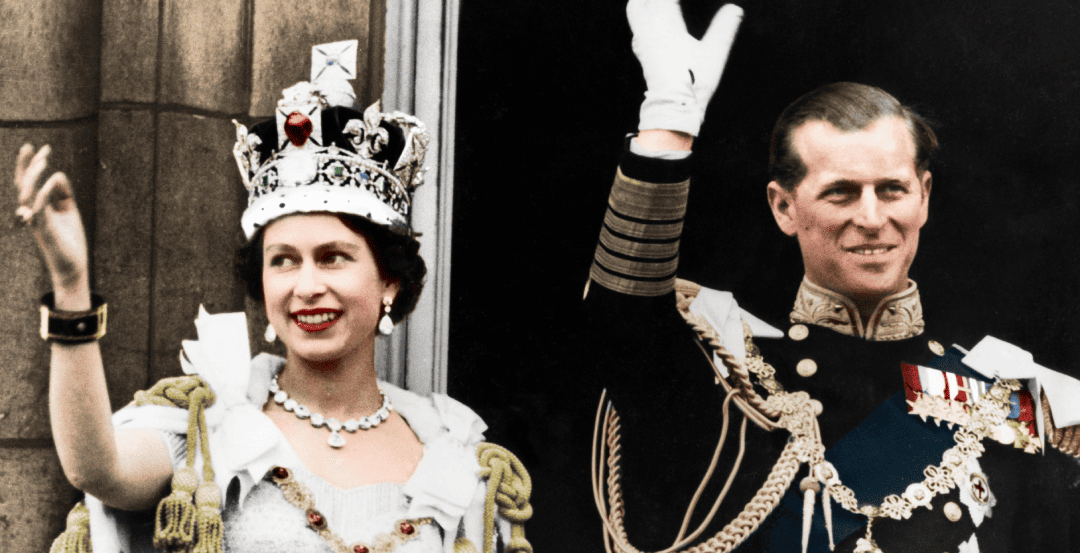
At her coronation in 1953 she was asked, hand on the Bible, whether she would to the utmost of her power maintain the laws of God and the true profession of the Gospel, uphold the Protestant Reformed religion established by law, and preserve to the Church of England its settlement, doctrine, worship and government. She said she would. She swore it before God and before the nation, and she meant it, or she should not have said it.
Will You to the utmost of Your power Maintaine the Laws of God the true Profession of the Gospell and the Protestant Reformed Religion Established by Law? And will You Preserve unto the Bishops and Clergy of this Realme and to the Churches committed to their Charge all such Rights and Priviledges as by Law doe or shall appertaine unto them or any of them.
King and Queene.
All this I Promise to doe.
After this the King and Queene laying His and Her Hand upon the Holy Gospells, shall say,
King and Queene
The things which I have here before promised I will performe and Keepe Soe help me God.
Then the King and Queene shall kisse the Booke.
To the utmost of her power. Not when convenient. Not when it cost nothing. To the utmost.
Then for seventy years she signed her name to an order of law marching steadily away from everything she had sworn to defend. The liberalisation of abortion. The hollowing of marriage into something her own Church would not bless. The patient, decade-by-decade eviction of Christianity from the public life of a Christian kingdom. She did not resist these. She did not delay them, question them, or spend a single ounce of her unique authority against them. She picked up the pen and made them law, and then she went to church on Sunday and spoke beautifully of her faith.
Her own son confessed he was troubled at the thought of signing yet another abortion measure. His subjects asked him not to and Monaco's king said no. The mother showed no such trouble across forty years of signature. If the oath went silent every time the law contradicted the Gospel she had sworn to maintain, then the oath was never a promise at all. It was a costume she put on for a morning in 1953 and took off the moment it asked anything of her.
A Violin, An Empire Burning
She inherited an imperial Crown and watched it fade into oblivion. Some of that was the tide of the century, and no honest person pretends she could have held India by glaring at it. The charge is not the loss; it is the squalour of how it was lost.
The Crown was the one institution on earth capable of turning the end of empire into something better than embarrassment, of insisting on continuity, on reciprocal obligation, on a real Commonwealth of trade and defence and common law and shared Christian inheritance binding a quarter of the planet. She had the standing to demand it. Instead she presided over the conversion of an empire into a sentimental social club, all flags and handshakes and royal tours, with not one strategic idea behind it. The greatest political inheritance in modern history was allowed to evaporate into bunting, and she smiled and cut the ribbons.
A Constitution Seized By Quangos
A guardian might be expected, at the very least, to guard the weapons. Under Elizabeth II the powers of the Crown were stripped from it one by one, fenced off, handed to ministers, to statute, to judges, to the permanent machinery of the state, and she raised not a word against any of it. Although she didn't want anyone looking at her private wealth.
The Fixed-term Parliaments Act of 2011 seized the dissolution of Parliament, an ancient prerogative running through the Crown, and reduced it to a railway timetable, before the whole misbegotten thing was scrapped again in 2022. It was one episode in a reign-long pattern. Power which had belonged to the sovereign drained steadily toward ministers and courts and committees, every theft dressed up as modernisation, and the sovereign watched her own office disarmed and called it... progress. She did not merely fail to wield the Crown's powers. She let them be taken from her crown forever and thanked the men who took them.
A Union Devolved In Front Of Her
She was Queen of the United Kingdom. By the end she had quietly overseen its conversion into a half-detached patchwork whose breakup is now a permanent item on the agenda. The oldest and most successful union in the world. Dismantled.
A Scottish Parliament. A Welsh assembly swollen into a Senedd. A bespoke arrangement in Northern Ireland. An England handed managerial regions and no voice of its own. And finally an actual referendum on whether the realm should exist, lost by a margin thin enough to terrify anyone who loves the union. The West Lothian question was never answered. The separatists never went home. The kingdom became, in cold constitutional fact, a thing for sale. As she drunk sherry with corgies at Balmoral.
The Crown is the symbol of the union. It is the one office standing above the four nations to hold them together. So how, under the living symbol of union, did the union become negotiable? She gave it no doctrine of permanence, no argument for why it should hold, no language at all. She gave it her presence, and her presence held nothing together, because presence is not the same thing as protection, however many ribbons it cuts.
England And An Islamic Invasion
One casualty deserves its own grave, because the country has not even noticed the burial. Devolution handed Scotland a politics, Wales a politics, Northern Ireland a special dispensation.
England it handed nothing.
The largest and oldest nation of the realm, the trunk from which the whole union grows, was dissolved into the grey abstraction of UK governance, recognised nowhere as a people with a Church, a law, a landscape and a thousand years of its own. A Crown rooted in English Christianity and English liberty might have refused to permit it. Hers did not. She reigned over the constitutional erasure of England and never once spoke the word as though it named anything she was bound to defend.
England has eighty sharia courts. And 1,888 mosques worth two billion. With a rape gang crisis which could have as many as a million child victims because of a dam which destroyed half of Pakistan ten years after her coronation. Which was a few years after the humiliation of Suez.
Sympathy Without The Sword
Northern Ireland was a wound in the union itself, and the Crown stood, in theory, above Westminster and Stormont and Dublin and every gun on every side. Nobody claims she could have ended the Troubles by intervention. The failure is quieter and more revealing.
The monarchy met the bloodshed pastorally. It visited. It consoled. It laid wreaths.
What it never did was meet the crisis constitutionally, never gave the union a higher language strong enough to shame the politicians and the paramilitaries both, never articulated why the bond should hold when men were dying to break it.
Sympathy is not a doctrine and a wreath is not a defence. She offered the comfort of a chaplain to a question that demanded the authority of a sovereign.
Sovereignty Treated Like Shame
Maastricht was not paperwork. As a backdoor mechanism the politicians of our country celebrated with glee it had been betrayed. It moved the seat of British self-government to a foreign assembly and placed the realm under law made elsewhere. A sovereign whose whole purpose is to embody the continuity of the nation cannot treat such a thing as a routine signature, yet that is exactly how the palace treated it. By repute she leaned toward Britain being under the axe of Europe. Whether she did or not, she said nothing of any constitutional weight as the sovereignty of her own kingdom was handed away.
Then came the Treaty of Lisbon when her country was truly bargained away.
A generation later it came back.
Brexit was the recovery of the very self-government Maastricht had surrendered, the largest constitutional event of her late reign, and again the Crown produced nothing. No reflection on what it means for a free people to govern themselves once more, no language of law or continuity or reconciliation, nothing. A Crown with nothing to say when sovereignty leaves and nothing to say when it returns is not guarding sovereignty. It is furniture in the room where sovereignty is decided by other people.
The Supreme Governor And Her Empty Church
In between assent for abortion acts, she spoke movingly, and by every account sincerely, of her own Christian faith. Meanwhile the Church she governed shrivelled. By the 2021 census, for the first time in the recorded history of the country, fewer than half the people of England and Wales called themselves Christian, just 46.2 per cent, down from 59.3 a decade before. This was not a soft decline. It was a collapse, and it happened on the watch of the Church's Supreme Governor.
She did not cause every empty pew, and only a fool would pin the secular age entirely on one woman. But a Supreme Governor who can neither halt nor even name the dissolution of the Church she is sworn to govern is not governing anything. She kept the grand title to the very end. The Church lost the nation.
By the close of her reign the established Church of a Christian people had become a heritage attraction with bishops on the payroll, and its Supreme Governor said nothing to stop the slide.
The Household That Became A Circus
The royal family is not a private family, whatever we are told. It is the human body of the Crown, the thing through which the whole institution is seen and understood, and under Elizabeth II that body became a long public spectacle of divorce, breakdown, scandal, and disgrace.
Every family has its failures, the defenders murmur, and so it does. But no other family is paraded before the country as the model of national continuity, and the gravest episode was no ordinary failure.
Her favourite son became entangled with convicted paedophile Jeffrey Epstein and the sordid allegations of Virginia Giuffre, settled a civil claim of sexual abuse without admitting liability, denied the allegations against him on television, before having his titles stripped from him. The point is not his guilt or innocence. The point is what the sacred household of the realm had been allowed to become.
By the end the House of Windsor resembled a celebrity dynasty with superior tailoring, its mystery spent managing one humiliation after another, and at the centre of it a Queen who guarded the family's image far more fiercely than she ever guarded the nation's faith.
An Honours System With No Honour
There is the charge with no escape route, because the power in question is hers alone and utterly uncontested. No minister, no statute, no court can be blamed.
The monarch is the fountain of honour.
Honour flows from the Crown and from nowhere else on earth. A civilisation shows what it worships by what it decorates, and under Elizabeth II the honours of the realm came to crown celebrity, donation, party loyalty, bureaucratic survival and the passing fashions of a self-satisfied establishment. The fountain never stopped flowing. What it watered had simply rotted.
The one instrument that was entirely, unanswerably hers, she used to baptise mediocrity and to anoint the very managed decline she presided over everywhere else.
An Exceedingly Uncivil Service
The civil service is His or Her Majesty's. Government acts, in law, through the Crown, and the vast permanent machine of the state is in constitutional theory the servant of the sovereign. Under Elizabeth II that machine grew steadily more autonomous, more technocratic, more tangled in the courts and in the cult of rights, and steadily less answerable to any voter who might wish to be rid of it.
She did not build the apparatus and could not have demolished it. But she gave it something it could never have earned for itself: a gracious, beloved, unimpeachable face to wear in public, a reassuring continuity behind which an unaccountable state did precisely as it liked. The service stayed Hers in name while becoming nobody's servant in fact. The mask was magnificent. What moved behind it answered to no one.
A Decimated Military
She was head of the armed forces, and no institution on earth mourned the British soldier more beautifully. The uniforms, the remembrance, the medals, the Cenotaph held in perfect silence year upon year. As a ceremony of grief the monarchy reached, under her, something close to perfection.
Meanwhile the forces were killed at Suez, the Falklands, the Gulf, Kosovo, Afghanistan, Iraq and Libya, and across the same decades were cut and stretched and gutted until the gap between the ceremony and the capability became a national embarrassment. She honoured the soldier with unmatched dignity and stood mute as the state took away his sword. The mourning was real and moving. The defence of the thing she was mourning never came.
A People Under Orwellian House Arrest
If one episode exposes the office reduced to pure ornament, it is the last great crisis of the reign. The country was placed under house arrest by ministerial decree. Churches were locked. Funerals were forbidden to the families of the dead. The old died alone behind glass, the young were confined, worship and movement and family life were suspended by order, and police patrolled the most intimate corners of ordinary existence. Through all of it the monarch offered comfort. She told us we would meet again. It was gentle, and it was adored, and it was the comfort of a chaplain at a deathbed, not the warning of a guardian at the gate.
Nobody asks the sovereign to write medical policy. The question is the one the entire reign has been driving toward. If the Crown has nothing to say when worship is criminalised, when families are torn apart, when the dying are abandoned and the liberty of a whole people is suspended by decree, then what in God's name has it been standing guard over? She had spent seventy years refusing to spend her authority on anything. At the single moment the office was invented for, she refused again, and the nation thanked her for the kindness.
What Could She Have Done?
Perhaps she could have kept scrupulously inside the constitution she had sworn to uphold. Never complain, never explain, so the wisdom goes.
- She could have used the weekly audience as it was built to be used, not for pleasantries but to warn, to delay, to compel a minister to put his reasoning in writing and defend it to her face before any law touching the oath was passed.
- She could have declared, on the rare and grave occasions when a bill struck directly at the coronation oath, such a matter could not be processed as ordinary politics, and asked the nation through her ministers to think again.
- She could have spoken in public, never for a party, but for the Christian inheritance, the union, the meaning of self-government, the family, the duties a government owes the people it rules.
- She could have defended the powers of her own office instead of watching them carted off.
- And in the last extremity, with everything on the table, she could have weighed refusal, or delay, or even her own departure, and told the country exactly why. The country would have backed her against the government, every time.
Not one was guaranteed to succeed. Several would have cost her dearly. The problem is not they would have worked. It is not one of them was ever attempted. She preserved the entire stock of her power across seventy years by never once daring to risk a particle of it, and a power never risked is, for every purpose the Crown exists to serve, a power which was never there.
The Fetish Apologism Must Stop
Parliament is sovereign over constitutional and political matters. It does not have authority or symbolic continuity over British civilisation. The Monarch preserves history and memory which transcends the stupidity of Whitehall. They embody Britishness. Englishness and Scottishness, jointly.
- She had no power. Then stop calling the monarchy a safeguard and admit one is paying for an ornament.
- She would have provoked a crisis. Some crises are how a living constitution proves it is still breathing.
- She had to stay neutral. Neutral between the parties, always. Neutral between a civilisation and its dissolution, never. That is not neutrality. It is desertion.
- The monarch must follow advice. Then the sacred oath is the servant of ministerial convenience, and the coronation was a pantomime with diamonds.
She gave her whole life to duty. The deepest of the praises, and the most damning when examined.
Duty to what?
A lifetime of immaculate conduct in the service of an office whose entire purpose went undischarged is not duty fulfilled. It is punctuality mistaken for greatness.
Dignified Silence Is Not Virtue
Her supreme achievement was to make silence look like sacrifice. She converted the refusal to act into the highest imaginable form of service, and an entire nation came to believe restraint and virtue were the same thing. It was a masterpiece, sustained over seventy years without a single false step, and it worked completely.
But silence is not always sacrifice. Sometimes it is prudence, and she had prudence to spare. Sometimes it is cowardice. Sometimes it is complicity. And sometimes it is simply the most effective strategy ever devised for being worshipped while everything you swore before God to defend comes quietly apart in your hands.
She made doing nothing look like nobility itself. The age she was given demanded, now and then, that someone understand doing nothing for what it was. Surrender.
A Faithful Queen Who Abdicated
Edward VIII abdicated by walking out of the palace. It was selfish, and it was honest, and it had the small mercy of being visible. And history condemned him for it, rightly.
Elizabeth II did the thing no one could see and no one could forgive. She kept the throne and abdicated the office. She stayed, and signed, and opened the Parliaments, and received the ministers, and consoled the bereaved, and stood with unfailing grace beside the Church as it emptied, the union as it loosened, the empire as it was forgotten, the law as it abandoned its Christian root, her own crown as it was disarmed, and her own people as they were locked in their homes. Present at every rupture. Silent at every single one.
She did not destroy Britain. The charge is cruder than the truth and would be false. She did something worse and far more revealing. She proved the modern Crown could stand beside the unmaking of nearly everything it was sworn to guard, and be loved more for it with every passing year, provided only that it stood there politely and said nothing.
She was the perfect constitutional monarch. The age needed a guardian, and it got a statue. We have spent seventy years laying flowers at the foot of the statue and calling it a Queen.
Moving on means we face the ugly painful truth. A new world lives on the other side of the grotesque reality.
The fish rots from the head down. A good tree cannot bear bad fruit. A head of a church who signs permissive laws about murdering children and legitimising counterfeit marriage while her church collapses into ruin is not a saint. Decades of meeting American presidents as a military collapses, a society collapses into 1970s IMF bailouts, and a society is given away to a foreign power to be taken over by Islamic mass migration, cannot pass for good fruit.
History has judged Henry VIII, James I, Victoria, and Edward VIII. And, in time, it will judge Elizabeth II.
Or as they sung in 1977.
God save the Queen
The fascist regime
It made you a moron
Potential H-bomb
God save the Queen
She ain't no human being
There is no future
In England's dreaming
God save the Queen
'Cause tourists are money
And our figurehead
Is not what she seems
Oh, God save history
God save your mad parade
Oh, Lord, God have mercy
All crimes are paid
When there's no future, how can there be sin?
We're the flowers in the dustbin
We're the poison in your human machine
We're the future, your future