The Extraordinary Fifty Year Failure of Britain’s Fishing Policy
Stanley sells fishing licences and funds a country on the proceeds. Westminster gives its own away free, rationed by catch records from the Major years, and has promised Brussels access until 2038. Britain has the fish, the waters, and the buyers. The fish were never the problem.
The Falkland Islands have a population smaller than Kendal. In 2022 the islands' government collected £30.5 million in fishing licence fees, enough to fund almost everything a country does apart from defending itself. You might think fish are boring. Perhaps they are. But what you are about to read, if you don't know about it already, is so stupid and infuriating it will make you want to tear your hair out.
The United Kingdom, with one of the richest continental shelves in the North Atlantic, charges the holders of its fishing quota no resource rent whatsoever. The fish are handed out free, and have been for a quarter of a century.
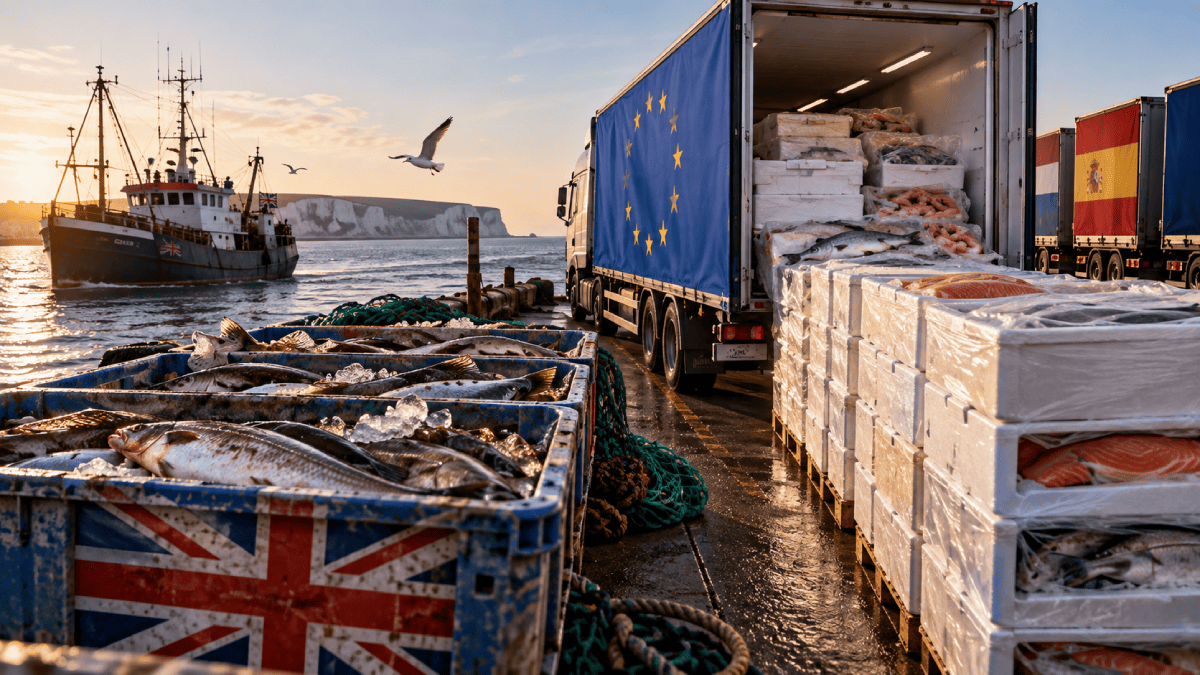
Britain's fleet landed 745,000 tonnes of sea fish in 2024, worth £1.16 billion on the quayside. In the same year the country imported seafood worth £3.5 billion, three times the quayside value of everything its own boats brought in.
The two figures sit at different points of the chain, imports being largely processed and landings being raw, which is rather the point.
Britain sells the raw thing and buys back the finished one.
The fish in British waters are a national asset, as real as North Sea oil or the radio spectrum. An owner with any sense protects the breeding stock, charges rent for its use, hands the harvesting rights to whoever will build British wealth with them, and sells the product wherever it fetches most.
Westminster has managed none of these things for fifty-five years, and the failure has a paper trail going back to the beginning.
They Knew The Fleet Would Shrink But Signed
Officials at the Department of Agriculture and Fisheries for Scotland put their assessment in writing on 11th December 1970. The EU Common Fisheries Policy, they warned, would produce a "weaker and less efficient national fleet". The same note conceded it was
much easier to see the drawbacks for our fishermen likely to be involved in the Common Fisheries Policy than to be at all positive there will be benefits to offset, let alone outweigh them.
Ministers went ahead regardless, reasoning the gains to English and Welsh fishermen would outweigh the Scottish losses.
Alex Smith of the Scottish Fishermen's Federation, reading the papers when they were released, said they confirmed what the industry had suspected for a generation: the Scottish fleet was expendable.
Nobody was deceived. The arithmetic was done, the cost was counted in men, and the signature went on the paper.
| Measure | Then | Now |
|---|---|---|
| Landings by UK vessels | 1,094,000 tonnes (1938) | 745,000 tonnes (2024) |
| Demersal landings, cod and haddock among them | 1938 baseline | about 17% of the 1938 volume |
| Men and women employed fishing | just over 21,000 (1970) | 10,724 (2021) |
| Registered fishing vessels | 8,667 (1996) | 5,232 (2024) |
| Fishing's share of UK economic output | not comparable | roughly 0.03% (2021) |
Sources: House of Commons Library and the MMO.
Some of the decline was nobody's fault.
The Cod Wars closed Icelandic grounds to British boats, and fish populations everywhere came under pressure from better technology.
Neither fact explains why a country would do so little with what it kept.
Parliament Tried to Stop Quota Hopping and Paid £55 Million for Trying
Westminster did once attempt the reform British fishermen still demand, and got its fingers badly burned. The Merchant Shipping Act 1988 required any vessel fishing against British quota to be genuinely British: at least 75% of its ownership and directors had to be British citizens resident in the United Kingdom, or British-incorporated companies meeting the same test.
The target was quota hopping, the practice of catching fish against Britain's allocation and landing it in Spain.
Ninety-odd Anglo-Spanish fishing companies sued. The European Court of Justice struck the ownership rules down, and in March 2000 the British taxpayer settled the damages claim at £55 million, including some £26 million of interest, against an original claim of £285 million.
Britain paid foreign fishing firms compensation for the offence of.... trying to keep its own fish.
Britain has since left the European Union, thank the Lord.
The court which killed the 1988 Act no longer has jurisdiction over British waters. The constraint is gone, yet not one government has picked the policy back up.
What grew in its place is worse.
The right to catch most fish in English waters rests on Fixed Quota Allocation units, which the government's own English Quota Management Rules confirm were introduced in 1999 and calculated predominantly from what each vessel landed in 1994, 1995, and 1996.
The guaranteed floor for England's smallest boats rests on their share of allocations in 1991 to 1993.
A skipper putting to sea in 2026 finds his access to a wild, migrating animal fixed by what other men caught before he was born.
Those units became tradable assets, and money did what money always does. In 2024, 79% of registered UK vessels were under ten metres long, yet they landed just 4% of the catch. Over three quarters of all landings came from 202 vessels over 24 metres, 4% of the fleet.
In 2018 an Unearthed investigation found five families on the Sunday Times Rich List held or controlled 29% of British fishing quota, with nearly half the remainder traceable to Dutch, Spanish, and Icelandic interests. The largest single holder of English quota was the UK subsidiary of Cornelis Vrolijk, a Dutch firm out of IJmuiden, sitting on roughly 24% of the English total.
The same group's supertrawler Frank Bonefaas was caught in 2014 with 632 tonnes of mackerel taken in restricted waters off Cornwall. The court fined the company £97,000 and let it sell the catch for an estimated £437,000.
The prosecution turned a profit for the defendant.
During the passage of the Fisheries Act 2020, the House of Lords inserted a requirement for 65% of fish caught in UK waters to be landed in the UK.
The government stripped it out in committee.
What survived is the English "economic link", a licence condition with the teeth of a goldfish. A vessel satisfies it by landing 70% of its quota catch in Britain, or by employing a mostly British crew, or by handing over a token of quota instead.
The government's own worked example shows a vessel landing half its £100,000 catch abroad and settling up with a £4,000 quota transfer. Four pence in the pound buys the right to feed a Dutch auction with British fish.
Mackerel To Norway, Cod From China
Three species carry most of the British seafood economy, and each is broken in a different way. Our seas are mostly full of Mackerel, Cod, and Haddock. All fine British fish. There are 442 different fish species in total.
| Mackerel | Cod | Haddock | |
|---|---|---|---|
| UK vessel landings, 2024 | over 233,000 t | about 20,000 t | about 40,000 t |
| Main trade direction | export | import | import |
| Imports, 2024 | about 18,700 t (whole-fish equivalent) | 77,700 t of product, worth £490m | 54,000 t of product, worth £196m |
| Standing with British shoppers | ninth in retail by volume | third in retail; 63.8% of chip-shop servings | seventh in retail |
| Condition of the problem | we catch it but barely eat it | we eat it but cannot catch it | we could catch it, eat it, and still import it |
Sources: MMO, Seafish mackerel report, Seafish fish and chips factsheet, and Seafish supply chain report.
Mackerel is Britain's great marine cash crop at 1% of the entire UK catch in 2024. Almost half of it never touched a British quay. Scottish boats alone ran about 68,000 tonnes worth £106 million straight into Norway, because Norwegian buyers paid roughly 14% more per tonne than Peterhead, a gap of about £191 a tonne.
The skippers behaved rationally. The British side of the market simply lost the auction, and nobody in Whitehall appeared to notice it was bidding.
Seafish traced the whole flow and found only 24% of Britain's mackerel supply stayed in the domestic market. British supermarkets sold under 16,000 tonnes of it. Researchers writing in Nature Food calculated the omega-3 fats leaving the country in British oily fish could cover 73% of the population's recommended intake.
Ministers worry publicly about the national diet while the cure sails for Bergen.
Cod runs the other way.
British consumers adore it, and British waters cannot supply it. Scientists at ICES advised zero catch of all three North Sea cod sub-stocks for 2026, with the southern component below the level where breeding itself is at risk. Britain's 2026 North Sea cod quota is 5,282 tonnes, which is a curious number to arrive at when the advice was nought.
The chip shop therefore runs on imports, and China topped the list of consignment countries for British cod in 2024, mostly as a filleting hub for Arctic fish. Even the Arctic supply is tightening:
Norway and Russia set the 2026 Barents Sea cod quota at 285,000 tonnes, the lowest since 1991.
Half The North Sea Haddock Left Swimming
Haddock is where the excuses run out because the stock is healthy enough for a large directed fishery. Britain holds about two thirds of the North Sea allocation. Large parts of Scotland, Yorkshire, and the Midlands already prefer haddock in their fish suppers, and it costs the customer about a pound less than cod.
No ecological constraint, no consumer resistance, no shortage of quota.
In 2024 Britain held 65,325 tonnes of North Sea haddock quota and British vessels caught 33,747 tonnes. In the same twelve months the country imported haddock equivalent to roughly 106,000 tonnes of whole fish, chiefly from Iceland and Norway.
The Marine Management Organisation quango opened a quota leasing scheme precisely because it knew spare North Sea haddock was sitting idle in English pools. Scottish figures for 2025 show 53% uptake in the North Sea and 24% west of Scotland.
Quota gets swapped, banked, borrowed, and tangled in mixed fisheries. Icelandic processors deliver frozen fillets of uniform size all year round, which British boats cannot promise.
None of it explains why a country pays foreigners to catch a fish it is entitled to catch, wants to eat, and leaves in the water.
The government prices Britain's 2026 quota at £964 million, yet expects only £682 million of it to be landed, judging by past uptake. Defra is careful to note the gap reflects banking, borrowing, and swaps as well as waste, and the caution is fair.
It is also completely besides the point.
No board on earth would accept a £282 million difference between the value of its inventory and what it expects to realise without demanding an explanation for every pound.
Brussels Keeps Its Seat Until 2038
Before Brexit, EU vessels took about 760,000 tonnes a year from UK waters, while British boats took about 90,000 tonnes from EU waters. The Trade and Cooperation Agreement shifted 25% of the EU's historic quota in UK waters to Britain, worth about £175 million in 2025.
Most of the old carve-up survived. Annual negotiation of access was due to begin in July 2026, handing Britain a lever to pull every single year for the rest of time.
At the UK-EU summit of 19th May 2025 idiot ministers agreed full reciprocal access until 30th June 2038, sweetened with a £360 million fund for coastal communities. The Scottish Fishermen's Federation rightly called it a "horror show".
| Access, 2023 | Tonnes caught | Value of catch |
|---|---|---|
| EU vessels in UK waters | about 580,000 | about £400m to £500m |
| UK vessels in EU waters | about 82,000 | about £73m |
Source: Defra data released under the Environmental Information Regulations.
The government puts British access to EU waters at about £80 million a year. Asked in the Lords what twelve years of EU access to British waters were worth, Defra replied it could not accurately estimate the figure.
This stupid crap should be familiar by now.
Ministers priced what they received to the nearest ten million and declined to price what they surrendered at all. A purchasing manager who signed a twelve-year supply contract on those terms would be escorted from the building.
Under Article 509 of the TCA, Britain may end the fisheries arrangements at any moment, but the trade, aviation, and road transport chapters collapse with them nine months later.
Fishing was lashed to the rest of the economy so no British government could tug on it without tearing something valuable. Because EU negotiators are predatory, and ours are useless cowards.
- Article 510 requires a review of access and quota shares in 2030, and:
- Britain keeps the right to close waters for conservation.
The sandeel arbitration proved the second: Brussels challenged British closures of North Sea sandeel grounds, and the closures continue.
4000 Falklanders Built It Better
In 1986 the Falkland Islands declared a fisheries zone around the archipelago and began selling licences to the foreign fleets already working the grounds. Government revenue rose fivefold. The islands became self-funding in everything except defence and foreign affairs, and fishing now provides the bulk of the economy.
Two species of squid (Argentine shortfin and the Patagonian calamari) account for roughly three quarters of the catch, and by the islands' own reckoning, half the calamari eaten in southern Europe comes out of Falklands water.
Falklands surveys run before each squid season, and when the numbers disappoint, the season does not open. In 2024, after the pre-season estimate came in below the 10,000-tonne safety threshold, the government cancelled the second Loligo season outright, for the first time in the fishery's history.
Sixteen large trawlers went home. The industry, facing roughly £100 million of vessels under refit, accepted the need to protect future seasons and said so publicly.
Stanley shut a profitable fishery because a survey said the stock could not bear it. London set a North Sea cod quota of 5,282 tonnes against scientific advice of zero.
| Falkland Islands | United Kingdom | |
|---|---|---|
| Rent charged for access | £30.5 million in licence fees (2022) | none |
| Ownership rule | joint ventures at least 51% locally owned since 2023 | struck down in 1988, never restored |
| Licence term | 25 years, long enough to justify new vessels | quota units derived from 1994 to 1996 catches |
| Response to a weak survey | season cancelled | quota set above a zero-catch recommendation |
Sources: Eurofish, Hook & Net, and the Scottish Government.
Since 2023 the joint ventures holding long-term Falklands squid licences must be at least 51% owned by Falkland Islands partners, in exchange for licences running 25 years. Spanish capital and Galician skill remain welcome, and three new trawlers were duly built in Vigo and Marín for the islands' fleet.
The islanders simply declined to let anyone else own the resource.
It is the identical principle the European Court struck out of British law, working perfectly well under a British flag.
Britain's reward for this competence was to leave the Falklands out of the Brexit trade deal altogether, so islands squid now pays a 6% EU tariff on arrival in Spain.
Stanley built one of the best-run fisheries in the world, and Whitehall forgot to take it to the table.
South Georgia's toothfish fishery scored 96 out of 100 in its Marine Stewardship Council assessment (among the highest marks ever awarded) on a catch held at around 2,170 tonnes.
Tristan da Cunha's own rock lobster, of which around 440 tonnes a year is sold to Japan and America, provides about 80% of the territory's revenue for a population of under three hundred.
The Faroes And Iceland Charge For Their Fish
Britain's North Atlantic neighbours reached the same conclusion as Stanley, by a different route. Denmark's Faroe Islands rewrote their fisheries law in 2017. They phased out foreign ownership of fishing rights entirely, began auctioning 15% of mackerel and herring quota and 25% of blue whiting, required catches to be landed at home, and made unused rights revert to the government.
A population of 54,000 concluded the public should be paid for its own fish.
Iceland went further in July 2025 by raising fishing fees from about a third of sector profits to nearly half. Icelandic firms had been booking catches between their own boats and their own factories at conveniently low internal prices, and the state now prices pelagic fish against Norwegian market rates instead.
Revenue roughly doubled, from about 10 billion krónur a year toward 18 to 20 billion, with the thirty largest firms carrying 90% of the burden and small operators given wider exemptions.
Norway, for its part, generally permits only active fishermen to own fishing boats, keeping processors and financiers off the deck.
Every one of these jurisdictions grasps the principle Westminster has missed for half a century.
The fishery is public capital, access carries a price, and the breeding stock is the asset rather than the harvest.
A British Ocean Estate From Shetland To Tristan
What follows costs the Exchequer nothing to start. Every measure below either raises money, redirects money already committed, or repeals a rule the government wrote itself. The obstacles are political, and the figures attached to each are the government's own.
Charge Rent on Every Tonne
Every holder of British quota should pay an annual resource fee, set as a share of the catch's market price and benchmarked, as Iceland does, against the best price obtainable anywhere rather than a company's internal transfer. Boats under twelve metres and owner-operators should pay little or nothing.
| Iceland's 2026 fishing fee | Per kilo |
|---|---|
| Whole cod | 50.79 krónur, roughly £0.30 |
| Haddock | 22.92 krónur, roughly £0.13 |
Source: The Fishing Daily.
A British fee capturing between 10% and 20% of the £964 million quota book would raise roughly £96 million to £193 million a year. Icelandic researchers have put resource rent there at 10% to 19% of fishing export value since 2008, so the range is hardly heroic.
Against such a fee, the £360 million coastal fund attached to the 2038 surrender amounts to two or three years of rent Britain could have been collecting since 1999, presented as a gift.
Every penny of a real fee should go back to coastal towns: harbours, cold stores, ice plants, training, and a fuel rebate for small boats.
Put Quota in the Hands of Working Skippers
Fixed Quota Allocations should become time-limited licences. Any unit sold, transferred, or left unfished for two consecutive years should return to a national pool and be reissued on ten-year terms, with a fixed share reserved for owner-operators and new entrants fishing their own quota from their own boats.
Crew should be paid by share of the catch, the old custom which made working fishermen prosperous.
The civil service has already proved it can allocate by merit when no incumbent stands in the way. The new bluefin tuna fishery gave Britain a 230.56-tonne allocation for 2026 to 2028, of which 120 tonnes went to a commercial fishery restricted to rod-and-reel boats of twelve metres and under.
Of 155 applicants, 66 passed assessment and a ballot picked 30 vessels at four tonnes each. Nobody asked who had caught tuna in 1995, because nobody had.
Defra's Quota Application Mechanism scores applicants on gear, monitoring, and economic benefit, with penalties for failing to use what they win. Both remain experiments at the margins while the inherited core goes untouched.
British Quota for British Owners
The Merchant Shipping Act 1988 already drafted this policy: 75% British ownership and directorship for any vessel fishing British quota.
Luxembourg killed it and the taxpayer paid £55 million for the funeral.
The court responsible no longer has jurisdiction, and the Falklands have been running the same rule at 51% since 2023 without the sky falling in.
Restore the threshold, allow a six-year window for foreign holders to sell as the Faroes did, and bear in mind a single Dutch firm currently holds about a quarter of England's quota.
Overseas buyers remain welcome to bid for British fish at a British auction. They should not own the right to catch it.
British Buyers Get First Refusal
Quota fish should pass through a British auction, open online to domestic processors before a vessel may sail for Bergen or IJmuiden. If a Norwegian buyer still wins on price, so be it, and the resource fee captures part of the premium for the Treasury.
Compulsion works, inconveniently for those insisting it cannot.
Scotland raised its pelagic landing requirement from 30% in 2023 to 40% in 2024 and 55% in 2025. The share of Scottish mackerel and herring landed at home rose from roughly 50% to 63%, bringing an estimated additional £58 million of landings into Scotland in two years.
For 2026 the requirement goes to 70%, to keep the four processors handling almost all Scottish mackerel in work. England has no equivalent and should copy it wholesale. The four-pence-in-the-pound quota gift in the English economic link should go, and the Lords' 65% landing rule should be restored in law.
Britain has 342 seafood processing sites employing about 17,200 people, and every tonne landed at IJmuiden is a tonne those sites never see.
Feed Schools, Hospitals, and Barracks
The state, for some unknown reason, serves millions of meals a week and could underwrite a domestic whitefish market by lunchtime. Schools, the NHS, prisons, and the armed forces should buy British mackerel, herring, haddock, and whiting on long contracts at fixed prices.
Almost nobody eats it.
Add 67,162 tonnes of blue whiting and Britain sits on over 170,000 tonnes of protein with no domestic market worth the name.
Guaranteed public demand gives a processor a reason to fillet and freeze it here, and puts cheaper, healthier fish on working-class plates, where it belongs.
Sell Premium Fish at Premium Prices
Britain undersells its best product with remarkable consistency. In 2024 Scottish creel-caught langoustine earned £17 million from 1,485 tonnes, about £11,400 a tonne. Trawled Nephrops earned £64 million from roughly 17,000 tonnes, about £3,760 a tonne. Same animal, three times the price, decided entirely by how it is caught and handled.
Vessels under ten metres average £3,907 a tonne for their landings against £1,255 for vessels over 24 metres. Live shellfish, day-boat fish, and Overseas Territory products such as South Georgia toothfish and Tristan lobster should carry one British provenance mark, pushed through embassies and trade missions.
An export trade built on quality rather than tonnage rewards the small boats most of all.
Rebuild Cod as a Long-Term Investment
Overfishing is asset-stripping, and Britain still does it. Only 29 of 56 catch limits based on full scientific advice were set in line with it for 2024, and the record for data-poor stocks is worse at 7 of 21. Cod quotas have been set well above zero-catch advice, prompting a High Court challenge by the Blue Marine Foundation.
Britain also joined Norway, Iceland, and the Faroes in setting a 2026 mackerel limit of 299,010 tonnes against scientific advice of 174,357 tonnes. Brussels complained, and on the science, irritatingly, it had a point.
Bigger fish are cheaper to catch, which is why restraint pays rather than merely soothes the conscience. Spawning grounds should close in season, and depleted stocks should rebuild until the marginal fish is worth more in the water than on the deck.
The Fisheries Act 2020 promised 43 Fisheries Management Plans; the government's own post-legislative assessment records 11 published and 32 still in preparation more than five years after Royal Assent, a delay Defra attributes partly to "optimism bias".
Stanley manages an entire fishery on annual surveys. The remaining plans should be finished within a year.
One Ministry for Every British Sea
Britain runs its ocean estate as a set of unrelated files in unrelated departments. The Falklands, South Georgia, Tristan da Cunha, St Helena, Ascension, and Pitcairn should form a single British ocean network with shared patrol vessels, satellite monitoring, science from Cefas and the British Antarctic Survey, and one export brand.
The Blue Belt programme already covers more than four million square kilometres and supplies the scientific spine; what is missing is anybody charged with making it pay.
Every future trade deal must carry every Overseas Territory fishery with it, beginning with tariff-free entry for Falklands squid.
Prepare for 2030 and Hold the Line in 2038
The 2030 review should open with a published British valuation of EU access, the very figure Defra currently declines to produce, and a demand for quota shares reflecting where fish actually live rather than where boats once fished.
Britain should use its conservation powers without apology wherever the science supports closures, as the sandeel case showed it can.
Well before 2038, every party in Parliament should commit to one position: no extension of EU access without full payment, in quota or in cash, at a price Britain sets.
With Politicians Like This, Who Needs Enemies?
Britain's seafood trade reached £6.09 billion in 2025. The raw fish underneath it belongs to the nation, and the nation collects nothing for it.
Rent goes uncharged. Quota drifts to rich families and foreign firms. Mackerel feeds Norwegian factories, haddock swims about untouched, Spanish ports reprocess the finest squid in the South Atlantic, and Peterhead, Newlyn, and Grimsby watch it all go past.
Ministers have spent fifty-five years arguing about who may fish in British waters, beginning with a Cabinet which knew the answer would cost four thousand Scottish jobs and signed anyway.
In five decades almost nobody in Westminster has asked the only question worth asking: what should the country get back?
Stanley worked it out in 1986, with a population smaller than a market town and no civil service to speak of. London has given itself until 2038. which is completely unacceptable.