Questions For Anyone Who Wants To Be Your MP
Before you vote, ask the questions a slogan cannot survive. Hand a candidate a hard truth about how Britain actually works, then watch whether they reason from it or reach for weasel words. There is nothing to revise for and nowhere to hide. Does the candidate understand the country?

This June, the voters of Makerfield will decide whether to send Andy Burnham back to the House of Commons in order to get rid of the meddling ambulance chaser. His case, built over years of running Greater Manchester, is honest and consistent. The state should do more, reach further, and take back what it once gave away. He re-regulated the city's buses on that conviction, and the Bee Network is the result he points to.
Sadly, Burnham's record is not exactly the utopia he claims. Homelessness doubled under his tenure, his attempt to copy the Muslim dwarf of London's emission zones was a disaster, the police were put into special measures for failing to report 80,000 crimes, the NHS were also put into special measures, and his green land plan was so catastrophic councils voted out of it.
One need not disagree with any of it to want better questions than the ones candidates normally hear. One does not need to ask if Burnham's ideas are favoured by The Restorationist. They are obviously a foul stench to the nose of any sensible person who understands the state took control of the country in 1914 and never gave it back. More state control is the absolute opposite of what we need.
Most questions invite a performance. Ask what someone would do about the NHS and you get a feeling, a figure lifted from a briefing note, and a comforting platitude about hard-working staff. Ask what they believe and you get the manifesto read back to you.
The sharper test is not whether a candidate knows a fact. Facts can be looked up in the time it takes to write a reply. The test is whether they can reason from one: take a hard truth about how the country works and say what follows from it, what they would protect, what they would give up, and who would carry the cost.
Ten Questions Which Reveal Competence
The questions below hand the candidate the fact. There is nothing to catch them out on and nothing to revise for. What remains is the only thing worth knowing. Faced with a real problem, can they think, or do they reach for the warm snake oil weasel words?
The bill to repair NHS buildings has overtaken the cost of running them for a year. What would you protect first?
This exposes the collision hidden inside the word "investment." Money for treating patients today is not the same as money for mending the roofs, the wiring and the operating theatres all of that treatment depends on. For years the building budget has been raided to ease the pressure of the moment. It holds the present together and deepens the collapse to come.green land plan was so catastrophic councils voted out of it
So the choice is real.
- Protect treatment now and let the fabric rot further, ringfence the rebuilding and watch waiting lists grow, or
- Cut something else to fund the estate properly.
A candidate who can reason will pick one of those and own the cost. One who cannot will say patients must come first, which sounds humane and settles nothing.
Debt interest now costs the country £111.2 billion a year, almost twice the defence budget. Which promise does your party drop first if borrowing costs rise again?
This is not a programme to be trimmed. It is a bill, and it arrives before the speech, before the pledge, before the press conference.
If the cost of borrowing climbs, as it has done within living memory, something has to give. Defence, welfare, the pension guarantee, the NHS rise, the infrastructure plan: one of them loses. A candidate who understands the arithmetic will name the thing they would let go and explain why it matters least.
One who does not will answer with growth, or fairness, or a vow to be responsible. Ask the quiet follow-up. Which department, how much, and in which year?
The state pension is paid out of today's taxes, by today's workers, and fewer of them stand behind each pensioner every year. What is your fix, and who pays for it?
There is no pot with anyone's name on it. Today's pensions come straight from today's wages, and the number of workers behind each pensioner has been shrinking for decades, while the promise to raise the pension every year makes the sum harder still.
The honest options are few.
- Tax workers more
- Lift the pension age
- Slow the yearly rise
- Cut elsewhere
- Borrow
- Lean on higher immigration to widen the workforce.
None is comfortable to say aloud at a public meeting. A candidate who can reason will choose from that short list and defend the choice. One who cannot will tell you pensioners deserve dignity, which is true and answers nothing. Of course they do. The question is who pays, and what loses.
Care for the elderly and for vulnerable children now swallows most of what a council spends, and several councils have run out of money entirely. Which local service should get worse so the duties they cannot drop survive?
Most councils have no spare pot waiting to be redirected. The legal duties consume the budget before the visible things, the libraries, parks, road repairs, street lighting and bin rounds, are even reached.
So the choice is forced, and it is local. What service you would allow to decline in order to keep the mandatory ones alive?
A candidate who can reason might argue the funding model itself has to change, which is fair, and then the follow-up stands: until it does, what gets squeezed? Blaming waste is the way out, and everyone takes it.
The state's record on building things, from railways to defence kit to large computer systems, is late and over budget far more often than not. What would have to change before it could be trusted with more?
This matters most for anyone promising a busier, larger state, because to widen its reach is to ask voters to trust it with more. The honest record on big undertakings is poor.
So the fair question is not whether the state should do more in principle. It is what about the way it delivers would have to change first. Clearer lines of authority, steadier funding, fewer points at which a single objector can stall a project, one named person who carries the blame.
A candidate who has thought about it will talk about the machinery of getting things done. One who has not treats wanting a thing done and being able to do it as if they were the same act.
Britain has not built homes at the rate it needs for half a century, largely because the system hands local objection a veto over almost anything new. Where would you let homes go up against organised local opposition?
This is the point where building more stops being a slogan and starts costing the candidate something. Everyone favours more housing in the abstract, and somewhere else.
The shortage is not a riddle of money. It is structural, written into a system where a determined handful of residents can delay or kill almost any development, and where an MP's first instinct is to take the side of the people standing in front of them.
So make it concrete. Which sites, near which voters, would they push through anyway?
A candidate who can reason will name the principle, the limit, and what the neighbours get in return, the compensation, the say they keep. One who cannot will tell you communities must be heard, which is true, and is not the question.
Spending is higher than it was before the pandemic and the state employs more people, yet the service has not improved to match. Is the problem the money or the machine?
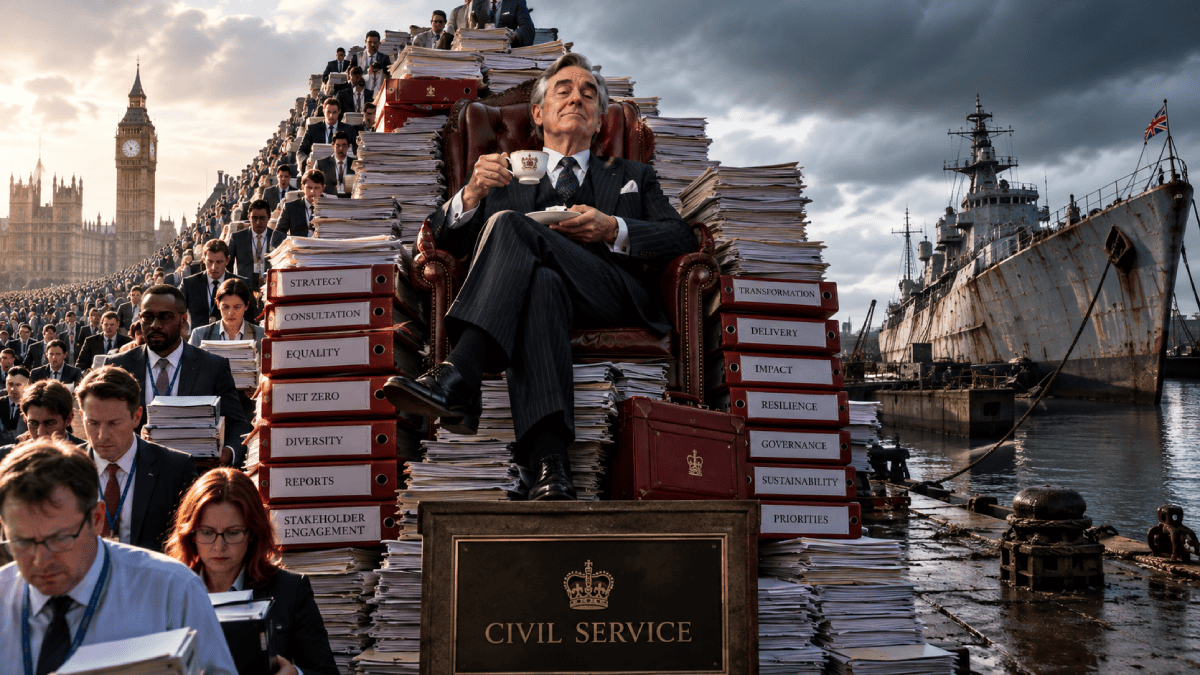
More cash and more staff have not bought proportionately more care, more justice, or shorter queues. The civil service is at its largest size for two decades. A candidate who understands this knows reform and cuts are not the same argument, and feeding money into a system without repairing how it works simply raises the price of the same result.
One who does not will treat every failure as a shortage of funding, as though the only question in government were how much. The reasoning lives in the second half of the answer. Granted the money, what inside the machine would they change?
An active state needs at least one thing the state plainly does well. What makes the buses work, and would the same approach hold anywhere else?
This is the friendliest question on the list and the most revealing. Hand the candidate their strongest example and ask them to take it apart.
- What made it work, clear control, honest costs, a service people can rely on, and
- Which of those conditions would have to hold for the same method to succeed in housing, or social care, or energy?
A candidate with a real grip will reason about what travels and what does not. One who holds the active state as a matter of faith will simply assert it should do more, which is conviction, not evidence.
Most of the budget, meaning health, pensions, welfare and debt interest, is fixed by law, by promise, or by politics too fierce to touch. Which part could you actually change, and what does that do to your other promises?
The genuinely movable part of public spending is a thin slice of the whole. Almost all public spending is locked by law as statutory duties officers of the state cannot refuse. To stop the spending, you have to remove the law which requires it in the first place.
A candidate who grasps this is honest about the limits of the job and careful about what they pledge. One who does not will speak as though the entire budget were theirs to redirect, which is how so many promises are made and so few kept.
Listen for the reasoning. Given how little is truly free to move, what would they put first, and what would they quietly let go?
Much of what looks like the power of government now sits with regulators, the courts, the Bank of England and other bodies voters cannot remove. If you want the state to do more, which of those powers would you bring back under elected control, and what could go wrong?
For a candidate who believes in an active state, this is the deepest question of all, because the British state has spent forty years giving its own power away. Interest rates, large areas of regulation, planning decisions, and a good deal of policy now rest with institutions placed on purpose beyond the reach of any minister or voter.
To say the state should do more, without saying where its power actually went, is to miss the structure entirely. A candidate who has thought about it can point to a specific power, explain why returning it to elected hands would help, and admit the risk in doing so.
Politicians handed direct control may use it badly, or for short-term advantage, which is often the very reason it was given away in the first place. One who has not will talk about taking back control in general, the warmest and emptiest phrase in modern politics.
Parsing The Weasel Answers
None of these is a trap. Every one has a real answer, and a good candidate will be glad to give it. Any candidate or MP can Google their way through a written answer or use ChatGPT to send an automated summary.
- Reward reasoning over fluency. A candidate who says "I had not looked at it that way, and here is how it changes my thinking" has told you something better than any polished reply. They are willing to follow a fact to its conclusion, even an awkward one.
- Be wary of the weasel words.
- I will fight for our NHS.
- I believe in fairness.
- We need real investment.
- None of these is a lie. Each is a tell. They are what people say when they have a feeling about a problem but no grip on how it actually works.
Ask these questions calmly and without heat, and the difference between a candidate who knows and a candidate who hopes will be plain long before you have to choose.
Is There A Mind Beneath The Manifesto?
There is a reason these questions stay clear of ideology, and it is not neutrality. It gets no-one nowhere to intimidate, humiliate, or corner representatives who need to do better.
Ideology tells you what a candidate wants the country to become. It tells you nothing about whether they understand what the country is. A Green party socialist and a Reform UK free-marketeer who both misread the structure will both fail, in opposite directions and with equal sincerity. The rosette changes the destination. It does not change whether the engine works.
Slogans and party policy sit downstream of all of it. You cannot mend the health service by wanting to mend it, not while the repair bill outruns the running cost and nobody will say which to protect. You cannot build the homes by promising them, not while a single street can block a development. You cannot keep the pension promise by calling it sacred, not while the workers behind each pensioner grow fewer every year. The wish is not the mechanism, and a manifesto is mostly a list of wishes. Vibes, as Coppen's Californians like to say.
The harder truth is that Britain's deepest problems are not partisan, and not one of them was made in a single Parliament. An ageing population. A state which handed away its own powers and forgot how to build. Capital starved for decades to feed the demands of the moment. Councils hollowed out by duties they cannot refuse. An economy which quietly stopped growing. None of this cares which party holds office, and all of it will outlast whoever wins in June.
A candidate fluent in ideology but blind to structure will spend the whole term being surprised. Surprised the money runs out; surprised the thing does not get built; surprised the machine will not move when they pull the lever.
Surprise is simply the price of not understanding the country you were elected to run.
When you weigh the person asking for your vote, the first question is not whether you share their "values" (whatever that means). It is whether they see the ground clearly enough to act on their ideas without being beaten by it. A clear-eyed opponent may do you more good than a well-meaning ally who is lost. Admire the conviction if you wish. Then make sure the person who holds it knows what they are standing on.