The Next Generation Of Sports Britain Can Be Champions Of
Football, rugby, tennis, snooker, and the Paralympics all began on these islands. The games Britons now take up fastest come from Mexico, Hungary, and America, while our own newest export crowns its champions in France. A country with underused sports halls can do better than spectate.
On 26th October 1863, men from eleven London clubs and schools met at the Freemasons' Tavern on Great Queen Street to settle an argument about kicking. The meeting had been called by Ebenezer Cobb Morley, a Hull-born solicitor and captain of Barnes, who had written to Bell's Life demanding a single code for football, much as the MCC had given cricket one a hundred years before.
By December, after six meetings in the same tavern, the Football Association existed and the game had its first laws. The FA now traces a sport played by more than 250 million people back to those evenings.
Morley had no grant, no strategy document, and no ministerial sponsor. He saw a muddle, drafted thirteen rules at his house in Barnes, and invited people to agree with him.
For roughly a century, Britain did this again and again.
Retired majors, schoolmasters, bored officers in Indian messes, and a refugee neurologist in Buckinghamshire took loose pastimes, wrote down rules, founded governing bodies, and exported the results.
A large share of the world's sporting calendar still runs on paperwork first drafted in English.
The recreational games spreading fastest through British towns were devised in Mexico, America, and Hungary. Britain's one notable sporting invention of the past fifteen years staged its 2026 world championships on the outskirts of Paris, and a team from elsewhere won.
It's time to reverse that trend. Sport is English.
Tavern Rules, Army Messes, And A Hospital in Buckinghamshire
The English rarely invented the act of hitting, kicking, or throwing a ball. People had done all three for millennia. England institutionalised and inventted the codified game: fixed dimensions, written laws, a governing body to enforce them, and fixtures to give the whole enterprise a reason to continue.
| Sport | Year | Where, and by whom |
|---|---|---|
| Golf | 1744 | Honourable Company of Edinburgh Golfers, Leith |
| Cricket | 1788 | Marylebone Cricket Club, London |
| Squash | c. 1830 | Harrow School |
| Association football | 1863 | Football Association, Freemasons' Tavern, London |
| Boxing | 1867 | Queensberry Rules, drafted by John Graham Chambers |
| Rugby union | 1871 | Twenty-one clubs at the Pall Mall Restaurant, London |
| Lawn tennis | 1874 | Major Walter Clopton Wingfield's patent |
| Snooker | 1875 | Officers' mess of the 11th Devonshire Regiment, Jubbulpore |
| Water polo | 1870s | William Wilson, Glasgow |
| Badminton | 1877 | Bath Badminton Club |
| Hockey | 1886 | Hockey Association, London |
| Rugby league | 1895 | Northern clubs at the George Hotel, Huddersfield |
| Table tennis | 1900s | Victorian parlour game sold as Ping-Pong |
| Netball | 1901 | First published rules, England |
| Paralympic sport | 1948 | Stoke Mandeville Games, Buckinghamshire |
Some of these began as accidents of boredom.
Lieutenant Neville Chamberlain (no relation to the Prime Minister) added coloured balls to a mess-table game called black pool and named the result after army slang for a raw cadet. Major Wingfield sold lawn tennis as a boxed set with a Greek name, Sphairistike, which nobody could pronounce. The public kept the game and quietly dropped the name.
The Victorian public schools treated organised games as training in courage, self-command, and loyalty to a side.
The outlook became known as muscular Christianity and reached a mass audience through Tom Brown's School Days.
Sport was meant to produce a particular kind of person, and its inventors said so openly.
The last great entry on the list came from a man who arrived in Britain with almost nothing. Ludwig Guttmann, a German neurologist who fled to Britain in 1939, ran the spinal injuries unit at Stoke Mandeville Hospital and believed movement was the route to recovery.
His first attempt, wheelchair polo, injured his patients so often he abandoned it.
Archery and netball worked.
On 29th July 1948, the day the London Olympics opened, his patients competed against ex-servicemen from the Star and Garter home in Richmond. By 1960 the Stoke Mandeville Games were held in Rome after the Olympics, and the world now knows them as the Paralympics.
Divers in Southsea devised underwater hockey in 1954 to keep fit through the winter.
Chesterfield's community trust launched walking football in 2011, and older players across the country took it up.
A London father chasing his son round the garden produced World Chase Tag.
Three entries in seventy years is a meagre return from the country whose rulebooks fill most of the world's back pages.
Britons Adopt Strange Games Fast
Padel was invented in Acapulco in 1969, spread through Spain and Argentina, and reached Britain with little fanfare. When the Lawn Tennis Association took over its governance in 2020, the country had 69 courts.
| Padel courts | Venues | |
|---|---|---|
| 2020 | 69 | Not published |
| End of 2024 | 870 | 293 |
| End of 2025 | 1,553 | 559 |
Britain is still a long way behind the leader.
Spain has around 17,300 courts and roughly six million players, and Playtomic's 2026 Global Padel Report counted 58,334 courts worldwide.
Nobody in Whitehall planned any of this, obviously. Sport is one area it has no competence or desire to interfere with, so the domain flourishes.
Private operators built indoor centres, tennis clubs found room for a court or two, and players paid to use them. The state's contribution was to notice.
Padel is proof of demand.
Britons will take up an unfamiliar game in very large numbers once somebody builds a place to play it. Courts came first, and players followed within five years.
Hundreds Of New Sports Ideas
ESPN offers a sense of the supply. Its annual ESPN8: The Ocho broadcast, which began as a joke in the film Dodgeball, ran to 74.5 hours across four days in August 2026, with 23 competitions making a debut.
The schedule included corgi races and dog surfing, which Britain can safely leave to the Americans. It also featured OmegaBall, a three-team football game, roller hockey, wiffle ball, and archery tag.
Beyond the novelty end sits a large body of organised international sport with federations, world championships, and in some cases Olympic status, yet barely a foothold here.
- Floorball, devised in Gothenburg in the late 1960s, had about 330,000 players on federation books worldwide by 2022. Finland alone counted 45,000 licensed players and around 400,000 recreational ones as long ago as 2010.
- Kabaddi's professional league is the most-watched in India after cricket's Indian Premier League.
- Teqball was added to the European Games in 2023, within a decade of its invention.
- Flag football will be played at the Los Angeles Olympics in 2028.
Ten deserve a serious look.
| Sport | Origin | Format | Space and kit | British foothold |
|---|---|---|---|---|
| World Chase Tag | London, 2012 | Squads of four to eight; one-on-one, 20-second chases | Obstacle arena known as the Quad | Founders and long-standing teams in London |
| Padel | Mexico, 1969 | Doubles | Enclosed glass court | 1,553 courts at 559 venues |
| Pickleball | USA, 1965 | Singles or doubles | Badminton-sized court | About 55,000 active players |
| Flag football | USA | Five-a-side at LA28 | Any pitch, flag belts | UK Sport funding for LA28 |
| Kabaddi | South Asia, ancient | Seven-a-side | Mat or hall floor, no equipment | Hosted the 2025 World Cup |
| Floorball | Sweden, late 1960s | Five plus a goalkeeper | Sports hall, plastic sticks and ball | Leagues in three regions |
| Teqball | Hungary, 2014 | Singles or doubles | Curved table, football | Donated tables in Manchester and Liverpool |
| Roundnet | USA | Two against two | Portable net, any flat ground | National tour and a GB squad |
| Ultimate | USA, late 1960s | Seven-a-side | Any pitch, one disc | University and club leagues |
| Tchoukball | Switzerland, 1970 | Seven-a-side | Hall, two rebound frames | Governing body since 2002 |
The Wider Field: 70+ Sports Worth Examining
The test for public investment should not be novelty alone. Games which encourage sportsmanship, team loyalty, courage, restraint, practical competence and judgement under pressure have a stronger claim to become permanent institutions. Those which exist chiefly for spectacle may be better suited to an annual festival.
Team games, fair play and tactical cooperation
| Sport | What it involves | Character or practical value |
|---|---|---|
| World Chase Tag | Timed pursuit and evasion in an obstacle arena | Courage, agility, composure |
| Kabaddi | Raiders attempt tags against coordinated defenders | Courage, teamwork, restraint |
| Floorball | Fast indoor hockey with lightweight sticks | Cooperation, tactical judgement |
| Ultimate | Disc-passing end-zone game, ordinarily self-officiated | Honesty, self-discipline, teamwork |
| Tchoukball | Non-contact rebound-frame team ball game | Sportsmanship, collective responsibility |
| Flag football | Tactical football with flag-pulling rather than tackling | Coordination, discipline, leadership |
| OmegaBall | Three teams contest a circular football-style pitch | Situational awareness, adaptability |
| 360 Hoops | Circular basketball variant with a three-sided hoop | Adaptability, rapid decisions |
| Kin-ball | Three teams contest an enormous lightweight ball | Cooperation, communication |
| Quadball | Mixed-gender team game inspired by Quidditch | Teamwork, multi-tasking |
| Jugger | Teams use padded implements to support a scoring runner | Discipline, tactics, controlled contact |
| Ball hockey | Ice-hockey-style game on a dry surface | Teamwork, positioning |
| Broom hockey | Hockey-style contest using broom-like sticks | Team coordination, recreation |
| Soap hockey | Hockey on a deliberately slippery surface | Primarily entertainment |
| Wrestball | Wrestling and ball-game hybrid | Physical teamwork, controlled contact |
| 3×3 basketball | Fast, half-court three-a-side basketball | Small-team discipline |
| Beach tennis | Racket sport played on sand | Agility, partnership |
| Footvolley | Volleyball-style game using football skills | Coordination, teamwork |
| Sepak takraw | Acrobatic net game using feet and body | Courage, technical mastery |
| Jai alai | High-speed court game using curved catching baskets | Reflexes, discipline |
| Underwater hockey | Teams manoeuvre a puck along a pool floor | Breath control, coordination |
| Underwater rugby | Three-dimensional underwater team ball game | Cooperation, composure |
| Bike polo | Cycle-mounted teams play polo on hard courts | Balance, teamwork |
Accessible racket, throwing, striking and recreational
| Sport | What it involves | Character or practical value |
|---|---|---|
| Padel | Doubles racket game played within walls | Partnership, tactical patience |
| Pickleball | Accessible small-court paddle sport | Social competition, judgement |
| Teqball | Football touches across a curved table | Precision, technical mastery |
| Roundnet | Two pairs rally a ball off a circular floor net | Agility, cooperation |
| Headis | Table-tennis-like game played with the head | Coordination, timing |
| PaddleSmash | Paddle play combined with a roundnet-style central target | Partnership, coordination |
| FlingGolf | Golf-style game played by flinging a ball with a stick | Control, accuracy |
| Footgolf | Kicking a football around a golf course | Patience, accuracy |
| Disc golf | Flying discs thrown into target baskets | Judgement, self-discipline |
| Wiffle ball | Bat-and-ball game with perforated plastic ball | Accessible team competition |
| Kickball | Baseball-style game played by kicking a ball | Teamwork, participation |
| Bottlesbee / Polish horseshoes | Teams throw discs at targets mounted on poles | Accuracy, casual competition |
| Popdarts | Suction-cup darts scored around targets | Dexterity, inclusive play |
| Roofball | Throwing balls against a roof under scoring rules | Precision, novelty |
| Cornhole | Beanbags thrown at raised boards | Accuracy, easy participation |
Adventure, endurance, physical courage and martial competence
| Sport | What it involves | Character or practical value |
|---|---|---|
| Orienteering | Navigating between checkpoints using map and compass | Navigation, judgement, endurance |
| Adventure racing | Team expedition racing across multiple disciplines | Leadership, resilience, mutual dependence |
| Obstacle course racing | Running courses with demanding physical obstacles | Perseverance, practical agility |
| Ninja competitions | Timed climbing, hanging and jumping obstacles | Self-control, strength |
| Parkour | Efficient movement through physical obstacles | Adaptability, balance |
| Speed climbing | Head-to-head timed climbing on standard routes | Nerve, mastery |
| BMX freestyle | Judged bicycle tricks on ramps and obstacles | Discipline, controlled risk |
| Freestyle scootering | Acrobatics and tricks on stunt scooters | Balance, technical progress |
| Onewheel racing | Racing self-balancing electric boards | Balance, risk management |
| Freestyle trampoline | Acrobatic routines and tricks on trampolines | Body control, composure |
| Freestyle jump rope | Complex athletic skipping routines | Timing, mastery |
| Death diving (Døds) | Extreme-form platform diving | Courage, precise technique |
| Chessboxing | Alternating rounds of boxing and chess | Composure, strategy, endurance |
| Armoured combat | Regulated full-contact contests in replica armour | Teamwork, courage, specialist safety |
| Axe throwing | Throwing axes at fixed targets | Accuracy, safety discipline |
| Firefighter competitions | Timed challenges based on firefighting tasks | Physical competence, practical teamwork |
| United Grid League | Co-ed team races involving functional-fitness tasks | Shared workload, resilience |
Engineering, invention and intellectual contests
| Sport or competition | What it involves | Character or practical value |
|---|---|---|
| Robot combat | Custom-built machines fight in controlled arenas | Engineering, ingenuity, teamwork |
| Drone racing | Pilots navigate drones around courses at speed | Reflexes, remote piloting |
| Drone soccer | Teams fly protected drones through aerial goals | Coordination, engineering |
| Competitive Excel | Timed spreadsheet-model problem solving | Analytical discipline |
| Speed puzzling | Racing to complete jigsaw puzzles | Patience, concentration |
| Professional pinball | Ranked competition on pinball machines | Precision, composure |
| Golden Tee golf | Tournament play on arcade golf machines | Skill, concentration |
| Pop-A-Shot | Fast timed basketball shooting into arcade hoops | Coordination, repetition |
| Diving chess | Submerged chess requiring dives between moves | Composure, eccentric stamina |
Spectacle, festival sports and deliberate absurdity
| Contest | What it involves | Likely British role |
|---|---|---|
| Combat archery / archery tag | Teams fire foam-tipped arrows at one another | Tactical recreational leagues |
| Pillow fighting | Regulated combat with specially made pillows | Spectator novelty |
| Carjitsu | Grappling contests inside parked cars | Specialist combat spectacle |
| Slippery Stairs | Racing up slick obstacle stairs | Television event |
| Bubble football | Football while wearing inflatable body bubbles | Social-event entertainment |
| Bossaball | Volleyball, football and trampolines on inflatables | Festival spectacle |
| Red Bull Flugtag | Homemade flying machines launched over water | Engineering festival |
| Red Bull Soapbox Race | Home-built gravity vehicles race downhill | Town festival |
| Pumpkin tossing / chunking | Machines throw pumpkins for distance | Engineering spectacle |
| Outhouse racing | Decorated portable toilets raced by teams | Comic community event |
| Mailboat jumping | Specialist jumps between mailboats and docks | Spectacle, not a school sport |
| Slippery bicycle / water obstacle racing | Cycling over unstable or floating obstacles | Comic spectacle |
| T-Rex racing | Sprints in inflatable dinosaur costumes | Festival entertainment |
| Dog surfing | Surfing competitions involving dogs | Animal-event spectacle |
| Corgi racing | Short races for corgis | Festival entertainment |
| Air guitar | Judged mimed guitar performances | Stage entertainment |
Some labels overlap: combat archery and archery tag are commonly used for the same family of games, while obstacle racing and ninja contests have distinct organisations but related skill sets.
Brand names such as PaddleSmash and Popdarts have commercial owners; a public programme should examine licensing, pricing and accessibility before committing to their equipment.
For a British character ranking, the strongest additional candidates are adventure racing, orienteering, underwater hockey, kin-ball, quadball, floorball and combat archery. They test combinations of self-command, cooperation, endurance, technical skill and judgement.
For a festival, robot combat, soapbox racing, death diving, carjitsu and slippery stairs offer a different sort of value. The two should not compete for the same public policy justification.
Crowded Schools And Leisure Centres
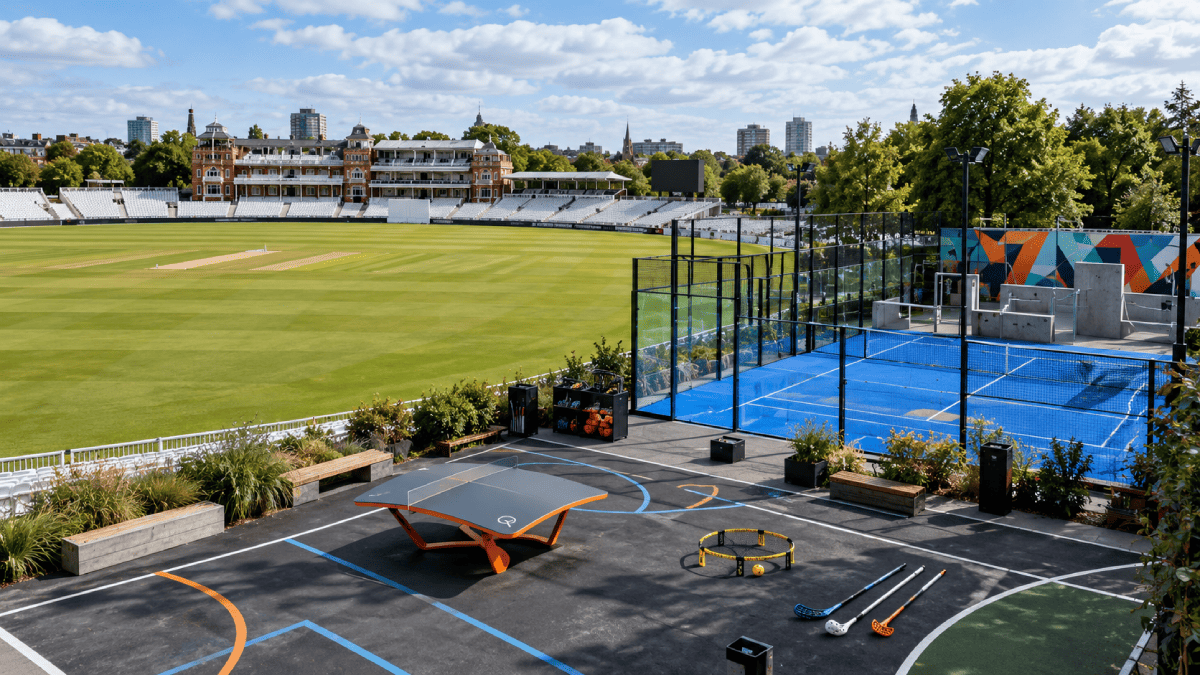
Floorball is indoor hockey with lightweight plastic sticks and a perforated ball, played in an ordinary sports hall. At Aberdeen University's club, a full season costs £35 and members need nothing beyond trainers.
The UK Floorball Federation runs adult, youth, and university leagues across the South, the Midlands, and Scotland, almost entirely on volunteer effort. Few British schools play it, which is odd for a team game with a kit bill smaller than a single cricket bat.
Roundnet needs four players and a net small enough to carry in a rucksack. Teams hit a ball down onto a circular trampoline, and once the serve is made there are no sides and no boundaries. Southampton claims the oldest university club in Britain. In 2026 British Roundnet signed FatFace as front-of-shirt sponsor for a summer tour through London, Bristol, Birmingham, and Brighton, and sent a GB squad to the world championships in Paris. Paris again.
Teqball is football played over a curved table, a sort of competitive keepy-uppy. Its inventor, former professional footballer Gábor Borsányi, practised with friends on concrete ping-pong tables in Budapest when no pitch was free. In a football-mad country the appeal is obvious, and the international federation donated tables to Manchester and Liverpool in 2021 to prove it.
There is a catch. Teqball is a proprietary sport.
The table design is protected, only licensed manufacturers may build it, and the name itself is trademarked. One British supplier lists tables at between £1,507 and £3,584 before VAT.
Nobody has ever needed to buy a licensed goalpost from the heirs of Ebenezer Morley. Public money for teqball should come with a hard-negotiated bulk price, or not at all.
Games With British Players Already Waiting
Kabaddi needs no equipment whatsoever. A raider crosses into the opposing half, tags as many defenders as possible, and must return home without being wrestled to the floor. The 2025 Kabaddi World Cup was staged across Wolverhampton, Coventry, Birmingham, and Walsall in March 2025, the first time the tournament had been held outside Asia.
It received £500,000 from the Commonwealth Games Legacy Enhancement Fund, and England fielded men's and women's sides. A contact sport demanding nerve, timing, and coordinated defence, with no kit bill at all, belongs in school halls well beyond the West Midlands.
Pickleball, a paddle game played on a court the size of a badminton court, has spread fastest among people who had given up on tennis or squash.
Pickleball England reported an estimated 55,000 active players and more than 1,000 places to play in late 2025. Its English Nationals in Bolton drew a record 1,350 entrants, and the organisers said the field would have topped 2,000 had the venue been bigger. Demand is running ahead of courts.
Flag football is American gridiron football without the tackling: defenders stop the ball carrier by pulling a flag from a belt. In December 2024 UK Sport awarded the British American Football Association £500,000 for the 2025 to 2029 cycle, the first public money the sport had ever received here, to prepare Great Britain for its Olympic debut at LA28.
The game needs nothing but an existing pitch and a bag of belts, and the NFL has made clear it wants flag at the Olympics beyond 2028.
Honesty As A Rule of Play
The Victorian schools claimed games built character. They were correct. Two modern sports go further and write character into the rulebook.
Ultimate, a seven-a-side game played with a flying disc, has no referees. Under the rules of the World Flying Disc Federation, players call their own fouls, and teams are held responsible for disciplining team-mates who behave badly. This applies at world championships as much as in a park.
In 2019 the federation wrote self-officiation into its bylaws and placed it beyond easy amendment. After every match, each side scores its opponents in five categories, from knowledge of the rules to self-control.
A player who wants to cheat must do it to an opponent's face, then explain himself.
Tchoukball came from a Swiss doctor, Hermann Brandt, who was appalled by the injuries contact games inflicted. His paper, A Scientific Criticism of Team Games, won the Thulin Prize in Lisbon on 16th August 1970, and the game he designed from it bans defenders from blocking or obstructing attackers.
Players score by bouncing the ball off an angled frame so it lands beyond the defence. Brandt's charter states the game excludes "any striving after prestige, whether personal or collective".
Britain and Switzerland were founding countries of the international federation, and Tchoukball UK has existed since 13th January 2002. A trade report credited it with growth from 600 regular players in 2007 to more than 10,000.
Anyone who has stood on a Sunday touchline listening to adults abuse a fifteen-year-old referee will grasp the appeal. These are games in which sportsmanship is a condition of play rather than a hope.
World Chase Tag Was Born In London
World Chase Tag began in 2012, when Christian Devaux played tag with his son in their back garden and wondered whether the oldest game could become the newest sport and his brother Damien joined a year later.
They moved from casual meet-ups in Hyde Park to a standard arena, the Quad, and a format any child understands: one chaser, one evader, twenty seconds.
Parkour athletes, a talent pool no other sport had bothered to recruit, took to it immediately.
The early world championships were held at York Hall in Bethnal Green, and Channel 4 broadcast highlights in 2019, the first time the sport had appeared on television anywhere.
The organisation now claims more than three billion lifetime views, 46 licensed Quads, and broadcasts in over 35 countries. Its rulebook distinguishes fair gamesmanship from feigned injury and refusing to admit an obvious tag.
Then the familiar pattern set in.
In 2020, an American television executive and the US broadcaster Gray TV took equity stakes. The world championships moved to Évry-Courcouronnes, south of Paris, in 2024 and returned there on 6th and 7th June 2026.
The 2024 title went to Hollywood Freerunners of Los Angeles, and the 2026 title to a side called Rooftop Kings.
England yet again supplied the idea, the founders, the rulebook, and the first television deal.
Others supplied the capital, the venue, and the champions.
The whole history of British industry, from the jet engine to the hovercraft, has now been replayed on a climbing frame.
None of this is irreversible.
The sport's athletes come from parkour and gymnastics, and Britain is full of climbing walls, gymnastics clubs, and parkour gyms capable of housing a Quad.
A domestic circuit, school taster sessions, and a televised national championship would cost very little against the prize: a modern spectator sport of genuinely British origin, with its home crowds in Britain.
Public Money Still Follows Victorian Antiques
Regrettably, the Government's grassroots facilities scheme is the largest pot available. Launched in June 2025, the £400 million Multi-Sport Grassroots Facilities Programme spent £98 million across 991 projects in 2025/26, with £85 million more available in 2026/27. In England it is delivered through the Football Foundation.
At least 40% of funded projects must offer more than one sport, and the examples ministers give are rugby, cricket, and basketball.
A multi-sport programme run through football's own charity, with a multi-sport floor of two projects in five, offers new games very little room.
UK Sport is investing a record £330 million in the Los Angeles cycle, of which five new or returning Olympic sports share about £3 million. The published allocations give flag football £500,000, against £28.75 million for aquatics and £30.1 million for cycling.
Medal money follows medals, which is defensible. It also guarantees a new sport receives almost nothing until it has already succeeded without help.
On 21st May 2026 the Government announced more than £1 billion over three years for PE and school sport: £580 million for a new national network to bring specialist coaching into every primary and secondary school, £200 million for school facilities, and £100 million to carry primary schools through the transition.
Nothing in the announcement specifies which sports.
A school hall equipped for floorball, tchoukball, and kabaddi serves thirty children at once for less than the price of a cricket net.
Below these sit Sport England's Movement Fund grants of £300 to £15,000, worth more than £20 million a year, for which a fledgling floorball club competes against every walking group and dance class in England.
Sport England's latest Active Lives survey found 64.6% of adults, or 30.9 million people, met the recommended activity level between November 2024 and November 2025.
In the year before, the number taking part in fitness activities rose by 904,000 while team sport showed no reportable change.
A Saturday cricket fixture needs twenty-two players, two umpires, a groundsman, and a tea rota. A roundnet game needs four friends and a park.
25 Million To Find The Next British Games
Britain should run a five-year trial of new sports, costed at £25 million. The sum is under a third of a single year's grassroots facilities allocation, and about 6% of the full £400 million programme.
| Element | Cost |
|---|---|
| School and community trials in twenty towns | £9m |
| Facilities and equipment, bought in bulk | £7m |
| Regional leagues and an annual national finals weekend | £4m |
| Coaching and safeguarding | £2m |
| Independent evaluation | £2m |
| A prize for new British games | £1m |
| Total | £25m |
The terms should be strict.
- Ten sports, chosen by open competition among governing bodies with safeguarding already in place.
- Twenty towns, weighted towards places with low activity levels and underused leisure centres.
- Two years of trials, followed by an independent count of how many new players are still playing a year after their first session. Free taster days prove nothing.
- The weaker half lose funding. The stronger half receive help building regional leagues and attracting private sponsors.
- No sport receives permanent public money for the crime of being new.
Schools, universities, clubs, and amateur inventors should be invited to submit new games with written rules. The best should be trialled in schools, and the winner should take a slot at the national finals.
Morley needed a tavern and some letters to a newspaper. A modern Morley needs a hall, thirty pupils, and a referee willing to try something unfamiliar.
The national finals weekend should rotate between towns, a British answer to ESPN's festival with the corgis left out. Combat archery in Wolverhampton, floorball in Leeds, and a World Chase Tag championship back in Bethnal Green would draw crowds, sponsors, and television at a fraction of the cost of a single Premier League transfer.
Our Opportunity Of A Century
Britain does not lack athletes, facilities, or appetite. Padel found close to a million players in five years without any help from Whitehall. Pickleball tournaments turn people away. Kabaddi filled arenas in the West Midlands.
The obstacle is a funding system built to maintain the games of 1863 and 1871, administered largely by the bodies created at those meetings.
Nothing here requires a new agency. It requires ministers to treat sport as an inventive industry and to put a small fraction of existing budgets behind games with no Victorian pedigree. Ideally, we want no government involvement at all.
The men in the Freemasons' Tavern were amateurs who believed a game could be improved by writing it down.
Britain's sporting inventors worked in taverns, army messes, schoolyards, and hospital wards, and handed the results to everyone else. Their descendants have spent the decades since keeping the minutes.