Whitehall's Lawyers And Their Quiet Coup D'Etat
Folded into one department in the name of efficiency, the state's lawyers became gatekeepers to every ministerial ambition. From Channel pushbacks to Chagos and Iran, their caution has cost Britain dearly, and a Labour Attorney General has now rewritten the rules to prove it.
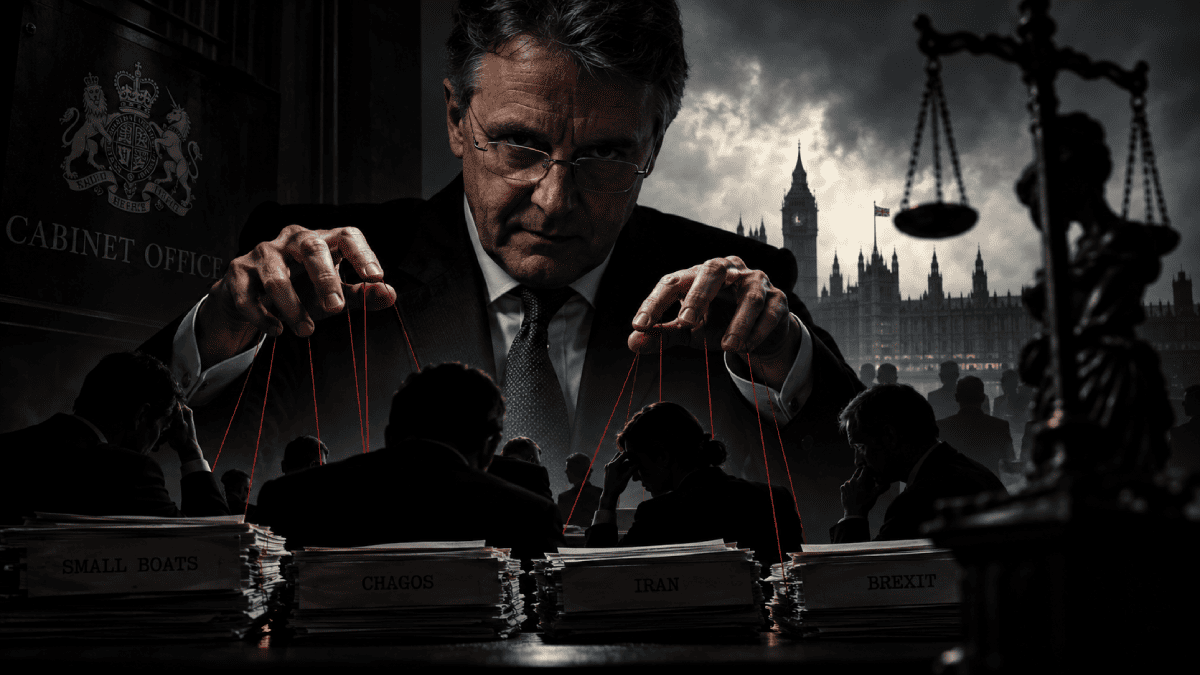
Dominic Cummings has never been accused of understatement, and this month he certainly did not start. Giving evidence to the House of Lords Constitution Committee's inquiry into constitutional safeguards, Boris Johnson's former chief adviser told peers Vladimir Putin was only "a tiny problem" next to the Ministry of Defence and the lawyers of the Cabinet Office.
As usual, Cummings was right. And glorious to watch.
In a two-part Spectator interview with Michael Gove and Madeline Grant and again in his evidence to the Lords, Cummings described a state in which elected ministers no longer decide what the government may lawfully do.
Government lawyers decide, and they work inside a machine assembled while Jeremy Heywood was Cabinet Secretary.
Ministers still sign the papers and still face the cameras.
What they lost, without any vote in Parliament, was control over which proposals reach their desks alive, and the nerve to carry the survivors into the Commons.
11 Departments' Lawyers Combined
Until 2012, most Whitehall departments employed their own legal advisers. A Home Office lawyer worked for the Home Office, answered to its permanent secretary, and built a career inside it. The Treasury Solicitor's Department handled litigation and some central advice, but departmental legal teams belonged to the departments they served.
Jeremy Heywood became Cabinet Secretary in January 2012. Within the year a cross-government "shared legal service" had been announced. Its architect was the Treasury Solicitor, Paul Jenkins, who complained of departments guarding their own lawyers and later credited Francis Maude, the Minister for the Cabinet Office, with helping him deliver it.
According to the Treasury Solicitor's annual report for 2013 to 2014, the merger programme and its sequencing were agreed with Maude in March 2013. Legal teams from the Home Office, the Ministry of Justice, and the Department for Communities and Local Government had been absorbed by March 2014.
On 1st April 2015 the enlarged body was renamed the Government Legal Department.
The lawyers were one of eight functions swept into what the Civil Service Reform progress report called a unified corporate centre, run jointly by the Cabinet Office and the Treasury. Human resources, communications, IT, commercial services, property, finance, and internal audit went the same way.
Of the eight, only one had the power to tell a Secretary of State his policy could not proceed.
Jonathan Jones succeeded Jenkins after an appointment announced in February 2014. On 25th June 2014 he explained the new arrangement to peers on the Delegated Powers and Regulatory Reform Committee.
Lawyers serving Education, Environment, Justice, and the Home Office had been brought into his department, and the object was tighter central co-ordination and supervision of their work. His own summary was blunt:
The lawyers report ultimately to me.
Baroness Andrews asked him the obvious question, whether departments would lose control of their own legal advice.
Jones replied with the benefits of professional consistency.
The question was never answered, because the honest answer was yes.
| Date | Development |
|---|---|
| January 2012 | Heywood becomes Cabinet Secretary; shared legal service announced later in the year |
| March 2013 | Legal merger programme agreed with the Minister for the Cabinet Office |
| September 2013 | Cabinet Office and Treasury begin building a "unified corporate centre" across eight functions |
| February 2014 | Jonathan Jones named to succeed Paul Jenkins as Treasury Solicitor |
| June 2014 | Jones tells peers departmental lawyers now report ultimately to him |
| September 2014 | Heywood adds the title of Head of the Civil Service |
| 1st April 2015 | Treasury Solicitor's Department becomes the Government Legal Department |
| July 2015 | GLD issues its Guidance Note on Legal Risk |
| 2026 | GLD employs over 3,400 people, roughly 2,600 of them solicitors and barristers |
On paper the GLD answers to the Attorney General. In practice the formal line of accountability runs to one Law Officer, while recruitment, promotion, professional standards, deployment, and the escalation of disputes run through a permanent hierarchy no voter can reach.
A Secretary of State advised by these lawyers no longer employs them, cannot promote them, and cannot replace them.
Their careers depend on the opinion of the central department, not on the success of the minister's programme.
A Cabinet Secretary Who Became A King
Maurice Hankey took the first minutes of the War Cabinet on 9th December 1916. His secretariat existed to prepare agendas, record decisions, and circulate papers. The National Archives' catalogue records the Cabinet Office keeping substantially to Hankey's functions until 1981, after which governments of both parties loaded it with responsibility for running and reforming the civil service itself.
Thatcher. Again.
By Heywood's tenure the Cabinet Secretary prepared Cabinet business, wrote the conclusions departments acted upon, advised the Prime Minister across the whole of policy, ran propriety and leak inquiries, and, from September 2014, led the civil service as a whole.
In his history of the Cabinet Office, Cummings cites Lord Butler, Cabinet Secretary under Thatcher and Major, conceding the obvious: influence over senior appointments gives the post leverage over every department in Whitehall.
An official who sets the agenda, writes the record, steers the appointments, and presides over a civil service whose lawyers now report to one central department has no need of a veto.
He needs only to influence what a minister is told, and when.
Hankey, for the record, was firm in his day the secretariat should never acquire responsibility for policy.
His successors were less shy.
Policies Must Have A Risk Score < 70%
The GLD's July 2015 Guidance Note on Legal Risk, produced on Jones's watch and released to the public only in 2018, deserves a frame above every ministerial desk. It graded the likelihood of losing a legal challenge in bands:
| Rating | Chance a challenge succeeds | What the minister could do |
|---|---|---|
| Low | Under 30% | Proceed |
| Medium-low | 30% to 50% | Proceed |
| Medium-high | 50% to 70% | Proceed |
| High | Over 70% | Proceed, if he accepts the risk |
| No respectable legal argument | Not a probability | Lawyers may advise the proposal is unlawful |
Under Whitehall's own rules, a minister was entitled to press on with a policy his lawyers rated more than 70 per cent likely to lose in court, provided a respectable argument existed to defend it.
Only the absence of any such argument justified telling him a proposal was unlawful. Even then, the lawyer was instructed to consult a line manager and a Legal Director before advising.
The person answerable to Parliament appears nowhere in the step which decides whether his own policy is legal. Parliament, as the sovereign legal authority in the United Kingdom, decides what is legal.
In the Spectator interview, Gove and Cummings recount trying at the Department for Education to strengthen school staff's powers to search pupils, only to be told the change offended European Convention privacy rights.
Cummings says they hired outside counsel and spent three or four months fighting their own department's advice.
Gove supplied the reason most ministers never bother: anyone who contests every legal objection soon earns a reputation for being difficult, and difficult ministers do not last.
Gove raised a second case.
After Grenfell, efforts to protect leaseholders trapped in dangerous buildings ran into objections founded on Article 1 of the First Protocol, the Convention's protection of property.
Property rights under the Convention are qualified. Parliament may override them in the public interest, and courts routinely accept it does.
Advice which treats a qualified right as an absolute barrier is a policy preference. It is civil servants doing their own will, in the same way judges often legislate from the bench.
Frightening Weak Ministers Is Easy
The villainous Sir Humphrey Appleby had one phrase for killing a policy he disliked. He would call it "courageous". Jim Hacker understood the word meant electoral suicide and dropped the idea himself.
Sir Frederick 'Jumbo' Stewart: There are four words to be included in a proposal if you want it thrown out.
Sir Humphrey Appleby: Complicated. Lengthy. Expensive. Controversial. And if you want to be *really* sure that the Minister doesn't accept it, you must say the decision is "courageous".
Bernard Woolley: And that's worse than "controversial"?
Sir Humphrey Appleby: Oh, yes! "Controversial" only means "this will lose you votes". "Courageous" means "this will lose you the election"!
Sir Humphrey never had to refuse anything. He made the minister afraid, and let the minister do the refusing.
Four decades on, the technique has a legal department of 2,600 lawyers behind it, and the word has changed.
A modern minister is not told his policy is courageous. He is told it may be unlawful, and he knows exactly what happens to a minister who takes an arguably unlawful policy to Parliament.
The machinery of fear is written down, and every part of it lands on the minister personally:
| Instrument | How it works on the minister |
|---|---|
| Section 19 of the Human Rights Act | Before a bill's second reading, the minister must state on its face whether it is compatible with Convention rights. Lawyers draft the assessment. If the minister cannot sign a compatibility statement, he must say so publicly, in writing, in his own name |
| The Ministerial Code | David Cameron removed the explicit duty to comply with "international law and treaty obligations" in 2015. Keir Starmer reinstated it in November 2024. An arguable breach of a treaty became an arguable breach of the code, which is a resignation matter |
| Leaked legal advice | Once the press reports the Attorney General thinks a course is unlawful, any minister who proceeds is publicly defying his own lawyers. The advice never needs to be correct; it needs only to be leaked |
| Judicial review | Every challenge carries the minister's name in its title, and every defeat becomes a headline about a lawbreaking Secretary of State |
| The submission | An option the lawyers rate as high risk can be marked "not recommended" and never reach the minister's box as a serious choice |
Presenting the Illegal Migration Bill in March 2023, barrister Suella Braverman made a HRA section 19(1)(b) statement and told MPs there was a better than even chance the bill was incompatible with the Convention. The legal judgement was hers to accept and Parliament's to override.
The coverage wrote itself:
Braverman admits her bill may not be legal. James Cleverly's Safety of Rwanda Bill carried the same admission months later. Lord Hermer, once in office, told his Bingham Lecture audience he had watched the Rwanda legislation pass with "fury, disbelief and profound sadness".
The design punishes the minister who acts and rewards the one who retreats:
- A minister who proceeds is branded a lawbreaker at the despatch box.
- A minister who backs down is praised as responsible, and
- The lawyers who frightened him are never named, never questioned by a select committee about the specific advice, and never held to account if a court later finds the policy was lawful all along.
Which means:
- The cost of every legal risk falls on the elected politician.
- The cost of every abandoned policy falls on the voters.
- The permanent machine bears neither.
This is how an outcome can be engineered without a single instruction being disobeyed. Nobody in Whitehall forbade a minister anything. They arranged matters so most ministers would never dare ask.
Burnham Reverses Hermer's Power Grab
If assessing legal risk were a neutral technical exercise, the rules for doing it would not lurch every time the Attorney General changes. They lurch.
| Version | Author | What it told government lawyers |
|---|---|---|
| July 2015 | GLD under Jonathan Jones | Ministers may proceed above 70% risk; "unlawful" reserved for cases with no respectable argument |
| August 2022 | Suella Braverman | Lawyers too cautious; offer solutions; end the "computer says no" culture |
| November 2024 | Lord Hermer | International law cited 24 times; tenable arguments only as a last resort; caution where fundamental rights would be significantly undermined |
| September 2026 | Ellie Reeves | Any tenable argument makes the decision properly the minister's, even at high risk; international law cited four times |
Braverman complained in 2022 of government lawyers hampering ministers' objectives needlessly, and was treated as a crank for saying so. Lord Hermer rewrote her rules within months. In his Bingham Lecture he promised to raise the bar for declaring a policy lawful and to embolden lawyers to stand up to ministers in the name of the rule of law.
Policy Exchange's Conor Casey and Yuan Yi Zhu argued his version undermined political accountability, and Whitehall insiders reportedly took to calling him the "Herminator".
On 20th July 2026 Andy Burnham became Prime Minister and thankfully sacked him.
By 8th September his replacement, Ellie Reeves, had published guidance stating a policy is unlawful only where no tenable argument exists, and otherwise belongs to the minister even when the risk of defeat is high.
A joint letter to all ministers from the Chancellor, the First Secretary of State, and the Attorney General went further, and the new Chancellor, John Healey, told the country legal risk was not the be-all and end-all of ministerial decisions.
Commentators at The Spectator noted Hermer's legacy being unpicked within two months of his departure.
The profession's response was telling.
Jonathan Jones, the man who designed the 2015 rules, observed the guidance was now aimed more at ministers than at lawyers, and noted its release to the media under embargo as a possible sign of politicisation. Legal risk guidance was apparently neutral for a decade while it restrained ministers, and became political the moment it handed the decision back to them.
A Labour government has conceded in writing what Braverman and Cummings were mocked for saying.
The machine had been telling ministers no when the law said maybe.
Nobody in Whitehall has offered to list the policies abandoned in the meantime, or to name the officials who advised against them.
The "Specific And Limited" Cowardice Stamp
In June 2025, as Israel and Iran exchanged fire, The Spectator reported Hermer had advised against any British role beyond defending allies. The advice reached the press before it could reach a Cabinet debate. Downing Street's response was a leak inquiry, not a second opinion.
In February 2026, with American strikes on Iran in prospect, Starmer refused US requests to use RAF Fairford in Gloucestershire and the joint base on Diego Garcia, citing international law. Donald Trump withdrew his support for the Chagos treaty in response.
On 28th February the United States and Israel struck Iran without British help. Within a day, with Iranian missiles falling on the Gulf states and British interests, Starmer granted American bombers use of both bases for what he called a "specific and limited defensive purpose". Trump told The Telegraph he was very disappointed in the delay.
The phrase has a pedigree.
On 8th September 2020 Brandon Lewis told the Commons the Internal Market Bill would breach international law in a "very specific and limited way", and Jonathan Jones resigned as Treasury Solicitor the same day rather than stay at the head of a department serving a government prepared to say so.
Six years later a Labour Prime Minister reached for the same formula to dress up a reversal his own legal caution had forced upon him.
"Specific and limited" is, it turns out, a crime against civilisation when a Conservative government uses it to protect Northern Ireland's place in the Union, and a mature statesmanlike nuance when Labour uses it to recover from a diplomatic own goal.
Chagos: Advisory Opinion As Instruction
On 25th February 2019 the left-leaning International Court of Justice delivered an advisory opinion saying Britain should end its administration of the Chagos Archipelago. Advisory opinions bind nobody, and Theresa May's government formally rejected its reasoning. As any British government should have.
On 28th January 2021 a Special Chamber of the International Tribunal for the Law of the Sea, hearing a boundary dispute between Mauritius and the Maldives in which Britain was not even a party, relied on the ICJ's opinion to treat Mauritius as the coastal state for the archipelago.
A non-binding view had been laundered into a premise for binding proceedings, and Whitehall's lawyers advised ministers to treat the trajectory as unstoppable.
Ministers obliged.
Conservative ministers opened sovereignty negotiations in 2022. Labour announced a political agreement in October 2024, and Hermer held Chagos up in his Bingham Lecture as proof of Britain honouring its obligations.
The Foreign Office has confirmed legal advice informed the decision. It has not published a word of it. Nobody outside the machine knows which alternatives were put to ministers, or whether "contest it and keep the base" ever reached a red box as a serious option.
Ratification stalled once Washington turned hostile, and the Commons Library records the treaty has still not entered into force.
Britain was told to pay a foreign government for the privilege of keeping a base it already held, on the strength of an advisory opinion and a boundary ruling in someone else's case, and then declined to let its closest ally fly from the same base when the moment came.
NGOs And Unions Figure Out The Trick
Priti Patel's Home Office insisted repeatedly it had a legal basis for turning boats back towards France, and had leading counsel's advice to say so. The policy was then challenged in the High Court by Care4Calais, Freedom from Torture, Channel Rescue, and the Public and Commercial Services Union, which represents the very Border Force officers expected to carry it out.
The Ministry of Defence would not touch it.
Royal Marines tested the tactics, and the Armed Forces Minister, James Heappey, later told MPs the military had advised against them, citing collision risks and the state's duties under maritime safety law. Even the armed forces now argue in the language of legal liability.
On 24th April 2022, a week before the hearing, the Government Legal Department wrote to the claimants confirming the policy was withdrawn.
No minister lost a case. No judge ruled on whether the policy was lawful. Ministers had been told it was; the government's own lawyers then surrendered it unargued, and the taxpayer paid the claimants' costs.
Turnbacks have not been attempted since.
Even in a year of falling arrivals, 18,565 people had crossed the Channel in small boats by 24th September 2026, with 781 landing on a single day.
Cummings told the Lords committee successive Prime Ministers were told exactly what legislation would end the crossings, and declined to pass it; on this subject he blames the politicians more than the officials. In his account, ministers have become infantilised and largely content with the arrangement.
The distinction matters less than it appears. A minister who has watched colleagues branded lawbreakers for every section 19 statement learns to stop proposing.
Unaccountable power rarely needs to seize anything. Frightened politicians hand it over.
Blair's Technocracy And The Rule Of Lawyers
The lawyers did not acquire this leverage in a vacuum and its origins trace back to the Blair/Brown technocracy. The Human Rights Act 1998 invited judges to weigh ministerial decisions against Convention rights. The abhorrent Constitutional Reform Act 2005 stripped the Lord Chancellor of his judicial role, removed the law lords from Parliament into a new Supreme Court, and turned one of the great offices of state into a revolving door.
When Alex Norris, a non-lawyer, took the job in July 2026, the legal press counted him as the 13th Lord Chancellor in just over a decade.
In September 2019 the Supreme Court declared Johnson's prorogation of Parliament void in Miller II, a ruling few lawyers predicted and none of them could have advised against with confidence.
Each change moved authority from the politically answerable to the professionally qualified.
A government lawyer warning a minister about judicial review in 2026 is warning about a court with far wider ambitions than the Appellate Committee of 1997.
Fear of the courts became Whitehall's most effective instrument of control, and the lawyers set the dose.
Cummings goes further still.
In his uncorrected evidence to the Lords, he told peers lawyers in the Cabinet Office leaked material during the 2019 Brexit crisis to damage the government they were employed to advise, and the Cabinet Secretary of the day personally apologised, saying he knew of no precedent.
Confidential legal material on prorogation reached the press more than once in 2019. If anyone was identified, disciplined, or dismissed, the public has not been told.
Parliament is entitled to ask.
Restoration Is What Is Left After Corruption
Jeremy Heywood died in November 2018 and cannot answer for the system he presided over. The system itself can be made to answer. As we have said repeatedly, the Cabinet Office should not exist and needs to be dissolved. It has too much power for an unelected administrative unit.
- Legislate for the rules. Legal risk guidance should be laid before Parliament and approved by both Houses, so the definition of "unlawful" stops changing with each Attorney General's politics.
- Name the lawyer. Any advice calling a proposal unlawful should be signed by a named lawyer, state its risk band, and be shown to the minister in full, with an automatic right to put the dispute to the Law Officers.
- Make the lawyers share the risk. Where a minister proceeds on a tenable argument, the department's legal director should defend it before Parliament alongside him, rather than leaving the minister to carry the charge of illegality alone.
- Free the second opinion. Every Secretary of State should be able to commission external counsel from the department's own budget, without permission from the central legal hierarchy.
- Return the lawyers. Advisory lawyers should go back to their departments, line-managed by permanent secretaries answerable to the ministers they serve, leaving the GLD to run litigation.
- Open the files. The March 2013 merger papers, the 2014 organisational design, and the GLD's escalation procedures from 2013 to 2018 should be released under the Freedom of Information Act 2000 or by order of a select committee.
- Find out about the leaks. The Cabinet Office should state whether Cummings's account of lawyers leaking Brexit advice was investigated, and with what result.
None of this requires ministers to break the law.
It requires them to know what the law actually says, rather than what a central department finds it convenient to tell them, and then to carry the responsibility the voters gave them.
A minister who receives a straight answer and still flinches can be voted out. A legal hierarchy which never gives a straight answer cannot.