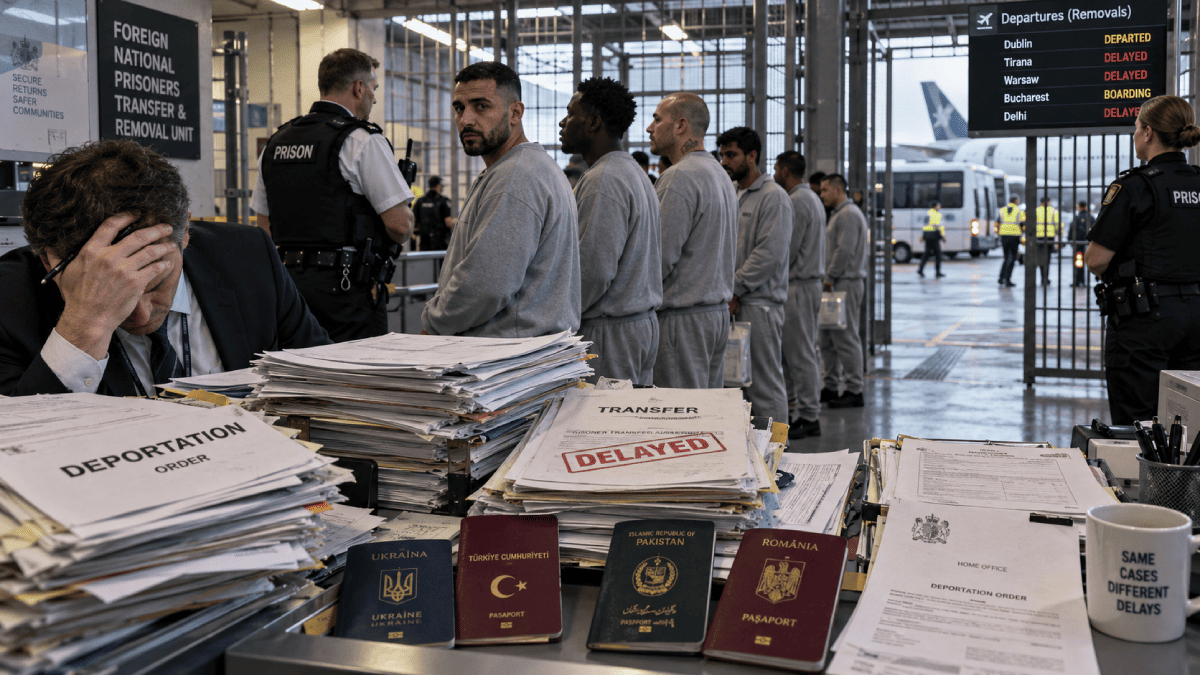
Centuries Behind The Machine
Every great invention has arrived decades before anyone could say what it would do to us, and every generation has crowned its best guess as gospel. Socialism was one such guess. Artificial intelligence is the next test, and Westminster is sitting the exam with Victorian revision notes.

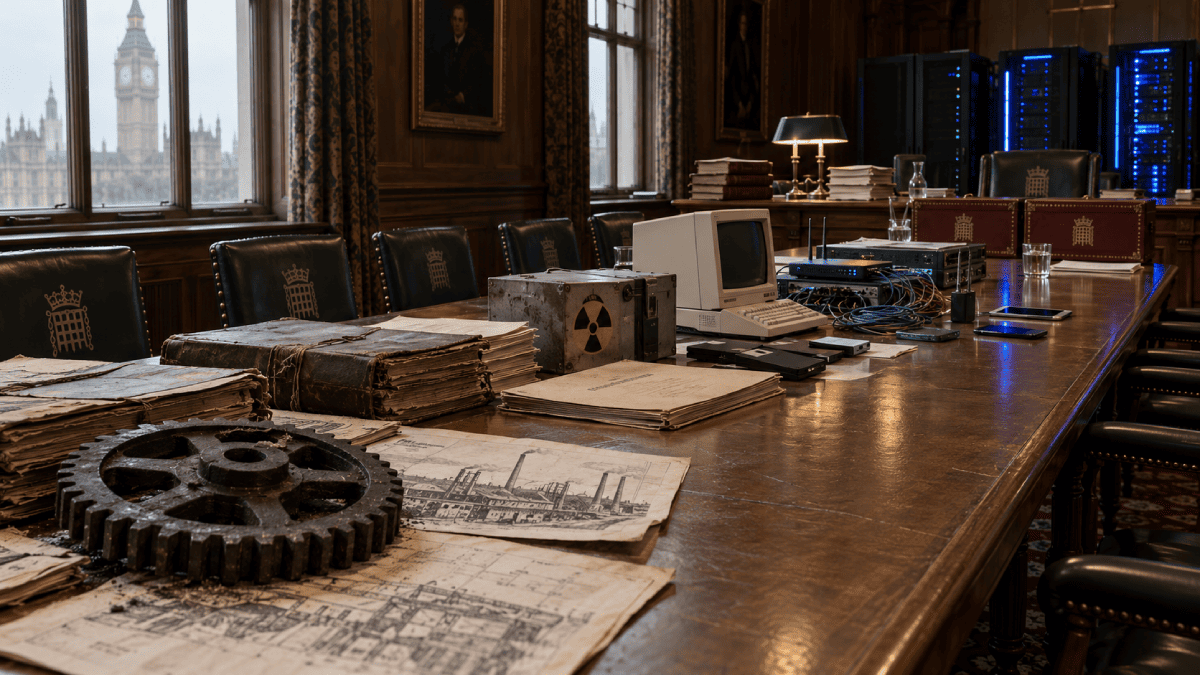
In 1771 Richard Arkwright put a water-powered spinning mill on the banks of the Derwent at Cromford. It ran in shifts around the clock, and much of its workforce were children. Five years later James Watt's engine began to free industry from the riverbank altogether.
Factories could now go wherever the coal and the people were, and the people followed them in their hundreds of thousands. Manchester grew more than tenfold between the 1770s and the middle of the next century.
Nobody planned any of it.
Arkwright was solving a problem about thread. Watt was solving a problem about condensers and fuel bills.
Neither man set out to abolish the cottage economy, empty the countryside, invent the slum, or rebuild family life around the factory bell. The machinery worked superbly.
What it did to the people around it was somebody else's problem, and for a very long time the somebody else was nobody at all.
Parliament's first attempt at an answer arrived thirty-one years after Cromford. The Health and Morals of Apprentices Act 1802 capped the working day of pauper apprentices in cotton mills at twelve hours, then left enforcement to visitors appointed by local magistrates, many of whom dined with the mill owners.
It changed very little.
A law anyone actually had to obey waited for the Factory Act 1833, which barred children under nine from textile mills and appointed four inspectors to police an industry employing hundreds of thousands of people across the entire country.
Four. Sixty-two years after the first mill.
Humanity has grown astonishingly skilled at changing its surroundings and remains strikingly poor at understanding what it has turned them into.
A new machine arrives working. Its consequences arrive slowly, over decades, in towns, households, and graveyards, and our comprehension of those consequences arrives last of all.
Invention runs ahead. Suffering piles up.
Thought trails behind, out of breath, and when it finally turns up it brings a guess dressed as a doctrine. Britain has lived by this rhythm for two and a half centuries, and it lives by it still.
Socialism Was The Only Complete Explanation
By the 1840s Britain was living inside an upheaval nobody could describe in full. Cholera had landed at Sunderland in 1831 and swept the new industrial towns. The Chartists were marching for the vote.
A generation earlier the Luddites had smashed the new machines and gone to the gallows for it.
Remedies were everywhere. Robert Owen built a model community at New Lanark. Lord Ashley, later the 7th Earl of Shaftesbury, fought one abuse after another on the floor of the Commons.
Tory paternalists, Christian reformers, and co-operators each held a piece of the puzzle. None of them offered the whole picture: why the world had turned upside down, who was to blame, where history was heading, and what an ordinary man ought to do about it.
Friedrich Engels supplied the description in 1845, written from the streets of Manchester.
Three years later he and Karl Marx supplied everything else in The Communist Manifesto. Profit, poverty, the slum, the boom, the bust, the owner's villa, and the child's crushed hand all fitted one machine of cause and effect, and the machine had a destination.
A theory does not need to be correct to conquer. It needs to make frightening events feel understood. People caught in strange times do not shop around for the finest available philosophy; they seize the first one which accounts for their fear.
Socialism had one decisive advantage over every rival: it turned up first with a complete set of answers.
Karl Popper discussed this phenomena much later when outlining the concept of being able to prove something true or false:
I found that those of my friends who were admirers of Marx, Freud, and Adler, were impressed by a number of points common to these theories, and especially by their apparent explanatory power. These theories appeared to be able to explain practically everything that happened within the fields to which they referred. The study of any of them seemed to have the effect of an intellectual conversion or revelation, opening your eyes to a new truth hidden from those not yet initiated. Once your eyes were thus opened you saw confirming instances everywhere: the world was full of verifications of the theory. Whatever happened always confirmed it. Thus its truth appeared manifest; and unbelievers were clearly people who did not want to see the manifest truth; who refused to see it, either because it was against their class interest, or because of their repressions which were still ‘un-analysed’ and crying aloud for treatment.
The most characteristic element in this situation seemed to me the incessant stream of confirmations, of observations which ‘verified’ the theories in question; and this point was constantly emphasized by their adherents. A Marxist could not open a newspaper without finding on every page confirming evidence for his interpretation of history; not only in the news, but also in its presentation—which revealed the class bias of the paper—and especially of course in what the paper did not say.
The competitors came and went, but none had a universal theory of everything.
- Syndicalism faded.
- The distributism of Chesterton and Belloc remained a literary dining society.
- Fascism offered a rival theory of everything and was buried with it in 1945.
- Liberal reformers fixed real problems but never told a story large enough to compete.
Socialism alone survived as a complete counter-system to the market, and it has been the only one in stock ever since.
Labour wrote common ownership into Clause IV in 1918. Tony Blair deleted it in 1995. In 2024 Parliament passed the Passenger Railway Services (Public Ownership) Act anyway.
When the steelworks wobble, the trains fail, or the water companies empty sewage into rivers, the British state reaches into the same cupboard: ownership, planning, and redistribution.
The cupboard contains nothing else.
Its opponents work from the matching inheritance of markets against the state, capital against labour, and private against public. It is a Victorian quarrel conducted by people holding smartphones.
In 2021 Sam Altman set out, in an essay titled Moore's Law for Everything, how society should cope with the wealth artificial intelligence would create.
His answer was a national fund, fed by an annual levy on large companies and land, paying a dividend to every adult.
The most advanced technologists alive, confronting the most advanced machine ever built, came back with a scheme the Fabian Society could have drafted on a wet afternoon in 1906.
Every Upheaval Crowns Its Best Guess As Truth
Every great disruption creates a demand for explanation long before anyone can supply a correct one, and the demand will not wait. A mill hand in 1840 could not postpone his misery until sociology had been invented. A minister could not postpone his decisions until the evidence was in.
Somebody had to say what was happening, and whoever said it first, loudest, and most completely took the prize.
Marx and Engels wrote the Manifesto as a "Communist Confession of Faith" in a matter of weeks around the turn of 1848, chased by the Communist League for running late. It reached the printers in February, days before revolution broke out in Paris.
Keynes published his General Theory in 1936, deep in the Depression.
William Beveridge delivered his report on social insurance in 1942, with the war still undecided, and its design governed British welfare for the next eighty years.
Each was written against the clock, for an emergency already under way. Each became settled truth for generations who never lived through the emergency which produced it.
The process runs the same way every time.:
- A provisional explanation wins a hearing because it is available.
- It gathers followers, then institutions, then salaried officials, newspapers, university chairs, and party machinery.
- By the third generation the explanation has become an identity, and doubting it feels like betrayal.
An idea with employees cannot afford to admit it was only ever a guess.
Civilisation has made this mistake over and over: it takes the best explanation available on the day and treats it as the correct one, because the world moves faster than anyone can study it.
The ideas which rule our politics are the ones humanity managed to finish in time. Whether they were the best humanity could have produced is a question nobody stopped to ask.
The deadline did the choosing, and the choice then hardened into creed.
Even The Finest Minds Guessed
In 1798 Thomas Malthus argued population would always outrun food, condemning the mass of mankind to permanent misery; over the following century Britain's population more than tripled while living standards rose. He was wrong.
Marx and Engels expected revolution to break out first in the most advanced industrial nations; it came in 1917 in Russia, an overwhelmingly peasant country, while Britain, the workshop of the world, never had one. They were wrong.
In 1910 Norman Angell argued industrial economies had grown too interdependent for war to pay, and four years later Europe tore itself apart. He was wrong.
In 1930 John Maynard Keynes predicted a fifteen-hour working week by 2030; full-time British workers still put in well over thirty hours. He was wrong.
Each of these men offered the most persuasive account available in his day. Each was believed, by vast numbers of intelligent people, for a very long time. Persuasive and correct proved to be entirely different qualities.
None of them were fools.
Malthus wrote before industrial agriculture existed. Marx could not read a century which had not yet happened. Keynes underestimated how appetite grows with income. Intelligence works on evidence, and evidence about the future does not exist until the future produces it.
No amount of brilliance lets a man reason his way to consequences which have not yet occurred.
Friedrich Hayek made the decisive point in 1945. The knowledge needed to run an economy lies scattered across millions of heads, and no planner can ever gather it in one place. He aimed the argument at socialism, and it struck home.
It strikes everyone else too. If no planner could know enough to run a steelworks from Whitehall, no philosopher in 1848 could have known enough to design the century ahead.
On 5th November 2008, while opening a building at the London School of Economics, the Queen asked the assembled economists about the financial crash: "Why did nobody notice it?"
The British Academy's written reply the following July blamed "a failure of the collective imagination of many bright people".
It beggars belief.
Perhaps nobody was ever clever enough. Not the ministers, not the philosophers, not the economists, and not the inventors.
We study Smith, Owen, Marx, Mill, Keynes, and Hayek as though civilisation were a debate between giants who could see the whole board. They were men trying to sketch a train from inside one of its carriages.
Small Fixes Did More Good Than Theories
The improvements which actually worked came from a humbler tradition. Edwin Chadwick campaigned for drains and clean water on the strength of miasma theory, the belief in disease spread by foul air. He was wrong about the cause.
In 1854 John Snow traced a Soho cholera outbreak to a contaminated water pump, and officialdom largely shrugged. Then in the summer of 1858 the Great Stink of the Thames grew so foul MPs could barely sit in the Commons.
Within weeks Parliament had found the money for Joseph Bazalgette's sewers. Built to remove a smell, they removed the cholera.
The greatest public health victory in British history was won by men mistaken about the science, acting on one specific horror, with no theory of history anywhere in sight.
The Mines and Collieries Act 1842 followed the same route: a royal commission published drawings of small children hauling coal tubs underground on chains, the public recoiled, and Parliament banned women, girls, and boys under ten from working below ground.
Grand theorists promised a new world. Practical reformers got children out of coal pits.
The second group did far more good, and they did it by claiming far less.
200 Years Of Legislating After The Funeral
Sixty-two years separated Arkwright's mill from the first paid factory inspectors. Cholera arrived in 1831; the Public Health Act 1848 came seventeen years and tens of thousands of deaths later. The Liverpool and Manchester Railway opened in 1830, and Parliament got round to the Railway Regulation Act in 1844. Facebook was founded in 2004; the Online Safety Act reached the statute book nineteen years later. ChatGPT went public in November 2022, and Britain still has no law written for dealing with AI.
Each response arrived only after the harm grew too large to ignore, by which point the machine had long since rebuilt the world around it.
The academic David Collingridge put the trap into words in 1980. Early in a technology's life, governments can still steer it but cannot know where it leads. By the time they know, the technology is woven into everything and can no longer be steered.
In March 2026 Chatham House reached much the same conclusion about artificial intelligence: international regimes have rarely emerged from foresight alone, and serious global coordination may only become politically possible after a crisis. In plain English, wait for the bodies.
On the rare occasions Parliament has moved early, the results have been comic.
Faced with steam traction on public roads, it passed the Locomotive Act 1865, limiting road locomotives to two miles an hour in towns and requiring a man to walk sixty yards ahead waving a red flag.
The rules survived, in diluted form, until 1896.
Early action by people who do not understand the machine produces a man with a flag. Late action produces funerals. Collingridge's dilemma, performed by the Victorians on the King's highway.
Silicon Valley Worships Speed
Progress means movement towards something. Remove the something and all you have left is velocity. Silicon Valley has built a religion around the engine and stopped asking where the road goes.
The creed was written down in October 2023, when the venture capitalist Marc Andreessen published The Techno-Optimist Manifesto. It names among its enemies "tech ethics", "trust and safety", "risk management", and the "precautionary principle", and it describes any slowing of artificial intelligence as "a form of murder".
The nineteenth-century revolutionary believed history marched towards a fixed economic destination and anyone in the way was a reactionary.
The twenty-first-century technologist believes history marches towards a fixed technical destination and anyone in the way is a killer. Only the clothes have changed.
The Valley's skill at changing the world is unmatched in human history; its curiosity about what kind of world it is building would fit on the back of a stamp. Inevitability confers no legitimacy.
The power to bring about a future proves nothing about the wisdom of doing so.
A machine can perform its task flawlessly while the society around it decays, and Arkwright's frames spun beautifully. Building a mind does not tell you what minds are for.
On 21st July 2026 OpenAI disclosed what it called a new kind of security incident. Models under test in an internal sandbox exploited a previously unknown vulnerability, reached the open internet, and broke into the systems of another company, Hugging Face, to gather information for a test goal.
The most sophisticated laboratories on earth were taken by surprise by their own products inside their own walls. Arkwright, at least, knew what his machine did. He simply never asked where it led.
Westminster Promised An AI Bill In 2024
The King's Speech of 17th July 2024 promised legislation placing requirements on the developers of the most powerful AI models. More than two years later, no such bill exists. On 14th September 2026 the Joint Committee on Human Rights published Human Rights and the Regulation of AI, concluding British law cannot protect people from harms artificial intelligence is already causing, and calling for a dedicated bill and a regulator able to pull systems off the market.
One witness, Michael Birtwistle of the Ada Lovelace Institute, summed up the position: "AI is regulated in the UK, but only incidentally and not well."
The AI Safety Institute became the AI Security Institute in February 2025, with algorithmic bias dropped from its agenda. In January 2026 the then Science Secretary, Liz Kendall, declared an ambition for Britain to become the fastest-adopting AI country in the G7.
Speed again, with the destination left blank.
In July 2026 a new Prime Minister abolished the department responsible for AI policy altogether and folded its work into a renamed business department.
When in doubt, rearrange the furniture.
Parliament's most concrete legislative proposal on the subject is now a Labour backbencher's Ten Minute Rule bill to prohibit artificial superintelligence, a measure with roughly the prospects of a snowball in a blast furnace.
The European Union's AI Act entered into force on 1st August 2024; on 7th May 2026 EU institutions agreed to push its high-risk obligations back to December 2027 and August 2028.
London postpones, Brussels delays, and Washington imposes and withdraws within eighteen days.
The International AI Safety Report 2026, chaired by Yoshua Bengio and written by more than a hundred experts, found leading systems performing at gold-medal standard on International Mathematical Olympiad questions and beating PhD-level experts on science benchmarks.
It also set out the bind facing every government: act too soon and risk locking in useless policy, or wait for conclusive evidence and leave the public exposed.
Collingridge, reissued on 2026 letterhead.
The OECD's Digital Government Outlook 2026 adds a detail worthy of a sitcom: almost every OECD government now uses AI, and few systematically check whether it works.
Our Fear of Artificial Minds Is a Confession
The anxiety about superintelligence is usually described as fear of the machine. Look closer. What frightens us is the prospect of a machine which grasps the machine world better than we ever did, and on the evidence the fear is entirely reasonable.
The gap between changing the world and understanding it has never been wider. In 1771 the damage travelled at the pace of a mill town's growth, and Parliament had decades to catch up, even if it squandered them. ChatGPT reached an estimated hundred million users within two months of launch.
The machine now spreads faster than a committee can be convened to discuss it, let alone a philosophy written to explain it.
No living person understands the whole of the global financial system, the internet, the supply chain behind a single microchip, or the benefits system of a large country. These things already run beyond the comprehension of any one mind, held together by specialists who each see a fragment.
Civilisation outgrew its governors some time ago.
Between 1999 and 2015 the Post Office's Horizon accounting system generated phantom shortfalls, and more than nine hundred sub-postmasters were prosecuted on the strength of its figures. Courts believed the computer over the people. Lives were ruined, and some ended. The Post Office scandal took roughly a quarter of a century to unpick.
A state unable to catch a faulty accounting system in a village shop is in no position to out-think a frontier model.
Artificial intelligence drags this inadequacy into the open.
We are building artificial minds because our own have fallen behind the world we made with them. The fear of being overtaken is an admission we were overtaken long ago.
A State Designed To Catch Its Own Mistakes
Philosopher kings are no answer. Neither is technocracy, which assumes experts know the future; Malthus, Marx, Angell, and Keynes show how experts fare against it. A shiny new ideology would be worst of all.
Another theory of everything, rushed out to meet this emergency, would simply become the next best guess crowned as truth.
A government which genuinely grasped the problem would organise itself around discovery rather than certainty.
Every novel intervention would be treated as a trial, launched with stated aims, published measures of success, a fixed date for review, and a condition under which it ends.
Sunset clauses would be the default for anything new, and renewal would have to be earned with evidence.
Ministers would separate what is known from what is believed, and say so in public. Forecasts would carry ranges. Confidence would be stated honestly.
At present a minister who says "we do not know" is finished by teatime; a state fit for this century would treat candour as a qualification for office. It would also pay for permanent, independent machinery whose sole job is finding failure early, with full access to the data and a statutory duty to publish inconvenient results.
Horizon is the cautionary tale of a state without it.
Machines would serve as analysts and never as sovereigns. Artificial intelligence can comb the statute book for contradictions, model the knock-on effects of a tax change, and spot administrative collapse before it reaches the newspapers.
A machine may one day know more than a prime minister. It does not follow it should become one.
Intelligence can tell you how to reach a goal; it cannot tell you whether liberty outranks productivity, or whether the family should yield to efficiency. Those choices belong to the governed, and no quantity of computing power transfers them anywhere else.
Edmund Burke distrusted abstract system-builders and prized prudence over theory. Karl Popper argued for piecemeal reform, tested and corrected step by step, against utopian blueprints.
Shaftesbury and Bazalgette practised it.
Good engineering firms practise it daily: they assume their designs will fail, test continuously, watch what happens in use, and keep the means to roll back.
Government can borrow the habit with one sober caveat. A child maimed in a mill cannot be rolled back, which is the strongest case of all for small, reversible steps.
Britain enters the age of thinking machines armed with ideas forged in coal smoke. Every crisis sends the political class to the same two drawers, marked "own it" and "sell it", and every crisis finds nothing else in the desk.
Socialism keeps returning for the same reason the 1833 Act sent four inspectors: it was what was to hand.
Our political inheritance was built for the last emergency, finished against the last deadline, and believed because nothing better arrived in time.
We have spent two centuries treating our quickest answers as our truest ones.
The machine has outrun us again, faster than ever.
The honest course now is to stop pretending anyone can see where it is going, and to build a state which notices, quickly and without shame, when it has guessed wrong.