Whitehall Cannot Organise The Deportation Of 10,000 Criminals In A Capacity Crisis
Ministers hold every legal power needed to send foreign convicts home, and say so loudly. Yet the cells stay full, the bill passes half a billion pounds a year, and one nationality enjoys near-immunity on the strength of a 2007 ministerial statement Parliament never voted on.

In April 2006 the Home Office admitted it had released 1,023 foreign prisoners between February 1999 and March 2006 without once considering whether any of them should be deported.
Among them were three murderers and nine rapists.
Worse, 288 had walked out after the National Audit Office had already warned ministers of the problem. Charles Clarke was gone as Home Secretary by 5th May.
Parliament responded with the UK Borders Act 2007.
Two decades, a long procession of Home Secretaries, and several "crackdowns" later, the prisons of England and Wales hold roughly as many foreign nationals as they did on the day Clarke was sacked. None of them should be here. All of them should be gone on the second day of prison breakfast. And no-one here should have to pay for these people.
10,134 Foreigners At £56,618 A Head
In June 2026 10,134 foreign nationals were in custody in England and Wales. They made up 12% of a prison population of 85,858, in an estate so close to its pre-mass-immigration limit ministers have spent two years releasing British convicts early to free up beds.
These are gross running costs, not a cash refund available the moment a cell empties. In an estate with almost no spare places, however, every cell held by a deportable foreign convict is a cell a British convict must be released early to vacate.
| Group (30th June 2026) | Prisoners | Annual cost at £56,618 each |
|---|---|---|
| Serving a sentence | 6,431 | £364.1m |
| On remand awaiting trial or sentence | 3,283 | £185.9m |
| Held as "non-criminal" prisoners | 420 | £23.8m |
| All foreign nationals | 10,134 | £573.8m |
Remand prisoners are a separate matter. A defendant awaiting trial has not been convicted, and deporting the accused before trial would simply let the guilty among them escape justice.
The sentenced group is the real target: 6,431 convicted criminals, costing £364 million a year.
The 420 in the last row are classed by the Ministry as "non-criminal" prisoners: neither serving a sentence nor awaiting trial.
For foreign nationals the category chiefly means immigration detainees, held in prison cells after their sentences have ended because the Home Office has not yet put them on an aircraft.
The taxpayer funds a prison place for each of them while the paperwork catches up.
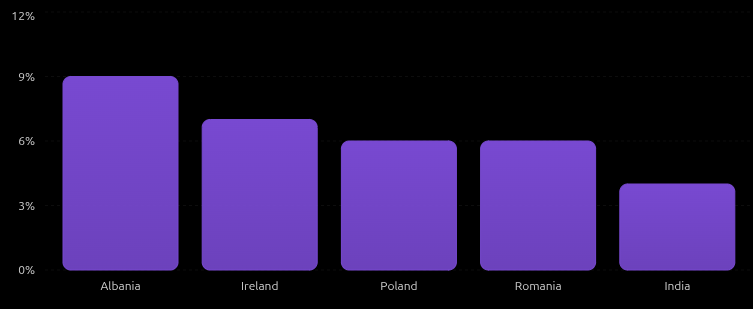
The largest nationalities are neither obscure nor diplomatically hostile.
| Nationality | Share | Transfer arrangement | Routinely deported? |
|---|---|---|---|
| Albania | 9% | Bilateral, compulsory | Yes |
| Ireland | 7% | Special referral rules | No |
| Poland | 6% | Council of Europe, compulsory | Yes |
| Romania | 6% | Council of Europe, compulsory | Yes |
| India | 4% | Bilateral, prisoner consent required | Yes |
Shares are from the Ministry of Justice figures for 30th June 2026. Transfer classifications come from the HMPPS Foreign Nationals in Prison Policy Framework, published in April 2026.
Four of the five are European democracies or close allies with functioning embassies, regular flights, and signed treaties. The fifth comes from a country with which the United Kingdom shares a land border, a language, and a ferry timetable.
Parliament Already Has Every Power Required
The legal framework is neither weak nor ambiguous. Section 32 of the UK Borders Act 2007 obliges the Home Secretary to make a deportation order against a foreign criminal sentenced to twelve months or more, subject to the exceptions in section 33, chiefly where removal would breach the Refugee Convention or the ECHR.
Since March 2026 the duty has also covered suspended sentences of twelve months or more, and the Immigration Rules were tightened to match.
The Early Removal Scheme under section 260 of the Criminal Justice Act 2003 lets prisons release eligible foreign offenders early for the sole purpose of deporting them.
A 2025 order cut the minimum custodial period.
The Sentencing Act 2026, which became law on 22nd January 2026, abolishes the minimum altogether: an eligible offender can be removed for deportation at any point after sentence.
There is a catch.
Section 35, the provision doing the abolishing, has not been switched on.
On 1st September 2026 a minister told the Commons removals immediately after sentencing would begin "next year". Parliament passed the law in January. The department charged with using it has awarded itself a year's grace.
Foreign offender returns reached 5,962 in the year to June 2026, up 12% and the highest figure since 2017. Early removals accounted for 3,141 of the returns in the year to July 2026.
Over the same period the queue grew faster than the exits.
At the end of June 2026 there were 21,294 foreign offenders subject to deportation living in the community, up 12% in a year.
The Home Office notes the sharpest rise came after March 2026, when the Sentencing Act brought offenders with suspended sentences into the deportation regime. Some on the list were therefore never jailed at all.
The law widened the pool of the deportable in March; the machinery for deporting them did not widen with it.
A Dept Unable To Count Its Own Caseload
In 2023 the Independent Chief Inspector of Borders and Immigration found the Home Office could not supply consistent data on its own foreign offender caseload. Inspectors reported it had no overall view of its casework system, and was not making proper use of the Early Removal Scheme, largely because of caseworking delays.
Officials could not even establish how many offenders of a given nationality were in the system.
A removal is a chain of separate tasks.
- Nationality has to be confirmed.
- The prison refers the case.
- The Home Office takes a decision and serves notice.
- Appeals run their course.
- A travel document is obtained.
- A seat is booked and escorts arranged.
Any link left until the last months of a sentence pushes the whole chain past the release date, at which point the offender leaves through the prison gate, or into immigration detention, rather than through the departure gate.
The National Audit Office told ministers in 2005 to start this work at the beginning of a sentence instead of at its end.
Twenty-one years later the inspectors are still finding the same fault.
Foreign Governments Determine Departures
Many removals need an emergency travel document from the offender's own embassy. A slow consulate, or a deliberately obstructive one, can hold a case for months. The Home Office alleges Eritrea stopped issuing travel documents in March 2026; in response its diplomats have been confined to within 60 kilometres of London without permission, have lost preferential visa treatment, and face the threat of a wider visa ban on Eritrean nationals.
Where Britain has bothered to negotiate properly, numbers follow.
Albanians have topped the foreign offender returns figures, helped by cooperation arrangements agreed with Tirana in 2022.
An offender deported under the Early Removal Scheme steps off the plane a free man, barred from returning; if he comes back, section 261 of the 2003 Act makes him liable to serve the rest of his sentence.
A transfer under the Repatriation of Prisoners Act 1984 keeps him behind bars in his own country for the remainder of the term.
In January 2026 Britain signed a compulsory transfer agreement with Italy requiring no prisoner consent, allowing only narrow grounds for refusal, setting deadlines for each stage, and moving the paperwork between the two prison services digitally. Those are working obligations, not diplomatic goodwill.
India's arrangement, by contrast, is voluntary. A convicted Indian national can still be deported once his sentence allows, but he decides whether the punishment itself is served in an Indian cell or a British one.
Other European governments have stopped waiting. Denmark has leased 300 cells in Kosovo for ten years, and Sweden is sending prisoners to Tartu in Estonia.
How Much Does The ECHR Really Block?
Ministers and critics alike usually blame the European Convention on Human Rights. Its actual effect can be broadly measured in these circumstances.
Article 3 prohibits removal to a real risk of torture and admits no exceptions.
Article 8 protects private and family life, but is qualified, and section 117C of the Nationality, Immigration and Asylum Act 2002 already instructs judges the deportation of foreign criminals is in the public interest, more so the more serious the offence.
Between 1st April 2016 and 8th November 2021, 1,011 foreign offender deportation appeals were allowed on human rights grounds at the First-tier Tribunal, an estimated 70% of them solely on Article 8.
Spread across five and a half years, it comes to fewer than 200 lost cases annually.
Some of those decisions were absurd, and the Immigration and Asylum Bill, now in committee, would require deportation unless the effect on the offender is out of all proportion to the public interest. A sensible and necessary correction, if it is ever implemented.
The figure counts appeals the Home Office lost, not the months consumed by appeals it eventually won. Even so, fewer than 200 tribunal defeats a year cannot by themselves explain a community queue of 21,294.
The courts have contributed to delay, most notably in Kiarie and Byndloss in 2017, when the Supreme Court struck down "deport first, appeal later" certificates. Of 1,175 people removed under them, only 72 had attempted an appeal from abroad. The Home Office itself blamed the ruling, together with a 2019 challenge which grounded charter flights, for the slump in removals.
Yet an appeal which begins in the final months of a sentence will always outlast it, and when to begin is a decision for the Home Office alone.
700 Irish Prisoners And A Statement From 2007
Irish citizens made up 7% of foreign prisoners on 30th June 2026: roughly 700 people, costing around £40 million a year. Almost none of them will ever be deported.
On 19th February 2007 the then Home Secretary decided the public interest would not generally be served by deporting Irish citizens, save where a court recommends it or exceptional circumstances apply.
The policy was announced to Parliament in a written ministerial statement. No vote was held on it. Home Office guidance concedes Irish cases are rarely judged exceptional enough to qualify.
"Rarely" is understatement.
In R (Foley) v Secretary of State for the Home Department in 2019, the court heard not a single Irish prisoner had been deported in the preceding three years.
The judge found this consistent with a policy of deporting only in exceptional cases, which is one way of describing a policy of deporting nobody.
Irish citizenship carries no special immunity in law.
The Home Secretary retains the power to deport any non-British national whose presence is not conducive to the public good, and Home Office guidance states plainly Irish nationality gives no automatic exemption.
Two statutory protections apply at the margins: section 7 of the Immigration Act 1971 shields Irish and Commonwealth citizens resident since 1973, and anyone who also holds British citizenship cannot be deported at all.
For every other Irish convict, what prevents removal is a twenty-year-old ministerial preference, which any successor can withdraw with another statement.
Withdrawing it would not touch Northern Ireland's dual nationals, who are British. The change would apply solely to citizens of the Republic convicted of crimes in Britain.
The government has already shown it will reopen old exemptions when a case embarrasses it badly enough.
In July 2026 ministers announced an amendment giving the Home Secretary power to disapply section 7 of the Immigration Act 1971, the protection for Commonwealth and Irish citizens resident since 1973, after the case of grooming gang and leader Shabir Ahmed.
The 2007 statement is a far smaller obstacle, and needs no legislation to remove.
Irish Convicts Who Ask to Leave Are Refused
Mr Foley, an Irish citizen, arrived from Cork so recently before his 2010 robbery he demanded his loot in euros. He received an indeterminate sentence. Long after his minimum term expired, he remained in prison because the authorities judged him too dangerous to release.
He then asked to be removed to Ireland under the tariff-expired removal scheme, which exists for precisely such prisoners.
The Home Office, mindful of what it called the very high threshold for deporting Irish nationals, refused.
He took the matter to the High Court and lost.
Britain had judged him too dangerous to release onto British streets and too Irish to send home, and the British taxpayer continues to fund the result. A Polish or Romanian prisoner making the same request would have faced no such policy.
Britain and Ireland are both parties to the 1983 Council of Europe Convention on the Transfer of Sentenced Persons, which Ireland applies through its Transfer of Sentenced Persons Act 1995. The convention depends on consent, and it has delivered very little.
On 16th September 2021 Ireland's justice minister, James Browne, told the Dáil only 154 people had been transferred into Ireland since 1995, about six a year, the great majority from the UK. He blamed incompatible sentencing.
Irish Supreme Court rulings meant a transfer could not reliably proceed where the British sentence did not fit the way Irish law enforces one, and Britain's automatic release on licence caused particular trouble.
Ireland legislated to fix the problem for transfers with EU states. Transfers with the UK still run under the 1983 convention and the 1995 Act.
The machinery exists, it is voluntary, and it jams on sentence arithmetic.
The Italian treaty shows the remedy: compulsory transfer, narrow grounds for refusal, fixed deadlines, and agreed rules for converting one country's sentence into the other's. A treaty with Dublin on those terms would let Irish convicts finish their sentences in Irish prisons, at Irish expense, with no early release.
London has signed such a treaty with Rome. It has not signed one with Dublin.
The numbers make the threat a small one. In 2016 Irish prisons held 63 British men. In April 2022 every non-Irish prisoner in the Republic, of every nationality combined, came to 593.
England and Wales alone hold roughly 700 Irish citizens. Were Dublin to deport every British prisoner it holds, Britain would receive a few dozen of its own citizens, whom it is obliged to admit in any case, and would no longer pay to jail several hundred Irish ones. 700 extra places would go a long way right now.
A Deportation Order Ends The Free Passage
The Common Travel Area lets Irish citizens enter Britain without passport checks, and a deported convict could in theory board the next ferry back. The law has already thankfully closed the door.
Under section 3ZA of the Immigration Act 1971, an Irish citizen subject to a deportation order loses the right to enter without leave, including on journeys within the Common Travel Area. Entering in breach of a deportation order is a criminal offence under section 24 of the same Act, and an offender removed early who returns can be made to serve the rest of his sentence.
None of this is untested.
Home Office guidance records deportation orders against Irish nationals removed before 2007 remain in force. The Common Travel Area coexisted with Irish deportations for decades before the policy changed.
Albanians and Romanians can also re-enter illegally, and nobody proposes keeping them in British cells at £56,618 a year on the strength of it.
The transfer route removes the question altogether. A man serving his sentence in Mountjoy catches no ferry.
No Excuse In An Overcrowding Crisis
Section 35 of the Sentencing Act should be commenced now, not in 2027. Every foreign national charged with an imprisonable offence should have nationality confirmed and a travel document requested before trial, so removal can follow sentence within weeks.
Visa penalties against states which refuse or stall travel documents should be applied by default rather than reserved for diplomatic emergencies.
Compulsory transfer treaties on the Italian model, with deadlines and sentence-conversion rules written in, should be sought with every country in the top twenty nationalities, India included.
The 2007 statement on Irish citizens should be withdrawn, and a compulsory transfer treaty negotiated with Dublin.
The 420 people held in prison under immigration powers should be removed or moved out of prison cells within a fixed deadline.
Finally, the Home Office and Ministry of Justice should publish, every quarter and by nationality, how many foreign prisoners are eligible for deportation or transfer, how many are waiting, what each is waiting for, how long, and how many of those removed were deported free and how many transferred to serve their time.
A department forced to count its failures in public tends to have fewer of them.
Charles Clarke lost his job because officials forgot to ask whether foreign prisoners should be deported. His successors' officials now ask the question every time.
What no department publishes is how many prisoners received the answer "yes" and are still sitting in a British cell, at £56,618 a year each.
There is no excuse for any of these problems and absolutely no circumstances where British citizens should have to pay for it.